

Cointime

Download App
iOS & Android

FTX Conspired With the SEC for Special Treatment

Validated Individual Expert

According to Tom Emmer, a crypto advocate and U.S. congressional representative for Minnesota, the SEC has been offering FTX special treatment and turning a blind eye to the exchange’s practices despite holding multiple meetings with the exchange’s Executives earlier this year.

The politician has said that SBF attempted to get “special treatment” from the SEX through meetings with the agency, and aimed to push legislation to the same effect.

The collapse of FTX leaves a big question mark as to how the SEC, or rather, any regulatory body within the financial system failed to see this coming. Just to be clear, FTX did not fail because of one or two bad calls and hard luck. FTX was in fact so disorganised that the new CEO, John Ray has said that:

“Never in my career have I seen such a complete failure of corporate controls”

The entire mind-numbing dumpster fire that is the internal FTX structure was outlined in the FTX bankcrupcy report. Go check it out if you haven’t already, it’s wild stuff. But basically:

FTX did not keep proper financial documents

Loans and expenses were being approved using emojis

SBF instructed the staff to use auto-destroying messages when communicating

In light of all this, along with SEC’s failure to act, Tom Emmer has said that:

“They [the SEC] were working, apparently, with Sam Bankman-Fried and others, to give them special treatment from the SEC that others aren’t getting, Sam Bankman-Fried was pushing special-treatment legislation through congress. when it was finally revealed what it was, and the industry started raising red flags all over the place, that’s when this thing came apart,”

Emmer also drew attention at the regulator’s failure to protect investors from some of the other crypto collapses that took place this bear cycle such as: Terra, Celsius and Voyager. Emmer added that the regulators seem to be preoccupied with going after the good actors in the industry and working backroom deals, instead of focusing on the ones that are doing nefarious things.
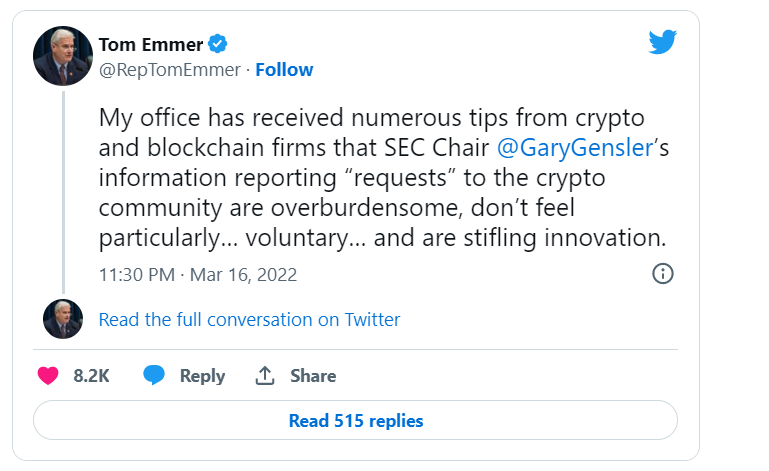
This highlights the lack of understanding from regulators, not just of how cryptocurrency itself works, but also of business practices in themselves. Yes, crypto can be confusing, but some concepts are universally true. Being able to identify ponzi schemes / scams and shady business practices should be a skill that the SEC employ gracefully and efficiently. Instead, they battle out the Ripple lawsuit until the observable universe ceases to exist.

Coinbase CEO Brian Armstrong argued that the regulator’s inaction has pushed trading activity to unregulated areas overseas, contributing to investor harm.

In addition to the damage caused by inaction, there is also the consideration of enabling such reckless business practices in the first place. Regarding the SEC’s stance on this whole situation, it’s either incompetence or favouritism that allowed FTX to cause the chaos it did. Whichever one it is, it highlights that financial regulators need to be regulated themselves, and held accountable when they fail to do their job.


SEC
Comments

All Comments

Recommended for you

  • Michael Saylor Releases New Bitcoin Tracker Information

    On July 5, Strategy founder Michael Saylor released new information regarding the Bitcoin Tracker. He stated, 'Bitcoin is digital energy.' Following previous patterns, Strategy typically discloses information about increasing Bitcoin holdings the day after related announcements.

  • BTC Falls Below $63,000

    Market data shows that BTC has fallen below $63,000, currently priced at $62,978.8, with a 24-hour increase of 0.24%. The market is experiencing significant volatility, so please ensure proper risk management.

  • Vitalik: Ethereum to Complete Major Third Iteration in Next 5 Years, Quantum Resistance and Privacy as Primary Goals

    On July 5, Vitalik Buterin announced that Ethereum researchers finalized the 'Streamlined Ethereum' roadmap during a conference in Berlin. This is not a one-time upgrade but a series of forks over the next 3 to 4 years (starting from 'I-star'), which will mark the third major era of Ethereum, almost replacing all core components. Core changes include: verification shifting from direct execution to recursive STARK; consensus introducing 1-2 rounds of finality for faster and safer transactions; multi-dimensional Gas pricing; and a complete replacement of existing solutions with quantum-resistant cryptography. The most disruptive change is the state model—current dynamic states only expand to about 2TB, while introducing new scalable states like UTXO and circular buffers, with a total scale reaching up to 100TB, suitable for ERC20/NFT/DeFi, potentially reducing transaction fees by over 10 times after the rewrite; complex applications (like Uniswap pools) will retain the old state without mandatory migration. However, the issue of who will store the 100TB state and the associated incentives has become a new focus of research. Privacy upgrades are now a primary design goal, with all new components needing to support quantum-resistant, intermediary-free privacy transactions. Formal verification will be fully implemented, and there is exploration into introducing RISC-V or leanISA as the underlying VM for the protocol, with EVM potentially becoming a feature at the compilation layer in the future. In terms of scalability metrics, Gas limits, Blob capacity, and block times will be increased multiple times over the next 5 years, with the Glasterdam fork set to significantly raise Gas limits first. In the order of forks, H-star (Hegota) will be the last 'pre-streamlined' fork, after which Ethereum will fully enter the streamlined era. Through this complex yet smooth transition, Ethereum is moving towards a quantum-resistant, massively scalable, privacy-first new network while maximizing the protection of existing applications. This cautious disruption over the next five years has officially begun.

  • ETH Surpasses $1800

    Market data shows that ETH has surpassed $1800, currently priced at $1803.65, with a 24-hour increase of 3.76%. The market is experiencing significant fluctuations, so please ensure proper risk management.

  • BTC Surpasses $63,000

    Market data shows that BTC has surpassed $63,000, currently priced at $63,057.24, with a 24-hour increase of 1.18%. The market is experiencing significant volatility, so please ensure proper risk management.

  • Bank of England Governor Bailey to Speak on Fiscal and Monetary Policy Coordination in Ten Minutes

    Bank of England Governor Bailey will deliver a speech on the issue of coordination between fiscal and monetary policy in ten minutes.

  • Solana Achieves $4.84 Billion in Spot Trading Volume for Tokenized Stocks This Quarter

    On July 3, it was reported that Solana broke multiple records in trading, revenue, and trading volume in the second quarter of 2026. In the tokenized stock sector, Solana's spot trading volume reached $4.84 billion this quarter, capturing over 96% market share. This volume far exceeded that of all other blockchains combined, marking the fourth consecutive quarter that Solana has led this sector, solidifying its dominant position. In terms of decentralized application revenue, the total dApp revenue for this quarter was $257 million, maintaining its lead over all Layer 1 and Layer 2 blockchains for the ninth consecutive quarter. Despite competitive pressure from peers, the enthusiasm of ecosystem developers and actual user demand remains strong. On-chain trading activity has surged, with daily, weekly, and monthly trading volumes all hitting new highs. The total number of non-voting transactions for the quarter approached 9.8 billion, with the overall network transaction volume rising to 59%, reaching an eleven-month high. The perpetual futures trading scale has seen a significant surge, with nominal trading volume for the quarter reaching $183 billion. GMTrade, Pacifica, and Jupiter were the main sources of trading volume, with GMTrade showing impressive growth in asset locking, cumulative trading volume, and protocol fees. The Phoenix platform also gained market recognition with its new features. Meanwhile, the Solana Foundation has proactively reduced its staking holdings, with the staking scale dropping to 4.92% of the total network staking, aiming to weaken its control over network validation and promote the decentralized and mature development of the validator ecosystem. Overall, even though the market is generally perceived to be at the bottom of a bear cycle, Solana's various innovative businesses and fundamental on-chain data are rising against the trend. If this quarter indeed marks the low point of the current market cycle, the existing performance will lay a solid foundation for long-term growth. The article also briefly mentions developments related to Solana's on-chain governance, the Grass rewards controversy, and future plans of the foundation's executives.

  • Venezuela's Largest Oil Refinery Resumes Operations

    On July 3, three sources reported that Venezuela's largest refinery, the Amuay refinery with a processing capacity of 645,000 barrels per day, has resumed operations after a power outage on Friday. It is currently processing approximately 140,000 barrels per day of crude oil, and the fluid catalytic cracking unit (FCC) has also restarted. Following two earthquakes last week that caused significant casualties, several refineries in Venezuela were affected by power outages. Additionally, sources indicated that the El Palito refinery, with a processing capacity of 146,000 barrels per day, has regained power, but staff have not yet been able to restart the production units.

  • US Bitcoin ETF Sees Net Outflow of 588 BTC Today, Ethereum ETF Records Net Inflow of 6,105 ETH

    According to monitoring by Lookonchain, today the US Bitcoin ETF experienced a net outflow of 588 BTC, with a total net outflow of 22,189 BTC over the past seven days. Meanwhile, the Ethereum ETF recorded a net inflow of 6,105 ETH, with a net outflow of 1,915 ETH over the past seven days.

  • US Stock Market Closed on July 3rd (Friday)

    On July 3rd, the US stock market will be closed for one day in observance of the Independence Day holiday.