

From coinmetrics by Victor Ramirez, Matías Andrade & Tanay Ved
Key Takeaways:
- Recent years show varying launch FDVs: 2020 saw a median of $140M (DeFi protocols), 2021 spiked to $1.4B (NFTs, gaming), and 2022 dipped ($800M for L2s). 2023 and 2024 rebounded ($2.4B and $1B), featuring alt L1s and Solana projects.
- FDV overlooks short-term market shocks; hence, float (publicly available supply) matters. High FDV, low float tokens like World Coin ($800M vs. $34B FDV) may misrepresent true valuations.
- Airdrops distribute tokens for protocol adoption, often liquidated quickly by recipients. While lucrative initially, most airdropped tokens depreciate long-term, with exceptions like BONK (~8x return).
Introduction
One of crypto’s most oft-debated topics is the issue of tokenomics, the system of how token supply is distributed. Tokenomics represents a balancing act of appeasing different stakeholders while securing the current and future value of the project.
Crypto projects employ various tokenomics schemes to incentivize certain behaviors within their respective ecosystems. A portion of a token’s supply is unlocked to the public so that users can own ‘shares’ of a project and the token can go through price discovery. To incentivize project development, a portion of a token’s supply can be locked up for early investors and team members, often at favorable rates and before it’s traded in the public market. Some projects even employ airdrops, which reward tokens to users based on key behaviors such as providing liquidity to a decentralized exchange, voting on governance proposals, or bridging to a layer 2.
In this week’s issue of State of the Network, we dive into the different factors of a project’s tokenomics and its effects on token valuation and on-chain activity.
Understanding Fully Diluted Value (FDV)
To understand the nuances of token valuation, we’ll explain some commonly used valuation metrics. The circulating market capitalization of an asset using just the circulating supply of tokens, not counting the supply to be vested to early investors, contributors, and locked for future issuance. Circulating market cap measures how the market perceives the current valuation of a token. The free float supply is the tokens that are readily available to trade in open markets. Fully Diluted Valuation (FDV) is the market capitalization of an asset once all tokens are in circulation, hence the term “fully diluted.” FDV is a proxy for how the market perceives the future valuation of a token.
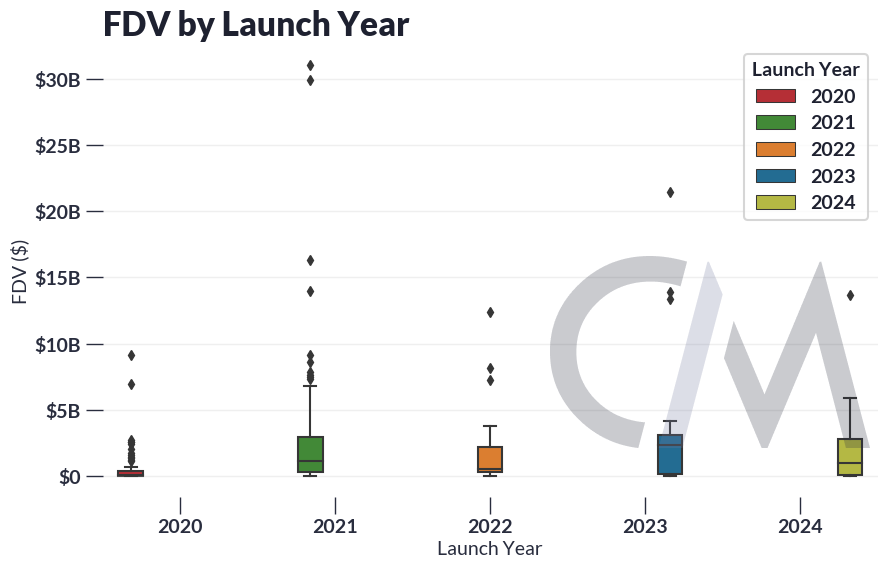
The FDV at launch can leave a hint as to how the market gauges the future value of current projects once they’re released. Below is a chart for the FDV at launch across several crypto tokens, segmented by the year the project was launched.
Source: Coin Metrics Market Data Feed, Network Data Pro
Major tokens launched in 2020 had a relatively low median FDV ($140M) compared to the later crop of projects, but it consisted of the blue chip protocols born in DeFi Summer such as Uniswap, Aave and prominent L1’s such as Solana and Avalanche. Median launch FDV jumped in 2021 to $1.4B consisting mainly of NFT & gaming projects such as Gods Unchained, Yield Guild Games, and Flow. Launch FDV decreased in 2022, headlined by Apecoin’s launch and early L2 tokens such as Optimism. 2023 and 2024 saw a rebound in launch FDVs to $2.4B and $1B respectively, featuring a new wave of alt L1’s like Aptos and Sui and the rise of Solana projects such as Jupiter and Jito.
Not All FDV is Valued Equally
Though FDV can be useful for gauging value on a long time horizon, it doesn’t factor the short term market dynamics that may come into play as a result of liquidity and supply shocks. Thus, it’s important to look at FDV in relation to its float, or the supply that is available to the public.
Tokens with a high float relative to its total supply such as bitcoin are fairly liquid and market participants don’t expect future supply shocks from token issuance—given that over 90% of all bitcoin has already been mined. Tokens with a low float relative to its total supply implies that much of its FDV is illiquid. Thus, tokens with a high FDV and low float may represent an inflated and illusory total valuation. An extreme example of a high FDV low float token is World Coin, which has a market cap of about $800M, but an FDV of about $34B—a 50x difference.
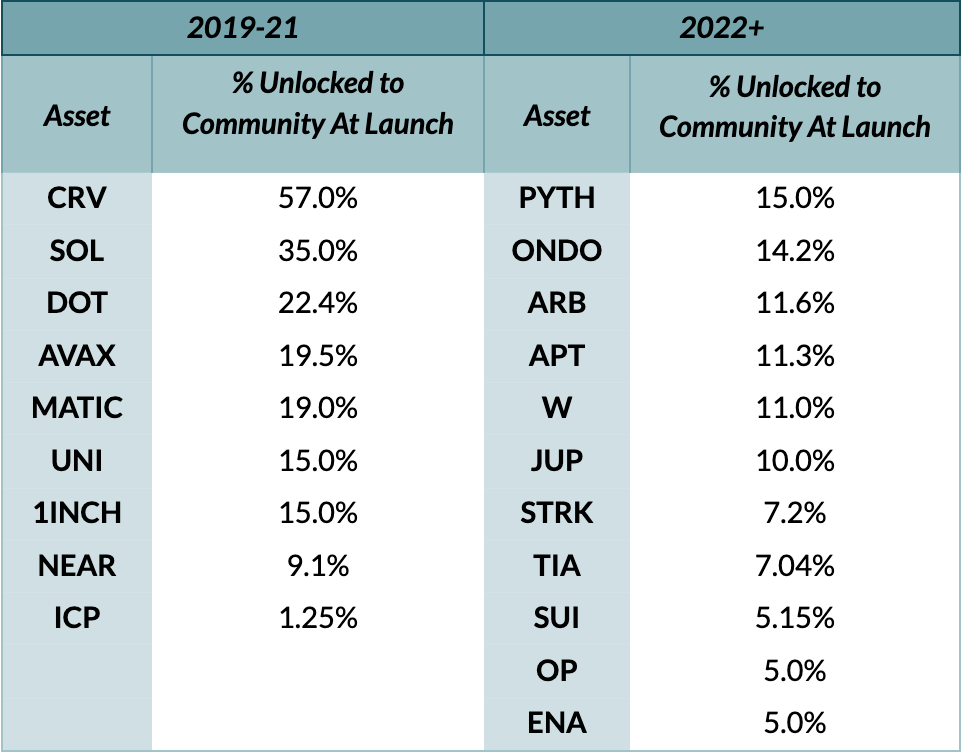
In general, we’ve seen the industry standard to converge around the 5-15% of a token’s supply to be unlocked to the community, with the rest of its supply locked for the team, investors, foundations, grants, or other unlock events. Projects launched before 2022 tended to have more varied distributions.
Source: Coin Metrics Labs
High FDV and low float tokens have been the subject of scorn by the crypto community. One historical example was FTX’s token FTT, which was used by FTX to inflate its balance sheet by counting its illiquid shares as assets against their liabilities. Token projects launching with a high FDV, low float have been criticized as a vehicle for enriching early investors and other insiders at the expense of retail users. This may have contributed to a shift in market sentiment towards nihilism, leading to massive flows of retail liquidity into memecoins, which tend to have a larger share of its supply available to the public early on.
But are low floats solely to blame for sluggish price action?

Source: Coin Metrics Market Data Feed, Network Data Pro
We found that in general, the float at launch doesn’t have a meaningful effect on token appreciation 1 year post-launch. This is fairly consistent with our previous findings, which suggest that sudden shocks in free float don’t have a coherent directional effect on prices.
Airdrops and Protocol Activity
Some protocols leverage airdrops to distribute tokens to the community and to mitigate risks against having a low float. Airdrops reward early users of a protocol with tokens by giving users tokens based on certain desired behaviors that promote the growth of that protocol, akin to crypto stimulus checks to early users. In a previous SOTN, we found that most addresses liquidate their airdropped tokens shortly after receiving them.
While airdrops provide a nice windfall, most airdropped tokens lose their long term value.

Source: Coin Metrics Market Data Feed
Using the first day of trading since an airdrop as a reference point, only about ⅓ of tokens have retained their value since the first airdrop. The median return of holding airdropped tokens until now would result in a -61% return. However, some airdropped tokens have appreciated such as BONK (~8x).
Token rewards are ultimately just one way to bootstrap network activity, but do they actually lead to real usage? Measuring real economic activity can be tricky because every protocol has different uses and metrics to measure those uses. As an illustrative example, we can take Optimism, a Layer 2 project, and take the amounts deposited to that network as a rough proxy for user activity.

Source: Coin Metrics’ Network Data Pro, Coin Metrics Labs
We saw a massive spike of deposit calls made to Optimism’s Gateway Bridge right after the airdrop. Activity tapered away the following year, coinciding with the general downturn in crypto activity. In short, airdrops may provide a small-term bump in the protocol’s usage, but it remains to be seen if it can create real, sustainable long-term growth.
While the hint of an airdrop can incentivize early usage of a protocol, it may not necessarily lead to sustained user activity. Complicating this is the emergence of airdrop farming, a way for users to gamify the protocol rules by generating superfluous activity on-chain in hopes of receiving tokens. Lately airdrop farming has become increasingly industrialized with sybil farms, where several on-chain identities are faked by few actors to generate activity en-masse. This results in project teams handing out rewards to mercenaries who have no long-term vested interest in the network.
Protocol teams have begun to fight back against sybils by developing methods to identify and withhold rewards from sybils. Notably, LayerZero is offering sybils to self-identify for a fraction of their allocation at risk of not receiving any tokens. With large airdrops from EigenLayer and LayerZero on the horizon, it remains to be seen if airdrops achieve their intended outcomes, or if projects do away with them entirely.
Conclusion
In many ways, crypto exposes every market actor’s motives in plain sight. Tokenomics can be seen as the art of harnessing those motives into cultivating success and sustainability of protocols. Distributing token supply, incentivizing behavior, and ensuring long-term value is a delicate balance that every project tackles differently. As market forces evolve and new metas emerge, it will be interesting to see how users and teams continue to adapt.


All Comments