

Cointime

Download App
iOS & Android

First crypto bill vote fails to get 100% Republican support despite Trump’s call

Cryptocurrency-related bills backed by US President Donald Trump failed to clear a key procedural step in the House of Representatives on Tuesday, despite the president’s public push for action.

Trump had urged Republican lawmakers to “get the first vote done this afternoon” on legislation to regulate payment stablecoins as part of a larger effort to pass crypto legislation before the August recess.

In a Tuesday post on his social media platform Truth Social, Trump ordered all Republicans to vote yes on the Guiding and Establishing National Innovation for US Stablecoins, or GENIUS Act, a bill designed to regulate payment stablecoins in the US.

The legislation is one of three bills, along with ones to address market structure and central bank digital currencies, that Republican House leaders had been pushing as part of the party’s “crypto week” plans.

The president may have been referring to a House resolution to consider the three bills and a defense bill, which failed to get support from a majority of lawmakers present on Tuesday — at least 13 Republicans may have voted against the resolution.

House Speaker Mike Johnson reportedly said the chamber would take up another vote “this afternoon.”
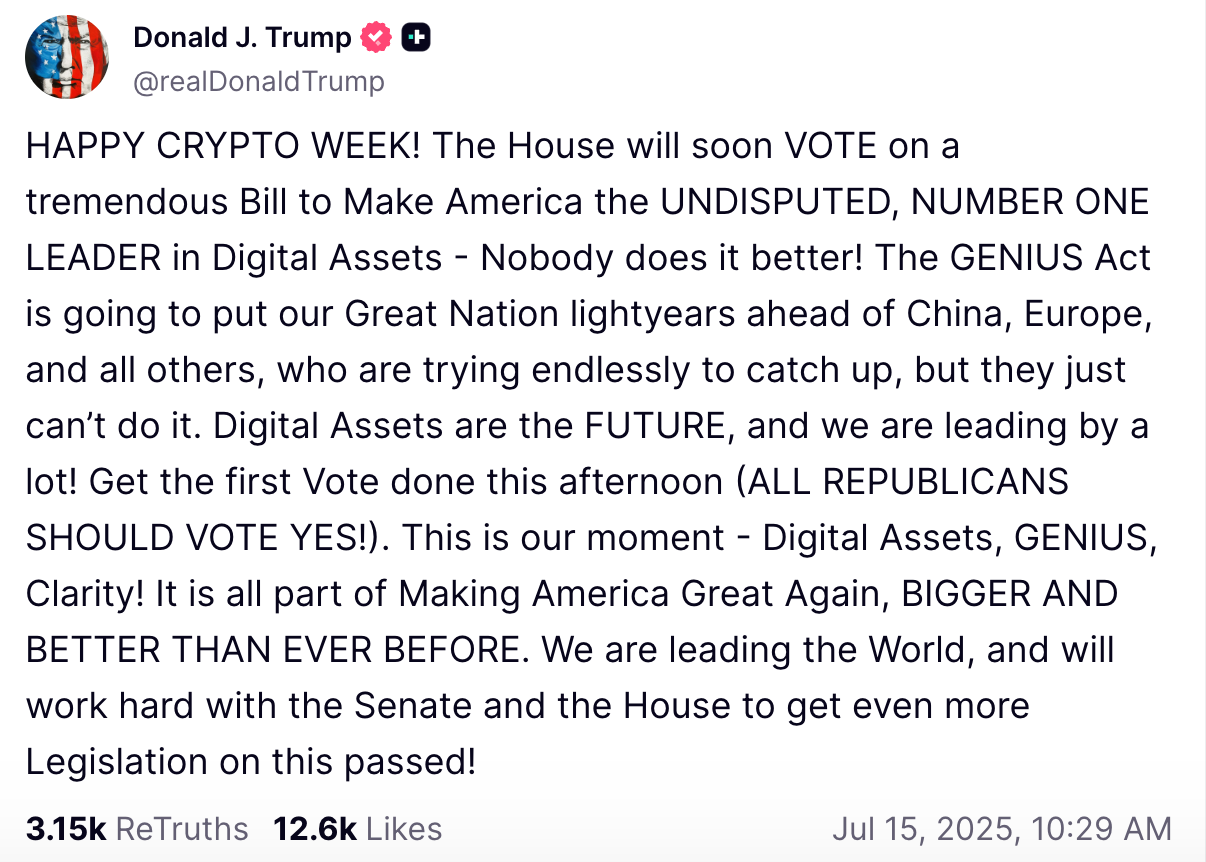
  Source: Donald Trump

The GENIUS Act, which passed through the Senate in June with bipartisan support despite initial resistance from many Democrats, is expected to head for a floor vote in the House by Thursday. At the time of publication, the bill was scheduled to be considered by the House sometime this week, but it was unclear whether the chamber planned a separate floor vote on Tuesday.

Signing off on a stablecoin law while investing in stablecoins?

Trump has personally come under scrutiny for his role in pushing the stablecoin legislation due to his involvement in his family-backed crypto company World Liberty Financial (WLF), which issued its own stablecoin and suggested a conflict of interest. Bloomberg reported on Friday that Binance helped create WLF’s USD1 stablecoin, also used by an Abu Dhabi-based investment firm to settle a $2 billion investment into the crypto exchange. 

“World Liberty Financial has received a significant portion of its funding from overseas, which has brought about serious ethical and national security concerns,” said California Representative Maxine Waters’ office on Tuesday, adding: “[F]oreign investment is not just a business deal, it’s a direct payment to the sitting US president with the goal of currying favor and influence within the White House.”

Many Democratic leaders have responded to Republicans’ push for the digital assets bills with their own “anti-crypto corruption week” agenda. They are calling for amendments in the three bills to address consumer protection and prevent the president, vice president, and members of Congress from holding or promoting crypto over concerns with conflicts of interest.


Comments

All Comments

Recommended for you

  • Bitcoin miner Core Scientific shifts to AI with 1.5GW data center push

    Core Scientific is converting its Pecos, Texas site into a high-density AI colocation hub, repurposing 300MW of mining capacity.

  • Acting AG Todd Blanche confirms ‘code is not a crime’ in DOJ pivot

    Acting US Attorney General Todd Blanche said developers will no longer be investigated or charged unless they knowingly help third parties commit crimes.

  • Bank of Japan Governor Kazuo Ueda: No Immediate Need for Rate Hike

    On April 28, Bank of Japan Governor Kazuo Ueda stated that there is currently no immediate need to raise interest rates. However, if the current supply shocks lead to secondary ripple effects, a rate hike may be necessary. (Jin Shi)

  • Central Political Bureau Meeting: Comprehensive Implementation of 'AI+' Initiative to Develop New Intelligent Economy and Improve AI Governance

    On April 28, the Central Political Bureau of the Communist Party of China held a meeting to analyze and study the current economic situation and economic work. The meeting emphasized the need to accelerate the construction of a modern industrial system and maintain a reasonable proportion of manufacturing. It called for deepening the construction of a unified national market and addressing 'involutionary' competition. The meeting also announced the comprehensive implementation of the 'AI+' initiative to develop a new intelligent economy and improve AI governance. Furthermore, it highlighted the need to deepen state-owned enterprise reform, systematically respond to external shocks and challenges, enhance the security of energy and resource guarantees, and address various uncertainties with the certainty of high-quality development. (Dongxin News Agency)

  • ByteDance, Zhiyu, and Alibaba Selected Among Top 10 AI Influencers by TIME

    On April 28, TIME announced its list of the '10 Most Influential AI Companies of 2026.' Unlike a simple comparison of model capabilities, this list emphasizes the comprehensive shaping power of companies in terms of industry, technological pathways, and social impact. The selected companies include ByteDance, Amazon, Zhiyu, OpenAI, Alphabet, Meta, Anthropic, Alibaba, Mistral, and Hugging Face. Among them, three are domestic companies: ByteDance, Zhiyu, and Alibaba. (Dongxin News Agency)

  • Arthur Hayes: More Concerned About Fed Nominee Waller's Comments on Balance Sheet Than Short-Term Interest Rates

    On April 28, BitMEX founder Arthur Hayes spoke about the Federal Reserve at the Bitcoin 2026 conference, stating, "When Kevin Waller was nominated as the Fed's SEC chairman, everyone started to panic because during his tenure as a Fed governor— I believe from the 2008 financial crisis until the current president— he has been very critical of the Fed's massive balance sheet. He has publicly stated that he believes the Fed's balance sheet is too large and that he needs to find ways to shrink it while also being able to lower interest rates. Now, if you have read my articles, you know that I am a firm advocate of the idea that the quantity of money is more important than its price. Therefore, I am more concerned about his comments on the balance sheet than the direction of short-term interest rates. So, if the market believes that due to Waller's actions at the Fed, the liquidity of dollars circulating in the system will decrease, then they will be bearish on Bitcoin and other risk assets. This is the discussion we see in the media about a hawkish Fed emerging after Waller takes over in May. Now, I don't think so. I believe that essentially the Fed will replace reserves, treasury bonds, and repos and put them into the commercial banking system, and they will do this with the help of new regulations concerning how banks hold assets on their balance sheets and how much capital they need to hold against those assets. Finally, I think the most important point to understand about what Waller will or will not do at the Fed is that he has a very substantial hard constraint, which is that he needs to work with Treasury's Scott Bessen to ensure that any actions he takes regarding the Fed's balance sheet do not impair Bessen's ability to sell billions and trillions of dollars in bonds.

  • SEC Chair: Reg GG Crypto to Allow Private Sector Token Sales Soon

    On April 28, U.S. SEC Chair Gary Gensler stated in an interview at the Bitcoin 2026 conference that the agency will continue to advance other exciting initiatives, such as truly allowing companies to conduct on-chain experiments, build tokenized securities, and trade on-chain within the United States. We plan to release innovative exemption regulations in the coming weeks. Additionally, we will permit the private sector to raise funds through on-chain token sales, which we refer to as 'Reg GG Crypto.' These initiatives are in preparation and will be launched soon. Currently, there is a bill titled the 'Clarity Act' under consideration in Congress. We do need Congress to provide regulations in this area. We are ready, willing, and able to explain their regulations and translate them into rules that people can rely on and pursue their innovative ideas. It is important to emphasize that this is happening domestically in the U.S., so they do not have to go overseas. This is the core idea that truly matters here.

  • SEC Chair Discusses Clarity Act: Codified Law Provides Greater Assurance for the Future

    On April 28, during the Bitcoin 2026 Conference, SEC Chair Gary Gensler spoke about the Clarity Act, stating that the U.S. Securities and Exchange Commission has considerable operational flexibility under the regulations. However, we are constrained by existing authorities, which, despite some amendments over the years, fundamentally remain rooted in the framework established in the 1930s. This is why having a piece of legislation is so important; it can shield future developments from adverse impacts, allowing us to leverage new authorities and the flexibility provided by the Act. We can collaborate with the Commodity Futures Trading Commission to coordinate and clarify definitions, and further develop from there. But again, nothing provides greater assurance for the future than codified law, coupled with sound judicial opinions that engrave the provisions of the law in stone through the mechanisms of the entire court system. Therefore, all of this is very important, but we are focused on efforts to simplify processes, enhance efficiency, and assist innovators in their endeavors, enabling them to operate with certainty rather than being stifled by those who jealously guard the existing ways of doing things. However, we must ensure that we remain at the forefront of innovation in the United States.

  • Meta Prepares to Withdraw Acquisition of Manus; Investors Including Tencent Plan to Cooperate

    On April 28, the Wall Street Journal reported, citing informed sources, that after the Office of Foreign Investment Security Review under China's National Development and Reform Commission made a legal decision to prohibit foreign investment in the Manus project, Meta is preparing to withdraw from the acquisition deal. According to sources, if Meta proceeds with the withdrawal process, several former Asian investors in Manus, including Tencent, Sequoia China, and ZhenFund, have planned to cooperate.