Cointime

Download App
iOS & Android

Ethereum transaction volumes see year-high amid SEC staking drama

Transactions on the Ethereum network have reached a one-year high as the US Securities and Exchange Commission issues new guidance on staking.

This comes amid historical highs in Ether staked on the network; according to Dune Analytics, over 36 million Ether 

ETH$4,198is nowstakedon Ethereum, representing nearly 30% of the total token supply. 

A large number of tokens locked into smart contracts indicates that Ether holders are hunkering down, preferring to render their ETH unsellable for the time being in exchange for staking rewards.

The increased network activity follows guidance from the SEC and an additional commission statement that liquid staking may be exempt from securities laws; however, commentary from one commissioner suggests that it may not be that simple.
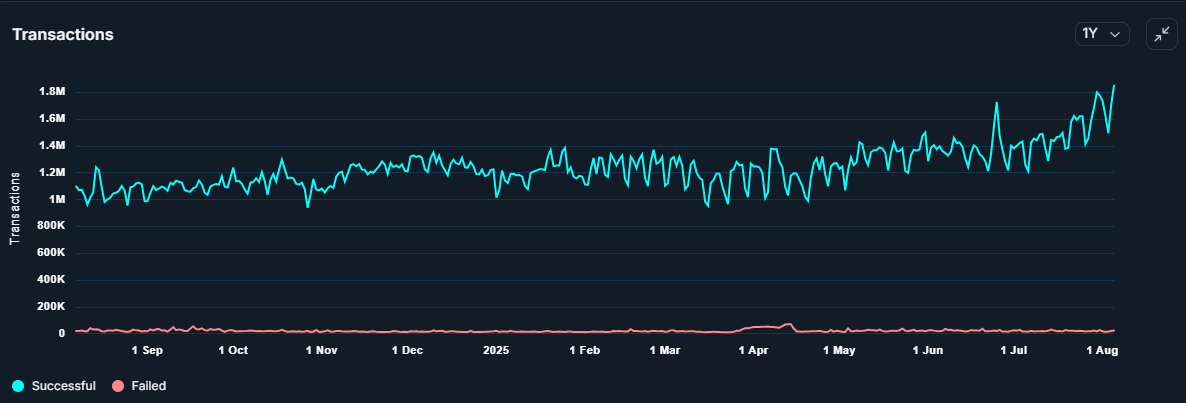
One-year chart of transactions on the Ethereum network. Source: Nansen


Liquid staking on Ethereum in “muddy waters”

On Tuesday, the SEC’s Division of Corporation Finance released a “Statement on Certain Liquid Staking Activities.” In it, the division defined and explained its views on liquid staking.

Liquid staking is a form of staking that issues a token representing a user’s staked asset. It allows investors to continue using decentralized finance (DeFi) protocols while earning staking rewards.

The division said that liquid staking activities, as well as the offer and sale of “staking receipt tokens,” insofar as they are described in the SEC’s statement, do not “involve the offer and sale of securities” as defined by the 1933 Securities Act. 

As such, entities issuing “staking receipt tokens,” so long as those tokens don’t constitute some form of investment contract, do not need to be registered with the SEC. 

The DeFi industry was quick to hail the updated guidance as a victory

“Institutions can now confidently integrate LSTs [liquid staking tokens] into their products, which is sure to drive new revenue streams, expand customer bases and enable the creation of secondary markets for staked assets,” Mara Schmiedt, CEO of blockchain developer company Alluvial, previously told Cointelegraph.

Jito Labs CEO Lucas Bruder said the guidance “shows the same nuanced understanding of LST technology that the Crypto Task Force exhibited when we met with them on this topic back in February.”

However, not everyone at the SEC is convinced that the Division of Corporation Finance made the right move. 

On Wednesday, Commissioner Caroline Crenshaw responded, saying that the division’s statement “stacks factual assumption on top of factual assumption on top of factual assumption, resulting in a wobbly wall of facts without an anchor in industry reality.” She said that their definition of staking “might not reflect prevailing conditions on the ground.” 

Per Crenshaw, the legal conclusions of the statement (i.e., that LSTs are exempt from securities laws) “apply only if those many factual assumptions hold.”

“To the extent that any particular liquid staking activity deviates from the numerous factual assumptions laid out in the Liquid Staking Statement, that activity is outside the statement’s scope.”

She concluded that the statement reflects only the views of the singular division, not the whole commission, and said it should give “little comfort” to entities involved in staking. 

The statement is not without allies in the SEC. So-called “Crypto Mom” Hester Peirce — an SEC commissioner who has advocated for more favorable regulations for the crypto industry over the years — released a statement of her own, saying that the division has clarified its view “that liquid staking activities in connection with protocol staking do not involve the offer and sale of securities.”

Chairman Paul Atkins said it was “a significant step forward in clarifying the staff’s view about crypto asset activities that do not fall within the SEC’s jurisdiction.”

Ethereum ascendent with DeFi still in legal gray area 

Regardless of the limitations of the division’s statement or the potential outcomes thereof, the Ethereum ecosystem is optimistic.

Pseudonymous CryptoQuant author Onchainschool noted in a Tuesday post that more than 500,000 ETH (worth approximately $1.8 billion at publishing time) was staked in the first half of June alone. 

“This growth signals rising confidence and a continued drop in liquid supply,” they stated. 

Furthermore, blockchain addresses with no selling history are also on the rise, holding nearly 23 million ETH (worth some $82.6 billion at current prices).
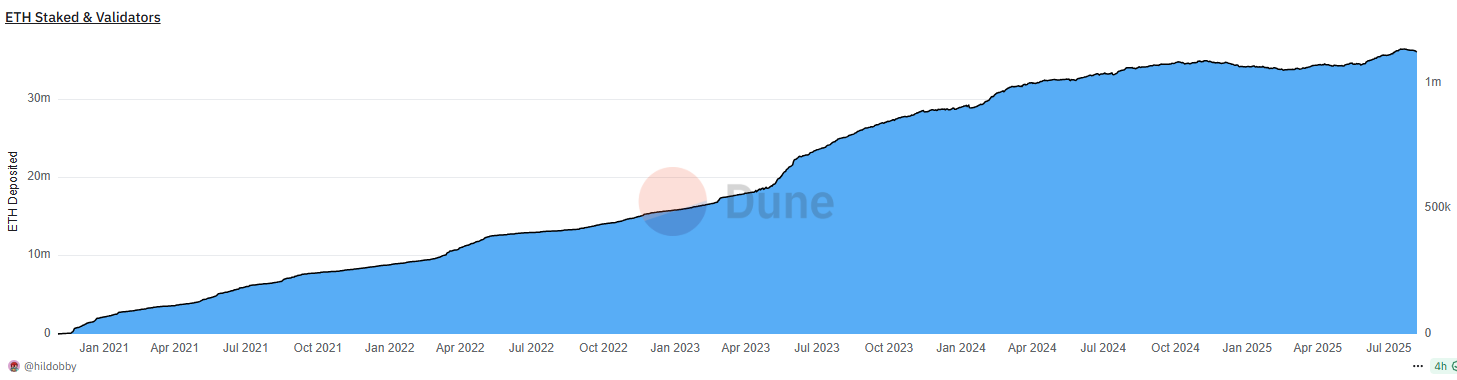
  Ether staked and validators since November 2020. Source: Dune


Still, the DeFi industry, much of which is built on the framework of Ethereum, still lacks legal recognition or regulation in many jurisdictions. 

In the case of the US SEC, the commission delayed its decision on Bitwise’s application to add staking to its Ether exchange-traded fund (ETF). 

The CLARITY Act, which would establish some regulations for the DeFi industry, is still making its way through the halls of Congress. The bill would exempt DeFi protocols from some of the standards it creates for other crypto-related entities and allow them to launch and sell native tokens. 

The European Union’s Markets in Crypto-Assets regulation does not contain provisions for the DeFi industry; however, this will reportedly become a priority for the bloc’s lawmakers in 2026.

Sooner or later, it appears that DeFi regulations are coming and ecosystems critical for the industry, like Ethereum, are getting ready. 
Comments

All Comments

Recommended for you

  • Latest Progress on DeFi United Ecological Rescue Initiative: Over 100,000 ETH Raised at Designated Donation Address

    On April 26, the DeFi United ecological rescue initiative, led by Aave, continues to advance. The Arbitrum DAO has released 30,765 ETH that was frozen after the rsETH incident on April 18. Currently, the designated donation address has raised a total of 100,360 ETH to address the collateral asset gap caused by the rsETH incident. The plan aims to restore the backing assets of rsETH through multi-party collaboration, stabilize the market, and prevent the spread of bad debts across protocols. The funds will be used to support the restoration of collateral rates and to gradually normalize the market in conjunction with relevant protocols. Key contributors or participants currently include: Arbitrum DAO releasing 30,765 ETH frozen after the rsETH incident, Mantle proposing to contribute 30,000 ETH, Aave DAO proposing to contribute 25,000 ETH, Aave founder Stani Kulechov confirming a contribution of 5,000 ETH, EtherFi proposing to provide 5,000 ETH, Lido proposing to provide 2,500 stETH, and the Golem Foundation and related projects contributing a total of 1,000 ETH, among others. Additionally, LayerZero, Ethena, Frax Finance, and Ink Foundation have also confirmed their participation, although the specific amounts have not yet been disclosed. It is important to note that the progress of this rescue initiative still relies on several external key conditions, including KelpDAO's restoration of rsETH redemptions and the Arbitrum Security Council's release of frozen assets, resulting in uncertainty regarding the overall recovery time and effectiveness.

  • Trump Evacuated from White House Correspondents' Dinner Due to Security Incident

    On April 26, local time April 25, U.S. President Trump was urgently evacuated from the White House Correspondents' Dinner due to a security incident. (CCTV News)

  • Shooting Incident at White House Correspondents' Dinner; Gunman Dead

    On April 26, local time on April 25, a shooting incident occurred in the hall of the White House Correspondents' Dinner, and the gunman is now deceased. (CCTV News)

  • Trump States He Will Not Allow Banks to Undermine Cryptocurrency Market Legislation

    On April 26, CoinDesk reported, citing attendees at a Trump cryptocurrency event, that Trump stated he would not allow banks to undermine cryptocurrency market legislation.

  • Iranian Officials to Depart Pakistan Without Meeting U.S. Representatives

    On April 25, according to a reporter from the New York Post: The Iranian delegation is set to leave Islamabad, the capital of Pakistan, and has consistently emphasized that they did not meet with U.S. officials during their brief visit.

  • Foreign Media: Second Round of Iran-U.S. Talks Scheduled for April 27

    On April 25, according to New Delhi Television: The second round of talks between Iran and the United States is scheduled to take place on April 27.

  • Iranian Lawmaker: Comprehensive Plan for Managing the Strait of Hormuz Formed

    On April 25, according to a report by Iran's Mehr News Agency, Iranian Islamic Parliament member Behnam Saidi stated that Iran has developed a comprehensive plan for managing the Strait of Hormuz. In an interview with Mehr News Agency, Saidi mentioned that an important aspect of this plan is the exclusive recognition of the name 'Persian Gulf' in all correspondence and commercial documents, rejecting any other names. Vessels and ships navigating in the region must obtain permission from Iran. Sovereignty over the Strait of Hormuz will be entirely under Iran's control. He also stated that vessels identified as hostile by the Supreme National Security Council or the General Staff of the Armed Forces of Iran are not allowed to pass through the Strait of Hormuz, and Israeli vessels are absolutely prohibited from entering the area. Ships passing through the region must pay relevant fees concerning safety, environmental protection, shipping management, and licensing, with priority given to payments in rials.

  • DeepSeek Plans to Raise $1.8 Billion with a Valuation of Approximately $20 Billion

    Sources reveal that the main reason for DeepSeek's current fundraising effort is the significant recent talent loss. Several core researchers have left the company to join ByteDance, Tencent, Xiaomi, and autonomous driving company Yuanrong Qihang. Meanwhile, competitors Zhiyu Technology and MiniMax have listed on the Hong Kong Stock Exchange, and the company Dark Side of the Moon has completed three rounds of financing in the first three months of this year, with a valuation more than quadrupling since the end of last year.

  • Iran Warns U.S. Against Continuing Piracy Actions

    On April 25, according to CCTV International News, Iran's Khatam al-Anbia Central Command issued a statement today warning that if U.S. forces continue to implement 'blockades, maritime interceptions, and piracy actions' in the region, they will face a strong counterattack from the Iranian armed forces. The statement emphasized that the U.S. should recognize that Iran's military capabilities and preparedness in safeguarding national sovereignty, territorial integrity, and national interests are stronger than ever, as demonstrated in previous conflicts. The statement also noted that Iran will continue to monitor enemy actions and movements and maintain control over the Strait of Hormuz. Should the enemy take further actions, Iran will respond with even harsher strikes.

  • Sources: Iran's Stance is Tougher than in First Round of Negotiations

    On April 25, official sources from Pakistan stated that Iran has adopted a tougher position compared to the first round of negotiations, emphasizing that any plan to end the war must be implemented according to Iran's conditions, rather than those proposed by U.S. President Trump. (Xinhua News Agency)