

The Merge upgrade, which effectively brought the Proof-of-Stake (PoS) mechanism to Ethereum, was activated almost a year ago. The subsequent Ethereum Shapella upgrade, which allowed staked ETH withdrawals, is about six months old. With these two monumental changes, we saw the rise of the Ethereum staking industry, which already counts more than $40 billion worth of staked assets and has generated over $1.6 billion in total staking rewards, a proxy for total revenue.
Below we look at three prominent matters for Ethereum staking going forward.
Growing institutional interest in staking
By any conceivable metric, the Ethereum PoS transition was a tremendous success. According to data from Staking Rewards, the total amount of staked ETH currently stands at $41.5 billion, representing 46% of the total staked assets across all blockchains. Staked ETH already represents 21.7% of the total supply, versus 6.5% and 15.1% when the Merge and Shapella were activated, respectively.
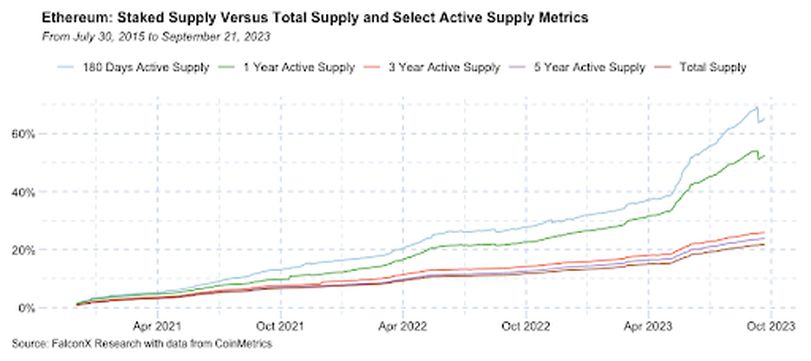
When measured against other supply metrics, the adoption is even more striking: The supply of ETH staked has recently surpassed 50% and 65% of the supply active over the past year and six months, respectively.
Notably, during this intense ramp-up period, the network has been operating smoothly, except for two relatively minor incidents, in which the network failed to finalize blocks for a few minutes but managed to recover on its own.
Institutional investors took notice, of course.
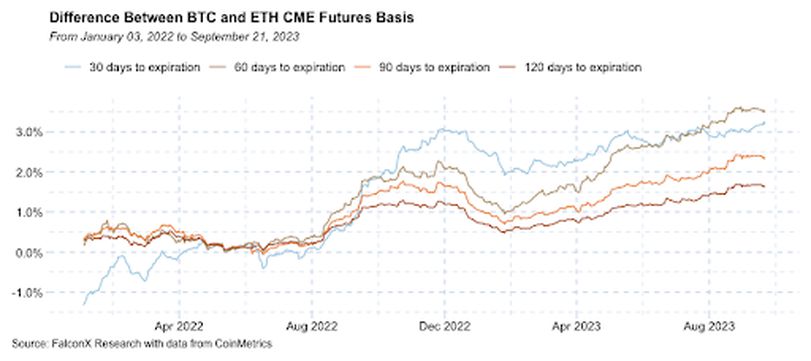
One measure of how ETH staking has been incorporated by institutions is the difference between ETH and BTC basis (i.e., the difference between futures and spot prices) in the CME, a venue used exclusively by institutional investors. The reason is simple: Given that ETH now derives a native yield and BTC does not, the difference between the BTC and the ETH basis should approximate this yield because it reduces the futures contract carry cost.
The chart below shows the evolution of the difference between BTC and ETH annualized basis on the CME futures contracts. It indicates that institutional investors are considering staking in their pricing process. This difference, which was negligible until about a year ago, currently stands at 3.2% and 3.5% for the most liquid contracts (30 and 60 days to expiration). This difference is close enough to the Composite Ethereum Staking Rate (CESR) of 3.9%.
Will Ethereum staking fervor cool?
But it’s not all rosy skies. Early signals indicate that the Ethereum staking adoption fervor could start to slow.
Ethereum's staking participation rate (22% of total supply staked) still significantly lags behind other PoS networks such as Solana (71% staked), Cardano (62% staked), and others. This is largely expected, given that ETH has a much more distributed holder base and is more used as a network resource.
The question is to what extent this gap will close.
Consider the number of validators wanting to stake their ETH and waiting in line because the network can only handle a certain number of new entrants simultaneously. After the Shapella upgrade, this number grew to nearly 100,000 in less than two months. This far exceeds the number of people wanting to remove their staked ETH, which has been virtually zero for most of the time.
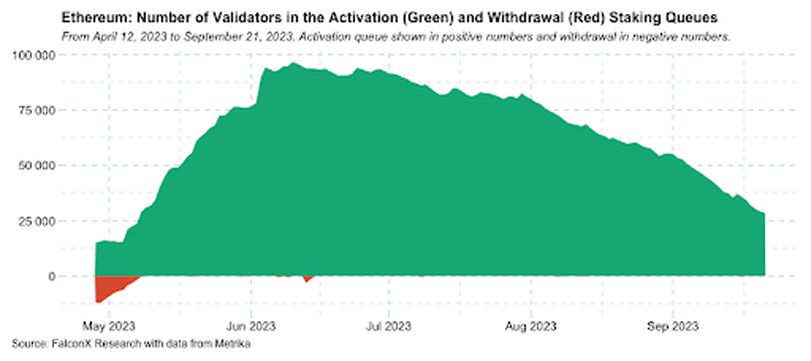
Since June 2023, the number of validators in the activation queue has consistently declined. It now stands at under 30,000, the lowest level since May. If this trend remains for a few months, the rate of increase of ETH staked will taper down in a couple of months.
One factor behind the slowdown is that broader macroeconomic conditions have shifted from a tailwind to a headwind for investors looking at crypto for yield generation. The Composite Ether Staking Rate shrunk from 5.5% at the Merge upgrade to 3.9% due to more validators and lower network activity. For comparison, the two-year Treasury interest rate climbed from 3.8% to 5.2% over the same period.
Another, perhaps more controversial, concern is the dominance that Lido, the leading staking provider that now controls a tad under a third of the total staked ETH, was able to maintain after Shapella. The one-third threshold is relevant because it could allow an attacker who owns this much staked ETH to start impacting the Ethereum network finality.
Recently, some staking providers committed to self-limit to less than 22% of the Ethereum validators, but Lido voted not to self-limit. The good news is that the protocol is working on further decentralizing their operator set and recently added seven more members. Moreover, further initiatives will contribute to network decentralization, including proposer-builder separation (PBS), which can democratize access to sophisticated MEV, and distributed validator technology (DVT), which will allow validators to be controlled by multiple entities. Lido itself is working on adopting DVT.
The future looks bright
2023 will mark the year in which Ethereum staking took off despite crypto’s longest bear market.
We expect the Ethereum staking industry to keep gaining momentum going forward. Institutional investors can now use increasingly seamless staking platforms geared to their specific needs. DeFi users are witnessing a burgeoning set of new primitives that leverage staked assets for new use cases, such as sophisticated interest rate trading.
Nothing in crypto evolves in a straight line, but it’s hard not to get excited about the long-term prospects of the Ethereum staking industry.


All Comments