

Cointime

Download App
iOS & Android

Ethereum is scaling: TPS, gas limit up as validators back 45M target

Validated Individual Expert

Ethereum’s throughput ticked up on Sunday as more validators signalled their support for increasing Ethereum’s gas limit to 45 million units, which will reduce transaction fees and enable improved network scaling.  

Ethereum’s gas limit rose to over 37.3 million units on Sunday, according to Etherscan, up almost 3% from levels late last week, while several blocks were proposed with higher gas limits.

The latest gas limit increase represents the first significant climb since February, when it was raised from 30 million to 36 million.
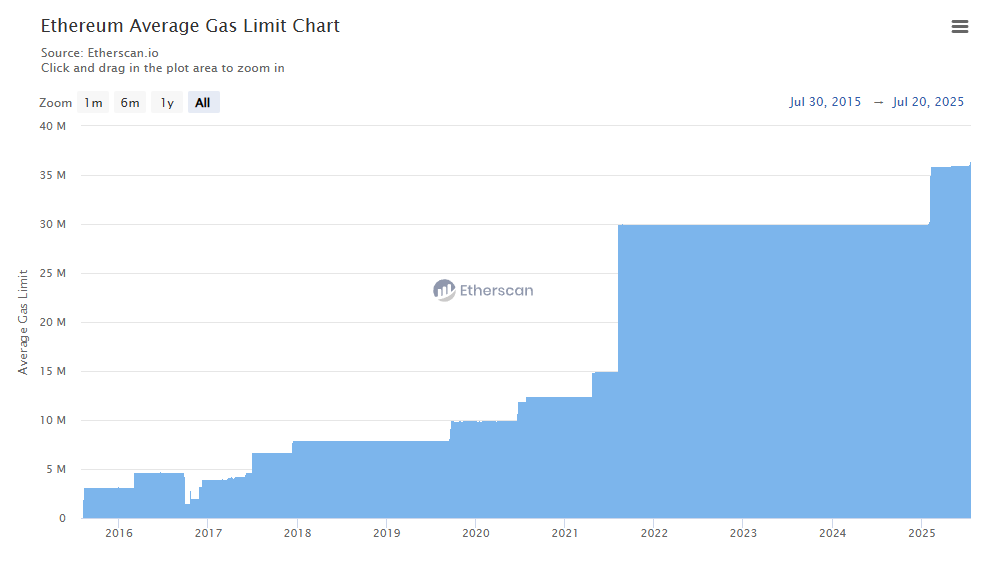
  Average Ethereum gas limits over time. Source: Etherscan

Improved transaction throughput

Higher gas limits mean more transaction throughput on Ethereum’s layer-1 network, and validators can automatically adjust the limit by about 0.1% per block when they signal support for changes.

Ethereum throughput ticked up to just below 18 transactions per second over the weekend, according to Chainspect. It has also risen since the last gas limit increase when TPS was around 15. 

Validators agree to “pump the gas”

The weekend gas limit increase came as nearly half of all staked Ether 

ETH$3,782is now signaling support to raise the gas limit to 45 million or higher through a grassroots “pump the gas” campaign.

“Almost exactly 50% of stake are voting to increase the L1 gas limit to 45 million,” observed Vitalik Buterin on Sunday.

Currently, 47.2% of staked validators are in favor of higher gas limits, according to GasLimits.pics.
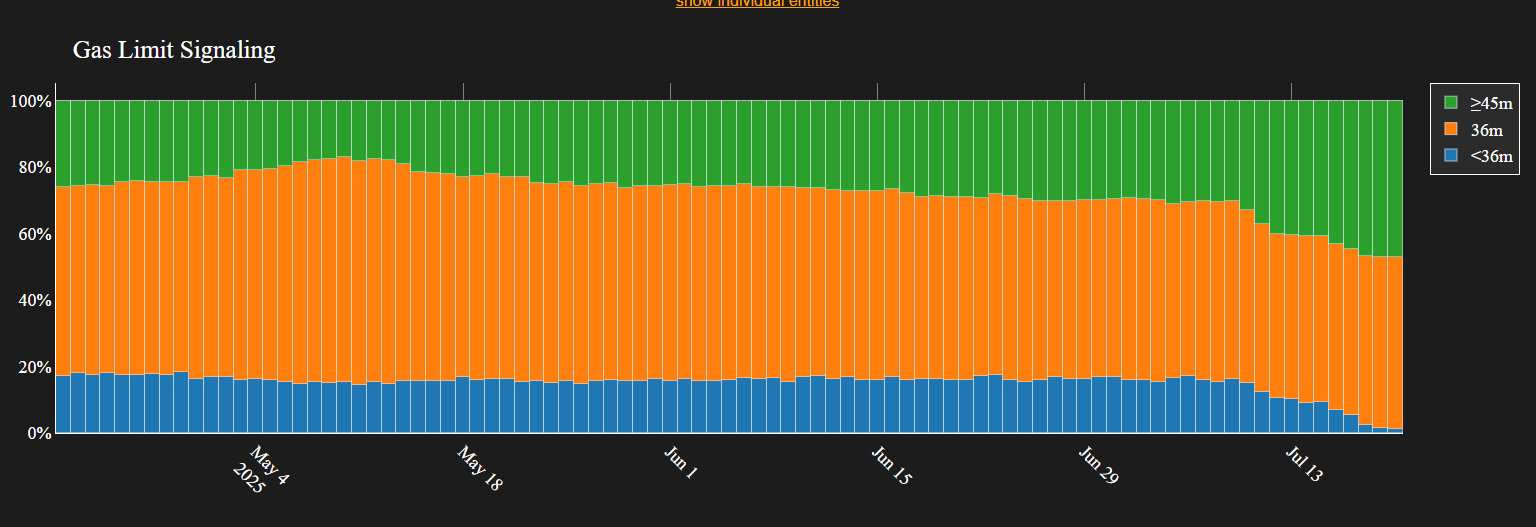
  Gas limit signalling. Source: GasLimit.pics

Pump the gas 

The gas limit refers to the maximum amount of gas spent on executing transactions or smart contracts in each block. Gas is the Ether fee required to conduct a transaction or execute a smart contract on the network.

Ethereum developers launched the “pump the gas” campaign in March 2024 to initially raise the Ethereum gas limit from 30 million to 40 million, which they claimed would reduce transaction fees on layer 1.

Buterin noted that recent Geth, the most popular Ethereum node client, team improvements make these scale increases safer with new archive node optimizations.

Ether activity and price continue higher

Ethereum network activity has also increased in recent months, with an uptick in daily transactions from around 1.1 million in April to current levels around 1.4 million, according to Etherscan. 

The uptick in network activity has correlated with an increase in price, with the asset gaining a whopping 54% over the past month. 

Ether topped $3,800 briefly in a seven-month high on Sunday as corporate treasuries and exchange-traded funds continue to load up. 

Comments

All Comments

Recommended for you

  • Meta Platforms (META.US) Reverses Pre-Market Decline, Currently Up Over 2%

    On September 14, Meta Platforms (META.US) reversed its pre-market decline and is currently up over 2%.

  • Strategy Repurchases $139 Million in STRC, Holds 845,050 BTC and $6.4 Billion in USD Assets as of September 13

    On September 14, it was announced that Strategy (formerly MicroStrategy, stock code: MSTR) Executive Chairman Michael Saylor disclosed that the company has repurchased $139 million worth of STRC. As of September 13, 2026, Strategy holds 845,050 BTC and $6.4 billion in USD assets. Saylor also revealed credit metrics: the duration of USD assets is 3.9 years, and the BTC credit spread for STRC is 57 basis points, assuming an annualized BTC return of 10%, BTC volatility of 40%, and a BTC price of $77,266.

  • Google Pre-Market Rises 1.65%

    On September 14, Google-C (GOOG.US) pre-market rose by 1.65%, reaching $340.97.

  • Economist Shocking Prediction: US Economy and Stock Market to 'Crash' in 2027, Nasdaq to Fall Back to '10,000' Level

    On September 14, the polarized economy and the artificial intelligence (AI) bubble are sowing the seeds for the next economic collapse. This warning comes from Danish economist Henrik Zeberg, who believes that the US economy and stock market will experience a rollercoaster of volatility in the future. He predicts that the stock market will face a significant 'top crash' before the end of the year, with stock prices plummeting from high levels and the economy entering a recession. In a recent interview, he stated that if events unfold as his model predicts, the Nasdaq 100 index could soar to 39,000 points by the end of 2026, an increase of about 33%, before crashing back down to around 10,600 points, which is the low point of 2022. 'I think we will see a scenario similar to that of 2000,' said the macro strategist from investment firm Swissblock, speculating that the market crash could trigger broader crises in the financial system, such as in the banking and private credit sectors. 'I believe the consequences of the AI bubble bursting will be quite severe,' he added.

  • Musk: Grok 5 May Surpass All Current Products

    On September 14, Musk stated on social media that Grok 4.7's level should be roughly equivalent to Opus 5.0, rather than 5.1. It performs better in some areas and weaker in others. We need to improve multimodal performance. Grok 4.8 will bring significant enhancements. Grok 4.9 may reach Astra/Fable levels. Grok 5 may surpass all current products. We will wait and see. (Jinshi) Musk also mentioned in response to a user on social media that Grok 5 will aim for AGI capabilities.

  • Japanese NAND Giant Kioxia Considers US IPO to Raise $10 Billion

    On September 14, market news reported that Japanese NAND giant Kioxia Holdings is considering an initial public offering (IPO) in the United States to raise $10 billion. The company is in discussions with Bank of America, Goldman Sachs, and JPMorgan Chase to seek greater liquidity in the US market.

  • Iran Increases List of Violating Vessels to 77

    On September 14, Iran's 'Persian Gulf Maritime Administration' announced that it has updated the list of violating vessels, bringing the total number of ships on the list to 77. The relevant vessels will face restrictions on passage in the future, including fines, detention, or confiscation. Warnings have been issued to insurance companies, P&I clubs, and classification societies, advising them not to provide services to these vessels to avoid related consequences from engaging in business with them. (Jinshi)

  • Spot Gold Falls Below $4,300 Again

    On September 14, spot gold and silver prices declined in the short term, with spot gold dropping nearly $20 to fall below $4,290 per ounce, a decrease of 1.37% for the day. Spot silver also saw a short-term decline of $0.6, currently reported at $62.69 per ounce.

  • BTC Surpasses $78,000

    Market data shows that BTC has surpassed $78,000, currently priced at $78,010, with a 24-hour increase of 1.62%. The market is experiencing significant volatility, so please ensure proper risk management.

  • South Korea's Securities Trading Platform Expands After-Hours Trading to 8 PM

    On September 14, the Korea Exchange officially launched after-hours trading, effective from Beijing time on September 14. The regular trading hours remain from 9 AM to 3:30 PM. With the implementation of the new system, investors can continue trading until 8 PM after the regular market closes. Regarding pre-market trading, the Korea Exchange has postponed the launch of the pre-market due to feedback from the securities industry about the significant burden of IT system development and personnel operations, now scheduled for the end of 2027. Concerning the market's interest in whether Exchange-Traded Funds (ETFs) and Exchange-Traded Notes (ETNs) will be included in after-hours trading, the Korea Exchange stated that, due to concerns about market volatility, ETFs and ETNs will not be included in after-hours trading for the time being. (CCTV Finance)
