

Cointime

Download App
iOS & Android

Call Overwriters Dominate ETH Flows

From deribit by Imran Lakha

Crypto Revival as GBTC Selling Slows

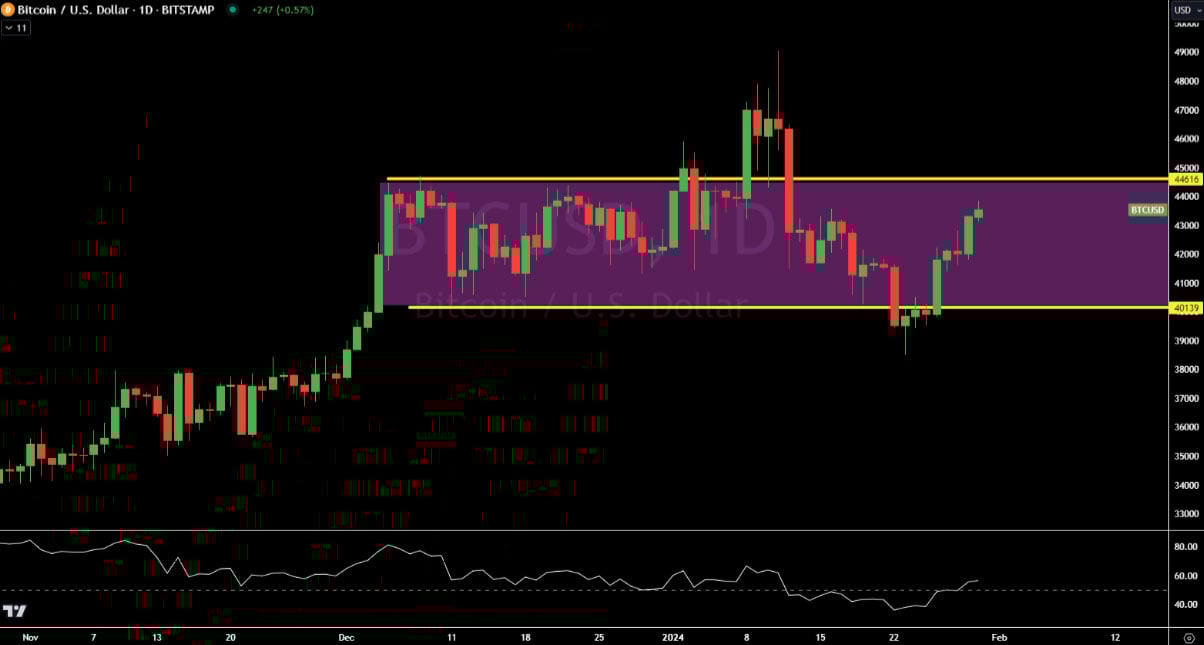
Bitcoin’s market has shown choppy moves 3 weeks following ETF introductions, struggling to establish a bullish footing. Attempts to surpass the $45,000 resistance or maintain a value sub $40,000 support have repeatedly failed.

The initial price increase was countered by withdrawals from the Grayscale Bitcoin Trust, balanced by inflows into other ETFs and purchases ahead of Bitcoin’s halving event in the spring, which is traditionally a bullish event for Bitcoin.

It’s worth noting that the rate of withdrawals from Grayscale’s spot ETF is decreasing, while ETFs from Blackrock and Fidelity continue to attract Bitcoin investments, each gathering roughly $2 billion since launch. Analysis from JP Morgan hints that the selling from GBTC might be mostly over, implying a market shift towards accumulation as the halving approaches.

The balanced funding rates suggest a decline in speculative trading, which means there is plenty of room for additional flows before the market reaches saturation.

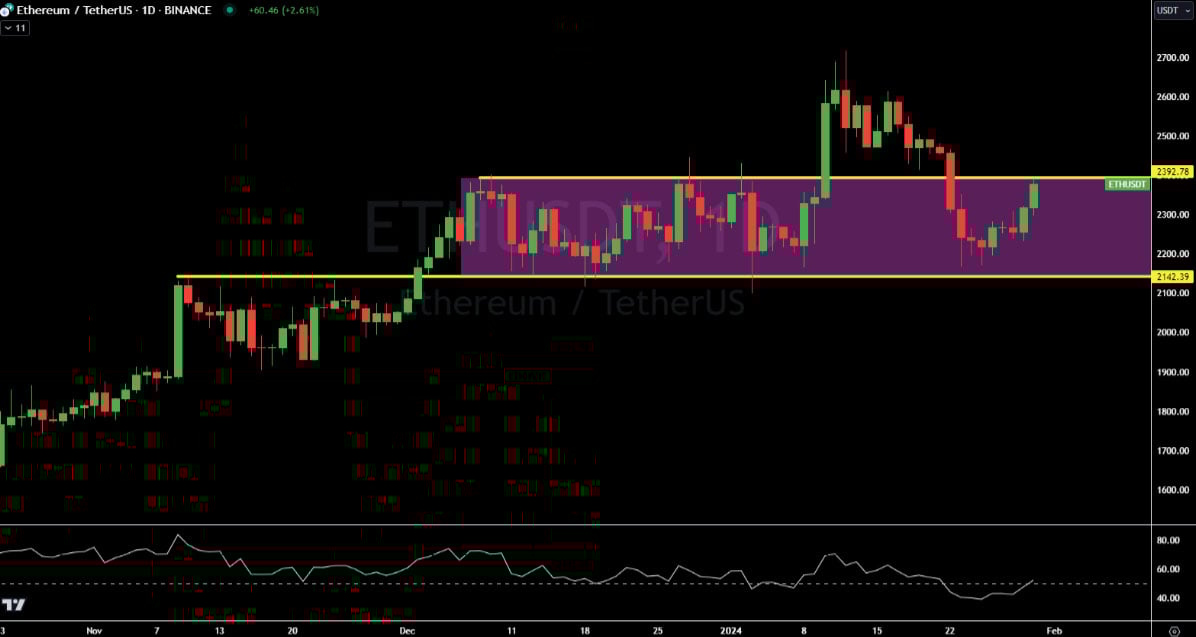
Meanwhile, Ethereum has lagged behind, with the ETHBTC ratio falling since its high on January 20. The anticipated ‘Dencun’ upgrade is likely to act as a positive catalyst for ETH, along with speculation about an Ethereum spot ETF. This all suggests potential for price appreciation in coming months.
‘Call Wall’ of Resistance in ETH

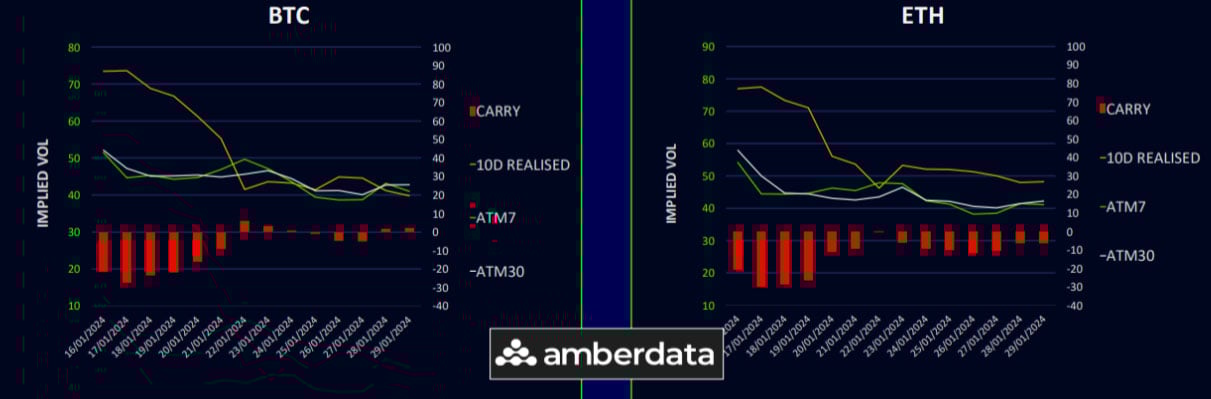
This week, Bitcoin’s 10-day realized volatility decreased to 40% and Ethereum’s to 48%. Weekly implied volatilities (pure gamma) also dropped, particularly for short-term expirations, by 6-7 points vs a more stable 1-month implied. Bitcoin’s volatility carry is slightly positive, while Ethereum’s is significantly negative due to a decline in implied volatilities as massive call selling has been seen, which may cause real difficulties to see further rallies in the near term. This gamma positioning is creating a ‘call wall’ of resistance.
Term Structures Falling Back into Contango

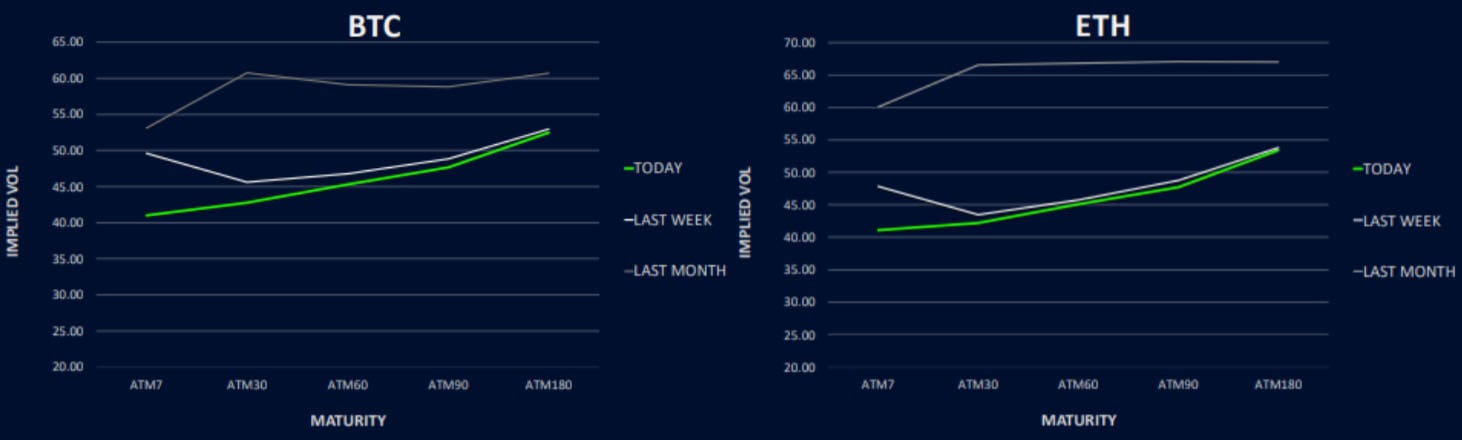
Bitcoin’s term structure has returned to contango as expected with a decline in realized volatility. The most significant change was in weekly volatilities, down by about 4 points. Forward vol premiums are slightly higher for expiries post-April, capturing the halving event.

Ethereum’s term structure is similar with a slight contango, with gamma buckets trading lower due to strong selling pressure that are overwhelming market makers’ books. VEGA is still well offered, even in the back-end expiries which were down 1-2 vols.
Longer Dated Call Switches in ETH/BTC Favoured

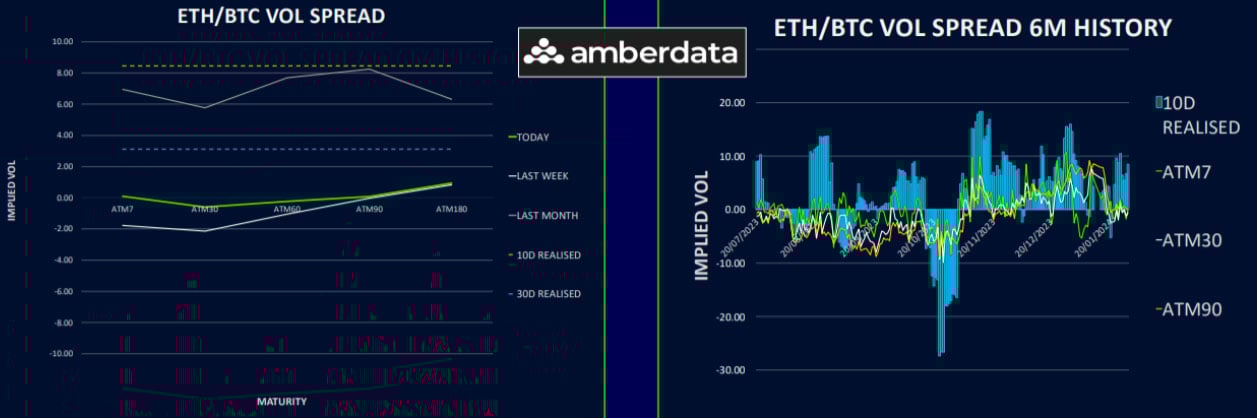
The ETH/BTC volatility spread is mostly stable, with weeklies fluctuating erratically on a daily basis. Ethereum continues to show 8 vols higher realized volatility than Bitcoin.

Owning the spread continues to offer decent value from a realized gamma perspective if one is interested to delta hedge the moves. Watch for sticky long strikes on the upside for ETH, which may cause this realized outperformance to dissipate.

The ETH/BTC spot spread retracted 13% from January highs, suggesting a good entry point for those bullish on Ethereum. Long-dated call switches were recently flagged to our subscribers in order to leverage Ethereum’s potential against Bitcoin.

We are cognizant that the short-term gamma positioning may act as a vol dampener for ETH in the near term though, and so we decided to use far OTM calls with longer expiries.
Skew Flips Back Into Call Premium

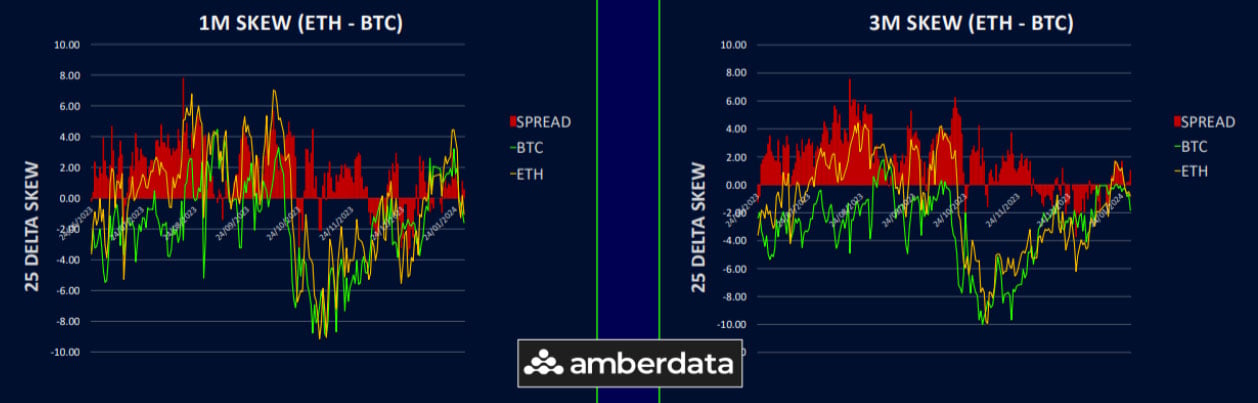
Bitcoin’s skew structure has shifted to call premium after the rally, with the front end seeing a 2 vol premium increasing to 5 vols in longer expiries.

Ethereum shows a similar move but with a more modest 1 vol call premium for up to 3-month expiries as the bullish ETH narrative seems to be getting pushed out in time.

Call overwriting is prevalent in Ethereum flows and may cap call skews, especially in the front-end. In turn, this may potentially keep realized volatility low.

Just remember that once a strong enough fundamental reason takes hold, call sellers may need to cover, and this can reverse the vol dynamics quickly.
Option Flows And Dealer Gamma Positioning

Bitcoin options volumes rose by 10% this week, mainly in calls, with significant interest in March 29 50k and 75k calls. A notable trade was buying April 26, 41k straddles against selling February 23, 37k/45k strangles.

Ethereum’s volumes also increased by 10%, with notable trades in bullish risk reversals and put spreads. Largest volume was on screen selling of 23Feb 2400 & 2500 calls (rolling down short 2700s) from the big overwriter.

Dealer gamma positioning in Bitcoin has neutralized after large 26Jan 42k short strikes expires and fresh sellers of 23Feb options came in last week. Meanwhile, Ethereum’s gamma positioning has significantly increased, indicating a potential challenge for major movements without significant news.

Strategy Compass: Where Does The Opportunity Lie?

Using the recent pop in crypto prices to enter short term some hedges makes sense. Put spread collars tend to work well with vol in the 40s.

For those who don’t have enough ETH exposure already, we really like ETH calls vs BTC calls in Jun24 to Dec24 expiries.

Comments

All Comments

Recommended for you

  • DeepSeek Seeks Over $300 Million in First Round of External Funding

    According to The Information, DeepSeek is seeking over $300 million in its first round of external funding, with a valuation exceeding $10 billion.

  • BTC Surpasses $78,000

    Market data shows that BTC has surpassed $78,000, currently priced at $78,024.64, with a 24-hour increase of 5.63%. The market is highly volatile, so please ensure proper risk management.

  • BTC Surpasses $77,000

    Market data shows that BTC has surpassed $77,000, currently priced at $77,022.24, with a 24-hour increase of 3.42%. Due to significant market fluctuations, please ensure proper risk management.

  • US and Iran Discuss Plan to End War

    On April 17, U.S. media reported, citing two American officials and two sources familiar with the negotiations, that the United States and Iran are communicating about a plan aimed at ending the war. One key topic is the U.S. potentially unfreezing $20 billion of Iran's frozen assets in exchange for Iran giving up its enriched uranium stockpile. The report also quoted another source familiar with the mediation efforts, stating that negotiations are expected to take place this Sunday in Islamabad, the capital of Pakistan. (Xinhua News Agency)

  • ETH Surpasses $2400

    Market data shows that ETH has surpassed $2400, currently priced at $2402.37, with a 24-hour increase of 2.58%. The market is experiencing significant volatility, so please ensure proper risk management.

  • US Plans to Unfreeze $20 Billion in Funds for Iran's Uranium Cessation

    On April 17, according to AXIOS, two US officials and two sources familiar with the negotiations revealed that the US and Iran are negotiating a three-page plan to end the conflict, one element of which involves the US unfreezing $20 billion of Iranian funds in exchange for Iran abandoning its enriched uranium stockpile. According to the two sources, in the early stages of negotiations, the US proposed unfreezing $6 billion for humanitarian supplies, while Iran requested $27 billion. The latest figures being discussed between the US and Iran are $20 billion. One US official stated that this is the US proposal. Another US official described the concept of 'cash for uranium' as 'one of many discussions.' Meanwhile, the US is demanding that Iran agree to send all its nuclear materials to the US, while Iran has only agreed to 'dilution' within its territory. Under the compromise being discussed, some highly enriched uranium would be sent to a third country (not necessarily the US), while some would be diluted under international supervision within Iran.

  • Iranian Foreign Minister Amir-Abdollahian: Commercial Shipping in the Strait of Hormuz is Open

    On April 17, Iranian Foreign Minister Amir-Abdollahian announced that commercial shipping in the Strait of Hormuz is now open.

  • Payward Agrees to Acquire Crypto Derivatives Firm Bitnomial for $550 Million

    Kraken's parent company Payward has announced that it has agreed to acquire the stock and crypto derivatives trading company Bitnomial for $550 million. This is a cash and stock transaction that enables Payward to gain control of a fully licensed U.S. cryptocurrency derivatives stack, accelerating its expansion in regulated markets.

  • Senator Pressures U.S. DOJ and Treasury on Binance-Iran Fund Flow Issues

    On April 17, U.S. Senator Richard Blumenthal (Democrat, Connecticut) sent a letter to the Department of Justice (DOJ) and the Financial Crimes Enforcement Network (FinCEN) requesting clarification on the status of two compliance supervisors at Binance. Reports had previously indicated that internal investigators at Binance warned executives about over $1 billion in funds flowing to wallets related to Iran, but were subsequently fired. Binance denies that the dismissals were related to the investigation's findings and claims that its compliance system is stringent. Notably, the DOJ had previously terminated independent oversight requirements for Glencore and Boeing, raising concerns about whether similar oversight mechanisms have also been suspended for Binance. In 2023, Binance was fined $4.3 billion for failures in anti-money laundering and sanctions compliance, and the two supervisors were part of the agreement at that time.

  • Goldman Sachs: Without Monetary Policy Support, US Stock Gains May Be Unsustainable

    On April 17, Goldman Sachs' head of asset allocation research, Muller-Grissman, stated that the recent rise in US stocks requires the Federal Reserve to restart interest rate cuts to maintain momentum. He described the recent stock market rebound as a 'rapid and intense recovery phase,' partly driven by technical factors, including hedge funds that previously sold stocks to reduce risk now being forced to rebuild their positions. Although the S&P 500 is expected to rise over 3% for three consecutive weeks, he questioned whether the gains could be sustained without monetary policy support. He noted that while the stock market is rising, oil prices remain high and the credit market is lagging. The strong performance of the stock market is partly due to high exposure to technology stocks.
