

Cointime

Download App
iOS & Android

Bullish investment strategies before spot ETH ETF approval

There are several reasons to be optimistic about the approval of spot Ether exchange-traded funds (ETFs) in the near future. First, the United States Securities and Exchange Commission has already shown a more favorable attitude toward cryptocurrencies in general, as evidenced by its approval of 11 spot Bitcoin ETFs in January 2024. This was a historic milestone for the crypto industry, as it marked the first time the SEC allowed investors to access the largest cryptocurrency through a regulated and mainstream investment vehicle.

Second, Ether has a strong case for being classified as a commodity rather than a security by the SEC. This is a crucial distinction, as commodities are subject to less stringent regulations than securities and are, therefore, more likely to be approved for ETFs.

Ether is widely regarded as a commodity by many experts and authorities, including the U.S. Commodity Futures Trading Commission, the Financial Conduct Authority in the United Kingdom, and Bloomberg’s ETF analysts. The Ethereum blockchain is also the backbone of the decentralized finance and nonfungible token sectors, which are booming with innovation and adoption, and demonstrate the utility and value of the network.

Third, there is a strong demand and interest for spot ETH ETFs from both retail and institutional investors. According to a recent survey by Bitwise Asset Management, 98% of financial advisers who currently have an allocation to crypto in clients’ accounts intend to maintain or increase their exposure in 2024, which also favors ETH.

Chris Kuiper, director of research at Fidelity, recently shared his insights on why Ether could be a more appealing investment option for institutional investors than Bitcoin. He highlighted that comprehending Bitcoin as an investment requires delving into intricate topics such as politics, philosophy, game theory and economics. In contrast, Ether provides a more straightforward perspective, emphasizing basic metrics and cash flow data. Kuiper believes presenting these metrics to institutional investors would make ETH appear more like a conventional financial instrument, making it easier for them to relate to the asset.

In addition, there are several applications for spot ETH ETFs pending with the SEC, such as the Fidelity Ethereum Fund, the WisdomTree Ethereum Trust and BlackRock’s iShares Ethereum Trust. These are some of the world’s most reputable and influential asset managers, and their involvement could sway the SEC’s decision in favor of spot ETH ETFs.

Given the positive outlook for spot ETH ETFs, how should investors prepare for the potential approval? There is no definitive answer, as different investors have different risk appetites, time horizons and market outlooks. However, here are some possible strategies to consider, depending on whether one is bullish or bearish on Ether.

For investors who are bullish and optimistic about the approval of spot ETH ETFs, there are several ways to benefit from the anticipation and speculation of an approval, such as:

  • Buying spot ETH: The simplest, most direct way to gain exposure to the price appreciation of Ether is to buy and hold the spot ETH, either through a crypto exchange or a wallet. However, this also involves the highest risk and cost, as the investor has to deal with the volatility, security, and custody issues of holding and storing Ether directly.
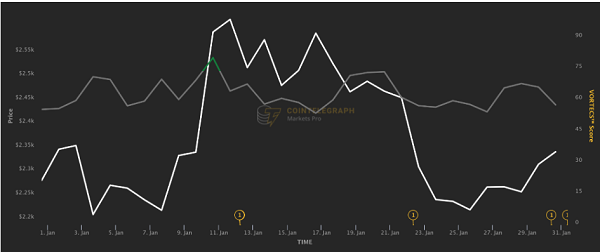
Using the Price vs. VORTECS™ function as a reference when buying Ether. Source: Cointelegraph Markets Pro
  • Buying futures ETH ETFs: Another way to gain exposure to the price appreciation of Ether is to buy and hold futures-based ETH ETFs, such as the VanEck Ethereum Strategy ETF or the ProShares Ether Strategy ETF. These ETFs track the price of Ether by holding futures contracts that promise to deliver ETH at a future date and price. However, this also involves some risk and cost, as the investor has to deal with the contango, rollover, and tracking error issues of holding and trading futures contracts.
  • Buying call options on ETH or ETH ETFs: A more sophisticated, leveraged way to gain exposure to the price appreciation of Ether is to buy call options on ETH or ETH ETFs, such as CME ETH options. These options give the investor the right, but not the obligation, to buy ETH or ETH ETFs at a predetermined price and date. However, this also involves the most risk and cost, as the investor has to pay a premium for the options, and the options could expire worthless if the price of Ether or the ETH ETF does not exceed the strike price by the expiration date.
  • Arbitraging between different ETH products: A more complex, arbitrage-based way to gain exposure to the price appreciation of Ether is to exploit the price differences between different ETH products, such as spot ETH, futures-based ETH ETFs, spot ETH ETFs (if available in other jurisdictions), and ETH derivatives. However, this also involves the most skill and capital, as the investor has to identify and execute the arbitrage opportunities, and hedge against the market and operational risks.

Ethereum is one of the most innovative, influential platforms in the crypto space, and the approval of spot ETH ETFs could be a game-changer for the industry. However, an approval is not guaranteed, and the timing is uncertain. Therefore, investors should be prepared for various scenarios and adopt the appropriate strategies according to their risk appetite, time horizon and market outlook. To aid in their strategies, investors may consider using a powerful trading dashboard such as Cointelegraph Markets Pro.

Whether one is bullish or bearish on Ether, there are multiple ways to invest in the cryptocurrency before a potential spot ETH ETF approval, and potentially profit from the anticipation and speculation of such an approval. But remember, this is not financial advice.


Comments

All Comments

Recommended for you

  • Bitcoin miner Core Scientific shifts to AI with 1.5GW data center push

    Core Scientific is converting its Pecos, Texas site into a high-density AI colocation hub, repurposing 300MW of mining capacity.

  • Acting AG Todd Blanche confirms ‘code is not a crime’ in DOJ pivot

    Acting US Attorney General Todd Blanche said developers will no longer be investigated or charged unless they knowingly help third parties commit crimes.

  • Bank of Japan Governor Kazuo Ueda: No Immediate Need for Rate Hike

    On April 28, Bank of Japan Governor Kazuo Ueda stated that there is currently no immediate need to raise interest rates. However, if the current supply shocks lead to secondary ripple effects, a rate hike may be necessary. (Jin Shi)

  • Central Political Bureau Meeting: Comprehensive Implementation of 'AI+' Initiative to Develop New Intelligent Economy and Improve AI Governance

    On April 28, the Central Political Bureau of the Communist Party of China held a meeting to analyze and study the current economic situation and economic work. The meeting emphasized the need to accelerate the construction of a modern industrial system and maintain a reasonable proportion of manufacturing. It called for deepening the construction of a unified national market and addressing 'involutionary' competition. The meeting also announced the comprehensive implementation of the 'AI+' initiative to develop a new intelligent economy and improve AI governance. Furthermore, it highlighted the need to deepen state-owned enterprise reform, systematically respond to external shocks and challenges, enhance the security of energy and resource guarantees, and address various uncertainties with the certainty of high-quality development. (Dongxin News Agency)

  • ByteDance, Zhiyu, and Alibaba Selected Among Top 10 AI Influencers by TIME

    On April 28, TIME announced its list of the '10 Most Influential AI Companies of 2026.' Unlike a simple comparison of model capabilities, this list emphasizes the comprehensive shaping power of companies in terms of industry, technological pathways, and social impact. The selected companies include ByteDance, Amazon, Zhiyu, OpenAI, Alphabet, Meta, Anthropic, Alibaba, Mistral, and Hugging Face. Among them, three are domestic companies: ByteDance, Zhiyu, and Alibaba. (Dongxin News Agency)

  • Arthur Hayes: More Concerned About Fed Nominee Waller's Comments on Balance Sheet Than Short-Term Interest Rates

    On April 28, BitMEX founder Arthur Hayes spoke about the Federal Reserve at the Bitcoin 2026 conference, stating, "When Kevin Waller was nominated as the Fed's SEC chairman, everyone started to panic because during his tenure as a Fed governor— I believe from the 2008 financial crisis until the current president— he has been very critical of the Fed's massive balance sheet. He has publicly stated that he believes the Fed's balance sheet is too large and that he needs to find ways to shrink it while also being able to lower interest rates. Now, if you have read my articles, you know that I am a firm advocate of the idea that the quantity of money is more important than its price. Therefore, I am more concerned about his comments on the balance sheet than the direction of short-term interest rates. So, if the market believes that due to Waller's actions at the Fed, the liquidity of dollars circulating in the system will decrease, then they will be bearish on Bitcoin and other risk assets. This is the discussion we see in the media about a hawkish Fed emerging after Waller takes over in May. Now, I don't think so. I believe that essentially the Fed will replace reserves, treasury bonds, and repos and put them into the commercial banking system, and they will do this with the help of new regulations concerning how banks hold assets on their balance sheets and how much capital they need to hold against those assets. Finally, I think the most important point to understand about what Waller will or will not do at the Fed is that he has a very substantial hard constraint, which is that he needs to work with Treasury's Scott Bessen to ensure that any actions he takes regarding the Fed's balance sheet do not impair Bessen's ability to sell billions and trillions of dollars in bonds.

  • SEC Chair: Reg GG Crypto to Allow Private Sector Token Sales Soon

    On April 28, U.S. SEC Chair Gary Gensler stated in an interview at the Bitcoin 2026 conference that the agency will continue to advance other exciting initiatives, such as truly allowing companies to conduct on-chain experiments, build tokenized securities, and trade on-chain within the United States. We plan to release innovative exemption regulations in the coming weeks. Additionally, we will permit the private sector to raise funds through on-chain token sales, which we refer to as 'Reg GG Crypto.' These initiatives are in preparation and will be launched soon. Currently, there is a bill titled the 'Clarity Act' under consideration in Congress. We do need Congress to provide regulations in this area. We are ready, willing, and able to explain their regulations and translate them into rules that people can rely on and pursue their innovative ideas. It is important to emphasize that this is happening domestically in the U.S., so they do not have to go overseas. This is the core idea that truly matters here.

  • SEC Chair Discusses Clarity Act: Codified Law Provides Greater Assurance for the Future

    On April 28, during the Bitcoin 2026 Conference, SEC Chair Gary Gensler spoke about the Clarity Act, stating that the U.S. Securities and Exchange Commission has considerable operational flexibility under the regulations. However, we are constrained by existing authorities, which, despite some amendments over the years, fundamentally remain rooted in the framework established in the 1930s. This is why having a piece of legislation is so important; it can shield future developments from adverse impacts, allowing us to leverage new authorities and the flexibility provided by the Act. We can collaborate with the Commodity Futures Trading Commission to coordinate and clarify definitions, and further develop from there. But again, nothing provides greater assurance for the future than codified law, coupled with sound judicial opinions that engrave the provisions of the law in stone through the mechanisms of the entire court system. Therefore, all of this is very important, but we are focused on efforts to simplify processes, enhance efficiency, and assist innovators in their endeavors, enabling them to operate with certainty rather than being stifled by those who jealously guard the existing ways of doing things. However, we must ensure that we remain at the forefront of innovation in the United States.

  • Meta Prepares to Withdraw Acquisition of Manus; Investors Including Tencent Plan to Cooperate

    On April 28, the Wall Street Journal reported, citing informed sources, that after the Office of Foreign Investment Security Review under China's National Development and Reform Commission made a legal decision to prohibit foreign investment in the Manus project, Meta is preparing to withdraw from the acquisition deal. According to sources, if Meta proceeds with the withdrawal process, several former Asian investors in Manus, including Tencent, Sequoia China, and ZhenFund, have planned to cooperate.