Cointime

Download App
iOS & Android

Bitcoin holders shift from panic to cash-buffer discipline as volatility deepens

Bitcoin holders are gradually becoming less prone to panic selling and instead building up cash buffers to deploy during discounted BTC buying opportunities. Onchain data supports this view, highlighting a large surge in stablecoin activity, with USD CoinUSDC$1and Tether’s USDt transfers reaching a combined $440 billion on March 22. 

This shift in investor behavior aligns with the increasing risk-off approach seen in markets as the United States Federal Reserve dismissed near-term interest rate cut expectations, amid rising energy prices due to the ongoing US and Israel-Iran war.

Bitcoin realized volatility expands, but investors are cool headed

Bitcoin’s recent price action highlights a volatile market. It dropped 3.75% to $67,300 on Sunday before rebounding above $71,700 on Monday, with the move largely driven by news around the US and Israel-Iran war.

As a result, BTC’s realized volatility, which measures how much the price has actually moved over a given period, remains elevated across multiple time frames. The three-month and six-month realized volatility measures have climbed to 107% and 148%, respectively, up from 60% and 94.5% over the past six months. 
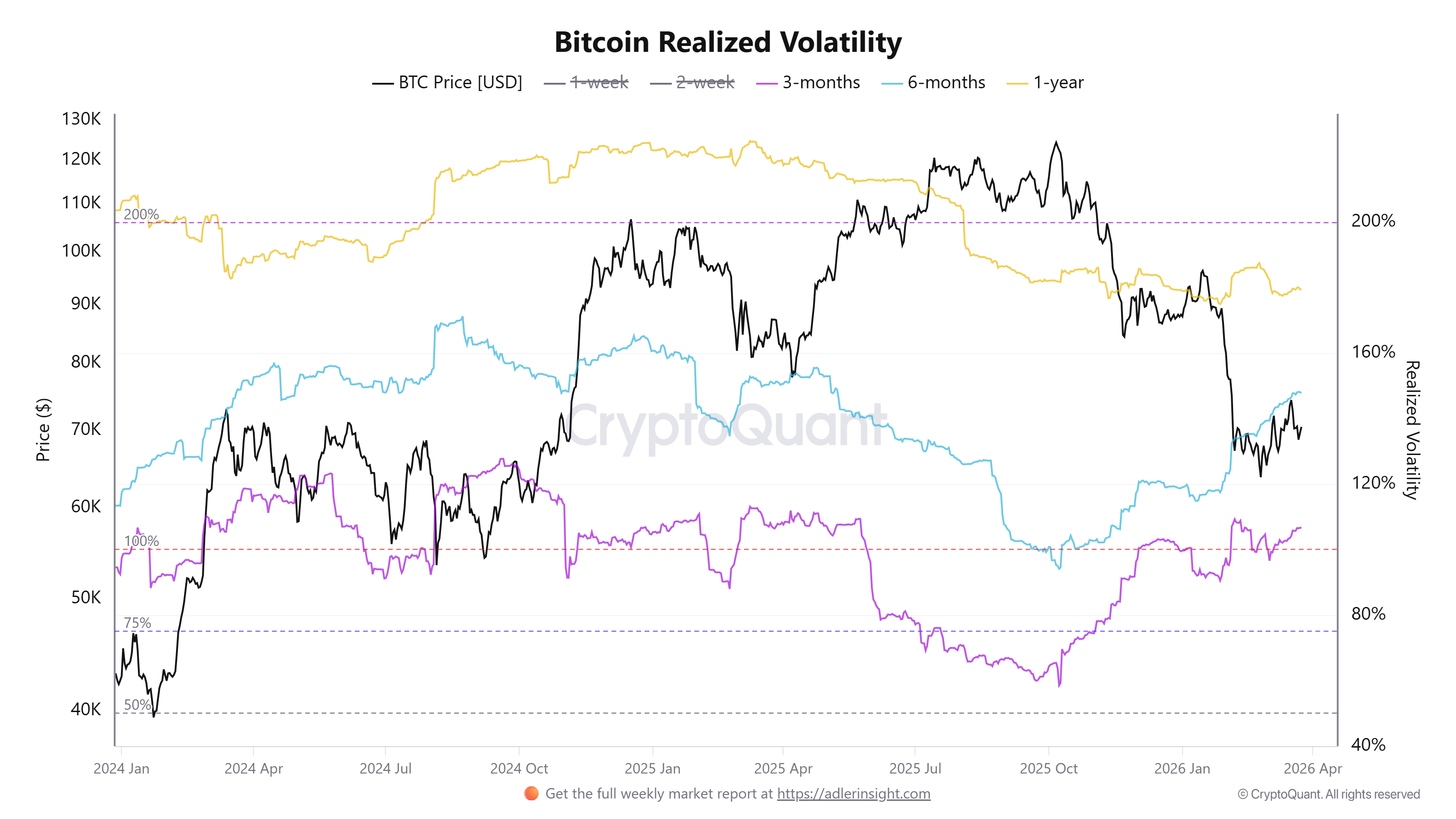
BTC realized volatility. Source: CryptoQuant


However, the long-term one-year realized volatility has remained unchanged near 180% during this period. That suggests the market isn’t in full panic mode, and it is dealing with uncertainty without widespread forced selling.

Stablecoin flows provide important context for this environment. On March 22, the total number of USDC tokens transferred surged to 368 billion, marking a roughly 2,081% daily increase to an all-time high, while USDT transfers on the Ethereum network reached 72 billion.
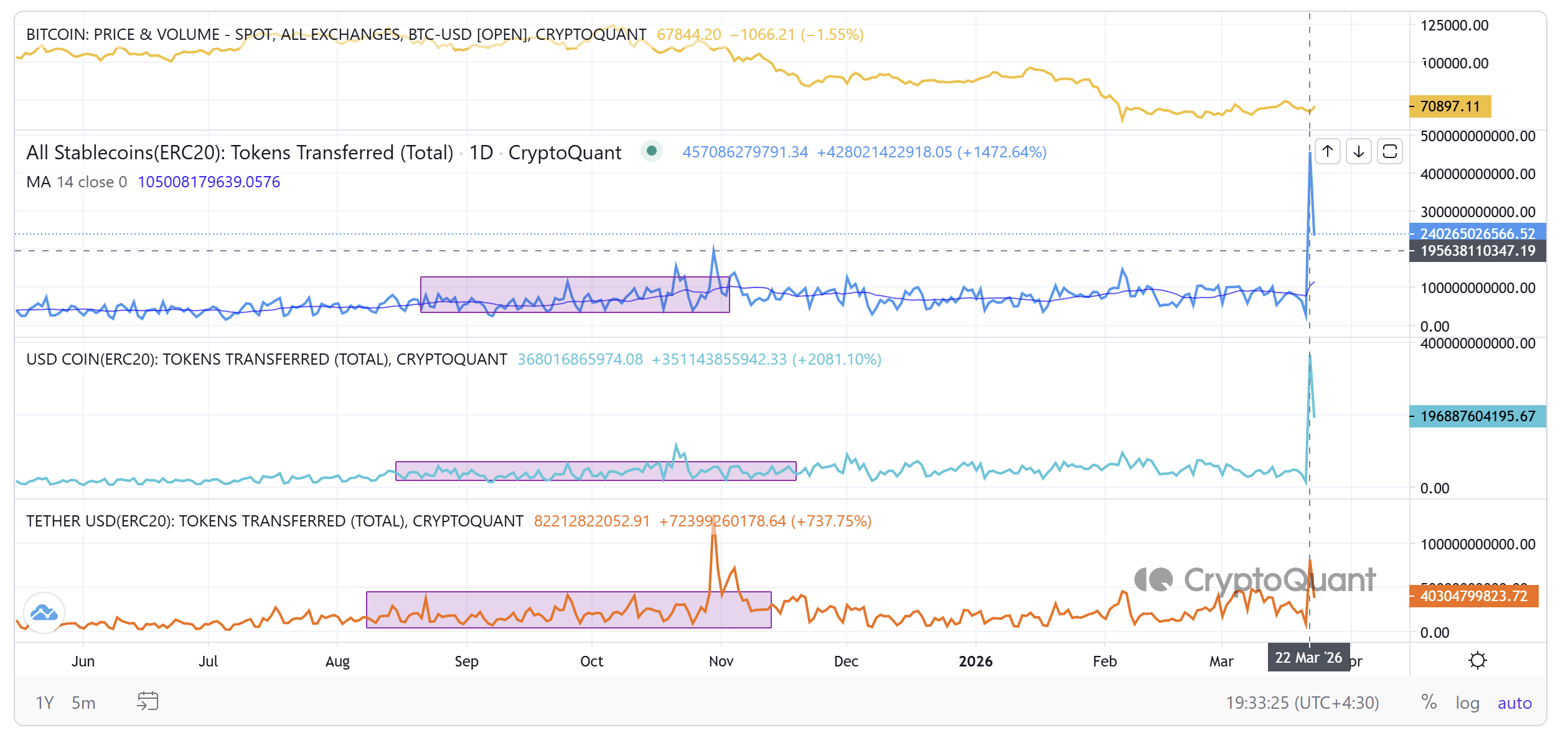
BTC price, USDC, and USDT token transferred chart. Source: CryptoQuant


These stablecoin flows point to a rapid capital rotation and repositioning. The market participants are actively moving funds into stablecoins as a temporary store of value, creating a “cash buffer” that can be redeployed quickly.

This dynamic often emerges in volatile conditions, where traders may prioritize monitoring the price over high exposure.

Spot and futures activity remain below bull market highs

Futures data further reinforces the current sidelined sentiment. BTC open interest (in USD) is down $19 billion over the past six months, indicating a steady reduction in leveraged exposure. This unwind reflects a market that is de-risking rather than building aggressive positions.
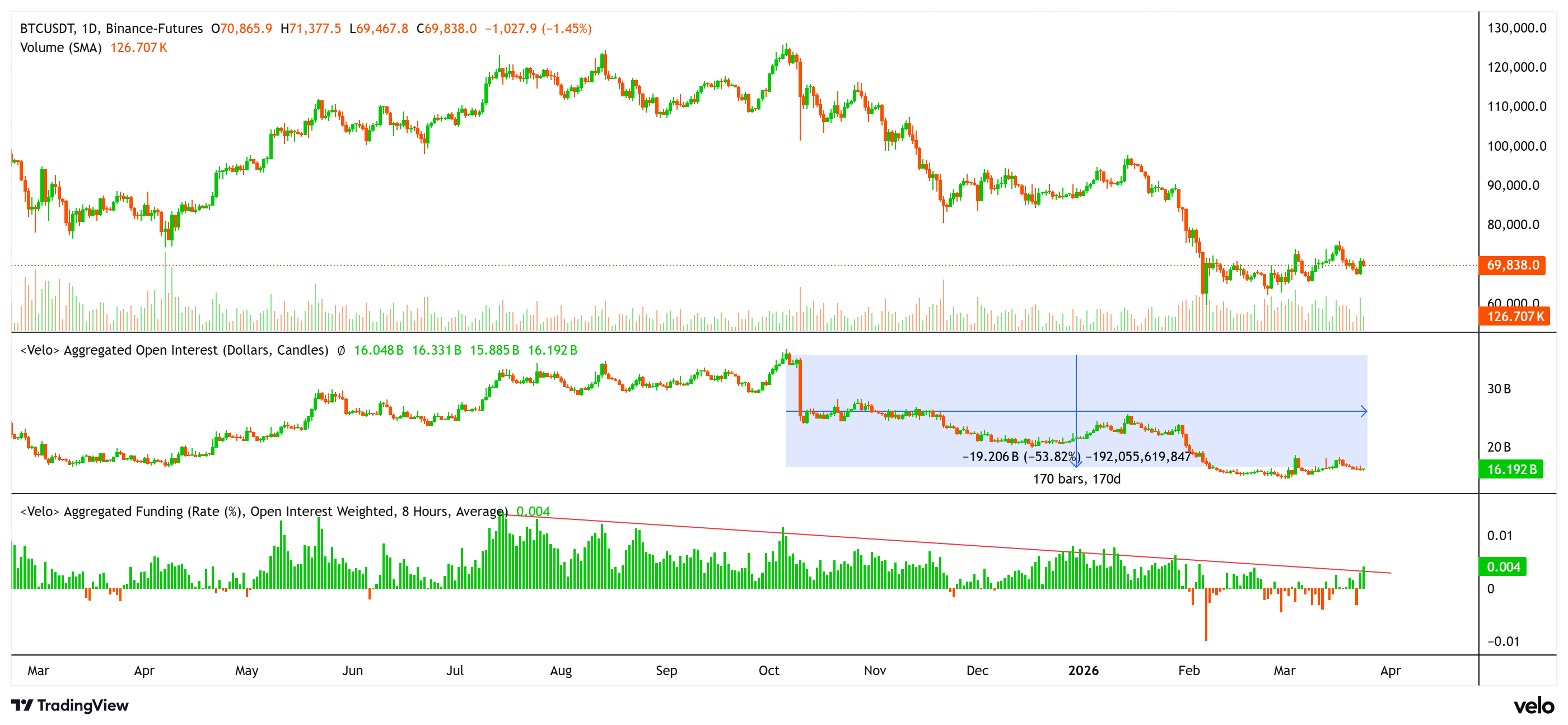
BTCUSDT, aggregated open interest, and funding rate. Source: velo.data


Aggregated funding rates have cooled to 0.01% from overheated levels near 0.1% in July-August 2025, occasionally flipping negative, while the perpetual futures premium continues to trade at a discount to spot.

Together, these signals point to subdued leverage demand and a market lacking strong directional conviction, with a slight bearish tilt.

The spot market activity paints a similar picture. Cointelegraph reported that Binance is on track to record its lowest monthly spot volume since September 2023, with volumes hovering near $52 billion.

The current participation levels align more closely with periods of reduced engagement seen during prior bear market cycles in 2022-2023.

Thus, the crypto market has strong liquidity, with capital actively moving through stablecoins, but it isn’t being deployed into Bitcoin yet, and BTC holders continue to observe the current market.


Comments

All Comments

Recommended for you

  • Rising US treasury yields, war in Iran, rising inflation risk pressure Bitcoin price

    Falling tech stock prices and rising bond yields have forced a rush for cash, preventing Bitcoin from gaining any bullish momentum.

  • Circle taps African fintech Sasai to expand USDC adoption in cross-border payments

    The move aims to integrate the second-biggest dollar-pegged stablecoin into regional payment networks to improve cross-border transactions and remittances.

  • 21shares sees active strategies shaping next phase of crypto ETFs

    21shares president Duncan Moir sees shifting investor demand and evolving product strategies pushing crypto ETFs and ETPs beyond passive exposure.

  • US Spot Bitcoin ETF Sees Net Outflow of $66.71 Million Yesterday

    According to monitoring by Trader T, the US spot Bitcoin ETF experienced a net outflow of $66.71 million yesterday.

  • BTC Surpasses $70,000

    Market data shows that BTC has broken through $70,000, currently trading at $70,011.9. The 24-hour decline has narrowed to 1.11%. The market is experiencing significant volatility, so please implement risk control measures.

  • BTC Drops Below $69,500

    Market data shows that BTC has fallen below $69,500, currently trading at $69,492.81. It has experienced a 2.2% decline in the past 24 hours. The market is experiencing significant volatility, so please implement risk control measures.

  • CLARITY Act Draft: Ban on Stablecoin Yields for Holding Only

    On March 24, according to CoinDesk, cryptocurrency industry practitioners on Monday saw the latest provisions regarding stablecoin yields in the revised version of the Senate's "Digital Asset Market Clarity Act" for the first time during a closed-door review meeting on Capitol Hill in Washington. The initial impression was that the relevant language was too narrow and lacked clarity. This new provision was released last Friday by Senators Angela Alsobrooks and Thom Tillis. According to a person familiar with the current draft, the new provision will prohibit earning yields solely from holding stablecoins, while restricting any practices that equate such programs with bank deposits, and imposing further limitations on other potentially permissible activities. The specific mechanism for determining activity-based stablecoin rewards remains unclear. This compromise stems from the lobbying battle between the crypto and banking industries. The banking industry insists that stablecoin rewards should not resemble interest-bearing bank deposits, arguing that such competing products could harm the banking sector and stifle lending. The final compromise allows for reward programs based on user stablecoin activities but prohibits balance-based rewards. This closed-door review aims to push the Senate Banking Committee to schedule a hearing, a significant step for the bill towards a full Senate vote. Similar versions of the "Clarity Act" have passed the House of Representatives in previous years, and another version has also passed the Senate Agriculture Committee's markup process. The bill's progress still faces other obstacles: all parties still need to reach an agreement on the DeFi regulatory framework, and Democrats are simultaneously insisting on including provisions that prohibit senior government officials from seeking personal gain from the cryptocurrency industry, a clause clearly targeting President Trump. (Dongxin News Agency)

  • Iran's IRGC: All Vessels Must Coordinate Passage Through Strait

    According to Al Jazeera: The Iranian Revolutionary Guard Corps (IRGC) Navy stated that the container ship 'Celine' was forced to leave the area because it did not possess a permit to pass through the Strait of Hormuz. The IRGC Navy further stated that any vessel transiting the Strait of Hormuz must coordinate fully with Iranian maritime authorities. (Jins10)

  • Circle Shares Plunge Over 16%, Hitting Largest Single-Day Drop Since June 2025

    Circle (CRCL) shares fell by more than 16% intraday, marking the largest single-day decline since June 2025. The stock is currently trading at $106.1.

  • BTC Drops Below $70,000

    Market data shows that BTC has fallen below $70,000, currently trading at $69,995.57. The cryptocurrency has seen a 1.86% decrease in the last 24 hours, indicating significant price volatility. Investors are advised to manage their risk accordingly.