


From ecoinometrics
Today we'll cover:
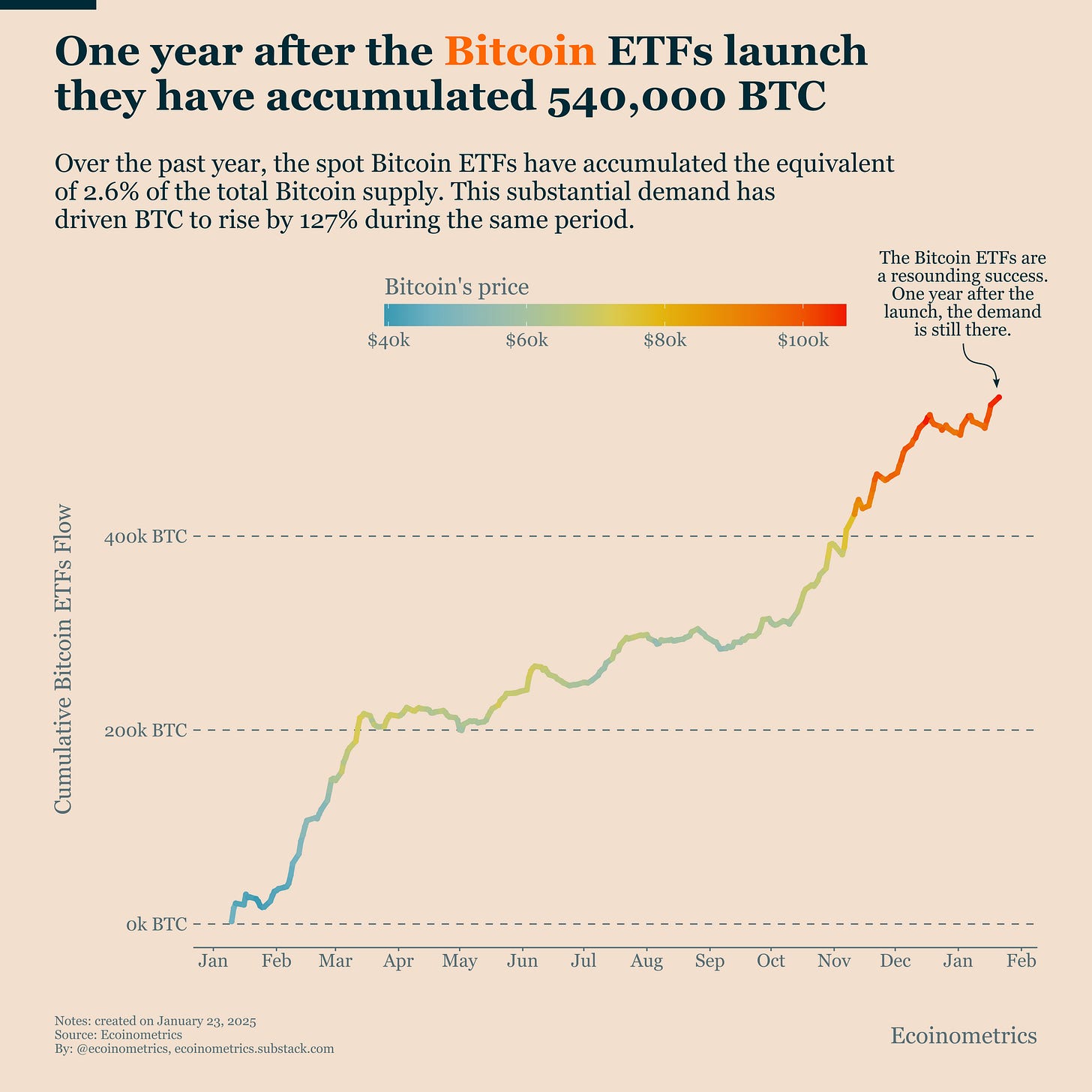
- Bitcoin ETFs: One Year Later
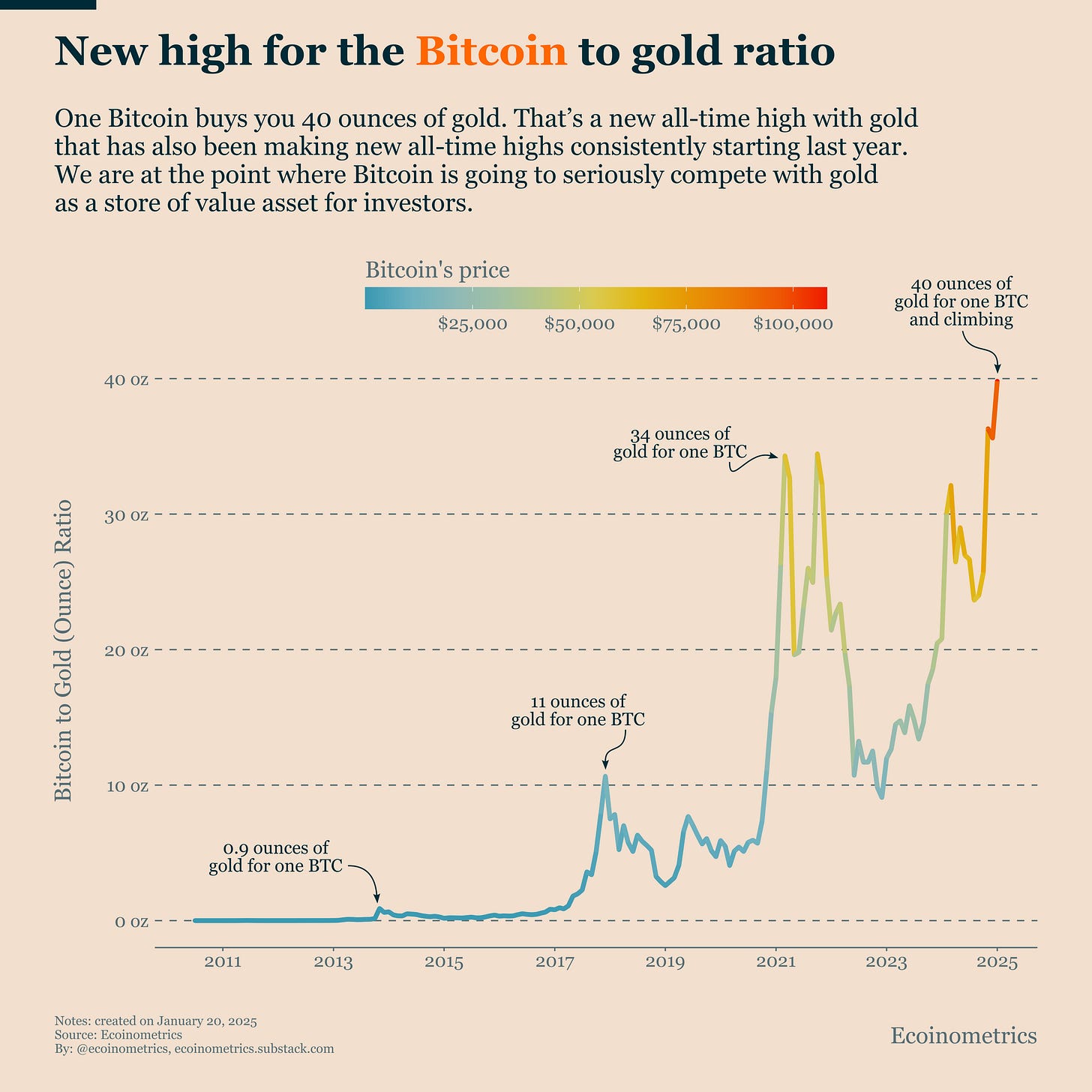
- New High for the Bitcoin to Gold Ratio
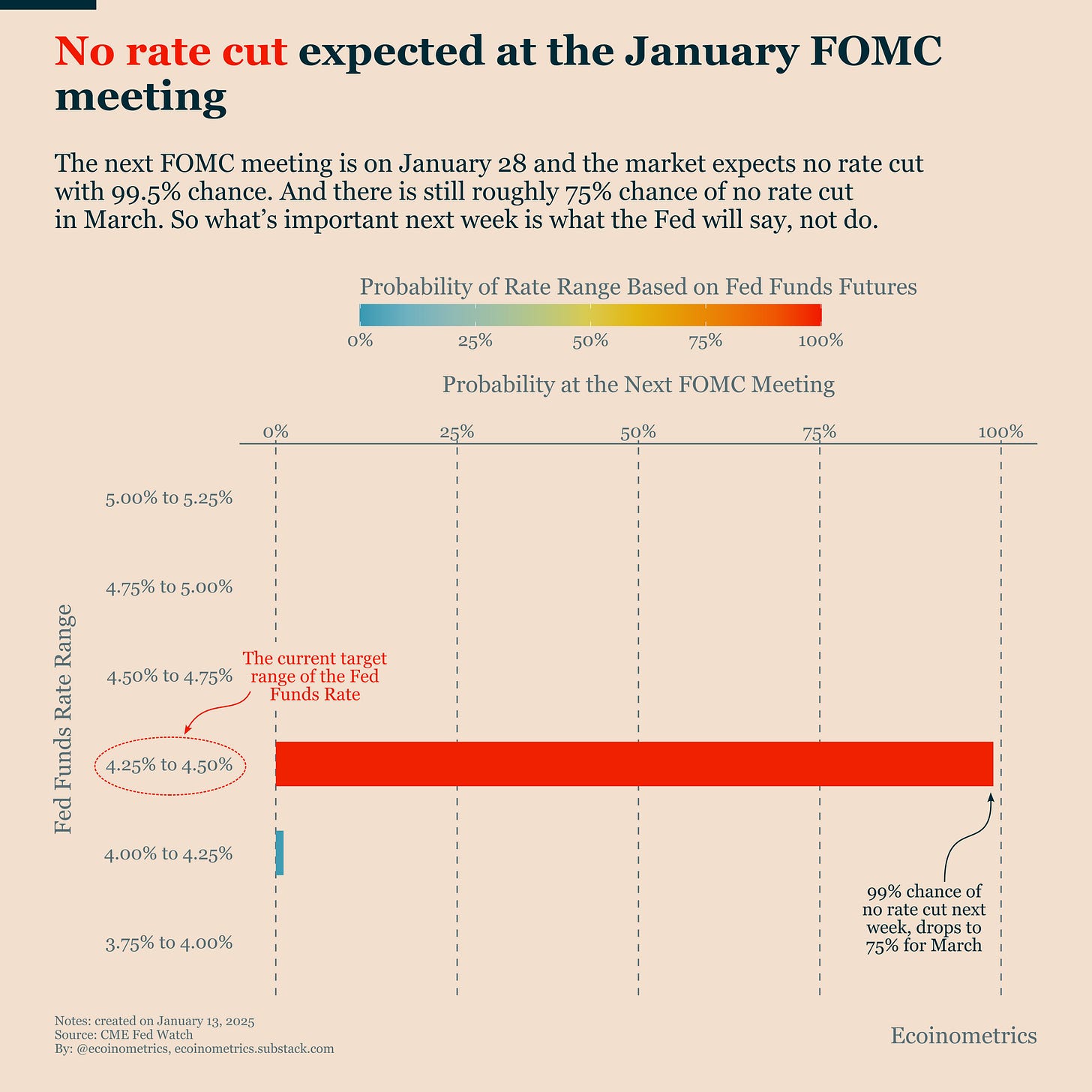
- The Fed's Words vs. Actions
Each topic comes with a small explanation and one big chart. So let’s dive in.
A year ago, skepticism surrounded the launch of spot Bitcoin ETFs.
Critics questioned if there was real demand for these products. They wondered why investors would need ETFs when buying Bitcoin directly was already possible. The target audience wasn't clear.
But the results speak for themselves. These ETFs have been remarkably successful, they accumulated 540,000 Bitcoins in a year, that's 2.6% of Bitcoin's maximum supply.
This strong demand helped push Bitcoin's price up by 127% during the same period. And it's more than just impressive numbers. These ETFs mark a crucial milestone in Bitcoin's path to mainstream acceptance, they are building a bridge between traditional finance and crypto markets.
The reason for their success? Many institutional investors wanted Bitcoin exposure without dealing with direct cryptocurrency ownership. The ETFs provided exactly that.
The timing worked in their favour too with improved market liquidity throughout most of 2024. And the steady accumulation by ETFs has reduced Bitcoin's free float, which certainly helps to amplify price movements.
Could 2025 mirror 2024's success? I’d say signs point to yes. The ETFs haven't seen any extended periods of outflows. Demand has remained consistent, varying only with broader market sentiment.
Recently, Bitcoin dipped along with other risk assets after the latest FOMC meeting. But ETF inflows are showing fresh momentum. This could signal the start of a new upward trend (and you want to get onto those early).
New High for the Bitcoin to Gold Ratio
Another milestone we've long anticipated has finally arrived.
Bitcoin has reached a new high against gold, as it has done in each of the previous market cycles. This week one Bitcoin could buy 40 ounces of gold. That’s a 40-fold increase in just ten years.
Bitcoin's growing scale, combined with the accessibility provided by spot ETFs, puts it in direct competition with gold-backed financial products. We're already seeing investment flows that might have traditionally gone to gold being directed to Bitcoin instead.
This trend could accelerate for gold.
Bitcoin has demonstrated it can deliver higher total returns while maintaining similar risk-adjusted returns as gold. But this competition isn't just about returns, it represents a generational shift in how investors view digital versus physical stores of value. This shift could fundamentally reshape traditional portfolio management.
Most investors typically allocate space for just one store-of-value asset in their portfolios. As younger investors increasingly favour digital assets, Bitcoin is winning this allocation decision over gold more frequently.
The Fed's Words vs. Actions
The Fed won't change rates at next week's FOMC meeting. The market is 99.5% certain of this, and gives a 75% probability of no rate cut in March either.
This extreme certainty about no rate change actually creates more risk, not less. Any surprise deviation from the expected script could trigger outsized market reactions.
So with no immediate action, the Fed's communication is crucial. The Federal Reserve has three key tools to influence the economy and financial markets:
- Adjusting the Fed Funds rate
- Managing their balance sheet through bond transactions
- Communicating about potential policy changes
Don't underestimate that third tool, their words. When the Fed hints at policy changes, institutional investors listen and act. Most prefer to move early rather than risk playing it contrarian.
This matters for Bitcoin because of its strong correlation with the stock market, which reacts sharply to Fed announcements. Whatever message emerges next week will likely impact Bitcoin's price.
If the Fed maintains its current stance and confirms a gradual approach to rate cuts, Bitcoin should remain stable. However, any hints of a more hawkish policy could create headwinds. The FOMC press conference next week will be critical.
That’s it for today. I hope you enjoyed this. We’ll be back next week with more charts.
Cheers,
Nick
P.S. We spend the entire week, countless hours really, doing research, exploring data, surveying emerging trends, looking at charts and making infographics.
Our objective? Deliver to you the most important insights in macroeconomics, Bitcoin and digital assets.
Armed with those insights you can make better investment decisions.



All Comments