

Cointime

Download App
iOS & Android

Bitcoin at $100,000—What’s Next for FinTech's King?

Cointime Official

From financemagnates by Louis Parks
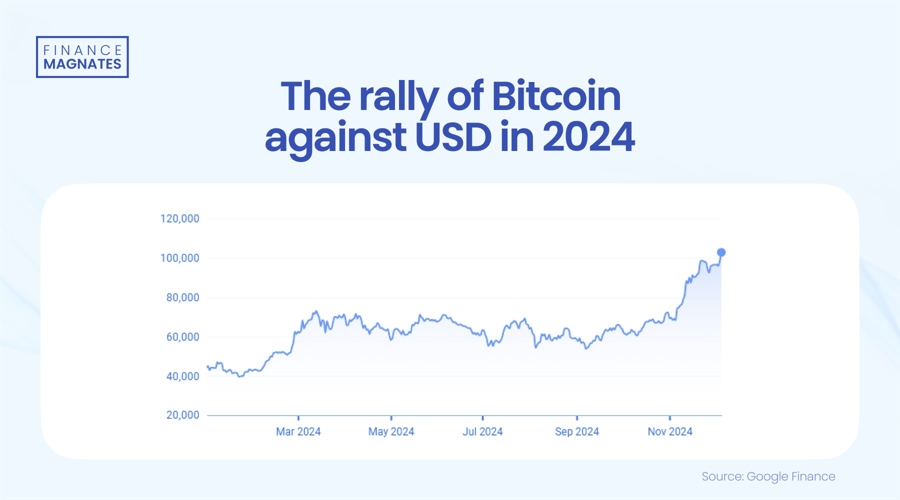
Bitcoin has reached unprecedented levels, but what's next?

Bitcoin has done it. After years of dizzying highs, crushing lows, and endless debates, the world’s leading cryptocurrency has crossed the $100,000 mark.

It’s a monumental achievement for a digital asset once dismissed as a passing trend, but now the big question looms: where does Bitcoin go from here, where does FinTech go from here? Whether you’re an investor, a skeptic, or a curious onlooker, there’s no denying that Bitcoin’s next chapter promises to be just as intriguing as the last.

Bitcoin and FinTech—The Future Looks Bright

According to Petr Kozyakov, co-founder and CEO of Mercuryo, a London-based leading payment infrastructure platform in the digital token space, “Cryptocurrency is destined to reach mass adoption in just the same way as the World Wide Web has today,” he said.

“Bitcoin has entered a new phase of adoption and recognition as a store of value and a transformative asset class,” said Matt Mena, a crypto research strategist at 21Shares. “Bitcoin will maintain its momentum leading into Q1 of 2025, well above the $100K mark,” he went on to say.

$BTC “is emerging as the world’s reserve capital network,” MicroStrategy executive chairman @saylor says, adding: “People are realizing that bitcoin is better than real estate. It’s better than stocks.” pic.twitter.com/i05CXmaMvq

— Yahoo Finance (@YahooFinance)December 5, 2024

“People are realizing that bitcoin is better than real estate. It’s better than stocks,” said Michael Saylor of MicroStrategy.

Institutional Investors: The New Power Players?

With Bitcoin hitting $100,000, institutional investors are stepping in like never before. Hedge funds, wealth managers, and even pension funds are now adding Bitcoin to their portfolios, signaling its evolution from a speculative asset into a financial staple. This institutional embrace lends legitimacy to Bitcoin and could drive its adoption further into the mainstream.

🔊 Bitcoin has catapulted over $100,000 for the first time in a major milestone for the cryptocurrency. Find out more on the Reuters World News podcast https://t.co/CDLSD3V0nW pic.twitter.com/mGH3cIO2Gd

— Reuters (@Reuters)December 5, 2024

However, increased institutional involvement also raises concerns about market manipulation and over-regulation. As traditional finance tightens its grip on crypto, the freewheeling, decentralized ethos that defined Bitcoin’s early days might give way to a more corporate, rule-heavy environment.

Tech Challenges: Scaling for the Future

Bitcoin’s rise has brought its technical limitations into sharp focus. As transaction volumes skyrocket, Bitcoin’s network faces significant scalability issues, with high fees and slow processing times threatening to undermine its usability. Enter the Lightning Network, a second-layer solution designed to make Bitcoin transactions faster and cheaper.

🌩️ The #LightningNetwork is among the most widely adopted real-world crypto payment systems, powering fast, low-cost transactions at 8,000+ merchants globally.Lightning is indispensable as we reshape money movement with PayFi. 🧵 pic.twitter.com/ltGe3qZeHx

— Astra (@Astralabs_LN)December 4, 2024

While promising, these upgrades come with challenges. Some critics argue that Bitcoin’s design is too outdated to compete with newer, faster blockchain technologies like Ethereum and Solana. Others believe Bitcoin doesn’t need to evolve—it just needs to maintain its status as a store of value. The next few years will be critical in determining whether Bitcoin can grow into its role as both a digital asset and a functional currency.

Retail Investors: Hold, Sell, or Double Down?

For retail investors, Bitcoin’s $100,000 milestone is a moment of celebration—and tough decisions. Some early adopters are cashing out, reaping life-changing gains. Others are holding on, convinced that Bitcoin’s journey to $1 million is inevitable. And then there are the new investors, lured by the milestone, who are diving in with dreams of striking it rich.

But history offers a cautionary tale. Bitcoin’s past is littered with dramatic crashes, and the higher the climb, the harder the fall. Retail investors must navigate a volatile market where emotions often overpower logic. For those in the game, tools like crypto wallets and investment platforms are becoming increasingly crucial in managing risk and seizing opportunities.

The Regulatory Landscape: Boom or Bust?

Bitcoin’s rise to $100,000 has caught the attention of regulators worldwide. Governments that once ignored or ridiculed crypto are now scrambling to develop policies to manage its influence. Taxation, anti-money laundering measures, and even outright bans are on the table, depending on the country.

For Bitcoin, the regulatory environment is both a challenge and an opportunity. Clearer rules could encourage more widespread adoption, particularly among institutional investors. But heavy-handed regulation could stifle innovation and limit Bitcoin’s potential to disrupt traditional finance.

The Road Ahead

Bitcoin’s $100,000 milestone isn’t just a number, it’s a statement. It signals the cryptocurrency’s transformation from a niche experiment to a major player in global finance. But, to misquote Stan Lee, with great power comes great uncertainty. Will Bitcoin stabilize as a trusted asset, or will its volatility continue to spark wild market swings? Will new technologies make it more accessible, or will competition from other blockchains erode its dominance?

For now, Bitcoin’s future is a mix of potential and unpredictability amid the FinTech universe. What’s certain is that its journey—from $0 to $100,000 and beyond—is reshaping the financial world, creating opportunities, challenges, and no shortage of drama along the way.


Comments

All Comments

Recommended for you

  • BTC Briefly Drops Below $77,000

    Market data shows that BTC briefly fell below $77,000, currently reported at $77,694, with a 24-hour decline of 3.3%. The market is experiencing significant volatility, so please ensure proper risk management.

  • BTC Briefly Drops Below $77,000

    Market data shows that BTC briefly fell below $77,000, currently reported at $77,694, with a 24-hour decline of 3.3%. The market is experiencing significant fluctuations, so please ensure proper risk management.

  • BTC Falls Below $78,000

    Market data shows that BTC has fallen below $78,000, currently priced at $77,876.01, with a 24-hour decline of 3.1%. The market is experiencing significant volatility, so please ensure proper risk management.

  • Analyst Andrew Sacher: Waller's Remarks Undermine Market Dovish Expectations

    On August 28, analyst Andrew Sacher stated: "Previously, some believed that Federal Reserve Chairman Waller advocated for using alternative inflation measures to select the one most favorable to him. However, in this speech, his approach was quite the opposite. He dissected PCE inflation and found that 49% of its components had an annualized price increase exceeding 3%, categorizing this level as 'quite high.' His discussion on the labor market was also hawkish, focusing on low unemployment rates and initial jobless claims. The usually closely watched non-farm payroll numbers were only briefly mentioned." (Jinshi)

  • Walsh Emphasizes Anti-Inflation Efforts as U.S. Short-Term Treasury Yields Rise

    On August 28, U.S. short-term Treasury yields increased. Federal Reserve Chairman Walsh, in a highly anticipated speech, emphasized the need for the Fed to curb rising consumer prices, alleviating some market concerns about its ability to combat inflation. During Walsh's speech, short-term U.S. Treasuries were sold off while long-term Treasuries rose. The yield on the two-year Treasury increased by 5 basis points to 4.28%, while the 30-year yield fell by 1 basis point to 5.19%. These changes indicate that the market expects the Fed may need to raise short-term rates. Since Walsh's first press conference in June, bond traders have had doubts about his policy stance. At that time, Walsh stressed the need to lower inflation and displayed a hawkish stance. Since the global economy reopened from the pandemic in 2021, U.S. inflation has remained above the Fed's 2% target. However, in July, the Fed kept rates unchanged, and Walsh did not indicate whether a rate hike might occur this year. Subsequently, long-term Treasury yields rose significantly as traders demanded higher returns to compensate for the risks posed by escalating inflation. On Friday, Walsh warned that inflation had not shown meaningful signs of slowing and stated that policymakers must be confident that inflation is improving; otherwise, the central bank 'has work to do.' He also reiterated that policymakers will bring the inflation rate back to the 2% target, emphasizing that this goal is clear and fixed.

  • Walsh Emphasizes Anti-Inflation Efforts as US Short-Term Bond Yields Rise

    On August 28, US short-term Treasury yields increased. Federal Reserve Chairman Walsh, in a highly anticipated speech, emphasized the need for the Fed to curb rising consumer prices, alleviating some market concerns about its ability to combat inflation. During Walsh's speech, short-term US Treasuries were sold off while long-term Treasuries rose. The yield on the two-year Treasury increased by 5 basis points to 4.28%, while the 30-year yield decreased by 1 basis point to 5.19%. These changes indicate that the market expects the Fed may need to raise short-term rates. Since Walsh held his first press conference in June, bond traders have expressed doubts about his policy stance. At that time, Walsh stressed the need to lower inflation and exhibited a hawkish position. Since the global economy reopened from the pandemic in 2021, US inflation has consistently exceeded the Fed's 2% target. However, in July, the Fed maintained interest rates, and Walsh did not indicate whether a rate hike might occur this year. Subsequently, long-term Treasury yields surged as traders demanded higher returns to compensate for the risks posed by rising inflation. Walsh warned on Friday that inflation has not shown meaningful signs of slowing and stated that policymakers must be confident that inflation is improving; otherwise, the central bank 'has work to do.' He also reiterated that policymakers will bring the inflation rate back to the 2% target, emphasizing that this goal is clear and fixed.

  • ETH Surpasses $2500

    Market data shows that ETH has surpassed $2500, currently priced at $2500.8, with a 24-hour decline of 0.21%. The market is experiencing significant volatility, so please ensure proper risk management.

  • ETH Surpasses $2500

    Market data shows that ETH has surpassed $2500, currently priced at $2500.8, with a 24-hour decline of 0.21%. The market is experiencing significant volatility, so please ensure proper risk management.

  • Waller Signals Hawkish Stance, Sees No Restrictive Financial Conditions

    On August 28, in a speech that was more hawkish than many market participants expected, Federal Reserve Chairman Kevin Waller cited a series of indicators showing a strong economic condition, including high corporate profits, stable consumer spending, and narrowing credit spreads. Waller stated, "In my view, the credit and loan markets show almost no signs that monetary policy is becoming restrictive. Overall, I find it difficult to describe the current overall financial conditions as restrictive." This statement boosted Wall Street's bets on interest rate hikes by the Federal Reserve.

  • Waller Signals Hawkish Stance, Sees No Restrictive Financial Conditions

    On August 28, in a speech that was more hawkish than many market participants expected, Federal Reserve Chairman Kevin Waller cited a series of indicators showing a strong economic condition, including high corporate profits, stable consumer spending, and narrowing credit spreads. Waller stated, "In my view, the credit and loan markets show almost no signs that monetary policy is becoming restrictive. Overall, I find it difficult to describe the current overall financial conditions as restrictive." This statement boosted Wall Street's bets on a rate hike by the Federal Reserve.