

Cointime

Download App
iOS & Android

Bitcoin analysts target $95K as Trump’s trade war cools — Do BTC futures agree?

Bitcoin surged to a 45-day high above $91,000 on April 22, and the upward movement coincided with gold reaching a new all-time high. The price gains reflect investors' concerns over a potential economic recession amid ongoing global trade tensions.

The tides are shifting, but does data support a Bitcoin price rally above $95,000?

In neutral markets, the Bitcoin futures premium typically ranges between 5% and 10% to compensate for the longer settlement period. At present, the annualized premium stands at 6%, which is not considered particularly bullish, even though BTC appreciated by $6,840 between April 20 and April 22. Some analysts interpret this as a sign that Bitcoin is beginning to decouple from the stock market.

Traders’ PTSD could emerge around BTC’s $90K zone

Part of this skepticism among traders stems from Bitcoin’s repeated inability to sustain levels above $90,000 in early March. For example, Bitcoin tested the $95,000 mark on March 3, only to fall to $81,464 the following day. This inconsistent performance since the $109,346 peak on Jan. 20 has contributed to a lack of conviction among bullish investors, especially as gold has continued to set new all-time highs during the same period.

Currently, Bitcoin is trading 16% below its all-time high, a figure that closely mirrors the S&P 500’s decline of 14.5%. This suggests that the recent era of excessive risk-taking may be behind us. Notably, even at its lowest point below $75,000, Bitcoin’s 32% drawdown was less severe than those experienced by Nvidia (NVDA), Amazon (AMZN), Facebook (META), and Tesla (TSLA).

Comments from US Treasury Secretary Scott Bessent on April 22 contributed to easing investor concerns. As reported by Bloomberg, Bessent described the ongoing tariff standoff with China as “unsustainable,” suggesting an increased likelihood of de-escalation. In contrast, US President Donald Trump took to social media to assert that US Federal Reserve Chair Jerome Powell is hindering economic growth by not reducing interest rates.

Bitcoin’s gains contrast with investors’ shift to government bonds

Regardless of where the blame lies for the subdued economic growth in the United States, demand for short-term US Treasurys has risen, as evidenced by the yield on the 2-year note declining to 3.81% from 4.04% a month earlier. Essentially, investors are accepting lower returns in exchange for the perceived safety of government bonds. Against this backdrop, Bitcoin’s 6.3% price increase over the past 30 days stands out as particularly notable.

To determine whether these recent gains have affected professional traders’ sentiment, it is important to examine the BTC options markets. If traders expect a correction, put (sell) options tend to trade at a premium, causing the 25% delta skew metric to rise above 6%. Conversely, bullish sentiment pushes the indicator below -6%.
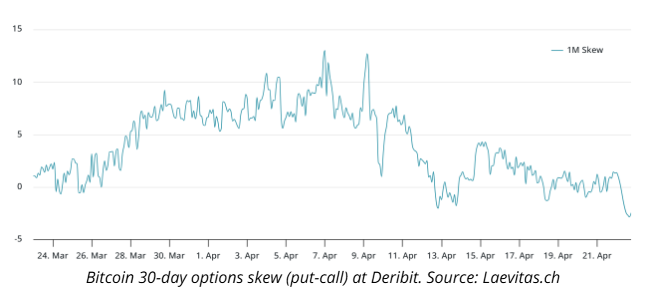
Currently, the Bitcoin options market reflects limited enthusiasm following the recent surge to $91,000, with the 25% delta skew indicator at -2%, which remains within the neutral range. According to this metric, the last period of bullish sentiment occurred on Jan. 30, when Bitcoin traded near $105,000. Therefore, there is no clear evidence that large investors or market makers are anticipating a sustained rally above $95,000.

Despite some weak macroeconomic data, market participants expect a relatively strong first-quarter earnings season. FactSet reports that the “Magnificent 7” companies are projected to achieve earnings growth of 14.8% for the first quarter compared to the prior year.

While Bitcoin still has a reasonable chance of revisiting $95,000 or higher, many traders appear to be waiting for further developments in the US-China trade war before placing additional bullish bets.


Comments

All Comments

Recommended for you

  • Iran Announces Escalation of Strikes in Response to U.S. Attacks

    On September 10, it was reported that an Iranian official stated that Tehran is prepared to engage in a more intense conflict with the United States if necessary. The official indicated that Iran would respond to U.S. attacks with escalated strikes. Iran views this conflict as a 'battle for survival.' The official remarked that Iran has 'no choice but to fight.'

  • Iran to Intensify Strikes in Response to U.S. Attacks

    On September 10, it was reported that an Iranian official stated that Tehran is prepared to engage in a more intense war with the United States if necessary. The official indicated that Iran will escalate its strikes in response to U.S. attacks, viewing this conflict as a 'battle for survival.' The official remarked that Iran has 'no choice but to fight.'

  • U.S. Treasury Announces Debt Buyback Size: Up to $6 Billion

    On September 9, the U.S. Treasury will buy back up to $6 billion in long-term bonds on Thursday. Previously, the U.S. Treasury indicated that before November 4, the size of a single long-term bond buyback would at least double to $4 billion.

  • U.S. Treasury Announces Debt Buyback Size: Up to $6 Billion

    On September 9, the U.S. Treasury will buy back up to $6 billion in long-term bonds on Thursday. Previously, the U.S. Treasury stated that before November 4, the size of a single long-term bond buyback would at least double to $4 billion.

  • Bank of America Reports Sixth Largest Weekly Inflow into US Stocks Since 2008, Driven by Institutions and Hedge Funds

    Data from Bank of America shows that last week, the US stock market recorded its sixth largest weekly inflow since 2008, marking the largest scale since mid-July. Bank of America strategist Jill Carey Hall noted that this round of inflows was primarily driven by institutional investors and hedge fund clients, with net purchases of US stocks for the second consecutive week. The funds mainly flowed into individual stocks and equity ETFs. In terms of sectors, 8 out of the 11 sectors in the S&P 500 saw net inflows, with the technology sector leading the gains, and the communication services sector receiving inflows for the first time in five weeks. The industrial sector experienced the largest outflow, facing selling pressure for the fifth consecutive week, with Hall stating that this sector is the most competitive and has the highest costs. In terms of stock preferences, clients favored large and mid-cap stocks while selling small-cap stocks. In contrast to professional institutions, retail clients have been net sellers of stocks for six consecutive weeks.

  • Bank of America Reports Sixth Largest Weekly Inflow into US Stocks Since 2008, Driven by Institutions and Hedge Funds

    Bank of America data shows that last week the US stock market recorded its sixth largest weekly inflow since 2008, marking the largest scale since mid-July. BofA strategist Jill Carey Hall noted that this round of inflows was primarily driven by institutional investors and hedge fund clients, with net buying of US stocks for the second consecutive week, focusing mainly on individual stocks and equity ETFs. In terms of sectors, 8 out of the 11 sectors in the S&P 500 saw net inflows, with the technology sector leading the gains, while the communication services sector recorded its first inflow in five weeks. The industrial sector experienced the largest outflow, facing selling for the fifth consecutive week, with Hall stating that this sector is the most competitive and has the highest costs. In terms of stock preferences, clients favored large and mid-cap stocks while selling small-cap stocks. In contrast to professional institutions, private clients have been net sellers of stocks for the sixth consecutive week.

  • U.S. Department of Justice and Treasury Target Xinbi, Seizing $52 Million in Crypto Assets

    On September 9, the U.S. Department of Justice and the Treasury took law enforcement action against the illegal scam service market Xinbi, seizing and restricting the disposal of over $52 million in cryptocurrency assets. This brings the total assets restricted by the task force to approximately $938 million. Tether assisted in the investigation. The Justice Department accused Xinbi of operating via Telegram, providing investment scam websites and money laundering services to scam groups. Law enforcement has seized its Telegram channel and two wallets holding about $12 million in cryptocurrency, and restricted the disposal of an additional 47 related wallets. The U.S. Treasury's Office of Foreign Assets Control has designated Xinbi as a significant transnational criminal organization and sanctioned two related entities. The task force also assisted Madagascar in shutting down 13 scam hubs, processing over 3,200 electronic devices, and arresting nearly 400 individuals.

  • U.S. DOJ and Treasury Target Xinbi, Seizing $52 Million in Crypto Assets

    On September 9, the U.S. Department of Justice (DOJ) and the Department of the Treasury took enforcement action against the illegal scam service market Xinbi, seizing and restricting the disposal of over $52 million in crypto assets. This brings the total assets restricted by the task force to approximately $938 million. Tether assisted in the investigation. The DOJ accused Xinbi of operating through Telegram, providing investment scam websites and money laundering services for fraud rings. Law enforcement has seized its Telegram channel and two crypto wallets holding about $12 million, while also restricting the disposal of an additional 47 related wallets. The Treasury Department's Office of Foreign Assets Control has designated Xinbi as a significant transnational criminal organization and sanctioned two related entities. The task force also assisted Madagascar in shutting down 13 scam hubs, processing over 3,200 electronic devices, and arresting nearly 400 individuals.

  • Philadelphia Semiconductor Index Rises Over 1%

    On September 9, the Philadelphia Semiconductor Index surged, currently up over 1%. Among the constituent stocks, Marvell Technology and Astera Labs rose over 6%, while Arm, Micron Technology, Coherent, and AMD all increased by more than 3%. Qualcomm gained nearly 2%, and ON Semiconductor rose over 1%.

  • Dell Surges Over 5%, Hits New All-Time High with 347% Year-to-Date Increase

    On September 9, Dell Technologies (DELL.US) rose over 5%, reaching $562.99 and setting a new all-time high. The company's market capitalization reached $358 billion, with a year-to-date increase of 347%.