

Cointime

Download App
iOS & Android

‘Avoidable errors’ wiped a year’s worth of Gary Gensler’s texts... oops

Validated Individual Expert

A Securities and Exchange Commission investigation into missing text messages from former chair Gary Gensler’s phone between October 2022 and September 2023 has concluded that “avoidable errors” led to their loss. 

The SEC Office of Inspector General (OIG) investigated how nearly a year’s worth of text messages from Gary Gensler were permanently lost between October 2022 and September 2023, during the height of the agency’s crypto enforcement action campaign.

In a report released on Wednesday, the OIG revealed that the SEC’s IT department “implemented a poorly understood and automated policy that caused an enterprise wipe of Gensler’s government-issued mobile device,” which deleted stored text messages and operating system logs.  

The loss was worsened by poor change management, lack of proper backups, ignored system alerts and unaddressed vendor software flaws.

The IT department failed to collect or maintain necessary log data, which is why the commission could not determine why Gensler’s smartphone stopped communicating with the SEC’s mobile device management system.
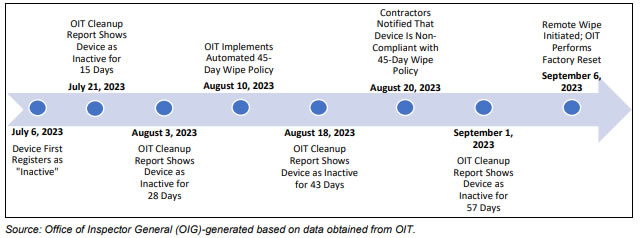
Timeline of events leading to the loss of Gensler’s text messages. Source: SEC


Key communications about crypto enforcement actions were lost 

The OIG found that some of Gensler’s deleted texts involved SEC enforcement actions against crypto companies and their founders, meaning that key communications about how and when the SEC pursued cases may never be fully known, even to courts, Congress or the public.

Investigators reviewed about 1,500 messages recovered from colleagues and other records. They determined that the majority were federal records, with around 38% of the recovered text conversations “mission related” concerning matters directly involving SEC senior staff at the time, such as: 

“A May 2023 conversation involving Gensler, his staff, and the Director of the Division of Enforcement about when the SEC would be filing an action against certain crypto asset trading platforms and their founder.”

SEC crackdown on recordkeeping 

Around the same time that Gensler’s messages were disappearing into a black hole, the SEC cracked down on the use of messaging apps. Several global investment banking and financial institutions were charged with violating record-keeping and books-and-records laws under the 1934 Securities and Exchange Act. 

“Finance, ultimately, depends on trust. By failing to honor their recordkeeping and books-and-records obligations, the market participants we have charged today have failed to maintain that trust,” said Gensler at the time. 

Undermining transparency in crypto decisions

The SEC has since disabled text messaging on most devices, notified the National Archives and Records Administration of lost records, introduced Capstone-specific records training for senior officials, and started improving backup practices for senior officials’ devices.

“The loss of Gensler’s text messages may impact the SEC’s response to certain Freedom of Information Act requests,” it stated. 

Gensler, who stepped down in January, was infamous in the crypto community for his bait-and-switch offer to “come in and get registered,” which pre-empted multiple SEC actions against companies that claimed they tried to do exactly that. Enforcement actions against crypto companies reached a 10-year high in 2023.  

“Think about everything that happened in crypto during this time. Basically, FTX collapse through the Grayscale spot BTC ETF lawsuit,” observed NovaDius Wealth Management President Nate Geraci, who added“makes you think.”

“So Gary Gensler’s text messages from his tenure as SEC chairman are forever lost in a mysterious ‘boating accident’ ???,” quipped Custodia Bank founder Caitlin Long. 

Comments

All Comments

Recommended for you

  • The Bank of Japan is reportedly planning further interest rate hikes; some officials believe the neutral interest rate will be higher than 1%.

    according to insiders, Bank of Japan officials believe that before the current rate hike cycle ends, interest rates are likely to rise above 0.75%, indicating that there may be more rate hikes after next week's increase. These insiders said that officials believe that even if rates rise to 0.75%, the Bank of Japan has not yet reached the neutral interest rate level. Some officials already consider 1% to still be below the neutral interest rate level. Insiders stated that even if the Bank of Japan updates its neutral rate estimates based on the latest data, it currently does not believe that this range will significantly narrow. Currently, the Bank of Japan's estimate for the nominal neutral interest rate range is about 1% to 2.5%. Insiders said that Bank of Japan officials also believe there may be errors in the upper and lower limits of this range itself. (Golden Ten)

  • OKX: Platform users can earn up to 4.10% annualized return by holding USDG.

    According to the official announcement, from 00:00 on December 11, 2025 to 00:00 on January 11, 2026 (UTC+8), users holding USDG in their OKX funding, trading, and lending accounts can automatically earn an annualized yield of up to 4.10% provided by the OKX platform, with the ability to withdraw or use it at any time, allowing both trading and wealth management simultaneously. Users can check their earnings anytime through the OKX APP (version 6.136.10 and above) - Assets - by clicking on USDG. Moving forward, the platform will continue to expand the application of USDG in more trading and wealth management scenarios.

  • The Federal Reserve will begin its Reserve Management Purchase (RMP) program today, purchasing $40 billion in Treasury bonds per month.

     according to the Federal Reserve Open Market Committee's decision on December 10, the Federal Reserve will start implementing the Reserve Management Purchase (RMP) program from December 12, purchasing a total of $40 billion in short-term Treasury securities in the secondary market.

  • Bitcoin treasury company Strategy's daily transaction volume has now surpassed that of payment giant Visa.

    according to market sources: the daily trading volume of Bitcoin treasury company Strategy (MSTR) has now surpassed the payment giant Visa.

  • The US spot Bitcoin ETF saw a net outflow of $78.35 million yesterday.

    according to Trader T's monitoring, the US spot Bitcoin ETF had a net outflow of $78.35 million yesterday.

  • JPMorgan Chase issues Galaxy short-term bonds on Solana network

     JPMorgan arranged and created, distributed, and settled a short-term bond on the Solana blockchain for Galaxy Digital Holdings LP, as part of efforts to enhance financial market efficiency using underlying cryptocurrency technology.

  • HSBC expects the Federal Reserve to refrain from cutting interest rates for the next two years.

    HSBC Securities predicts the Federal Reserve will maintain interest rates stable at the 3.5%-3.75% range set on Wednesday for the next two years. Previously, Federal Reserve policymakers lowered rates by 25 basis points with a split vote. The institution's U.S. economist Ryan Wang pointed out in a report on December 10 that Federal Reserve Chairman Jerome Powell was "open to the question of whether and when to further cut rates at next year's FOMC press conference." "We believe the FOMC will keep the federal funds rate target range unchanged at 3.50%-3.75% throughout 2026 and 2027, but as the economy evolves, as in the past, it is always necessary to pay close attention to the significant two-way risks facing this outlook."

  • Institution: US AI companies face power pressures that will drive up operating costs.

    Benjamin Melman, Chief Investment Officer of asset management company Edmond de Rothschild, pointed out that American artificial intelligence companies are facing intense competition in terms of electricity costs. He stated that the current power capacity in the U.S. is insufficient to meet the growing demand of AI companies, and electricity prices are significantly higher compared to other countries. "The U.S. faces intense competition in electricity costs, which will drive up the operating costs of AI."

  • Institutions: The US dollar may face further pressure next year, with AI bubble and interest rate outlook being key risks.

    Benjamin Melman, CEO of asset management company Edmond de Rothschild, stated that the US dollar may face downside risks again next year. "If the market worries again about US interest rates or if the artificial intelligence bubble suddenly bursts, the US dollar will be at risk." With the Federal Reserve cutting interest rates, the US dollar has continued to weaken this year. The US Dollar Index (DXY) recently fell 0.05% to 98.59. In mid-September, the index hit a three-and-a-half-year low of 96.218.
