


Web3 is booming, and Arweave is becoming a popular infrastructure choice for developers. PermaDAO is a community where everyone can contribute to the Arweave ecosystem. It's a place to propose and tackle tasks related to Arweave, with the support and feedback of the entire community. Join PermaDAO and help shape Web3!
Author: Spike @ Contributor of PermaDAO
Translator: Spike @ Contributor of PermaDAO
Reviewer: Kyle @ Contributor of PermaDAO
- There are actually two steps to on-chain NFTs. The first step is to write the metadata information and the issuer into the blockchain block in the form of smart contracts, but there are generally three options for actual material storage: Decentralized storage service providers such as IPFS/ Arweave, centralized storage providers such as Amazon cloud, and the third is on-chain storage such as Bitcoin and Ethereum.
- NFT projects reject on-chain storage for the following three reasons: first, on-chain storage is too expensive; The second is that on-chain storage is inefficient to read and is not friendly to ordinary users. The third is that AR and other service providers are still not accepted by the market.
- At present, there are two mainstream on-chain storage solutions, one is ordinals protocol on Bitcoin, which stores NFT data, and the other is a lot of ERC protocols on Ethereum, such as ERC-721, ERC-1155, and a dedicated data storage solution EthStorage.
- Another obstacle to on-chain NFT assets is the capacity constraints of Bitcoin and Ethereum, ordinals can write up to 4MB of data. Ethereum is also difficult to support cheap large-scale use of audio and video. IPFS, Arweave and other networks do not have capacity constraints. Arweave, in particular, has an incentive mechanism for miners to store audio and video.
- In addition, Arweave also provides a real more than on-chain NFT storage solution - Atomic asset, which can also perform complex editing, transfer, and cutting operations while retaining the characteristics of on-chain storage.
- At present, there is also a problem of low market recognition of atomic assets on Arweave. The main reason is that the Bitcoin and Ethereum communities are worried about using Arweave for storage, and whether they can answer the legitimacy question of on-chain storage instead of on-chain storage.
- In view of the current situation of low acceptance of Arweave by other ecosystems, with the support of Arweave ecosystem, BazAR, an NFT trading market based on the content capitalization on Arweave chain, has been launched, which can integrate the underlying technologies such as $U and UDL.
- Arweave's atomic asset feature, in fact, contains the ability to further promote to any Token. It is fully possible to integrate real assets and external chain assets into Arweave and use it as a unified RWA (real asset on-chain).
- Atomic assets on Arweave originate from solving the problem of Fully on-chain of NFT, but in the process, it gradually deeps into how to rewrite the creator economy from the underlying principle. The existing creator economy, especially the hype of NFT focusing on PFP images, After Auzuki has fallen into a dead end, and the activation of more creators to join is the main theme of the competition in the next era.
- In a word, Musk's discussion on NFT chain proves that NFT has been concerned by the mainstream vision, but since then, Arweave's many solutions have not been paid equal attention, especially the empowerment of atomic assets to the creator economy.
Foreword
Recently, Musk unexpectedly mentioned NFT when he was an guest on a podcast. Unlike ordinary people, Musk pointed out the biggest problem of NFT from the technical aspect - most of the material is not stored on the chain.
In a dark sense of humor, the long-dormant NFT market has come alive again since Azuki, with ordinals on Bitcoin and atomic asset features on Arweave all joining the conversation.
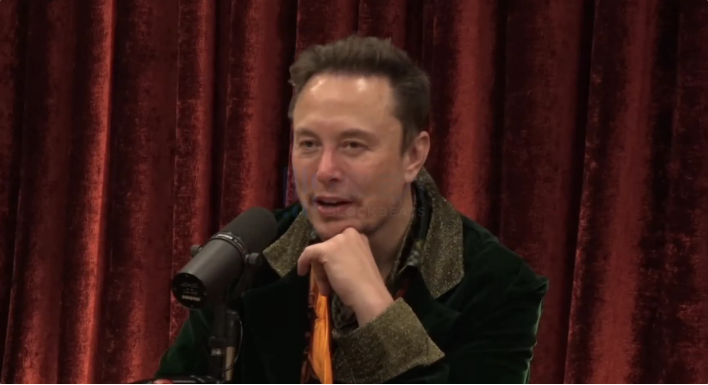
This shows that NFT has the possibility of re-active, and even people are guessing whether Musk will enter the NFT, just like his popularity of Bitcoin and Dogcoin. It can only be said that everything is possible. What if Musk buys NFT earlier than BTC spot ETF?
NFT Onchain: Three Options for Metadata Storage
With the rise of NFTs (non-fungible tokens), metadata storage has become a critical issue.
In the process of putting an NFT on the blockchain, we need to write its metadata information and issuer information into the blockchain in the form of smart contracts, but there are many options for storing the material itself. This section describes three options for on-chain NFT metadata storage: decentralized storage providers (e.g., IPFS and Arweave), centralized storage providers (e.g., Amazon Cloud), and on-chain storage (e.g., Bitcoin and Ethereum).
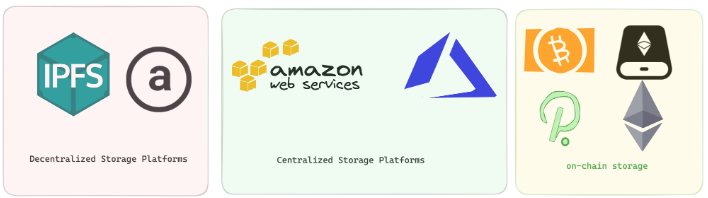
With the popularity of NFTs, more and more digital content is being converted into unique non-fungible tokens, traded and transferred on-chain through blockchain technology. There are two key steps in the process of putting an NFT on the blockchain: writing the metadata and issuer information into the blockchain, and choosing the appropriate storage method to preserve the material itself.
For the first step, smart contracts can be used to write the metadata information and issuer information of the NFT into the block of the blockchain. This metadata includes but is not limited to: the name of the work, description, image or audio/video link, release time, creator information, etc. By writing this information into the blockchain, NFTs can be ensured to be tamper-resistant and traceable.
While for the second step, there are three options for the actual material storage:
- Decentralized storage providers: IPFS/Arweave, etc.Decentralized storage providers such as IPFS/Arweave use a distributed network to store NFT assets. IPFS (Inter Planetary File System) and Arweave are two common decentralized storage providers. IPFS uses a Distributed Hash table (DHT) to store files, and retrieves and verifies the integrity of files by their Hash value (CID). This method has a high degree of decentralization and anti-censorship ability, so that NFT material files can be stored for a longer time, and is not easily limited by centralized storage service providers.
- Centralized storage providers: Amazon Cloud, etc.Centralized storage providers use centralized servers to store NFT footage. One common centralized storage provider is the Amazon cloud, which has high availability and reliability and offers various storage service options. Choosing a centralized storage provider can result in higher performance and stability, with some centralization risk.
- On-chain storage: Bitcoin, Ethereum, etc.On-chain storage refers to storing NFT's material files directly on the blockchain. For example, Ethereum's smart contract can achieve on-chain storage by storing the hash value of the material file on the blockchain. This method has the highest security and reliability, but it will also increase the storage burden and transaction cost of the blockchain.
The onboarding process of NFTs includes writing metadata and issuer information to the blockchain, as well as choosing a suitable storage method to store the material itself. For metadata storage, smart contracts can be used to write it to the blockchain. For material storage, you can choose a decentralized storage service provider, a centralized storage provider, or on-chain storage. Choosing an appropriate storage method should consider factors such as decentralization degree, security, availability, reliability, storage capacity, and cost. In this way, the integrity and sustainability of NFTs can be ensured, and better support for the protection and trading of digital assets can be provided.
However, in practice, most NFTs tacitly choose to reject on-chain storage, and the reasons can be concentrated in three aspects: high price, low reading efficiency, and low market acceptance. Especially after the dense casting of crypto-cats caused the congestion of Ethereum, the subsequent NFT projects all chose centralized servers or decentralized servers for storage, and rarely chose Ethereum itself for storage.
First, it is expensive: the high cost of on-chain storage is one of the main reasons why NFT projects choose to exclude. On-chain storage requires the purchase of sufficient storage space, and storage fees are usually high due to the public nature of blockchains. For small or start-up NFT projects, on-chain storage fees may be too expensive and exceed the project budget, so alternative storage schemes are chosen.
According to Ethereum storage project EthStoarge, "If everything was stored on-chain, the cost would be very high -- for example, Storing 1GB of data using Sstores would cost 1GB / 32 (bytes per SSTORE) * 20,000 (gas per SSTORE) * 10e9 (gas price) / 1e18 (Gwei to ETH) * 1,500 (ETH) Price) = $10 million! Even if using contract code can reduce the cost to 1/3, it's still much more expensive than other storage solutions (like S3/FILECOIN/AR/ etc.)."
In addition, due to the limited block space, Ethereum itself has limited support for high-quality images, audio and video materials, and its in-block storage cost will increase exponentially with the growth of data volume, exceeding the acceptable cost of existing projects, which restricts the development of other kinds of NFT art forms other than PFP, such as painting and music.
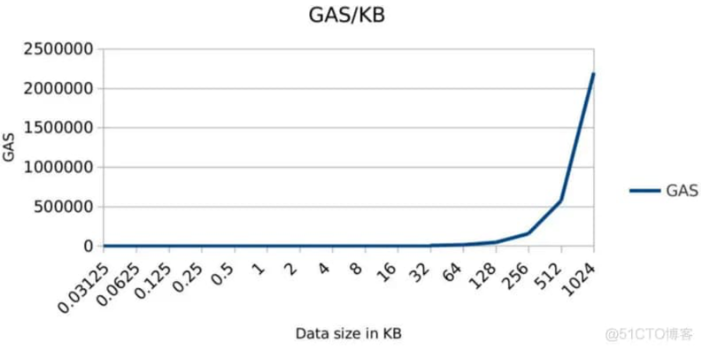
Mage caption: Ethereum storage cost curve
Photo credit: https://blog.51cto.com/u_15127612/4670539
Second, read inefficiency: on-chain storage is relatively inefficient to read, which is not friendly enough for ordinary users. Due to the distributed nature of blockchain, data synchronization and reading between nodes takes time, resulting in slow reading speed of data stored on the chain. For users, waiting for data to load for a long time can degrade the use experience, which is why some projects choose other off-chain storage schemes.
Using centralized storage and a content Delivery network (CDN) can quickly improve access efficiency for users, otherwise it would be extremely difficult for users to simply open and inspect NFTs.
Third, the market acceptance is not high: the acceptance of AR and other service providers in the market is still low, which is one of the important reasons why NFT projects reject on-chain storage. Although AR and other service providers can provide rich and colorful interactive experiences, most people pay more attention to the value of the work itself when using NFTs, rather than using additional AR services. Therefore, focusing on on-chain storage in Arweave is not a mainstream option for these projects.
There is often a noise in the Bitcoin or Ethereum community that anything other than storing content on the main chain or the main network is not legitimate. It can be called Bitcoin fundamentalism or Bitcoin Maximalism. And the blind rejection of Arweave is also a disregard for the perpetuity.
To Bitcoin maximalists, for example, even ordinals or the Lightning network, let alone forking or using off-chain storage, are a betrayal of Satoshi Nakamoto.
However, current NFT projects are still experimenting with more possibilities, such as zero-royalty policies, or on-chain NFT exchanges like Blur, which are different from OpenSea. The massive use of storage facilities such as Arweave is on the way, otherwise no high-performance mainnet can afford the cost of keeping a huge backlog of material on-chain.
On-chain storage: Ordinals and ERC are competing
In the current mainstream blockchain networks, there are two mainstream solutions: Ordinals (inscriptions) protocol on top of Bitcoin and ERC protocol involving NFTs on Ethereum. This article will provide an introduction to these two solutions and explore their application in the field of on-chain storage. With the development of blockchain technology, on-chain storage has become an important topic.
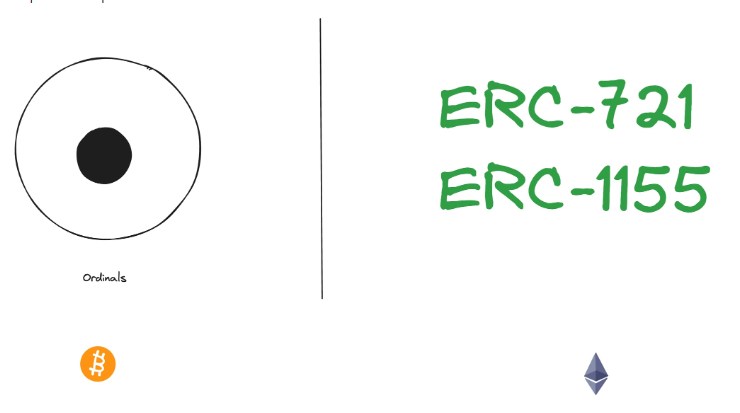
1. Ordinals Protocol
Ordinals protocol is an on-chain storage solution built on top of the Bitcoin network. It utilizes Bitcoin's UTXO model to store NFT (Non-fungible token) data in the form of an inscription in the transaction output. Through this protocol, holders of NFTs can securely store their data in the Bitcoin blockchain, verify and transmit it through transactions.
The ordinals protocol's strength lies in its security and decentralized nature, as well as its good compatibility with the Bitcoin ecosystem.
The ordinals protocol has a wide range of applications in the Bitcoin ecosystem, especially in scenarios where Bitcoin is used as a means of payment. Secure and decentralized NFT transactions and verification can be achieved by storing the data of NFTs directly on the Bitcoin chain.
2. ERC protocol
The ERC protocol is a series of standard protocols used on the Ethereum network. In the current division, the ERC protocol is officially classified as the application layer protocol, and the EIP protocol is classified as the protocol layer protocol. The ERC involving NFT includes ERC-721 and ERC-1155 protocols. Through these protocols, applications on Ethereum can realize the creation, transaction and storage functions of Non-fungible Token (NFT). In addition, Ethereum provides dedicated data storage solutions, such as EthStorage, which enables on-chain storage by storing data in Ethereum's smart contracts.
ERC-721 is a non-fungible token standard that provides a standard API for implementing non-fungible tokens in smart contracts. This standard provides basic functionality to trace and transfer non-fungible tokens. NFTs can represent ownership of digital or physical assets.
Key features of the ERC-721 standard include:
- The basic functionality to track and transfer non-fungible tokens.
- Allows individuals to own and trade NFTs, and can also delegate to third parties.
- Offer a variety of asset types, including property, art, virtual collectibles, and more.
- Ensure contract compliance by implementing ERC-721 and ERC-165 interfaces.
- Optional metadata extensions and enumeration extensions for providing descriptive information about NFTs.
Contracts implementing the standard can choose to support metadata extensions and enumeration extensions based on requirements. Implementations of the ERC-721 standard can extend functionality by implementing ERC721 Metadata, ERC721 Enumerable, and other related interfaces. At the same time, the standard also follows some semantics in the ERC-20 token standard.
ERC-1155 is a multi-token standard that defines a smart contract interface that can be used to manage many different types of tokens. Unlike standards such as ERC-20 and ERC-721, which require the deployment of separate contracts for each token type, the ERC-1155 MultiTokenStandard (tokento-token standard) allows each token ID to represent a configurable token type, Each type can have its own metadata, supply, and other attributes.
The use of this standard can be used to represent multiple token types in a domain. Any combination of fungible tokens, non-fungible tokens, or other configurations (such as semi-fungible tokens) can be included in the same contract.
The standard supports both single token type transfers (using the safeTransferFrom function) and bulk token type transfers (using the safeBatchTransferFrom function). It also supports querying the balance of an account for a specific token type (using the balanceOf function) and querying the balance of multiple accounts for multiple token types (using the balanceOfBatch function).
In order to ensure the security of the transfer, the standard specifies a series of transfer rules, including the verification and processing of the operator, the transferred out account, the transferred into account, the token ID and the transferred out amount. At the same time, it is also necessary to check whether the transferred account is a smart contract during the transfer process. If it is a smart contract, the onERC1155Received or onERC1155BatchReceived function of the contract needs to be called, and the corresponding processing is made according to the return value.
The standard also specifies the URI and format of the metadata, as well as optional localization support.
Overall, the ERC-1155 standard provides a flexible and efficient way to manage multiple token types and support secure transfer and query operations. It is of great value for building applications such as blockchain games and platforms, while it can be adapted to other scenarios as well.
The ERC protocol is widely used in various application scenarios in the Ethereum ecosystem, including games, art transactions, domain name transactions, etc. By using protocols such as ERC-721 and ERC-1155, the creation, trading, and storage of non-fungible tokens can be realized. Meanwhile, with solutions such as EthStorage, data can be stored in Ethereum smart contracts and accessed and verified through smart contracts.
Ordinals protocol on top of Bitcoin and ERC protocol on Ethereum are two current solutions for storage on mainstream chains. Each solution has its own unique advantages and application scenarios. When choosing the right solution, one needs to take into account security, decentralized features, compatibility, and the specific requirements of the application scenario. With the continuous development of blockchain technology, on-chain storage solutions will also continue to evolve and innovate to provide more perfect support for various application scenarios.
In addition, mainstream blockchain networks such as Bitcoin and Ethereum also face the problem of capacity limitation in the process of launching NFT (Non-fungible Token) assets. For example, ordinals can write up to 4MB of data, and Ethereum is difficult to support cheap large-scale applications of audio and video. However, dedicated storage solutions such as IPFS and Arweave offer solutions that not only do not have capacity constraints, but also provide incentives that are expected to drive further development in the NFT space.
IPFS (InterPlanetary File System) is a decentralized distributed file system that enables unique identification and access of data through the use of content addressing (CID). Using IPFS, the data of NFT assets can be stored in various nodes of the network in a distributed way, avoiding the capacity limitation caused by centralized storage. At the same time, IPFS provides efficient data transmission and sharing functions, which makes it possible to cheaply and large-scale applications of audio and video NFT assets.
Arweave is a permanent storage network based on blockchain technology. Unlike IPFS and Ethereum, Arweave employs a miner incentive mechanism to ensure the perpetuation and availability of data. Miners earn revenue by storing and transmitting data, which provides strong support for the storage of audio-video-like NFT assets, thus encouraging miners to store and transmit data on a large scale.
Arweave: A True on-chain Storage Solution
Arweave is not only a permanent data storage network. With the update of Arweave 2.6, Arweave can actually handle large-scale on-chain data storage, even for complete preservation of the public blockchain. Specifically, this major update includes the following four points:
- Reduce the storage acquisition cost of the network by encouraging miners to use cheaper hard drives to store data, rather than optimizing the speed of hard drives.
- Reduce energy waste in the network by spending more mining fees on efficient data storage.
- Miners are motivated to self-organize into exact replicas of the Arweave dataset for faster data routing and more uniform data replication distribution.
- Enable better dynamic price estimation in the network, that is, storage cost per GB/ hour.
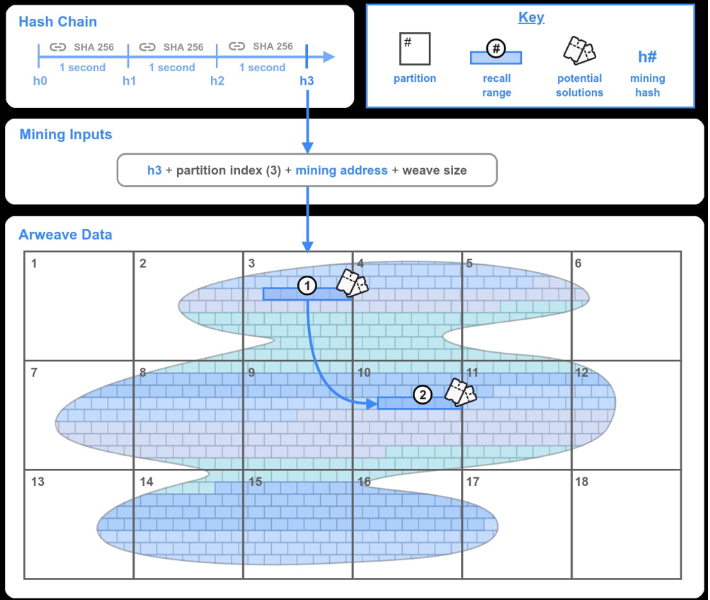
Arweave's optimal mining strategy is to store unique copies whenever possible to maximize the number of copies stored on the network. The mining solution requires chunks to be packed in a specific format. In version 2.6, each copy is also a unique miner address.
The incentive mechanism that limits the speed of the hard disk makes the mining process more balanced because the read range is contiguous blocks of memory, minimizing the read head movement of the hard disk drive. This mechanism also makes it possible to calculate the ratio between drive speed and space. Faster drives, while giving a slight speed advantage when evaluating potential solutions, did not increase their number of solutions per second compared to using cheaper hard drives. On top of that, faster drives cost more, and idle time wastes miners' resources.
Dynamic pricing is based on the price of storing 1GB of data for one hour to determine the storage price of Arweave. Users can calculate the dynamic pricing based on the market price, capacity and mean time to failure of the hard drive. The difficulty of the network is constantly changing, and the price is adjusted every 50 blocks by +/-0.5%. For version 2.6, instead of relying on the average drive speed when calculating the price, a basis for the maximum incentive drive speed is provided.
In addition to cheapness and permanence, Arweave also proposes solutions to some chronic problems of NFTs. For example, there are many restrictions on editing, transferring, cutting and other operations of NFT storage solutions on the market. Arweave introduces the concept of atomic assets to provide users with a true on-chain NFT storage solution, which further promotes the development of NFT.
Atomic assets are an innovative concept introduced by Arweave, which extends the traditional NFT storage model into a more flexible and operational form. Different from other NFT storage schemes, atomic assets can realize complex editing, transfer, cutting and other operations, allowing users to manage and utilize their digital assets more conveniently.
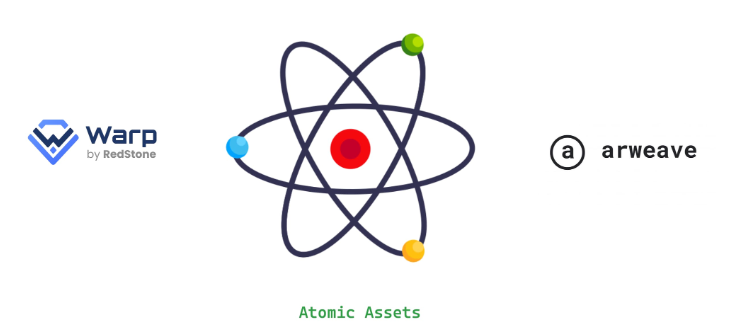
Atomic asset is a standard protocol that defines the structure, properties, and behavior of digital assets. Its core goal is to achieve interoperability between digital assets, so that digital assets on different platforms can interact and transfer seamlessly. The underlying principle is to decompose a digital asset into multiple assemblable parts, each with unique attributes and functions. Atomic assets on Arweave have the following characteristics:
- On-chain native: Atomic assets exist in the form of on-chain storage on Arweave, ensuring the reliability and security of the assets.
- Arbitrary operations: Users can perform complex edits, transfers, cuts, and other operations on atomic assets, resulting in greater flexibility.
- Permanent storage: Arweave's storage model ensures the permanent storage of atomic assets, avoiding the loss of assets due to server failure or data loss.
- Interoperability: The design of atomic assets enables a high degree of interoperability of digital assets across different platforms, enabling seamless cross-chain interaction and transfer.
- Right confirmation mechanism: Through smart contracts and blockchain technology, the ownership confirmation of digital assets and the decentralized management of changes are realized, which improves credibility and security.
- Simple maintenance: The standardized design of atomic assets and the application of smart contract technology make the management and maintenance of digital assets more simple and efficient.
- Scalability: By embedding code logic into the components of digital assets, the intelligent function and scalability of digital assets are realized to meet complex business requirements.
Since Arweave atomic assets can realize complex editing operations, artists can continuously improve and edit their artwork information on the chain. At the same time, the copyright information of artworks can also be effectively protected by smart contracts on the chain to ensure the creative rights and interests of artists.
Arweave's atomic assets enable on-chain asset transfer operations, allowing users to transfer their virtual assets from one blockchain to another, and circulate and use them in different ecosystems.
With Arweave's atomic asset cutting function, users can cut an NFT into multiple fragmented assets, which can be sold or used in an independent form. In addition, users can also merge multiple NFTs into one large atomic asset to realize centralized management and utilization of resources.
As a new type of on-chain NFT storage solution, Arweave's atomic asset brings users a more flexible and operational experience. Through the editing, transferring, cutting and other functions of atomic assets, users can better manage and utilize their digital assets. As Arweave continues to develop and improve, it is believed that atomic assets will play an increasingly important role in the NFT field, providing greater space for the application and innovation of NFT.
As a standard based on blockchain technology, Atomic Asset is committed to solving numerous issues faced by digital assets, such as interoperability, dispute resolution, ownership confirmation, and more. It not only provides a unified specification, but also provides a secure, transparent, and verifiable way to create and manage digital assets by leveraging smart contracts and a decentralized network.
With the widespread adoption of digital assets across the globe, the Atomic Asset standard will be more widely recognized and applied within the industry. It will provide a stronger infrastructure for the development of the digital economy and facilitate the flow and exchange of assets.
Creator Economy: The next step for atomic assets
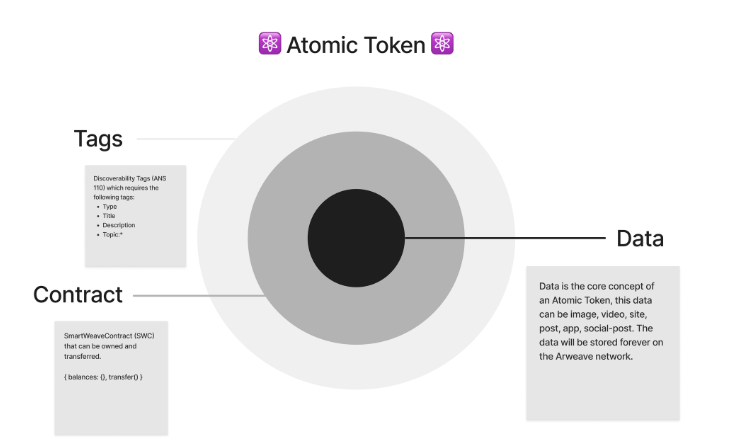
Image caption Atomic Asset concepts and principles
Image source: https://cookbook.arweave.dev/concepts/atomic-tokens.html
With the development of blockchain technology, on-chain storage has gradually become a new option for digital asset storage. However, Arweave, as a distributed storage solution, faces the problem of low market recognition. The Bitcoin and Ethereum communities have reservations about the use of Arweave, fearing that the technology could lead to a crisis of legitimacy for on-chain storage.
Primarily because of concerns about its use, known as the legality and legitimacy of on-chain storage, Bitcoin and Ethereum communities believe that the act of on-chain storage should happen on their own main-chains, rather than relying on third-party storage solutions, whether centralized or decentralized providers. They are concerned that using technologies such as Arweave could lead to a crisis of legitimacy for on-chain storage, mainly for the following reasons:
- The Bitcoin and Ethereum communities believe that on-chain storage can only guarantee the permanent preservation of NFT assets on the Bitcoin or Ethereum chain, and the adoption of third-party solutions may violate the principles of on-chain storage.
- Although Arweave has strong security features, the Bitcoin and Ethereum communities still have concerns about the security of its storage solution, worried about the risk of hacker attacks or data tampering, because the use of Arweave still requires additional URI pointing, which cannot be completely avoided at present.
- In addition, the Bitcoin and Ethereum communities are concerned that storage methods using technologies such as Arweave may adversely affect the on-chain storage competition of their own mainchains, affecting their market share and recognition.
In response, Arweave actively strengthens cooperation with the Bitcoin and Ethereum communities to jointly promote the development of on-chain storage technology and increase its market recognition. For example, Lens Protocol adopts Arweave as its own data solution to save social data generated by users on the chain.
Secondly, Arweave is also actively establishing many standards for on-chain storage, clarifying the requirements and specifications of storage. Based on this, Arweave creatively launched BazAR, an NFT trading marketplace focusing on the capitalization of Arweave's on-chain content. Although NFTs are widely used on mainstream public chains such as Ethereum, the acceptance of the NFT exchange market is far from expectations for the Arweave ecosystem.
As a response to this situation, BazAR, which is supported by Arweave ecosystem, has emerged.
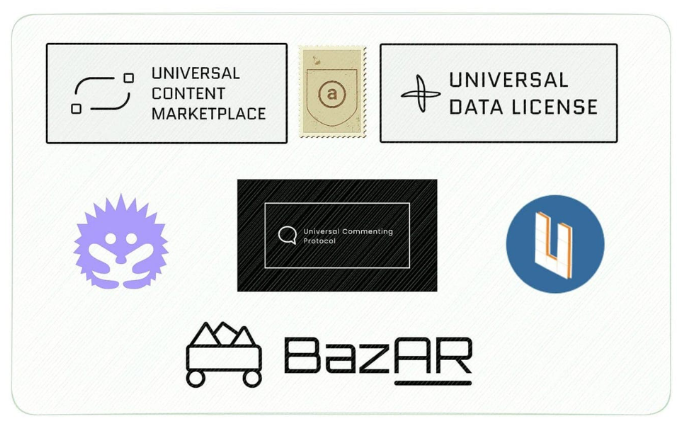
BazAR is an NFT marketplace based on the Arweave chain, designed to help users convert their digital assets into unique and irreplaceable NFTs. Through BazAR, users can easily capitalise their works, such as art, music, videos, and other content, and trade them.
As an emerging NFT trading market, BazAR not only supports content capitalization on the Arweave chain, but also integrates underlying technologies such as U and UDL to provide users with a more reliable and efficient trading environment. U is the token on Arweave's ecological chain, and UDL (Universal Data License) is a decentralized, universal on-chain content protocol that provides creators with customized content management functions.
First, let's understand the concept of UCM and UDL. UCM is a smart contract tool on the BazAR platform to manage users' digital assets and transactions. UDL is a tool on the BazAR platform for storing and managing all atomic asset information. The combination of these two technologies provides a solid foundation for BazAR's atomic asset marketplace to operate.
The interoperability of atomic assets is also a highlight of the BazAR market. On the BazAR platform, users can exchange their digital assets with those of other users without going through cumbersome third-party intermediaries. This atomic-level exchange of assets greatly simplifies the transaction process and improves the efficiency and flexibility of transactions.
In addition, BazAR provides an automated trading mechanism. Through smart contracts and algorithm technology, BazAR can automatically match and match transactions, so that users can quickly find a transaction that meets their needs. This automated trading mechanism greatly improves the liquidity and participation of the market.
The BazAR atomic asset market also supports the trading of multiple digital assets. Not only cryptocurrencies, BazAR can also support the trading of many types of digital assets such as tokens, digital artworks, and game items. This gives users more options and opportunities.
Arweave's atomic asset feature doesn't just apply to assets like content, it also has the ability to generalize to any asset. This means we can integrate both real and off-chain assets into Arweave's ecosystem to build a unified RWA (Real Asset on-chain) platform. Arweave's atomic assets feature allows us to incorporate various assets in the real world, such as real estate, art and jewelry, as well as assets on other chains, such as tokens from other public chains, assets locked in DeFi, etc., into Arweave's ecosystem. As a result, these assets can be verified and traded in a decentralized, tamper-resistant manner.
By putting real assets such as real estate and jewelry on the chain, asset segmentation and liquidity enhancement can be achieved. With the help of smart contracts, we can split a property into multiple shares, investors can buy these shares according to their own needs, and realize leasing, income distribution and other functions through smart contracts. This will bring higher flexibility and openness to traditional real estate investment.
At present, there is an island effect between different public blockchains, and the seamless transfer and interaction of assets cannot be realized. By introducing tokens from other public chains into Arweave's ecosystem, this island effect can be broken and cross-chain flow of assets can be realized. This can not only promote the development and cooperation of the blockchain industry, but also provide more choices and convenience for users.
Conclusion: The expedition is still not over
By reinventing the creator economy, and specifically by introducing the concept of atomic assets, we have an opportunity to break through the current bottlenecks in the NFT market and propel the creator economy into the next era. By providing more diverse types of atomic assets, establishing creator communities and cooperation mechanisms, as well as providing better incentive mechanisms and reward systems, we can activate more creators to join and achieve sustainable development of the creator economy.
References:
- https://foresightnews.pro/article/detail/21231
- https://blog.51cto.com/u_15127612/4670539
- https://eips.ethereum.org/EIPS/eip-721
- https://eips.ethereum.org/EIPS/eip-1155
- https://2-6-spec.arweave.dev/
- https://academy.warp.cc/standards/atomic-asset#what-is-atomic-asset
- https://specs.g8way.io/?tx=FHoS7GZ-MiLy7Uaw0GFFX_DcLrgSpUBV6TtxB-mqAQ0
- https://cookbook.arweave.dev/concepts/atomic-tokens.html
🔗 关于 PermaDAO:Website | Twitter | Telegram | Discord | Medium | Youtube


All Comments