

At 18:00 last night, BTC began to fall from 45,400 USDT, and fell by more than $5,000 in the next three hours, falling as low as 40,157 USDT. It then rose back above 42,000 USDT and has been trading sideways ever since.
This sudden drop caught many investors off guard. In the general market decline, the performance of some tokens was surprising, among which ARB’s trend was the most amazing.
Hit an all-time high with a market capitalization of US$2.4 billion
ARB prices have continued to rise in recent days. Ouyi OKX market shows that ARB fell rapidly in the general market decline, once falling to 1.4 USDT, losing all the gains in the past week.
After a short decline, ARB not only started to rebound, but also hit a new all-time high, once reaching 2.095 USDT.

Arbtrim’s historical high, how can the L3 concept differentiate itself in the L2 competition?
In this round of rise, some ARB whales also made good profits. Data on the chain shows that a whale with the address 0xc41C92EbbA959d3bE9F7affAacCbDB648EedB70d had opened a position in ARB as early as 10 months ago. In this rally, 1.08 million ARBs (valued at US$2.01 million) were sold, with an average buying cost of US$1.33 and a selling price of US$1.94, resulting in a profit of US$660,000.

Arbtrim’s historical high, how can the L3 concept differentiate itself in the L2 competition?
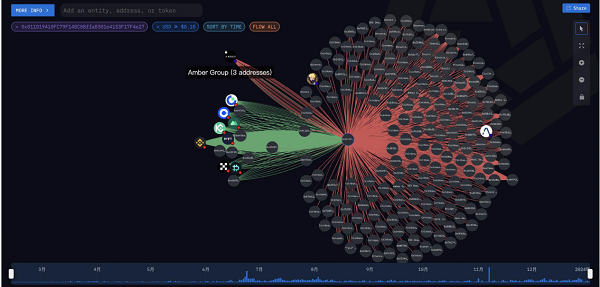
The address suspected of being Amber Group has a larger position.
The address is 0x011D19410FC79F140C08ffa8301e4153F17F4e27. Although there is no clear label showing who the address belongs to, it seems to be owned by Amber Group based on related transactions on the chain. Since March 2023, this address has accumulated 14.57 million ARB, with a floating profit of nearly 10 million US dollars. It costs just $1.23 to open a position.
Arbtrim’s historical high, how can the L3 concept differentiate itself in the L2 competition?
Coingecko data shows that ARB’s current market capitalization is approximately US$2.4 billion, ranking 39th among all included tokens.
Although this market value is relatively large, it is still slightly inferior compared to the main competing product OP.
According to Coingecko data, Optimism’s market capitalization is currently $3.1 billion, ranking 30th in market capitalization. Immutable has a market capitalization of $2.8 billion and ranks 35th in market capitalization. Mantle has a market capitalization of $1.8 billion, ranking 45th in market capitalization.
What’s going on with ARBs whose prices keep rising?
Judging from the market situation, ARB continues to rise. And what measures did this rise come from?
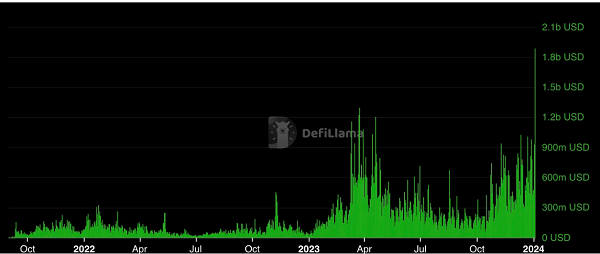
From the short-term data point of view, first of allActive on-chain transactions. Data from DeFiLlama shows that the Arbitrum on-chain DEX hit a 24-hour trading volume of approximately $900 million yesterday. Surpassing Solana to rank second among all chains.
In the last 24 hours, Arbitrum’s DEX trading volume hit a new high, rising sharply to $1.88 billion.
Arbtrim’s historical high, how can the L3 concept differentiate itself in the L2 competition?
Another short-term benefit may come from the Binance effect.The representative XAI in the Arbitrum ecosystem was listed on Binance yesterday。
On January 3, Binance announced the launch of the 43rd phase of new coin mining project Xai (XAI), which is the first game blockchain built on Arbitrum Layer 3.
For the increasingly prosperous Layer 2, the Layer 2 track project is already quite crowded. How to create differentiation and stand out from the fierce competition is a key issue.
For more information about Xai, Odaily released Arbitrum ecological L3 game chain, understand Binance’s latest Launchpool project Xai (XAI) in one article” is explained in the article and will not be repeated here. Layer 3 of the Arbitrum ecosystem is a concept worthy of our attention.
Layer 3 changing the way Layer 2 competes?
For Arbitrum, OP Stack may be its most worrying competitor.
As Rollup technology gradually matures, more and more chains are using solutions from well-known big manufacturers to build them. OP Stack has been deployed on multiple chains, led by Coinbases Base chain, but Arbitrum is obviously lacking in this regard.
In June this year, the Arbitrum development team Offchain Labs released the Arbitrum Orbit development tool, aiming to help developers develop more easily on the L3 blockchain Arbitrum Orbit and manage their own Arbitrum Rollup and AnyTrust chains.
In October, Arbitrum Orbit completed mainnet preparations. This also provides an example and template for other Arbitrum L3 developers, making it easier for the market to accept the Arbitrum L3 concept. Arbitrum’s DA (Data Availability) solution enables ultra-low fee transactions of less than 1 cent without compromising high security and trust minimization, and can write smart contracts using Rust, C and C++ while maintaining the Orbit chain Full EVM compatibility.
Fast forward to December, and we finally saw the feedback Arbitrum Orbit brought to the market. The RARI Foundation, which focuses on NFT infrastructure, announced on the X platform that it used Arbitrum Orbit technology to create a new second-layer chain RARI Chain and released a test network.
The launch of XAI announced that Arbitrum has officially entered the competition in the Layer 3 market. As the competition in Layer 2 has become increasingly fierce, it is not difficult to see that the competition method of the mainstream Layer 2 has gradually shifted to the ecological niche of the world - from the competition for project developers to the competition for chain developers. scramble.
In the future, what we will see is not just competition between different Layer 2s, but large-scale cluster competition between different technology stacks and between several chains.


All Comments