

Cointime

Download App
iOS & Android

AL #49: The Airdrop ROI Equation

From PETERIS ERINS

Contrary to popular thought, airdrops are not a purely social or political construct – they are a growth device.

In the two previous posts from the series Why Airdrops Don't Work and What Blast Can Teach Us About Incentives we set up the problem: airdrop allocations have traditionally been a guessing game as opposed to a science.

We also observed a trend of airdrops more closely resembling liquidity incentives as a way to drive user behavior.

In this post, we’ll propose a clear metric for airdrop effectiveness.

Airdrops vs. marketing

One hypothesis of how to think about airdrops is that they are focused on user acquisition and therefore follow the Lifetime Value > Cost of Acquisition calculus.

This method is well described in Beyond Hype: Understanding the Impact of Airdrops on NFT Marketplace Performance by J. Hackworth.
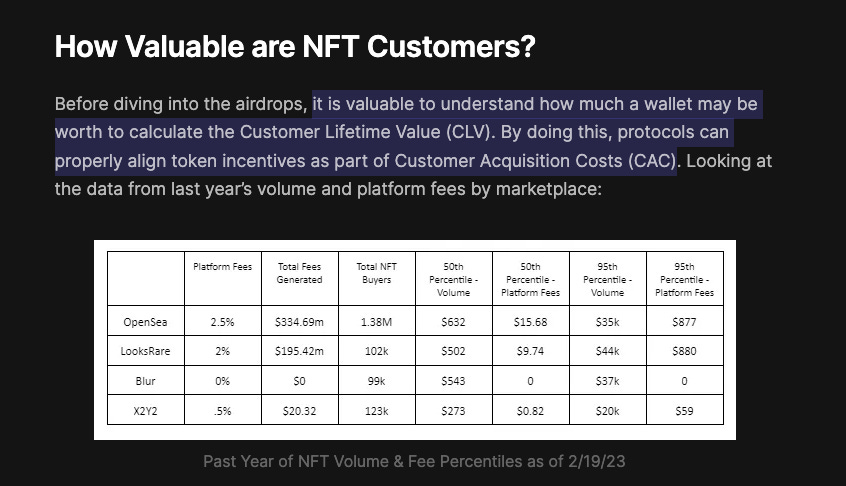
But the difference between airdrops and a more traditional marketing incentives is that they distribute ownership and are inherently dilutive.

Dilution events are not only aimed at customer acquisition, they necessarily should increase the value of the network.

Customer acquisition could be a primary part of that but other objectives may also.

These include increasing security, improving governance, investing in community goodwill, bootstrapping developer ecosystems and more.

So how should we think about increasing network value through an airdrop?

Burn rates

Time to dust off a Fred Wilson classic from 2017: Some Thoughts on Burn Rates in which he writes:

Your company’s annual value creation (valuation at the end of the year minus valuation at the start of the year) should be a multiple of the cash your company has consumed during the year...I think annual value creation should produce a 3-5x return on annual burn. That feels like a good solid range to me.

So if our starting valuation is $100M and we burn 10% in an airdrop, we could have instead used that 10% to raise $10M more (hypothetically).

So “burning” the opportunity cost of that $10M suggests that we should be increasing our valuation by $30-50M to $130-150M.

One could argue that given the valuation risks inherent to crypto networks, the valuation multiple should be even higher, perhaps 5-10x return on burn, which would suggest a valuation target of $150-200M.

Putting this into practice

Let's look at Starknet as a recent example.

They committed 9% to Provisions.
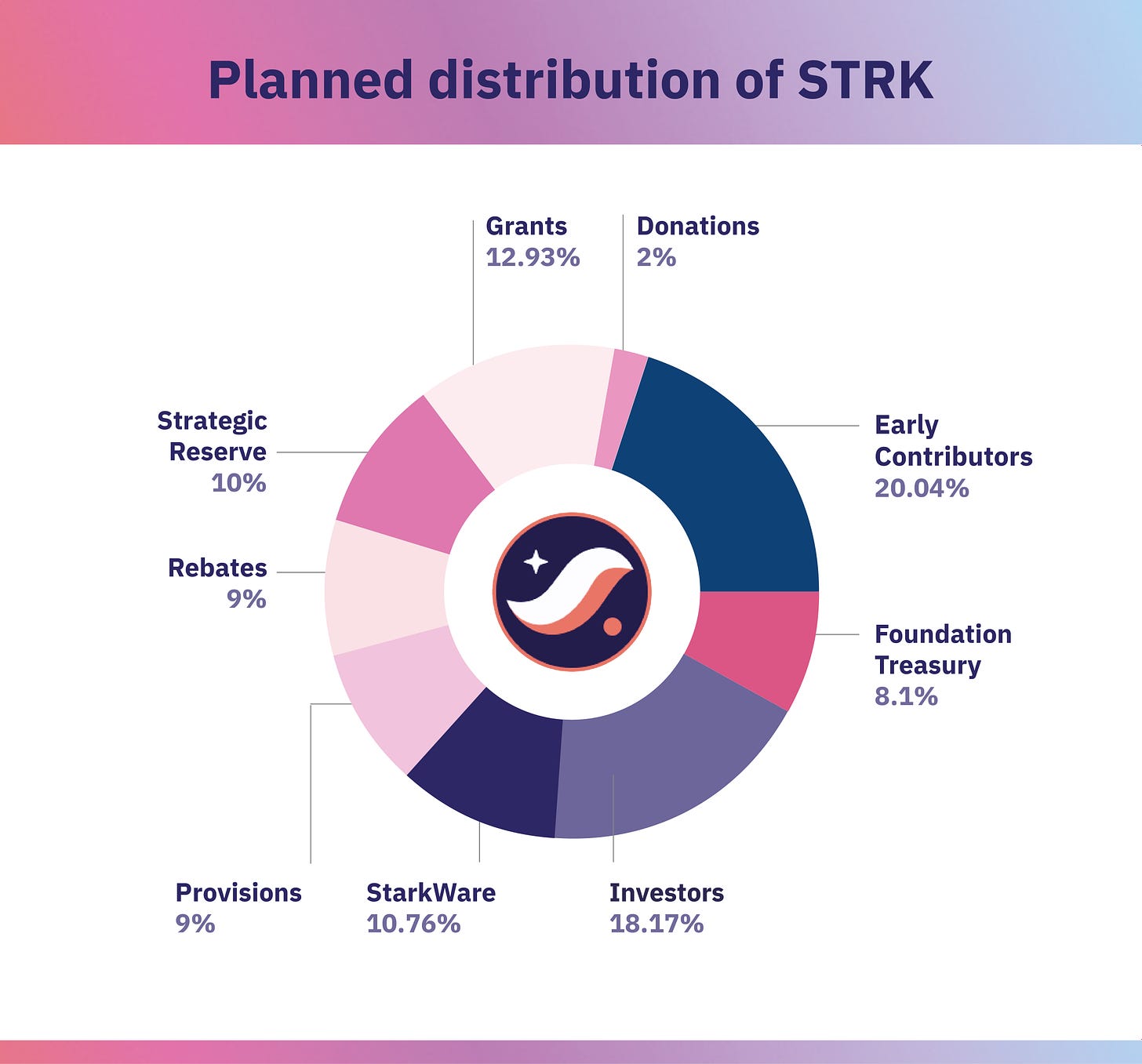
The market cap stabilized around $20 B post launch/airdrop.

Using our multiple of 5-10, this would suggest that the airdrop would have been a success if the private market valuation pre-launch was in the $10-13B category.

Issues with this approach

Of course, this is a gross simplification, in practice, challenges arise. Here are a couple:

  • Crypto market valuations are lagging indications of value. It may be better to also consider other lenses such as looking at protocol revenue where appropriate
  • In that context, some protocols are mature with more linear valuations (e.g., Maker), while others like Blast are harder to value and feature non-linear step change increases in value based on narrative evolution
  • Pre-airdrop valuations like private market valuations are also not very reliable
  • Airdrops are often one-off events (today) which conflates the analysis/objectives somewhat with regulatory pressures. I do think iterated airdrops and liquidity incentives are a better model.
Comments

All Comments

Recommended for you

  • ETH breaks through $3100

    the market shows ETH breaking through $3100, currently at $3100.29, with a 24-hour increase of 1.74%. The market is highly volatile, please manage your risks accordingly.

  • BTC breaks through $91,000

     the market shows BTC breaking through $91,000, currently at $91,011.99, with a 24-hour increase of 1.78%. The market is highly volatile, please manage your risk accordingly.

  • BTC breaks $90,000

    market shows BTC breaking through $90,000, currently at $90,009.99, the 24-hour decline narrowed to 0.57%, market volatility is high, please manage your risk properly.

  • The US spot Bitcoin ETF saw a net inflow of $54.8 million yesterday.

    according to data monitored by Farside Investors, the US spot Bitcoin ETF had a net inflow of 54.8 million USD yesterday.

  • The US spot Ethereum ETF saw a net outflow of $75.2 million yesterday.

     according to data monitored by Farside Investors, the US spot Ethereum ETF had a net outflow of 75.2 million USD yesterday.

  • Economists expect the Federal Reserve to cut interest rates in December, with two more cuts possible in 2026.

    according to economists surveyed, Federal Reserve officials are expected to vote next week to cut interest rates again to guard against the rising risk of a sharp deterioration in the labor market. The median of respondents shows that the Fed is expected to implement two more 25 basis point rate cuts within the year starting from March 2026. Next week's rate cut will continue the momentum of rate cuts from the policy meetings in September and October. A considerable majority also expect Fed officials to once again reiterate the statement that "the downside risks to employment have increased in recent months," as they did in October. The Federal Reserve will announce its decision at 2 PM Washington time on December 10, followed by a press conference held by Chairman Jerome Powell.

  • Bank of America: Markets will soon digest expectations of a Fed rate cut in January.

    Bank of America stated the market may soon price in the Federal Reserve's rate cut expectation in January. (Jin10)

  • He Lifeng held a video call with U.S. Treasury Secretary Bessant and Trade Representative Greer.

    He Lifeng, China's lead for China-US economic and trade relations and Vice Premier of the State Council, held a video call with the US leads, Treasury Secretary Janet Yellen and Trade Representative Katherine Tai. The two sides had in-depth and constructive exchanges on implementing the important consensus reached by the Chinese and US heads of state at the Busan meeting and the November 24 call, focusing on carrying out pragmatic cooperation and properly addressing mutual concerns in the economic and trade field. Both sides positively evaluated the implementation of the outcomes of the China-US economic and trade consultations in Kuala Lumpur, stating that under the strategic guidance of the two heads of state, they will continue to make good use of the China-US economic and trade consultation mechanism, continuously extend the cooperation list, reduce the list of issues, and promote the sustained, stable, and positive development of China-US economic and trade relations. 

  • Hassett: No discussion with US President Trump regarding the Federal Reserve Chair (selection)

    Director of the White House National Economic Council, Hassett, stated: He has not discussed the Federal Reserve Chair (candidate) issue with U.S. President Trump and supports Bassett's views on the Federal Reserve Chair. 

  • White House National Economic Council Director Hassett: It's Time for the Fed to Cautiously Cut Interest Rates

    White House National Economic Council Director Hassett stated: It is time for the Federal Reserve to cautiously cut interest rates.
