

Chapter 1: The Overall Ecosystem Architecture of AI.Claw Foundation
As a global platform focused on AI-native finance and digital asset infrastructure, AI.Claw Foundation has spent the past two years continuously expanding its ecosystem around “AI agent networks, on-chain trading, Web3 payments, RWA asset digitization, and global liquidity systems.” Compared with traditional standalone exchanges or single-protocol projects, AI.Claw aims to establish a long-term digital financial system capable of covering the full lifecycle of “asset issuance — trading circulation — payment consumption — value accumulation.”
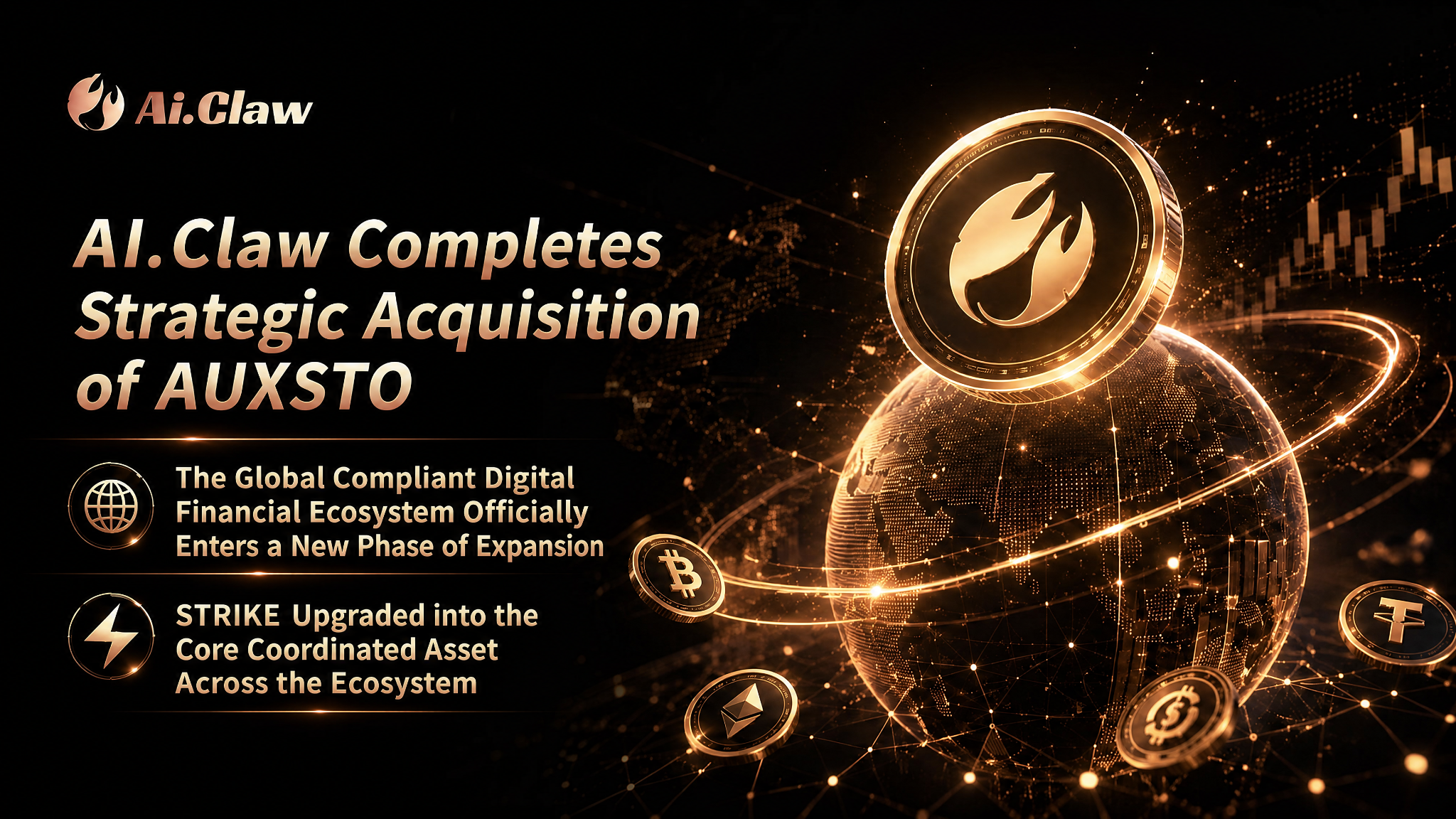
At present, the AI.Claw ecosystem has gradually evolved into a collaborative structure driven by multiple core sectors. Among them, SuperStrike primarily serves as the AI agent network and on-chain intelligent execution layer; DexSK will operate as an independent derivatives trading platform focused on high-frequency on-chain trading and perpetual contracts; PayMall is positioned as a Web3 commerce and digital payment platform connecting real-world consumption with on-chain asset circulation; while AUXSTO, newly integrated through this strategic acquisition, further strengthens AI.Claw’s capabilities in compliant digital asset gateways and fiat settlement infrastructure.
According to the Foundation, its long-term objective is not merely to build a trading platform, but rather to establish a global infrastructure network connecting on-chain finance, real-world consumption, and cross-regional digital liquidity. Within this system, ecosystem components are not designed to operate independently, but instead form a closed-loop structure built around unified value circulation logic and coordinated asset mechanisms.
From a technical perspective, AI.Claw has assembled R&D and financial engineering teams across multiple regions in Asia and North America. Core development teams based in Tokyo have long been involved in protocol optimization, cross-chain clearing systems, and AI agent infrastructure development, while North American financial engineering teams focus more heavily on liquidity structures, risk management, and digital asset market stabilization mechanisms. In addition, AI.Claw has established long-term operational and market expansion teams across the Asia-Pacific region, the Middle East, and Europe, gradually building a global community and ecosystem partnership network.
The Foundation believes that the future of digital finance will no longer revolve solely around “faster trading” or “higher yields,” but rather around building a new financial network capable of connecting real-world economies with on-chain finance. This vision is also the core reason behind AI.Claw’s continuous ecosystem expansion and infrastructure integration efforts.
Chapter 2: Why AI.Claw Chose to Acquire AUXSTO
Within AI.Claw’s broader ecosystem strategy, the integration of AUXSTO is regarded as a highly strategic addition.
Over the past few years, while the Web3 industry has experienced rapid growth in technological innovation and asset liquidity, most ecosystems have remained largely confined to internal on-chain asset circulation. Whether in DeFi, on-chain derivatives, or high-frequency arbitrage, the underlying value systems have continued to revolve primarily around crypto-native assets, lacking deeper connections to stable real-world economic cash flows.
AI.Claw believes that the next generation of ecosystems capable of achieving long-term value accumulation must establish stronger links with the real economy, payment systems, and real-world assets. AUXSTO’s long-standing strengths in regional market resources, digital asset services, and compliance systems provide an ideal gateway for AI.Claw’s expansion into RWA integration and global ecosystem deployment.
According to publicly available information, AUXSTO has maintained a strong presence across the Asia-Pacific market, with mature infrastructure in digital asset trading, fiat services, and regional user operations. Following the acquisition, AI.Claw will not only gain more comprehensive regional service capabilities, but also significantly strengthen its market coverage throughout Asia-Pacific and Southeast Asia.
More importantly for AI.Claw, AUXSTO brings not only trading users, but also a digital asset structure that is substantially closer to real-world commercial systems. This means the ecosystem will not only support crypto-native assets, but also gradually facilitate the digitization and circulation of real-world assets.
The Foundation stated that over the coming years, RWA (Real World Assets) will become one of the defining directions of global digital finance. Sectors including real estate, supply chains, consumer commerce, technology assets, and cross-border trade all possess strong potential for digitization, enhanced liquidity, and global operational efficiency. Through this integration, AI.Claw aims to establish infrastructure connecting on-chain finance with the real economy ahead of broader market adoption.
In addition, AUXSTO’s expertise in fiat settlement and regional market operations further enhances AI.Claw’s global capabilities. As traditional capital increasingly enters the digital asset sector, compliance and regional service infrastructure are becoming essential industry barriers. AI.Claw’s acquisition of AUXSTO fundamentally represents a forward-looking strategic deployment into the next generation of global liquidity markets.
Chapter 3: STRIKE’s Upgraded Positioning Within the New Ecosystem
With AUXSTO formally joining the AI.Claw ecosystem, the role of STRIKE is undergoing a significant transformation.
Initially, STRIKE primarily functioned as the core fuel asset within the StrikeBit.ai modular agent protocol and the SuperStrike network, supporting AI agent operations, on-chain execution, intelligent strategy scheduling, and network coordination functions. At that stage, STRIKE primarily served as a technical infrastructure asset.
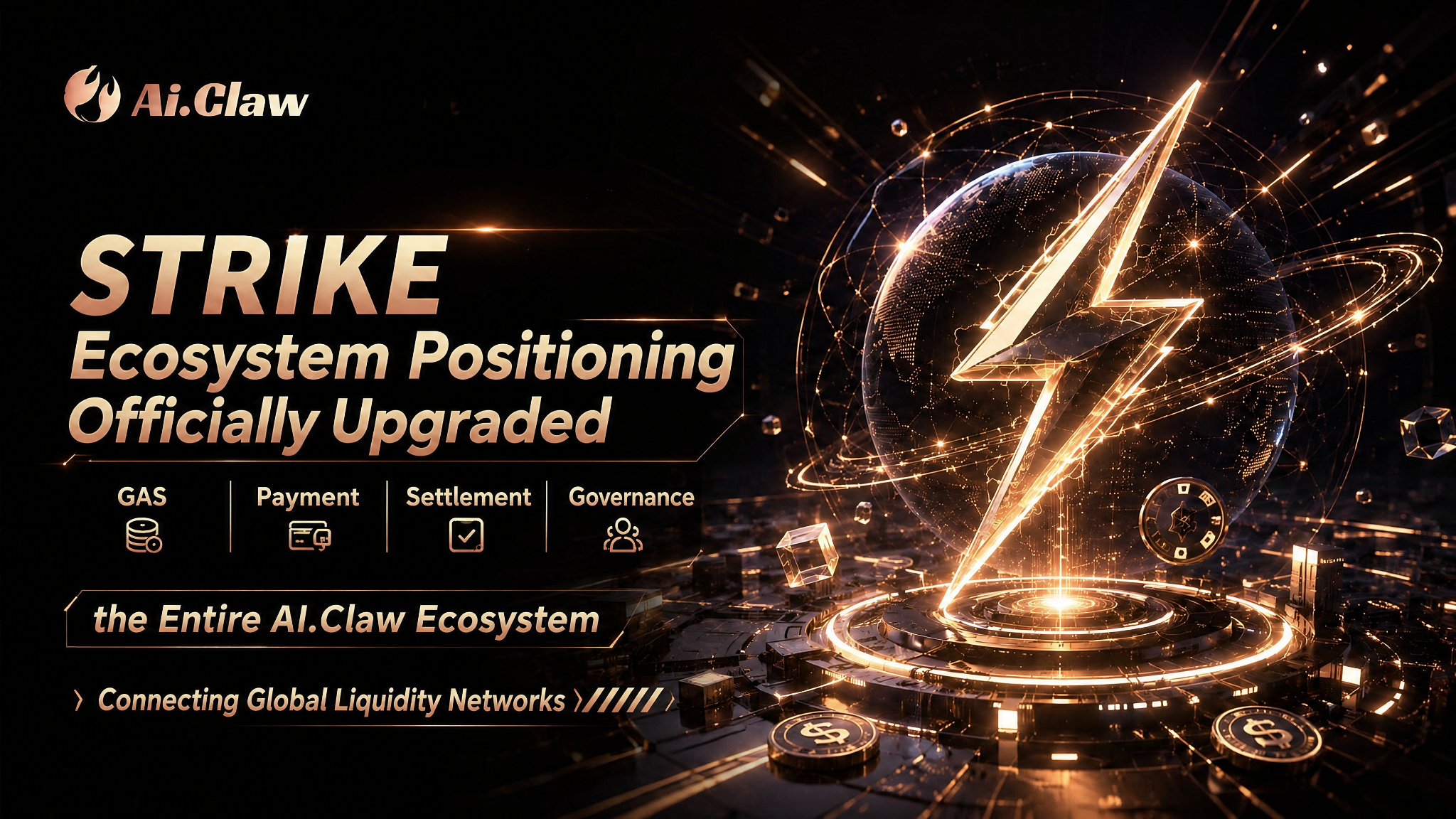
However, as the ecosystem continues to expand, STRIKE is evolving from a standalone technical token into a core collaborative asset spanning the entire ecosystem.
In the future AI.Claw architecture, STRIKE will not only be integrated within the SuperStrike network, but will also gradually expand into multiple ecosystem applications including AUXSTO, DexSK, and PayMall, covering utility scenarios such as fee deductions, ecosystem settlements, platform function access, on-chain governance, and coordinated asset mechanisms.
This evolution means STRIKE’s value logic will no longer remain confined to a single protocol, but instead become increasingly tied to ecosystem-wide user growth, payment scenarios, trading liquidity, and real-world commercial systems.
The Foundation emphasized that its long-term objective is not merely to drive short-term token market performance, but rather to establish a stable and utility-driven on-chain circulation structure supported by real business applications through continuous ecosystem expansion.
Particularly as PayMall and the RWA ecosystem continue integrating into the broader infrastructure, STRIKE may increasingly serve as a bridge between real-world consumption and on-chain assets. For example, within certain ecosystem applications, STRIKE may function as a transaction fee medium, a user rights credential, or an ecosystem utility asset, further increasing its real-world usage frequency throughout the ecosystem.
Meanwhile, AI.Claw also stated that it will place greater emphasis on long-term ecosystem stability mechanisms, including liquidity management, open-market recirculation systems, and long-term deflationary structure optimization, in order to strengthen the sustainability of the overall ecosystem.
Chapter 4: Ecosystem Synergy Between PayMall and SuperStrike
If AUXSTO addresses compliant market access and regional infrastructure, then PayMall and SuperStrike represent AI.Claw’s key pillars for real-world consumer applications and AI financial networks.
Among them, PayMall is positioned as AI.Claw’s future flagship Web3 commerce and digital payment platform. Compared with traditional e-commerce platforms, PayMall places stronger emphasis on integrating consumption, payments, and digital rights, aiming to improve coordination efficiency between users, merchants, and platforms through blockchain infrastructure.
Within the PayMall ecosystem, consumer behavior is no longer treated as a simple payment activity, but instead becomes connected to digital rights, ecosystem incentives, and on-chain asset systems. At the same time, merchants and supply chains can leverage more transparent on-chain settlement mechanisms to improve capital efficiency and cross-regional operational coordination.
The Foundation believes that the next wave of large-scale Web3 adoption will primarily emerge from real-world consumer scenarios rather than purely on-chain financial activity. As such, PayMall’s core mission is to progressively bridge real-world commercial traffic with digital asset infrastructure.
On the other hand, SuperStrike serves as the critical AI agent network and intelligent on-chain execution layer. As AI agent systems continue to evolve, increasing portions of on-chain trading, data scheduling, and asset management may eventually be executed through automated networks. SuperStrike aims to become one of the foundational infrastructures powering this transition.
At the same time, assets from the former DexFV ecosystem will gradually migrate and upgrade to the SuperStrike mainnet according to the previously announced migration framework. The Foundation stated that its objective is to ensure a smooth transition for existing user assets and ecosystem rights while further strengthening long-term network coordination across the broader ecosystem.
As PayMall, SuperStrike, DexSK, and AUXSTO progressively establish deeper interoperability, the AI.Claw ecosystem is evolving from a single-protocol structure into a multi-layered, multi-scenario digital financial system.
Chapter 5: 2026–2027 Ecosystem Roadmap
According to AI.Claw’s long-term strategic roadmap, the period from 2026 to 2027 will represent a critical phase of ecosystem-wide expansion and infrastructure coordination.
On June 15, 2026, the SuperStrike mainnet upgrade and asset migration plan will officially launch. At the same time, the independent derivatives platform DexSK and the Web3 commerce platform PayMall are scheduled to launch concurrently, further strengthening the ecosystem’s foundational capabilities across trading, payments, and consumer applications.
Entering the second half of 2026, AI.Claw plans to continue advancing multi-ecosystem asset coordination mechanisms while accelerating RWA-related collaborations across sectors including real estate, supply chains, technology assets, and consumer commerce.
In parallel, the Foundation will continue expanding its global liquidity infrastructure while strengthening ecosystem partnerships throughout Asia-Pacific, the Middle East, and Europe.
Looking ahead to 2027, AI.Claw stated that it will continue building around global payment networks, stable asset systems, AI-agent financial infrastructure, and cross-chain liquidity infrastructure, while progressively guiding the ecosystem toward a more sustainable, real-world integrated, and globally connected digital financial architecture.
Conclusion: From a Single Protocol to a Comprehensive Digital Financial Ecosystem
AI.Claw Foundation’s completion of the strategic acquisition of AUXSTO marks the official beginning of a new stage in the ecosystem’s evolution.
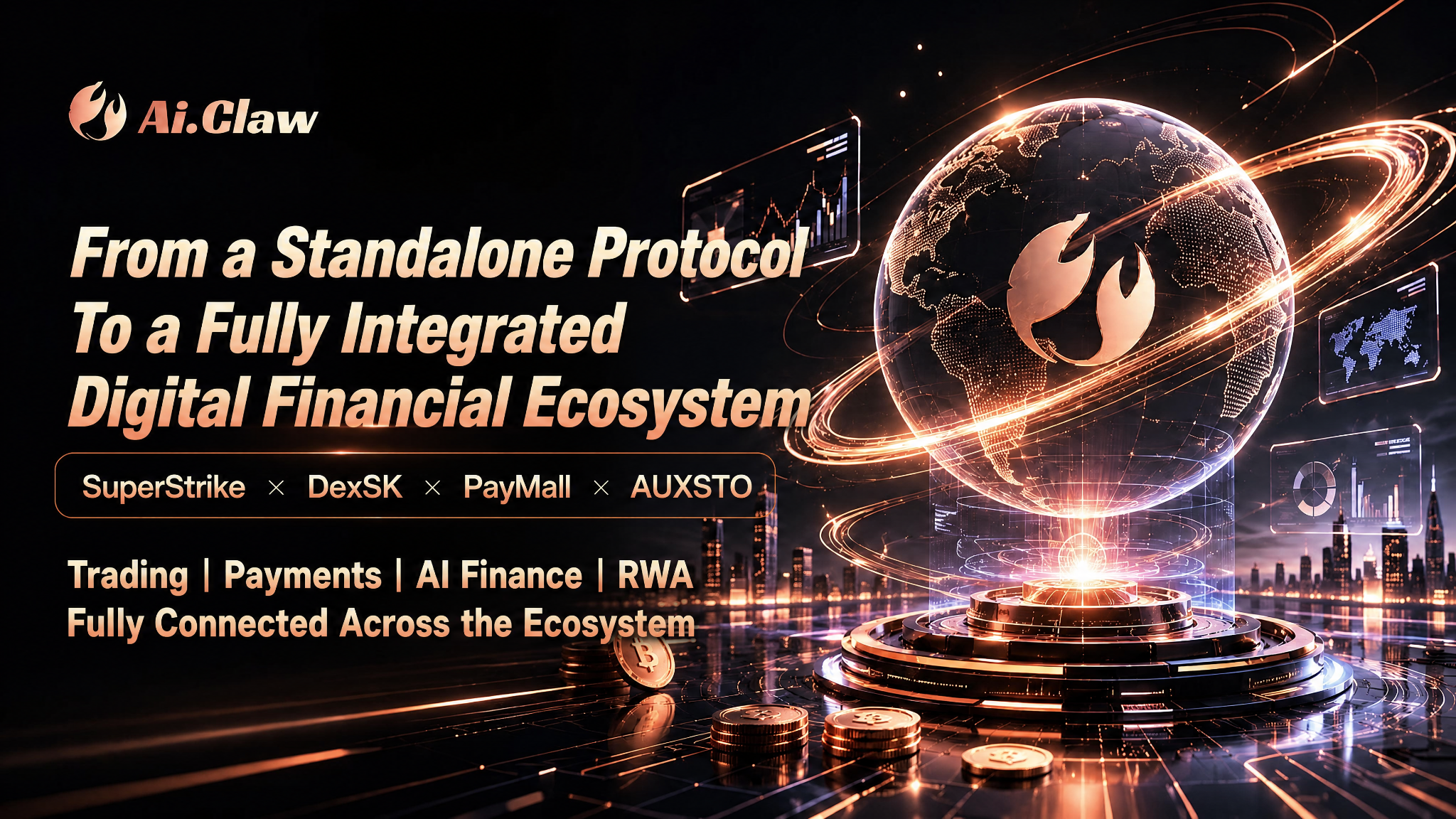
From SuperStrike’s AI agent network to DexSK’s on-chain trading infrastructure; from PayMall’s consumer and payment applications to AUXSTO’s regional compliance capabilities, AI.Claw is actively building a next-generation digital financial network connecting digital assets, real-world commerce, and global liquidity.
As a core collaborative asset spanning the entire ecosystem, STRIKE will continue assuming increasingly important value circulation functions moving forward.
As the global digital asset industry enters a new phase increasingly focused on real-world utility and long-term value support, AI.Claw’s vision extends beyond the development of a single protocol or platform, evolving instead toward a more comprehensive digital financial infrastructure ecosystem.


All Comments