Cointime

Download App
iOS & Android

8 Ways to Check if It’s a Token Scam

Validated Project

The blockchain is awash with promises of quick money and easy rides. But it pays to know if the token you’re holding is part of an elaborate scam to separate you from your hard-earned cash. There are eight straightforward ways of carrying out your due diligence to avoid fraudsters and con artists.

In various places across the internet, you’ll find the same message:

Do Your Own Research!

Cyber security experts

You’re given this advice without instructions on how to do it or what to look for. It takes experience and knowledge to identify exploits and rug pulls.

So here’s a checklist to help you decide if a token is worth looking at or if it contains strong signals of a token scam.

This article covers the Ethereum network but the same methods with alternative tools will work for other blockchains.

Note: you can find a token’s address by look at the associated website or going to Etherscan and typing the token’s name into the search bar.

1. Start from the very basics

To verify the legitimacy of a token, you can always start with the most accessible ways, such as Google search and Twitter. This involves researching the token and its team, checking for any red flags or warning signs, and seeking out trusted sources of information, such as official websites, news articles, and verified social media accounts. 

1.1 Check for social media red flags

Verified Twitter accounts can often help prove the legitimacy of this project. In addition, you can participate in discussions about the tokens to get a sense of the community’s views and opinions.

Also, be cautious of projects that have a high volume of followers on social media but very little engagement.

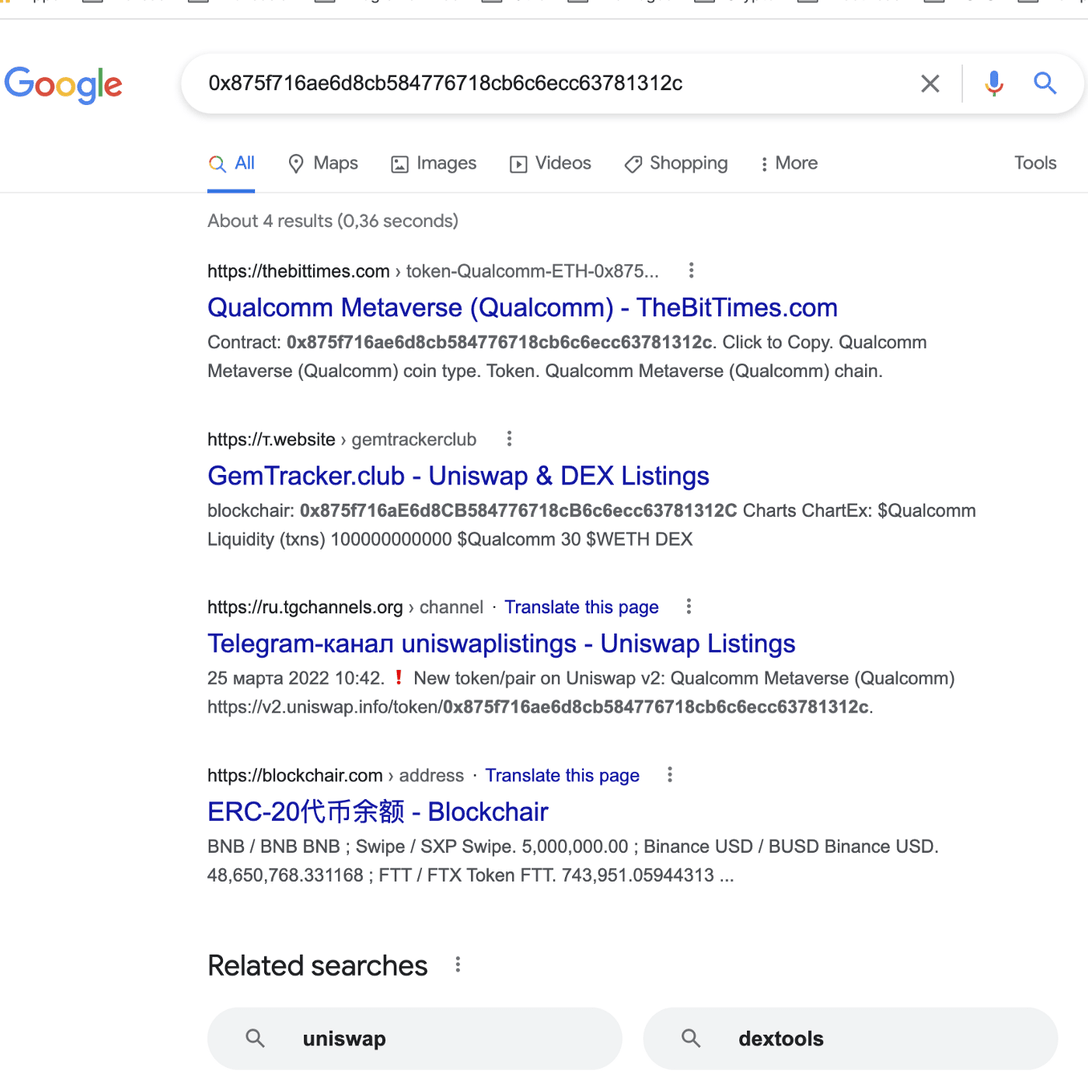
1.2 Check for the token’s address in a Google search

If you do an internet search and can’t find a clear homepage, “white paper” or obvious token purpose, it is probably a scam.

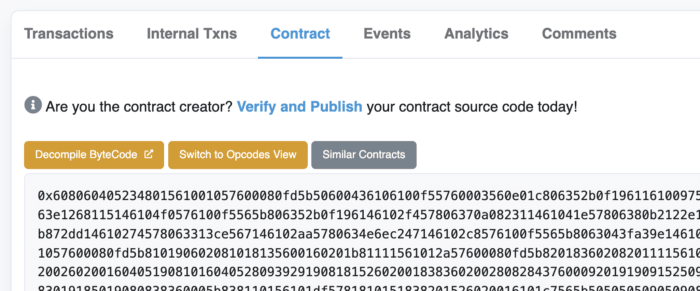
2. Check code is verified on Etherscan

Visit Etherscan and check a token’s code.

If code is not verified, you’re probably dealing with a scam. The reason that scammers do not reveal their code is if has problems, or bugs, or has a purpose other than the stated one.

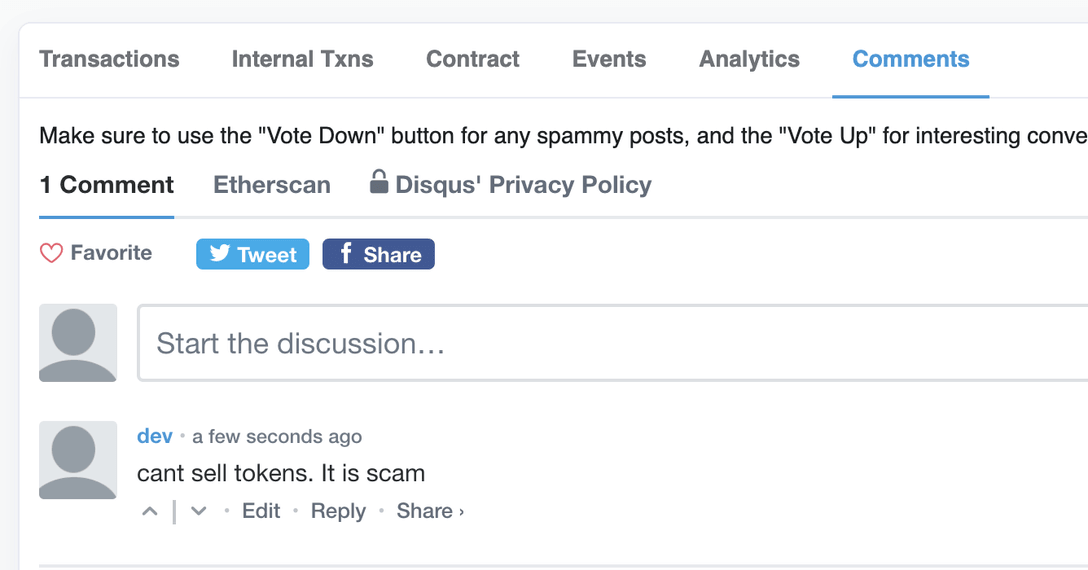
3. Check the Etherscan comments section

If someone is calling it a scam, it is 99% certain to be a scam. If you have been a victim of this activity, do not hesitate to also leave a comment.

Again, go to Etherscan and click on the comments tab to read what people are saying about a token.

4. Check the DappRadar blacklists

Our token blacklists can be found at this Github address.

If the token address is in the list, it’s a scam.

5. Check the token details in a token explorer

If you cannot find the token on CoinGecko or DappRadar’s token explorer (or a similar coin price tracker), the token is probably a scam. 

If it is on the token explorer and you see warning notifications like this, proceed with caution:

All legit tokens share their information with Token Explorers for the purposes of verification.

6. Check how many exchanges host the token

If the token is only traded on a couple of decentralized exchanges (dex), it is almost certainly a scam.

7. Check the amount of liquidity in a token’s balance pool

It is very easy to check a token’s liquidity on a platform like Uniswap V2 or other dexes.

Liquidity is the amount of cryptocurrency or number of tokens locked in smart contracts to enable people to buy and sell assets in decentralized exchanges.

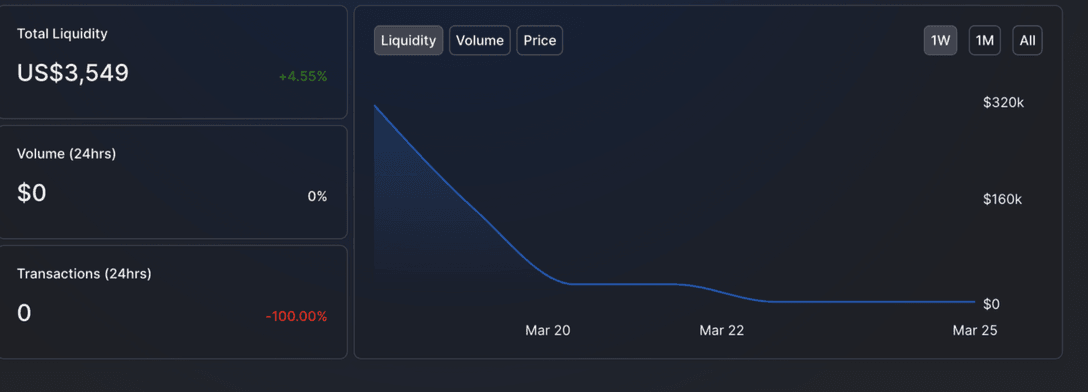
If liquidity is less than $100,000 or is dropping at a significant rate, you’re probably looking at a scam. 

While you’re using a dex, be sure to check other basic on-chain activity: 

  • Transactions volumes – the amount of tokens being swapped, often in dollar value.
  • Transactions counts – the number of token swaps.
  • Unique active wallets interacting with the smart contracts – the number of users connecting to a dex with their Web3 wallet.

If any of these seem unusual, do a bit more digging.

8. Check third party analysis tools

Here are a few token analysis tools:

  • Smell Test – this does an automated audit of the token. The lower its score out of 100, the more likely the token is a scam.
  • Is it a Honeypot scam? Honeypots are smart contracts with an obvious programming flaw purposefully inserted into them. When attackers attempt to exploit the flaw, another piece of hidden code is activated and essentially attacks the attackers. Whether or not you plan on becoming a crypto hacker, honeypots should always be avoided.
  • Learn the basics of DEXtools. It records live token prices and will help you evaluate a token’s true worth in real time.

Scammers will always exist, whether it’s on the blockchain or out in the real world. Follow these tips, and you should avoid the fake tokens designed to take your money.

https://dappradar.com/blog/8-ways-to-check-if-its-a-token-scam

Comments

All Comments

Recommended for you

  • The US FDIC plans to establish an application process for regulated institutions seeking to issue payment stablecoins.

    U.S. Federal Deposit Insurance Corporation (FDIC) announced the approval of a proposed rule to establish an application process for institutions seeking to issue payment stablecoins and regulated by the FDIC. A 60-day public comment period has now been opened. It is reported that this is the first formal rulemaking proposal following the passage of the "GENIUS Act" - the "American Stablecoin Innovation Act."

  • BTC breaks through $88,000

     market shows BTC breaking through $88,000, currently at $88,002.21, a 24-hour increase of 1.34%. The market is highly volatile, please manage your risk accordingly.

  • Bitwise believes 2026 will be a bull market for cryptocurrencies and has released ten predictions.

    Bitwise believes 2026 will be a year of a cryptocurrency bull market. From institutional adoption to regulatory progress, the current positive trends in cryptocurrency are too strong to be suppressed for a long time. Here are Bitwise's top ten predictions for the coming year.

  • China Properties Investment plans to purchase and hold BNB as a strategic reserve asset.

    China Real Estate Investment (00736) announced that in order to promote the diversification of the company's asset allocation and seize the opportunities of digital economy development, the company has resolved to use its own funds to purchase and hold BNB (Binance Coin) and other suitable digital assets in the open market, under the premise of complying with relevant laws, regulations, and risk control, as the company's strategic reserve assets. The company is optimistic about the long-term development prospects of the digital asset industry and has full confidence in the operating entity behind BNB, its technology research and development, ecological layout, and industry competitiveness, recognizing its long-term development potential and value growth space in the blockchain field.

  • Payment infrastructure company Speed1 raises $8 million in funding, led by Tether.

    payment infrastructure company Speed1 announced the completion of an $8 million financing round, led by Tether and participated by Ego Death Capital. The company is committed to building instant global settlement channels using the Bitcoin Lightning Network and stablecoins.

  • Visa begins supporting US financial institutions to settle transactions using USDC on Solana.

    Visa has started supporting U.S. financial institutions to use USDC on Solana for transaction settlements. Cross River Bank and Lead Bank are the first institutions to use this service. As a partner of the Circle Arc blockchain, Visa will also provide support after Arc goes live.

  • Bank of America survey: Kevin Hassett expected to lead the Federal Reserve

     Bank of America's December Global Fund Manager Survey shows that most investors expect U.S. President Trump to nominate White House economic advisor Kevin Hassett as the next Federal Reserve Chair. About 69% expect Hassett to be nominated, while only 4% mentioned Federal Reserve Governor Christopher Waller, and another 4% expect former Fed Governor Kevin Warsh. The survey was conducted before Trump told the media he preferred Hassett or Warsh to lead the Fed. Current Federal Reserve Chair Jerome Powell's term will end in May.

  • Singapore-based digital trade platform Olea completes $30 million Series A funding round.

    Singapore digital trade platform Olea has completed a $30 million Series A funding round, with investors including Banco Bilbao Vizcaya Argentaria (BBVA), XDC Network, theDOCK, and SC Ventures, a subsidiary of Standard Chartered Bank. The funds will be used to accelerate the deployment of AI and Web3 solutions in high-growth markets, strengthening embedded finance, risk analysis, and other products. Since its establishment in 2022, the Olea platform has been licensed by the Monetary Authority of Singapore (MAS) CMS and has provided over $3 billion in financing to more than 1,000 enterprises across more than 70 trade corridors.

  • BTC breaks through $87,000

    market shows BTC breaking through $87,000, currently at $86,986.63, with a 24-hour decline of 3.19%. The market is highly volatile, please manage your risk accordingly.

  • MEXC now supports USD1 (AB Core network).

    On December 16, AB DAO announced that MEXC has officially supported the deposit of USD1 (World Liberty Financial USD) on the AB Core network, and withdrawals will be opened after liquidity meets the platform requirements, further promoting the cross-platform circulation and use of USD1 within the AB ecosystem.