

Cointime

Download App
iOS & Android

5 things you didn't know about Bitcoin halvings and BTC price

Every four years, the Bitcoin community celebrates the Bitcoin halving. Many BTC market analysts view this as a quadrennial milestone event due to its historically bullish impact on the cryptocurrency market as a whole.

As the market edges closer to Bitcoin's fourth halving on April 19, let's dive into five fascinating facts about this phenomenon that even seasoned crypto-enthusiasts might not know.

Bitcoin price's up over 650,000% since the first halving

Historically, Bitcoin’s price has increased following a halving, though this largely hinges on the balance of supply and demand.

Historical data provides some insights: After Nov. 28, 2012, the day of Bitcoin’s first halving, its price climbed from $11 to the then-record high of $1,240 a year later. Similarly, after the second halving in July 2016, Bitcoin’s price surged from around $650 to a new record high of $20,000 in December 2017.
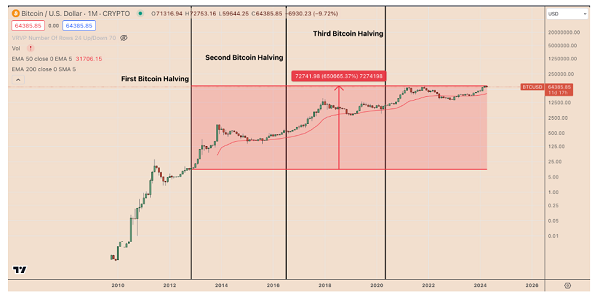
In May 2020, after the third halving, Bitcoin's price boomed from around $8,8000 toward $69,000 in November 2021. So, Bitcoin's returns since the first halving stand at an astounding 650,000%.

Multiple catalysts have spurred demand for Bitcoin following its halving events. For instance, during 2020-2021, a generally dovish stance by global central banks significantly contributed to Bitcoin's price rally.

Halvings test miners' economic resilience

Each halving reduces the income that miners receive for verifying transactions, making profitability more challenging, especially for those with higher operational costs. This situation pressures miners to either upgrade to more efficient technology or cease operations.

For instance, after the third Bitcoin halving in May 2020, the average cost to mine one BTC rose, as the blue wave in the chart below illustrates.
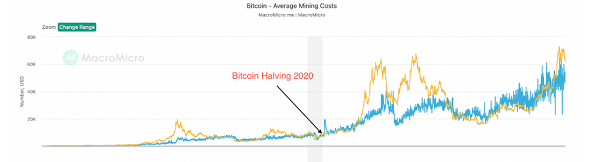
The rise in operations costs squeezed smaller players out of the market, potentially increasing network centralization.

Pre-halving price rallies can be speculative

The anticipation of a Bitcoin halving often leads to speculative price increases.

For example, in the six months before the 2020 halving, Bitcoin's price increased by over 40%, from around $7,000 in November 2019 to approximately $10,000 by May 2020.

BTC/USD weekly price chart. Source: TradingView

These gains are often driven by speculative investors hoping to capitalize on the post-halving price increase, reflecting historical patterns and leading to volatility.

The theory behind a post-halving price increase is based on a supply shock. With each of the first three halvings, the daily production of Bitcoin decreased from 50 to 25 to 12.5, and most recently in 2020, to 6.25 BTC per block. This reduction can lead to significant price movements if demand remains strong.

For instance, the year following the 2016 halving saw a nearly 300% rise in Bitcoin's price, partly attributed to this supply shock.

Macroeconomic impact on Bitcoin halving cycles

The broader economic environment plays a crucial role in shaping the impact of Bitcoin halvings on its price.

For example, the 2020 halving coincided with the period of loose monetary policies, including near-zero interest rates in the U.S. This unique situation contributed to Bitcoin's appeal as a "digital gold," helping its price to soar from around $8,000 at the time of the halving in May 2020 to an all-time high of nearly $69,000 by November 2021.
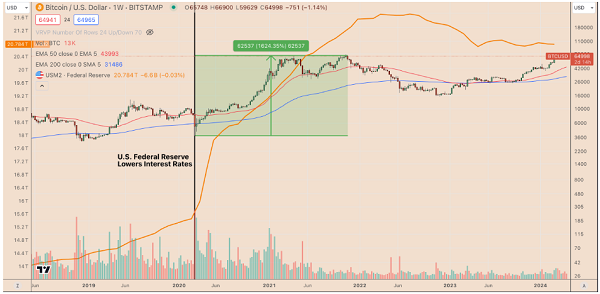
BTC/USD vs. U.S. M2 supply weekly performance chart. Source: TradingView

Last Bitcoin halving will occur next century

Thanks to the halving process, the final Bitcoin is projected to be mined around the year 2140. After the last halving, miners will no longer receive block rewards in new BTC but will rely solely on transaction fees for revenue.

This shift could fundamentally change Bitcoin's security and economic model, influencing everything from miner participation to transaction costs.


Comments

All Comments

Recommended for you

  • Circle minted 500 million USDC on the Solana network.

    according to Onchain Lens monitoring, Circle has minted 500 million USDC on the Solana network. Since October 11, Circle has issued a total of 18 billion USDC on the Solana network.

  • Sources familiar with the matter: JPMorgan Chase is considering offering cryptocurrency trading services to institutional clients.

    according to Bloomberg, as major global banks deepen their involvement in the cryptocurrency asset class, JPMorgan Chase is considering offering cryptocurrency trading services to its institutional clients. A knowledgeable source revealed that JPMorgan is evaluating what products and services its market division can offer to expand its business in the cryptocurrency field. The source stated that these products and services may include spot and derivatives trading.

  • Federal Reserve Governor Milan: We believe that the policy rate will eventually be lowered.

    Federal Reserve Board member Mylan stated that due to the US government shutdown, there were some anomalies in last week's inflation data; he believes that the US will not experience an economic recession in the near term, but if policies are not adjusted, the US will face an increasing risk of economic recession. We believe that policy interest rates will eventually be lowered.

  • BlackRock deposited 819.39 BTC, worth approximately $73.72 million, into Coinbase.

     according to Onchain Lens monitoring, BlackRock deposited 819.39 BTC into Coinbase, worth approximately 73.72 million USD.

  • Ghana passes law legalizing the use of cryptocurrency

    according to Bloomberg, the Ghanaian Parliament has approved a cryptocurrency legalization bill aimed at addressing the expanding use of cryptocurrencies in the country but the lack of regulation. According to Johnson Asiamah, Governor of the Bank of Ghana, the newly passed Virtual Asset Service Providers Act will facilitate the licensing of crypto platforms and the regulation of related activities.

  • CryptoQuant: Bitcoin network activity cools, market shows clear bearish signs.

    CryptoQuant published an analysis stating that the Bitcoin market continues to be in a bear market state, with multiple network indicators showing a significant cooling of activity. Data shows that the 30-day moving average of Bitcoin is below the 365-day moving average (-0.52%), and the bull-bear cycle indicator confirms the current bear market pattern. The number of network transactions has dropped from about 460,000 to about 438,000, fees have decreased from $233,000 to $230,000, and highly active addresses have reduced from 43.3K to 41.5K, all indicating reduced speculative activity and that the market is in a defensive phase.

  • ETH falls below $3,000

    the market shows that ETH has fallen below $3000, currently at $2999.5, with a 24-hour increase of 0.86%. The market is highly volatile, please manage your risks accordingly.

  • BTC breaks through $89,000

    market shows BTC breaking through $89,000, currently at $89,014.5, with a 24-hour increase of 0.85%. The market is highly volatile, please manage your risk accordingly.

  • F2Pool co-founder: Last year, 500 bitcoins were transferred in to confirm whether the private key had been leaked; hackers took 490 bitcoins.

    regarding the community's heated discussion about the 50 million USDT phishing attack, F2Pool co-founder Wang Chun tweeted, "Last year, I suspected that my private key was leaked. To confirm whether the address was really hacked, I transferred 500 bitcoins to that address. To my surprise, the hacker 'generously' only took 490 bitcoins, leaving me 10 bitcoins, enough for me to make a living."