

Cointime

Download App
iOS & Android

#347: Crypto is Stocks but Better

Cointime Official

From paragraph by TPan

On the note of celebrating special days, it’s holiday season for many of us. That means family, friends, and conversations about various topics, including crypto.

Fortunately, this year the conversations are met with (hopefully) curiosity instead of sarcastic remarks like this one.

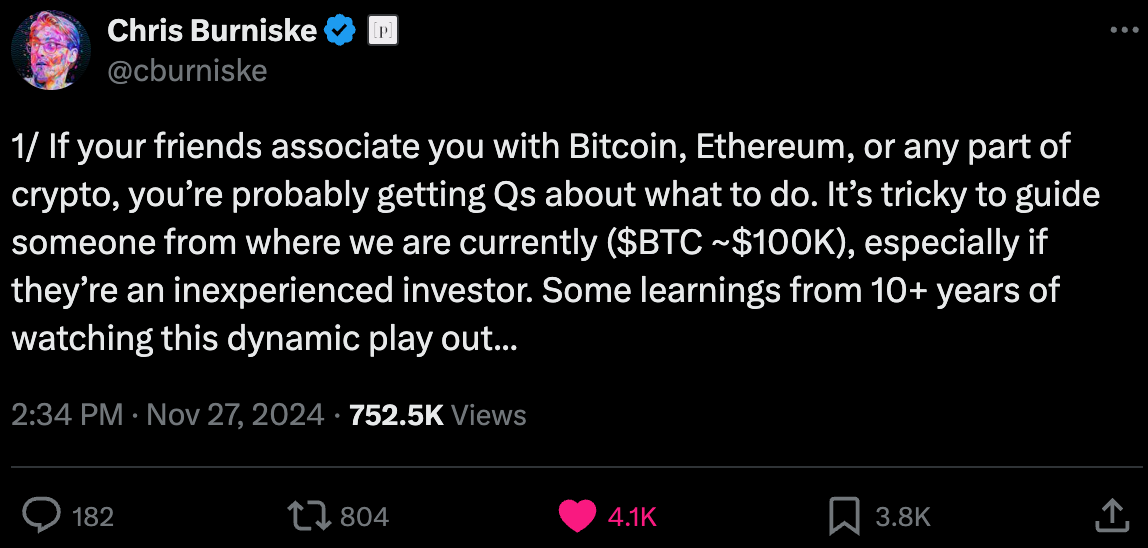
The day before Thanksgiving Chris Burniske, respected VC and OG in the space, shared practical tips on how to have conversations with friends and family about crypto.
And that got me thinking about how to explain crypto to people who ask me about it. What IS crypto?

Earlier today, I realized one way to describe it is with all the technical jargon and industry buzzwords that it’s like stocks, but better. How so?
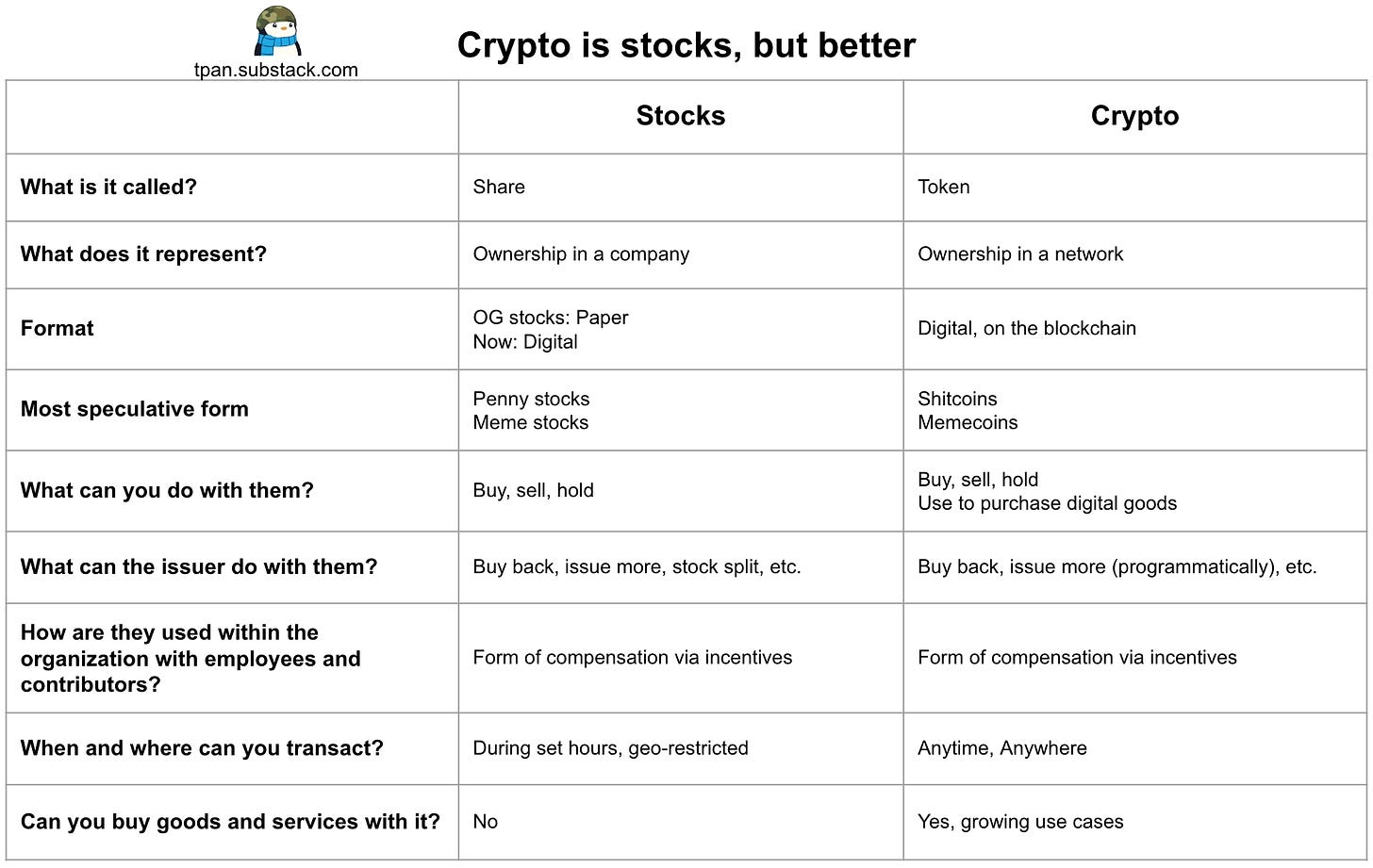
There are plenty of nuances to nitpick with the comparison, but we’re going for general comprehension, not complete accuracy. This comparison also assumes the audience understands stocks and wants to better understand crypto vs. ‘How do I make as much money as quickly as possible?’

This type of explanation reminds me of 6529’s famous thread explaining what NFTs are as the NFT frenzy was in full swing. The point that made it click for me was when he clarified that banknotes are actually non-fungible.
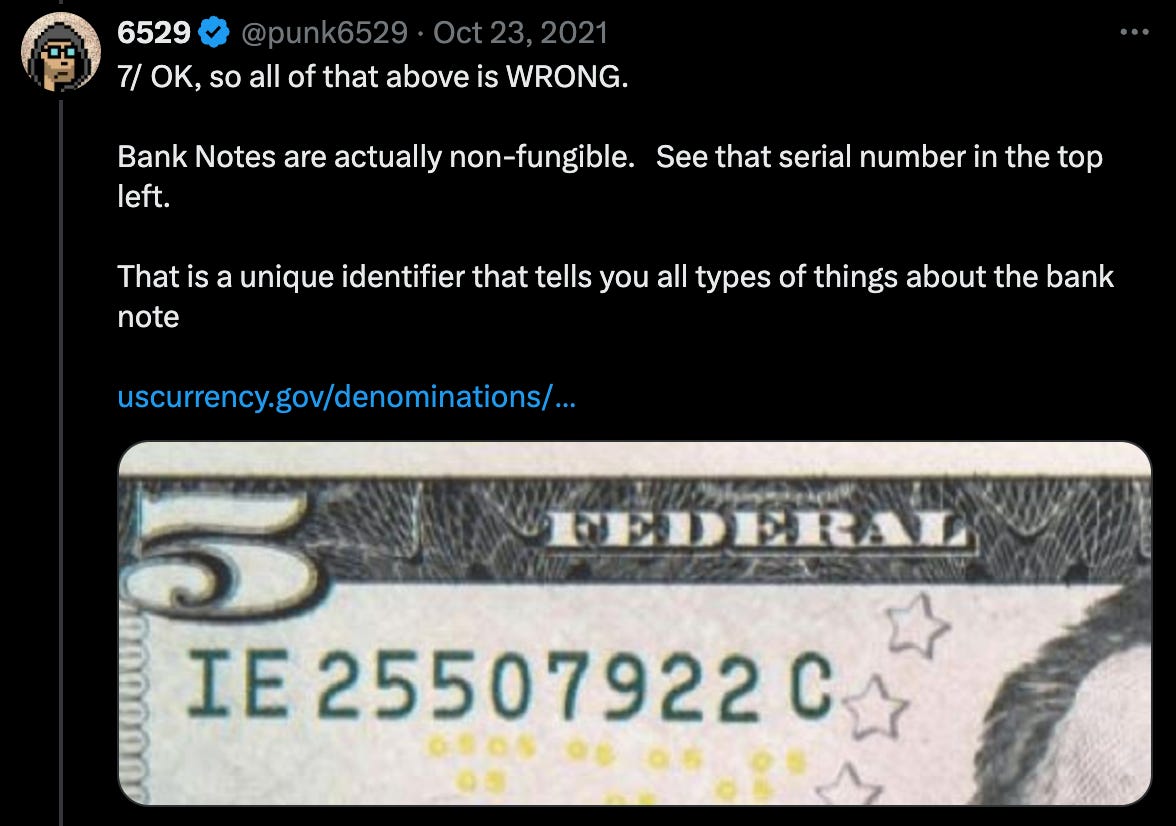
I don’t know why it took me so long to make this comparison and have it click, but if I read something like this it certainly would have helped me have a stronger foundation as I went down the crypto and web3 rabbithole. From there, concepts like supply, governance, unlocks, decentralization, permissionless, and other industry-specific terms become easier to understand.

I’ll let you guys know if I use this analogy and how it does, and let me know if you do as well. If anything, it helps me to solidify my personal understanding even more than I did yesterday 🙂

Art as memecoins

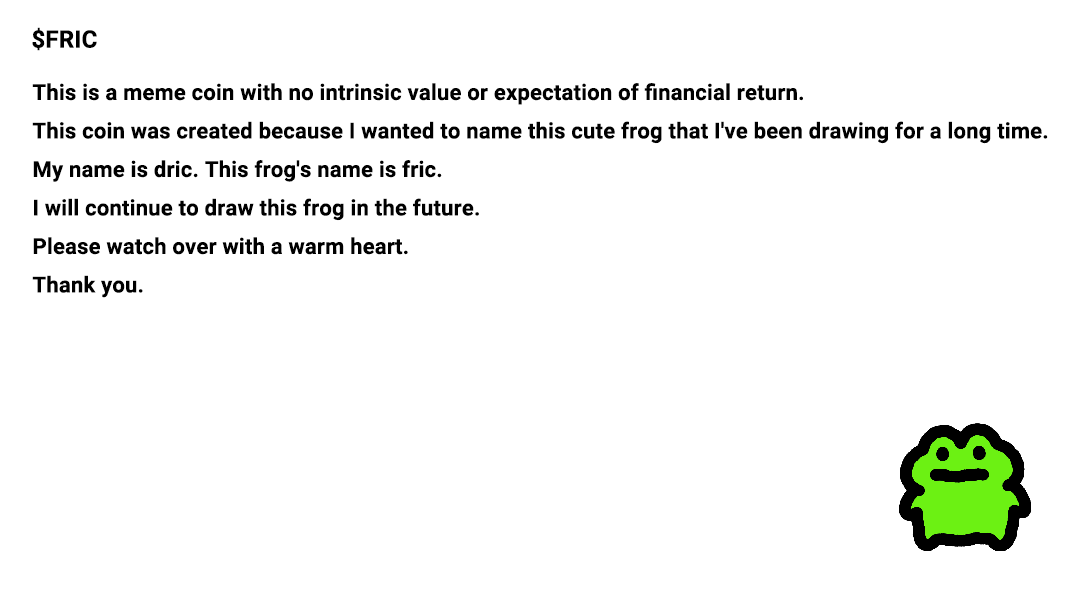
A couple nights ago I saw this cute frog on my timeline and I had to investigate, what with this lil fella doing on my timeline?!

I should’ve known, but it was a memecoin: fric the frog. But I couldn’t help it, the art style and fric are so cute. And thanks to the power of cuteness and a little research, I bought a bit of the memecoin, mentally prepared to become exit liquidity to sharper and earlier wallets. Fortunately, the memecoin is still alive, so I live to see another day (and hopefully longer).

fric is the creation of dric, a Korean artist who has been creating art for over 10 years on Instagram, amassing an audience of 664k followers. The frog character was first featured in 2020 and has turned into a main character of sorts.

And on November 24th the frog finally had a name, fric, and a memecoin to commemorate the moment.
Since the memecoin launch, dric has drawn fric in various crypto-related settings: on the Solana logo (fric on sol, good wordplay there!), with Phantom, with Moonshot, celebrating Bitcoin reaching $100k, and more.

Other artist + art focused memecoins that have ‘made it’ (using this loosely) that come to mind:

Of course there’s Pepe, the $9B behemoth of a memecoin that’s leading this cycle’s newly created memecoins, but the artist Matt Furie didn’t have a direct role in its creation.

The artist’s art-to-memecoin strategy is still an uncommon path compared to the standard mint 1/1s or series and sell them, or NFT PFP collection path. Additionally, the artists that have launched memecoins focus on a character or concept, so the pure memecoin path isn’t a good fit for many artists who don’t do character art.

The memecoin approach makes tradeoffs with the standard NFT approach that was popular in the past, while applying lessons learned from that period.
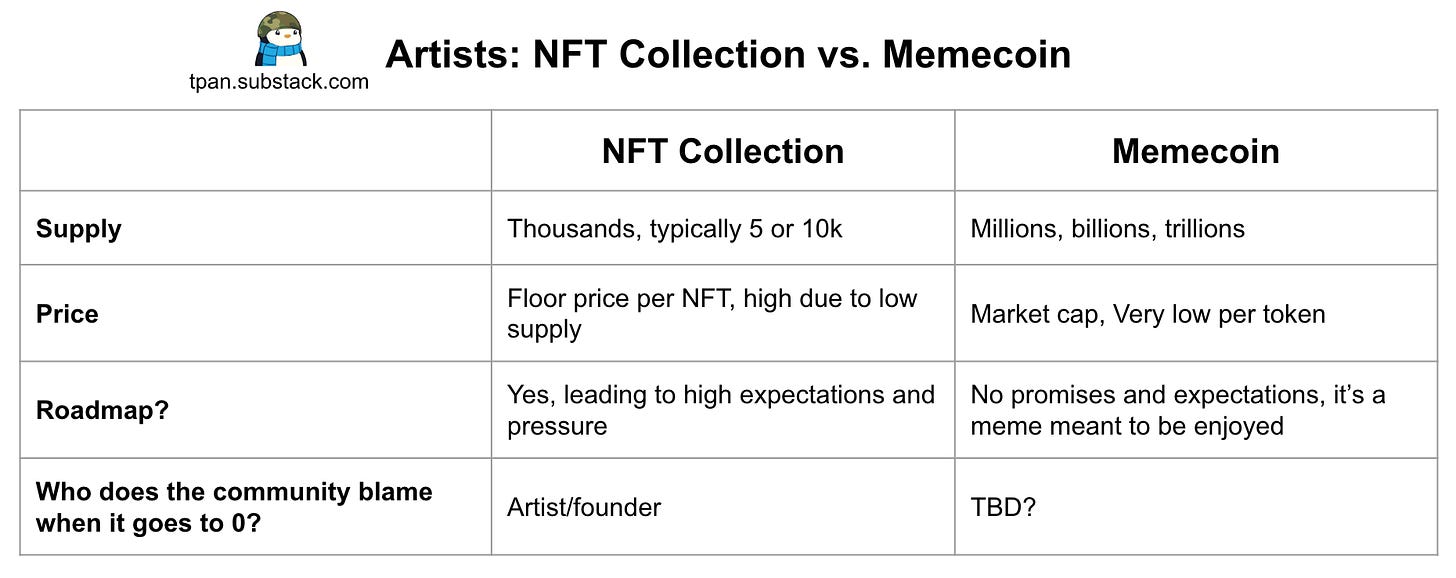
Looking back, one key pitfall for artist-led NFT collections was that many were unprepared for the responsibilities entailed in managing a community and fulfilling a roadmap, even if there was a team helping with these functions. Memecoins remove some of these pressures, although there will always be an eternal battle around price and community expectations even if the disclaimers are made.

Another interesting observation is that there is a memecoin —> NFT collection path playing out as these two things aren’t mutually exclusive.

One notable example is fwog and its limited collection of 100 “The Pond” NFTs. fwog memecoin holders can enter a raffle for an exclusive fwog PFP for 50 fwog (~$20) per ticket.

Because of the small collection and each PFP NFT is a unique 1/1, the floor price of The Pond NFTs is currently 113 SOL (~$27K), with the next one being 161 SOL (~$38k).

And fric is unintentionally following a similar path if the memecoin takes off. In December 2022, dric minted the This is Frog NFT, a collection of 2,222 frics, which had almost 0 sales since its creation…until the past couple of weeks when the memecoin launched.
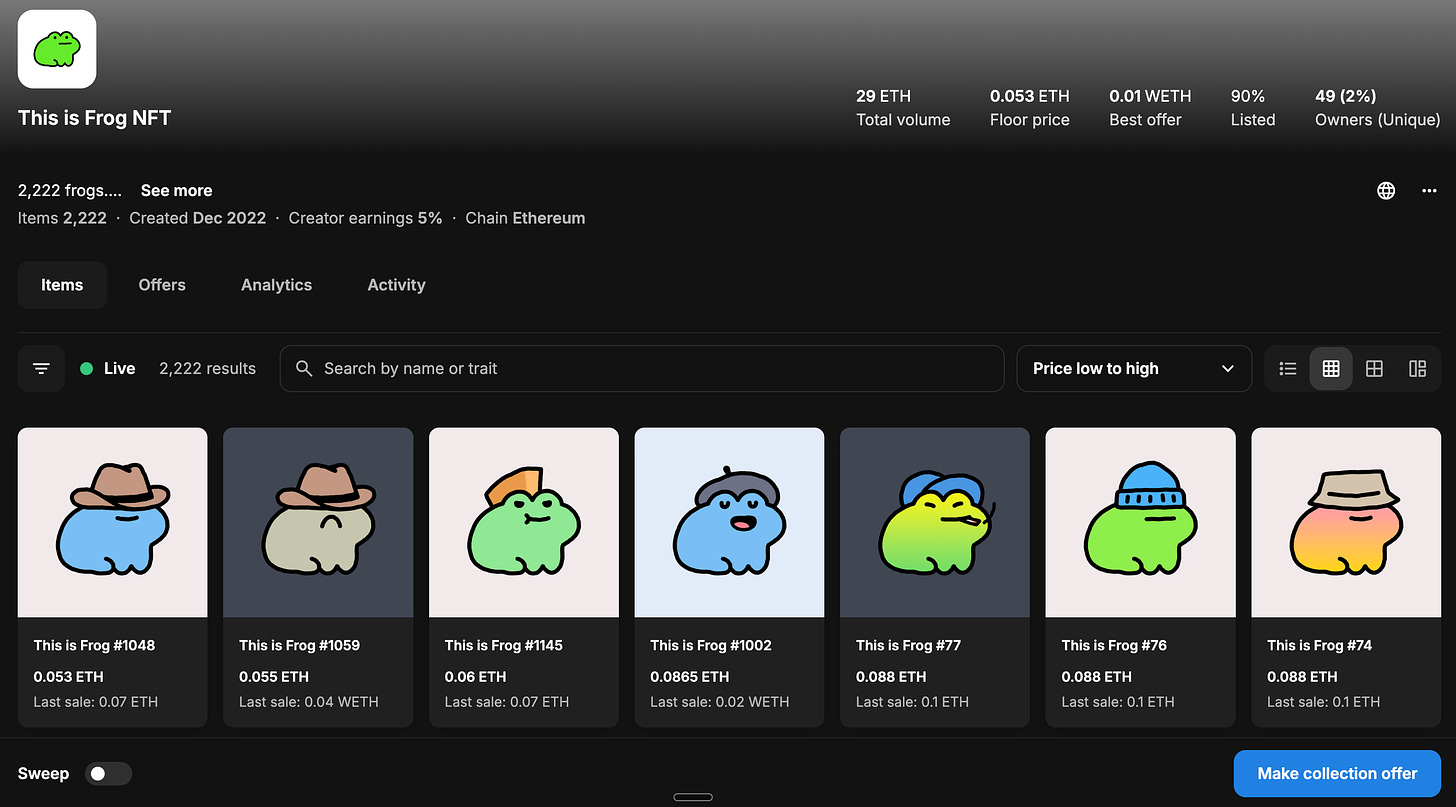
So if fric the memecoin takes off, fric the NFT collection will eventually follow suit, which will be fun to observe.

Much of what I’m sharing here is a combination of trendspotting (and a healthy dose of confirmation bias), luck, and timing as we’re getting into the thick of a nearly up-only type of market. It remains to be seen if more artists enter the memecoin arena, which is certainly a crazy one.

But for now, there seems to be a unique window of opportunity for artists who are able to thread the needle in the way they do best: creatively.

See you next week!

Comments

All Comments

Recommended for you

  • Trump Claims Strait is Open, US Officials Say Iran's Leverage is Diminishing

    On August 28, it was reported that since the outbreak of war at the end of February, the Strait of Hormuz has been Iran's most powerful leverage. However, US officials stated that over the past two months, the US military has gradually weakened Iran's control over this critical waterway. They believe that the situation in the Strait of Hormuz has been reversed and that this could become a turning point in the war, potentially easing the global economy and paving the way for a better agreement with Iran. In a phone interview with Axios on Thursday, US President Trump stated, 'It's open there (the Strait of Hormuz), and Iran's response has been very mild. They do not want us to take action against them again. That's the key. Everything else is unimportant.' It is reported that after the breakdown of the US-Iran memorandum, the US military began taking unilateral actions to reopen the Strait of Hormuz. These actions include the formation of a task force in cooperation with the UAE to guide ships through the southern route of the Strait while providing aerial cover and intercepting drone and cruise missile attacks launched by Iran. A two-week bombing campaign significantly weakened the capabilities of the Iranian Revolutionary Guard to attack vessels passing through the strait. A mine-clearing operation involved Navy divers, SEALs, underwater and surface drones, and private contractors to detect and eliminate mines. The blockade of Iranian ports has been restored.

  • Trump Claims Strait is Open, US Officials Say Iran's Leverage is Diminishing

    On August 28, news emerged that since the outbreak of war in late February, the Strait of Hormuz has been Iran's most powerful leverage. However, US officials stated that over the past two months, the US military has gradually weakened Iran's control over this critical waterway. They believe that the situation in the Strait of Hormuz has been reversed, which could become a turning point in the war, potentially easing the global economy and paving the way for a better agreement with Iran. In a phone interview with Axios on Thursday, US President Trump stated, 'It’s open over there (the Strait of Hormuz), and Iran’s response has been very mild. They don’t want us to take action against them again. That’s the key. Everything else is unimportant.' Following the breakdown of the US-Iran memorandum, the US military began unilateral actions to reopen the Strait of Hormuz. These actions include the establishment of a task force in cooperation with the UAE to guide ships through the southern channel of the Strait, providing aerial cover for vessels, and intercepting drone and cruise missile attacks launched by Iran. A two-week bombing campaign significantly weakened the capabilities of the Iranian Revolutionary Guard to attack vessels passing through the Strait. A mine-clearing operation involved Navy divers, SEALs, underwater and surface drones, and private contractors to detect and remove mines. The blockade of Iranian ports has been restored.

  • Japan Invests $96.4 Billion in One Month to Support Yen, Record Intervention Scale

    On August 28, Japan invested a record $96.4 billion over the past month to support the yen, which had previously fallen to its lowest level in 40 years. This underscores the Japanese authorities' willingness to take increasingly strong measures to support the yen's exchange rate. Data released by the Japanese Ministry of Finance on Friday showed that from July 30 to August 26, the Japanese government intervened in the foreign exchange market with a total of 15.4 trillion yen, setting a record for monthly intervention amounts. This intervention was also supported by the United States, further warning speculators not to bet on a decline in the yen. Japanese Finance Minister Shunichi Suzuki and U.S. Treasury Secretary Janet Yellen confirmed in early August that the two countries coordinated their intervention on July 31. Both officials stated that they are prepared to intervene in the market again without hesitation if necessary. The funds contributed by the U.S. are not included in the data released by the Japanese Ministry of Finance and are expected to be smaller in scale, but their symbolic significance is more important.

  • Japan Injects $96.4 Billion in a Month to Support Yen, Setting Record Intervention Scale

    On August 28, Japan invested a record $96.4 billion in the past month to support the yen, which had previously fallen to its lowest level in 40 years. This underscores the willingness of Japanese authorities to take increasingly strong measures to support the yen's exchange rate. Data released by the Japanese Ministry of Finance on Friday showed that from July 30 to August 26, the Japanese government injected a total of 15.4 trillion yen into the foreign exchange market, setting a record for monthly intervention amounts. This intervention action was also supported by the United States, further warning speculators not to bet on a decline in the yen. Japanese Finance Minister Shunichi Suzuki and U.S. Treasury Secretary Janet Yellen confirmed at the beginning of August that the two countries coordinated their intervention on July 31. Both officials stated that they are prepared to intervene in the market again without hesitation if necessary. The funds contributed by the U.S. are not included in the data released by the Japanese Ministry of Finance and are expected to be smaller in scale, but their symbolic significance is more important.

  • Changxin Technology: Net Profit of 77.605 Billion Yuan in First Half of Year, Turning Losses into Profits Year-on-Year

    On August 28, Changxin Technology announced that its operating revenue for the first half of 2026 reached 150.31 billion yuan, a year-on-year increase of 873.64%. The net profit attributable to shareholders of the listed company was 77.605 billion yuan, compared to a loss of 2.332 billion yuan in the same period of 2025, marking a turnaround to profitability.

  • Changxin Technology: Net Profit of 77.605 Billion Yuan in First Half of Year, Turning Losses into Profits

    On August 28, Changxin Technology announced that its operating revenue for the first half of 2026 reached 150.31 billion yuan, a year-on-year increase of 873.64%. The net profit attributable to shareholders of the listed company was 77.605 billion yuan, compared to a loss of 2.332 billion yuan in the same period of 2025, marking a turnaround from losses to profits. (Jin Shi)

  • Market News: Japan's Forex Intervention Reaches Record 15.4 Trillion Yen in the Past Month

    Market news: Japan's forex intervention has reached a record 15.4 trillion yen in the past month. (Jin Shi)

  • Market News: Japan's Foreign Exchange Intervention Reaches Record 15.4 Trillion Yen in the Past Month

    Market news: Japan's foreign exchange intervention has reached a record 15.4 trillion yen in the past month. (Jin Ten)

  • SK Hynix CEO: Storage Shortage to Last Until End of 2030, HBM Demand Will Not Plummet Even in Downturn

    On August 28, SK Hynix CEO Lee Seok-hee stated at a press conference, "We expect the current market conditions to persist until the end of 2030. At present, we do not see any clear signals indicating that the market will enter a downturn." Lee also pointed out that even if the storage market faces a downturn in the future, the likelihood of a drastic decline similar to past cycles is very low: "In previous downturns, the storage business was essentially 100% a commodity, with manufacturers primarily competing through capacity expansion. However, for HBM, customers and semiconductor manufacturers collaborate closely in chip development, which requires both parties to work together to maximize performance, making market demand easier to predict."

  • SK Hynix CEO: Storage Shortage to Last Until End of 2030, HBM Demand Will Not Plummet Even in Downturns

    On August 28, SK Hynix CEO Lee Seok-hee stated at a press conference, "We expect the current market situation to continue until the end of 2030. Currently, we do not see any clear signals indicating that the market is entering a downturn." Lee also pointed out that even if the storage market experiences a downturn in the future, the likelihood of a drastic decline similar to past downturns is very low: "In previous downturn cycles, the storage business was essentially 100% a commodity, and manufacturers primarily engaged in homogeneous competition by expanding capacity. However, for HBM, customers and semiconductor manufacturers participate together in chip development, and both parties must work closely to maximize performance, making market demand easier to predict."
