

Cointime

Download App
iOS & Android

$20M crypto scam victim who sued Citibank says 2 more banks liable

The self-claimed victim of a crypto romance scam who recently sued Citibank for failing to catch red flags has just filed a second lawsuit targeting two other banks. 

Michael Zidell sued East West Bank and Cathay Bank in a California federal court on Tuesday, accusing the banks of turning “a blind eye to their statutory duties and obligations.”

He claimed he sent 18 transfers totalling nearly $7 million to the alleged scammers’ account at East West Bank, and made 13 transfers totalling over $9.7 million to an account at Cathay Bank.

Zidell sued Citibank on June 24, accusing it of ignoring the red flags in 12 transfers totaling around $4 million to accounts at the bank allegedly held by scammers.

Cointelegraph contacted East West Bank and Cathay General Bancorp, the parent company of Cathay Bank, for comment.

Scam NFT investments made in Facebook romance

Zidell claimed in his lawsuits against the banks that “Carolyn Parker,” a purported business owner, contacted him on Facebook in early 2023, and the pair formed a romantic relationship.

Parker allegedly told Zidell a month into the relationship that she’d made millions investing in non-fungible tokens, suggesting he do the same and directing him to a trading platform. 

Zidell decided to invest and, over the next few months, said he sent 43 transfers totalling over $20 million to various bank accounts given to him by the platform, which claimed it needed to process the funds at multiple banks due to a large volume of customer deposits.
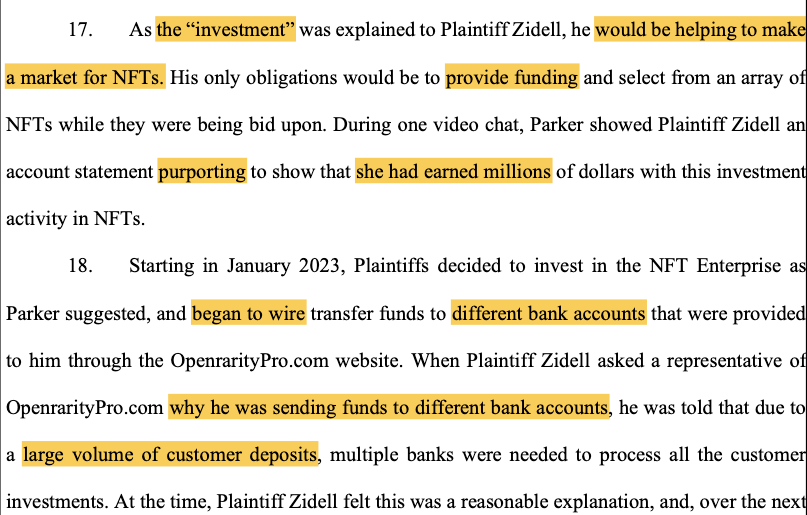
A highlighted excerpt of the complaint detailing the alleged fraud scheme. Source: PACER

He said by April 2023, the website for the platform “was suddenly gone,” along with his millions. 

“Romance scam. Rug pull. Pig butchering. These are just some of the terms to describe the scam that befell the Plaintiffs.”

East West and Cathay allegedly aided fraud

Like his complaint against Citibank, Zidell’s latest lawsuit seeks to hold East West Bank and Cathay Bank liable for negligence and as “aiders and abettors” of securities fraud.

“Defendants through their recklessness, materially aided Parker and her co-conspirators by opening bank accounts, providing services including wire transfers and allowing them to be used to perpetrate the NFT Enterprise scam,” the suit alleged.

It also argued that the two banks had a “duty to exercise due care in monitoring suspicious transactions,” but they “failed to detect clearly suspicious transactions.”

Zidell said the “large, round numbers of funds, among other things, should have triggered the bank’s investigation into the suspicious activity.”

Banks liable for elder abuse, suit alleges

The complaint is also looking to hold East West Bank and Cathay Bank liable for “aiding and abetting elder abuse,” an accusation he didn’t make against Citibank.

Zidell doesn’t mention his age in the complaint, but California law defines an elder as someone 65 years old and over.

His lawsuit seeks compensatory damages, legal costs and interest at a jury trial.

Comments

All Comments

Recommended for you

  • Nexus Chain & Cointime to Host Industry AMA — Unpacking DeFi’s “Missing Layer”

    Nexus Chain will host a global AMA on December 27, 2025, at 20:00 (UTC+8) — “DeFi AMA|Unpacking the Missing Layer in Layer1.” The session will explore a key question facing the industry: as PoS evolves and liquidity remains fragmented, does DeFi still lack a foundational execution layer?

  • Japanese listed company ANAP Holdings increased its holdings of Bitcoin by 127.73.

    according to market sources, Japanese listed company ANAP Holdings has disclosed an increase in its Bitcoin holdings by 127.73 coins. As of now, the company's total Bitcoin holdings have reached 1,346.58 coins, valued at approximately 118 million USD.

  • Changpeng Zhao: Binance Wallet now supports identifying malicious addresses; you will receive a warning if you transfer funds to them.

    Zhao Changpeng posted on Binance Plaza stating, "The cryptocurrency industry should be able to completely eradicate address poisoning attacks and protect users. All wallets should simply check whether the receiving address is a poisoned address and block the user.This is a blockchain query. Wallets should not even display these junk transactions anywhere. If the value of the transaction is very small, filter it out. Security alliances in the industry should maintain a real-time blacklist of these addresses so that wallets can check before sending transactions. Binance Wallet is already doing this. If a user tries to send to a malicious address, they will receive a warning.

  • Bitcoin spot ETFs saw a total net outflow of $189 million yesterday, marking the fourth consecutive day of net outflows.

     according to SoSoValue data, the total net outflow of Bitcoin spot ETFs is 189 million USD.The Bitcoin spot ETF with the largest single-day net outflow yesterday was Blackrock's ETF IBIT, with a single-day net outflow of 157 million USD. Currently, IBIT's total historical net inflow has reached 62.34 billion USD. The second is Fidelity's ETF FBTC, with a single-day net outflow of 15.2979 million USD. Currently, FBTC's total historical net inflow has reached 12.189 billion USD. As of the time of writing, the total net asset value of Bitcoin spot ETFs is 114.289 billion USD, with the ETF net asset ratio (market value as a proportion of Bitcoin's total market value) reaching 6.53%, and the cumulative historical net inflow has reached 57.076 billion USD.

  • BTC falls below $88,000

     market shows BTC fell below $88,000, currently at $87,997.85, 24-hour decline reaches 0.88%, market volatility is significant, please manage your risk accordingly.

  • The U.S. spot Ethereum ETF saw net inflows of $84.59 million yesterday.

     according to Trader T monitoring, the US spot Ethereum ETF had a net inflow of 84.59 million USD yesterday.

  • ETH breaks $3,000

     the market shows ETH breaking through $3000, currently at $3000.08, with a 24-hour decline of 0.38%. The market is highly volatile, please manage your risk accordingly.

  • Binance Wallet launches "secure auto-signature" service

     according to the official announcement, Binance Wallet has launched the "Secure Auto Sign" (SAS) service: it now supports mnemonic/private key wallets to trade on Binance Wallet (web version).

  • Circle minted 500 million USDC on the Solana network.

    according to Onchain Lens monitoring, Circle has minted 500 million USDC on the Solana network. Since October 11, Circle has issued a total of 18 billion USDC on the Solana network.
