


Blockchain security has never been a purely technical problem. It is, fundamentally, a long-term economic challenge. Node operations, consensus maintenance, state verification, and risk response all require continuous and non-discretionary cost coverage. The real point of divergence is not whether a security budget is necessary, but whether its source is structurally sustainable over time.
Across more than a decade of public blockchain development, the most common solution has been token inflation. Through continuous issuance, networks incentivize nodes and participants to provide computation, staking, or consensus participation. This approach has practical value during early-stage bootstrapping. However, it rests on a critical assumption: that security is supported by price expectations rather than by the intrinsic usage of the system itself.
When market sentiment shifts and the marginal effectiveness of inflation incentives declines, security becomes directly exposed to price volatility. For blockchains intended to support real-world assets, this assumption does not hold.
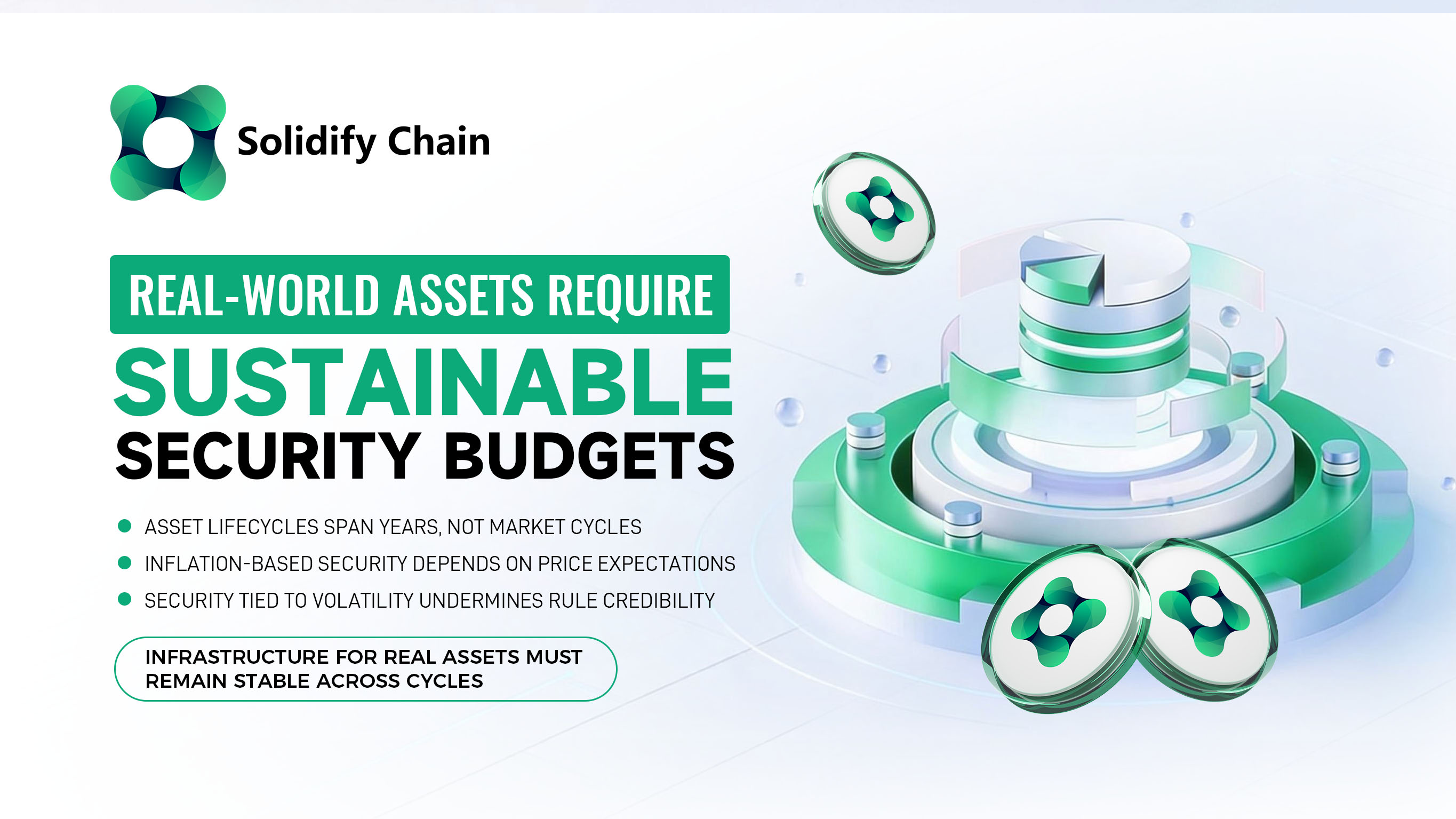
Real-World Assets Require Sustainable Security, Not Temporary Incentives
The operational lifespan of real-world assets is typically measured in years, often decades. Whether infrastructure revenue rights, corporate cash flows, or long-lived financial structures, their primary requirement is not short-term activity, but the consistent execution of rules across market cycles.
If a blockchain’s security budget relies primarily on inflation incentives or secondary market trading intensity, then during market downturns it is not the application layer that weakens first, but the credibility of the protocol itself. Such uncertainty is incompatible with the expectations of institutional participants, asset managers, and regulatory counterparts.
For this reason, Solidify Chain deliberately avoids the long-term path of “trading inflation for security.” Instead, it reduces the security question to a more fundamental assessment:
Can the protocol, through genuine usage, continuously obtain the resources required to sustain its own operation?
Protocol-Level Fees: Anchoring Security Budgets to Real Activity
Solidify Chain’s economic structure is not built on application-layer revenue sharing or transaction matchmaking. The protocol does not operate applications, nor does it participate in market behavior. What it provides are a set of non-substitutable, protocol-level capabilities: asset registration, compliance enforcement, lifecycle management, and settlement.
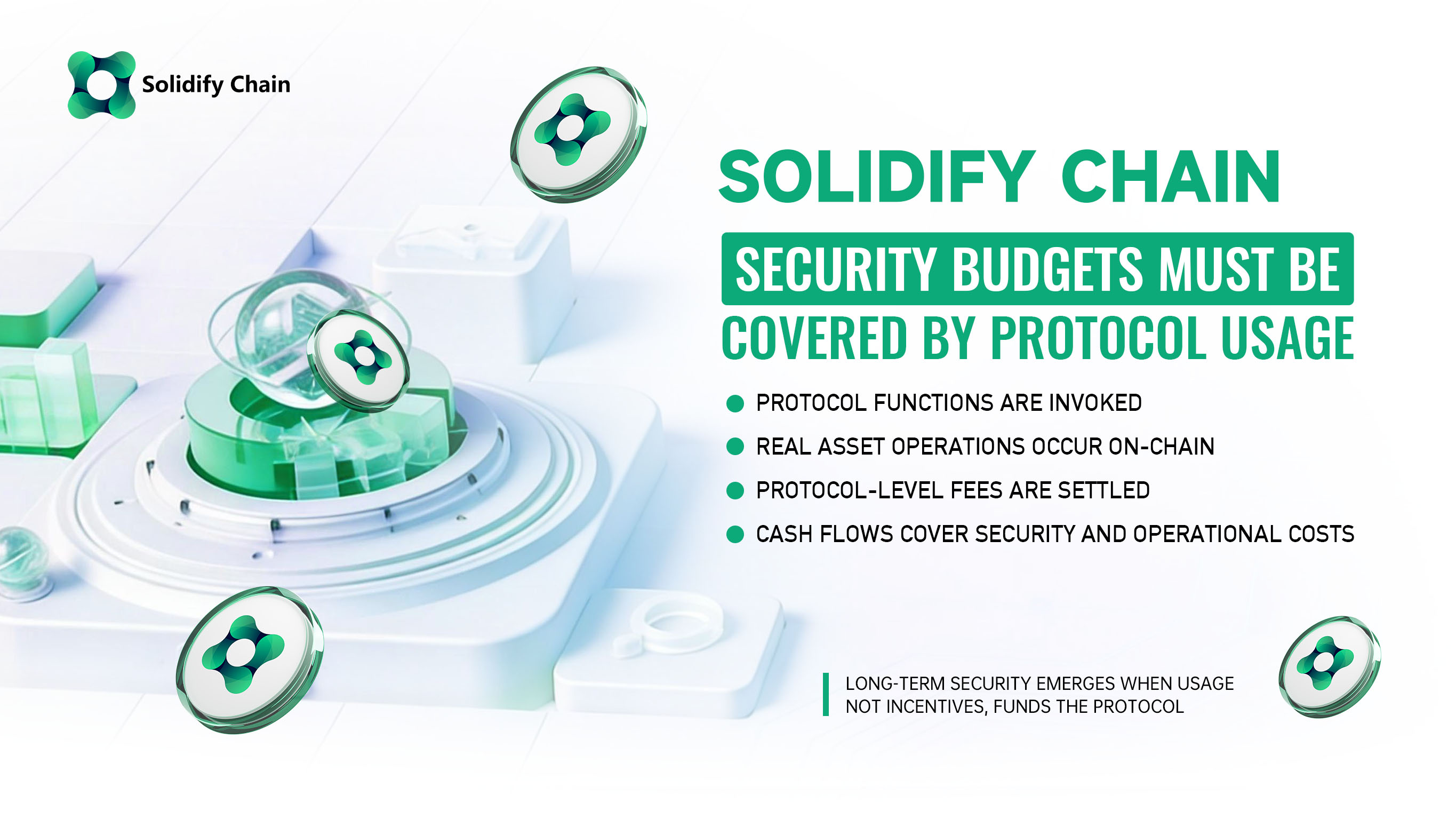
When these capabilities are invoked, they constitute protocol usage and trigger protocol-level fee settlement according to predefined rules. These fees are not the result of commercial optimization, but a prerequisite for system operation—comparable to clearing fees, custody fees, or infrastructure service charges in traditional financial systems.
Crucially, these fees do not originate from token speculation or traffic-driven dynamics. They arise directly from the on-chain operation of real-world assets. As asset scale grows, lifecycles lengthen, and settlement and management actions increase in frequency, the protocol’s cash flows become more stable. This creates a structural linkage between security budgets and actual system usage, rather than market sentiment.
From Incentive-Driven Security to Cash-Flow-Covered Security
As protocol-level cash flows accumulate, Solidify Chain does not treat them as discretionary revenue. Instead, they are incorporated into clearly defined allocation and utilization paths enforced by protocol rules.
A portion of these resources covers long-term costs such as network operation, node maintenance, compliance obligations, and risk reserves. Another portion flows back into the network’s security mechanisms, supporting node participation and system stability. This process is executed automatically by the protocol, not through ad hoc governance decisions.
As protocol usage expands, network security gradually transitions from being incentive-driven to being covered by cash flows. Under this structure, even as inflation incentives diminish over time, the system can continue to sustain its security budget through real settlement activity.
This design does not prioritize short-term efficiency. It is engineered for long-term sustainability.
Why This Structure Is Better Suited for RWA
Real-world assets are ill-suited to systems that depend heavily on market expectations. They require infrastructure that can execute rules reliably across price volatility, market cycles, and shifts in sentiment.
By anchoring security budgets directly to protocol usage, Solidify Chain avoids the path dependency of subsidizing infrastructure through speculative activity. Protocol security is not determined by whether the token is in an upward cycle, but by whether the system continues to serve the issuance, management, and settlement of real assets.
This grants the network greater structural resilience across cycles and aligns it more closely with the operating logic of traditional financial infrastructure.
Conclusion
Blockchains are not inherently trustworthy. Trust emerges when rules can be executed consistently over time—and rule execution ultimately depends on whether sustainable resources are available to support it.
What Solidify Chain is building is not a network that relies on inflation to maintain security, but a system sustained by protocol-level cash flows derived from real asset settlement behavior.
When security is no longer “purchased” through incentives, but “sustained” through settlement, blockchains can begin to function as long-term infrastructure that real-world assets can truly depend on.


All Comments