


Obtaining comprehensive NFT and statistical analysis data for wallet addresses is crucial for both developers and investors. Specifically, for developers, acquiring complete asset data for each wallet and conducting statistical analysis forms the foundation for building wallet management tools and asset analysis applications. These applications require comprehensive and accurate representations of the asset allocations for each wallet. For investors, analyzing the asset data of wallets provides insights into the asset structures and transaction patterns of important accounts, which is crucial for making investment decisions. Accurately representing the full asset situation for each wallet address is an indispensable foundation for both development and investment, providing essential insights and support for participants in the NFT ecosystem. Transparency and credibility of the data also contribute to enhancing trust and cooperation in the market, driving innovation and development in the NFT field.According to NFTScan data, as of September 28th, there have been a total of 147,965,427 NFT assets generated on the Ethereum blockchain, with 256,154,198 on-chain records, and 10,199,868 wallet addresses that have interacted with NFTs.

NFTScan EthereumTraditionally, obtaining and analyzing this full dataset required a significant amount of manual work. However, now developers and investors can programmatically access asset statistics data for each wallet, including multi-chain NFTs and holding values, by calling relevant statistical APIs. NFTScan provides Account Statistics APIs, greatly assisting developers in easily obtaining digital asset statistics data for various wallet addresses. This streamlines and optimizes the process of fetching and analyzing on-chain data, providing a solid foundation for building wallet analysis, asset management, and other applications. It also makes research and investment decision-making based on on-chain data more efficient.
Before using the NFTScan API, you need to visit the developer website and create an account. Go to the NFTScan official website and click the “Sign Up” button for NFTScan API registration.NFTScan Developer

Sign Up (NFTScan Developer Platform)After logging in, find your unique API KEY on the Dashboard and copy it. Visit the API documentation and input your API KEY as guided. You can then start using the API service. In the API documentation, developers can find various interface modes to choose from based on their needs.

Dashboard (NFTScan Developer Platform)In the Dashboard, developers can also view statistics on their API usage, helping to track historical usage data. Moreover, NFTScan provides each registered developer with 1M CU (Call Units) of API calls, allowing access to all NFT API interfaces, and CU never expires.
After successfully registering as a developer and obtaining your API Key, you need to review the NFTScan API documentation. The API documentation includes all available API endpoints and parameters, along with detailed instructions on how to build requests and handle responses. Carefully read the API documentation and ensure you understand how to use the API to retrieve the data you need.
NFTScan API services aim to enhance developers’ experience in obtaining NFT data analysis. NFTScan currently boasts the largest and most comprehensive NFT Collection library, supporting full NFT data for Ethereum, Solana, BNBChain, Bitcoin, Polygon, zkSync, Aptos, Linea, Base,TON,Avalanche, Arbitrum, Optimism, Fantom, Moonbeam, PlatON, Cronos, and Gnosis on 18 blockchains.The covered NFT data is diverse, providing a complete set of interfaces for accessing ERC721 and ERC1155 assets, transactions, projects, market statistics, and more. It supports over 50 public interfaces for EVM-compatible chains and a set of similar interfaces for Solana, Aptos, and Bitcoin, satisfying developers’ needs to index various types of NFT data.

1)Account Overview Statistics: /v2/statistics/overview/{account_address}
This API allows developers to programmatically obtain a comprehensive overview of digital asset statistics for a specified Ethereum wallet address. Developers only need to input the wallet address they want to query, and the API can return multidimensional statistical information, including the quantity of NFTs and other multi-chain assets held at that address, specific asset holdings, overall value distribution, recent transaction activity overview, and more. The data on asset allocation provides a comprehensive view of the asset profile of a wallet address. By directly calling this API, you can obtain a complete wallet asset statistical analysis. This API provides essential data interfaces for building applications such as wallet management, asset data analysis, and investment decision support. You can refer to the NFT Account Overview

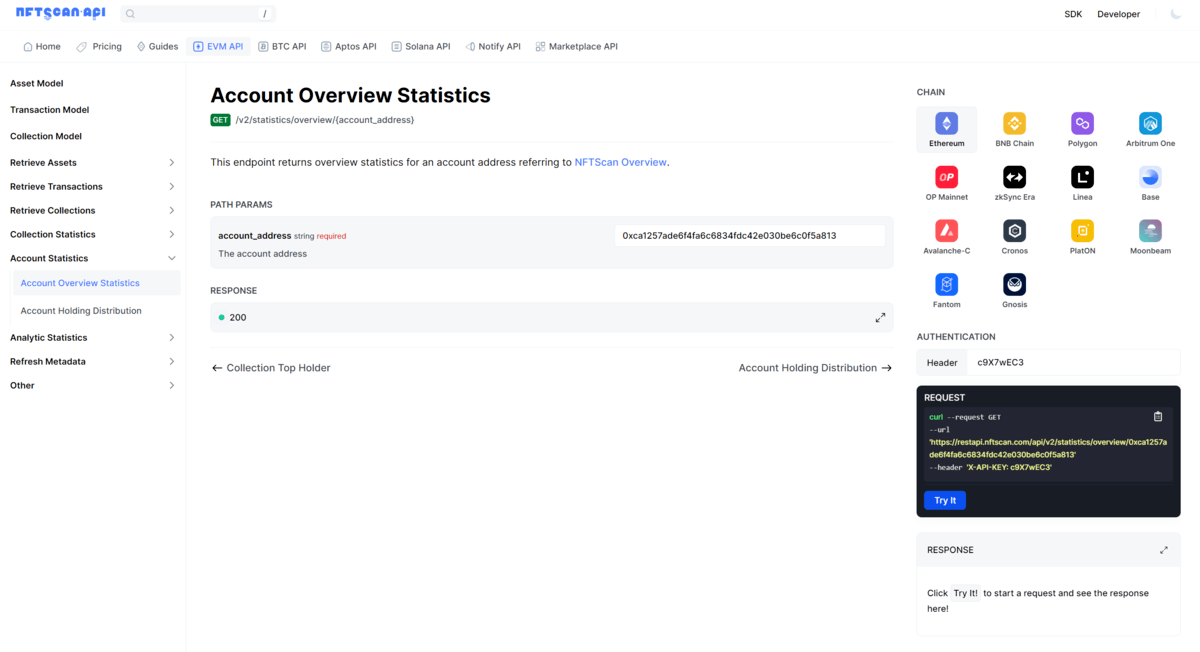
Developers can select a wallet address using the EVM multi-chain option in the top right corner. Here, we have chosen the Ethereum whale address as an example:0xca1257ade6f4fa6c6834fdc42e030be6c0f5a813
After inputting their API key, they can click "Try it," and the data returned will display 16 pieces of information:
"holding_value":822.3818
"bought_value":212.81
"sold_value":669.24
"gas_value":0.9
"holding_value_usdt":1329807.82
"bought_value_usdt":344118.03
"sold_value_usdt":1082174.46
"gas_value_usdt":1455.32
"holding_count":652
"mint_count":291
"bought_count":8
"sold_count":70
"send_count":105
"receive_count":645
"burn_count":23
"collection_count":360

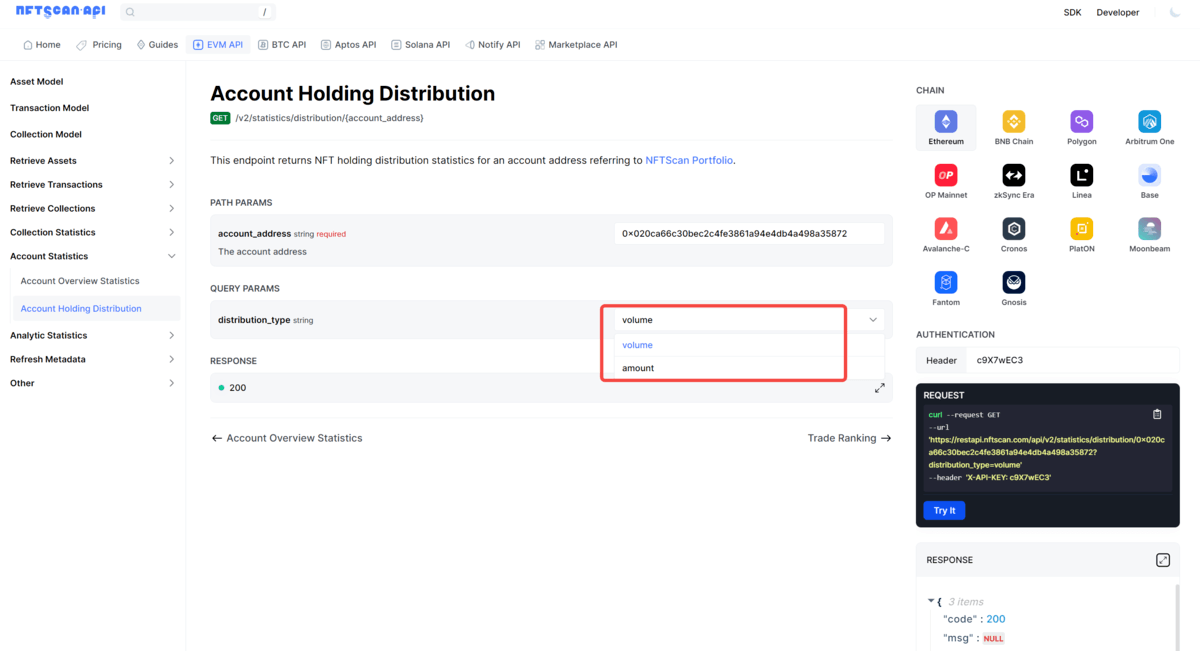
2)Account Holding Distribution: /v2/statistics/distribution/{account_address}
This interface provides statistical information about the distribution of NFT holdings for an account address. Developers can call this interface and pass the account address parameter to obtain detailed information about all NFT holdings for that account address. This includes the total quantity of held assets and statistical data such as asset quantity and total value categorized by NFT Collection. Developers don't need to handle on-chain data themselves, and this provides essential data support for building asset analysis and portfolio management applications. For more details, you can refer to NFTScan Portfolio
For path parameters, here, the address 0x020ca66c30bec2c4fe3861a94e4db4a498a35872 has been selected. Query parameters include volume/amount, which respectively return NFT holding distribution statistics based on transaction volume and quantity.
—"contract":"0xbc4ca0eda7647a8ab7c2061c2e118a18a936f13d"
"name":"BoredApeYachtClub"
"value":3549.6
"proportion":"73.05%"
—"contract":"0xc73b17179bf0c59cd5860bb25247d1d1092c1088"
"name":"QQL Mint Pass"
"value":682.5
"proportion":"14.05%"
—"contract":"0x60e4d786628fea6478f785a6d7e704777c86a7c6"
"name":"MutantApeYachtClub"
"value":368.6
"proportion":"7.59%"
—"contract":"0x3c6fbc94288f5af5201085948ddb18aded2e6879"
"name":"DeFiApes"
"value":137.8
"proportion":"2.84%"
—"contract":"0x7a63d17f5a59bca04b6702f461b1f1a1c59b100b"
"name":"Winds of Yawanawa by Yawanawa and Refik Anadol"
"value":41.6
"proportion":"0.86%"
—"contract":NULL
"name":"other"
"value":78.96
"proportion":"1.63%"

When developers locate the Account Statistics-related interfaces and parameters in the NFTScan API documentation, they can use their preferred programming languages (such as Python, Java, JavaScript, etc.) to call these interfaces, write API request code to obtain account statistics data. Developers can conveniently organize interface parameters, initiate requests, and process returned data.
NFTScan's SDK library also offers seamless deployment of smart contracts and methods and functionalities for invoking common contract definitions through the NFTScan API, eliminating the need for developers to master Solidity, compile code, or import ABI. By using the SDK, developers can easily execute calls in JavaScript on supported networks. Furthermore, the SDK clearly defines standard read and write methods, with the read methods available for trial through an interactive REST API.
For example, here, we make a request to the /v2/statistics/distribution/{account_address} interface to retrieve NFT distribution details for a specific address.
Step 1: Import Necessary Libraries and Modules
First, you need to import the necessary libraries and modules to make HTTP requests and handle response data in your code. In Python, you can use the requests library for these tasks. Make sure you have the library installed, and if not, you can install it using "pip install requests."

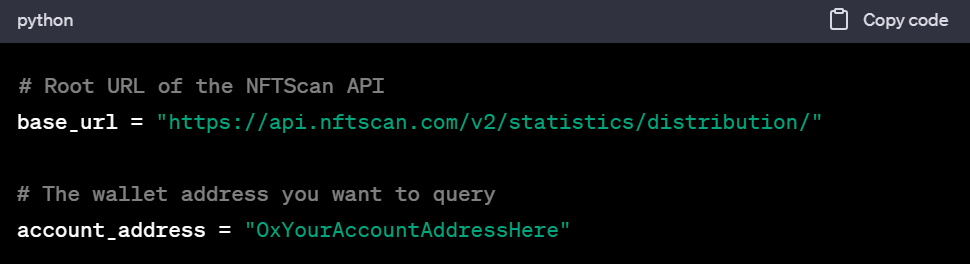
Step 2: Configure Basic Information for the API Request
In this step, you need to configure the basic information for the API request, including the root URL of the API and the required parameters. Here, you will replace the {account_address} parameter with the wallet address you want to query.
Step 3: Build the API Request
Build the API request using the requests library. This typically involves specifying the type of HTTP request (GET, POST, etc.) and request headers (if needed). Here, we will initiate a GET request.

Step 4: Handle the API Response
Finally, you need to handle the data from the API response. Typically, the API will return data in JSON format, and developers can use Python's built-in JSON parser to parse the response.

This is a basic example of using Python to make an NFTScan Account Holding Distribution API request. Please note that developers can add error handling and data processing logic as needed to meet specific requirements.
NFTScan aims to provide developers with streamlined and optimized data interfaces, accelerating their application development and innovation in the NFT space. By offering high-quality, consistent, and reliable NFT data, NFTScan enables developers to build applications more rapidly while reducing the burden of parsing and processing raw NFT data. This greatly benefits developers by eliminating the need to repeatedly develop basic functionalities for fetching and handling NFT data, allowing them to focus more on application innovation and core business logic development. NFTScan provides developers with a reliable data infrastructure, making it a crucial tool for building NFT applications.
NFTScan is the world’s largest NFT data infrastructure, including a professional NFT explorer and NFT developer platform, supporting the complete amount of NFT data for 18 blockchains including Ethereum, Solana, BNBChain, Arbitrum, Optimism, and other major blockchains, providing NFT API for developers on 16 blockchains.
Official Links:


All Comments