
Cointime

Download App
iOS & Android

Three reasons why Ether traders expect ETH to hold above $1.8K

Validated Media

Ether’s (ETH) recent sell-off was stopped at $1,800, as bulls aggressively defended the level. Ether’s rebound above $2,100, along with on-chain and technical data, suggests that traders will hold the price above $2,000 for the short-term.

Key takeaways:

  • Ether’s profitability metrics drop to levels that have historically marked local bottoms.
  • The MVRV Z-score and pricing bands suggest ETH price drop to $1,800 was the bottom.
  • ETH price bounced off a multi-year trendline that has marked previous macro lows.

Ether traders realize losses

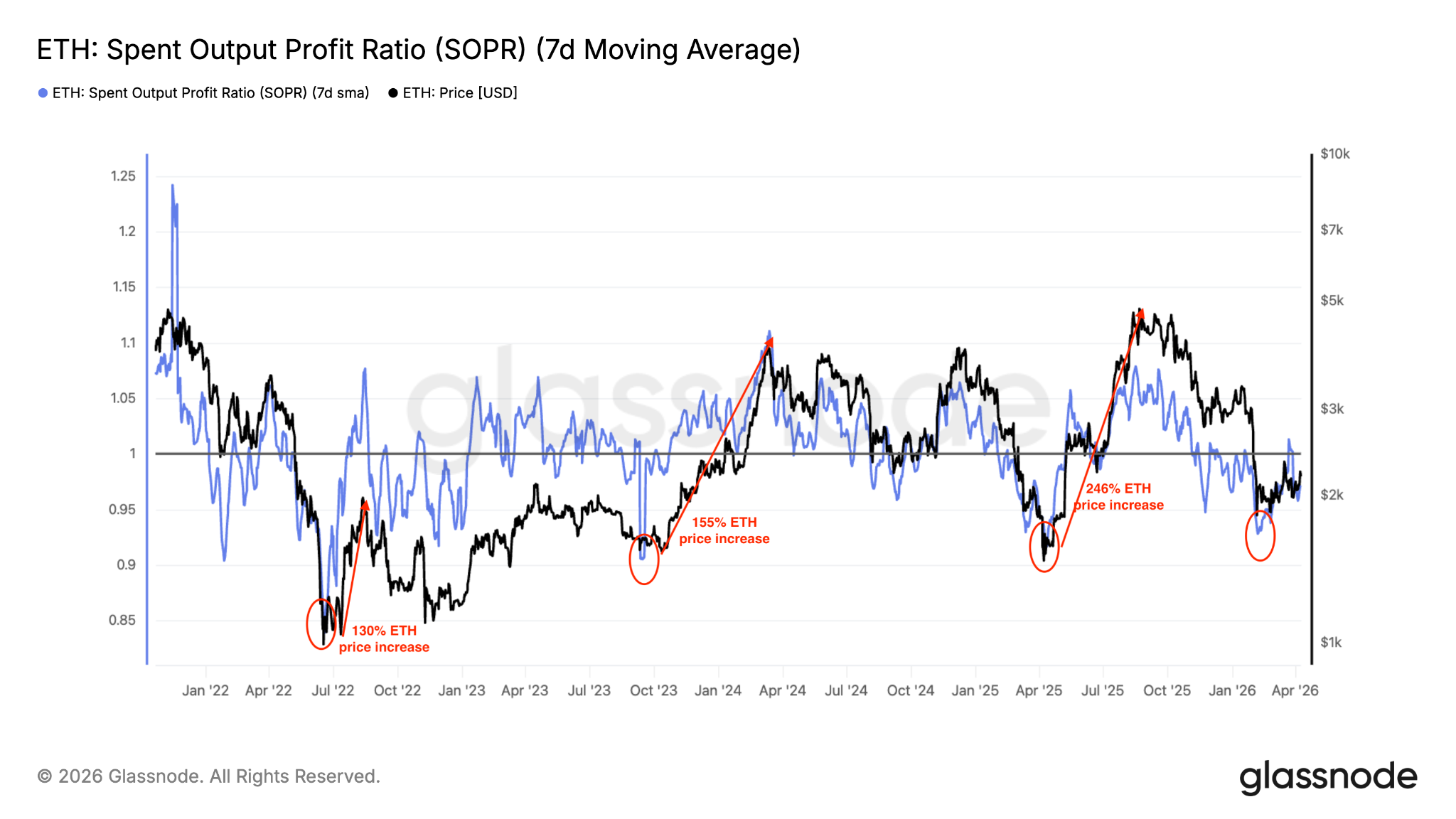
Onchain data shows that Ether’s Spent Output Profit Ratio (SOPR) is at 0.96, suggesting ETH investors are still selling at a loss. 

This metric dropped as low as 0.92 on Feb. 6, implying that Ether’s price drop to $1,800 was driven by traders realizing losses amid panic and extreme fear.

SOPR measures the profit or loss of spent ETH outputs by comparing the value of coins when they were last moved to their value when they are spent again. 

A value below 1 might suggest capitulation or a market bottom, potentially signaling a good time to buy.
Ether SOPR. Source: Glassnode


Historically, this scenario has often preceded price recoveries. When SOPR fell to 0.86 following Ether’s drop to $1,500 in April, it was followed by a 246% price recovery to its current all-time high of $4,950. 

Similar scenarios in 2022 and 2023 were followed by 130% and $155% ETH price rallies, respectively.

As such, some investors saw the drop to $3,000 as an opportunity to buy.

MVRV Z-Score suggests Ether bottomed at $1,800

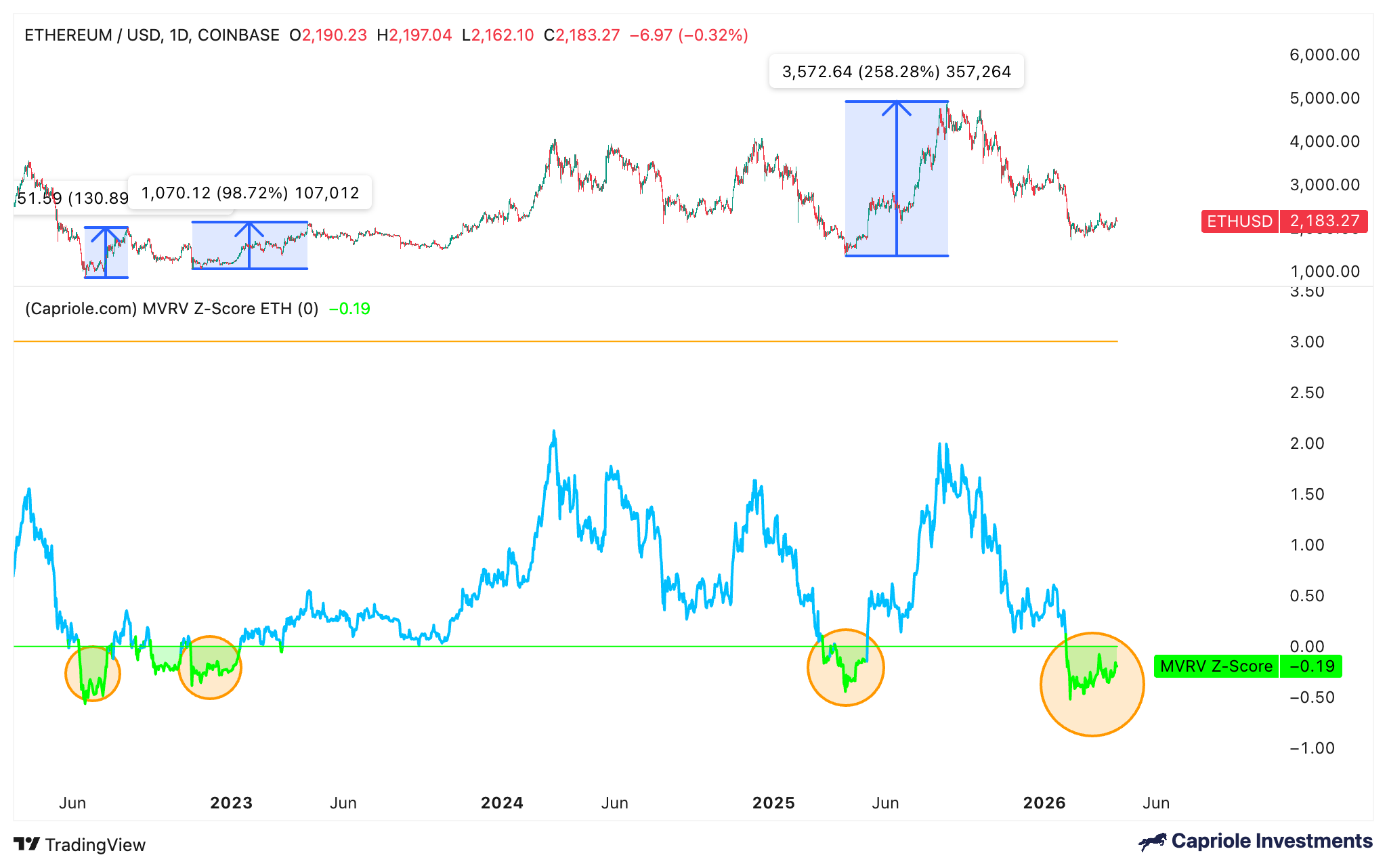
Ether’s MVRV Z-Score, a key onchain metric used to identify market tops and bottoms, has dropped into the historical accumulation zone (the green line in the chart below), strengthening the argument that ETH may have found a bottom.
Ethereum: MVRV Z-score. Source: Capriole Investments


The last time Ether’s MVRV Z-score fell to the current levels was in April 2025, after a 66% price drawdown. This coincided with a macro market bottom at $1,400 and preceded a multi-month rally, with the ETH/USD pair rising 258% to its current all-time high of $4,950. 

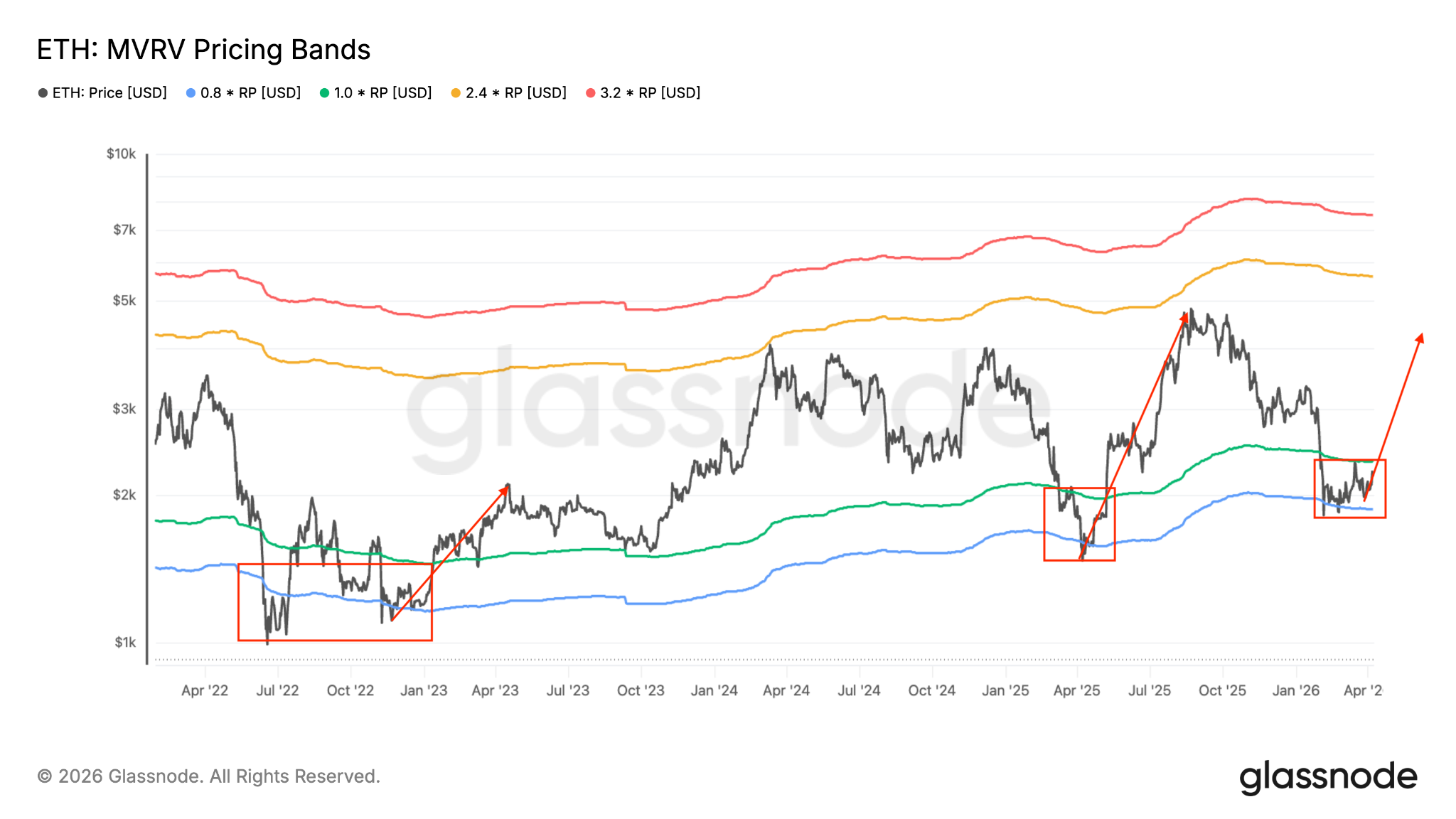
Meanwhile, the 0.80 MVRV pricing band, which has historically marked cycle bottoms, is currently at $1,880. 
ETH: MVRV pricing bands. Source: Glassnode


This indicates that, from an onchain perspective, Ether is undervalued and may continue the ongoing recovery, potentially rising toward dense liquidity clusters between $2,400 and $2,600 in the short term.

ETH price sits on strong support above $1,800

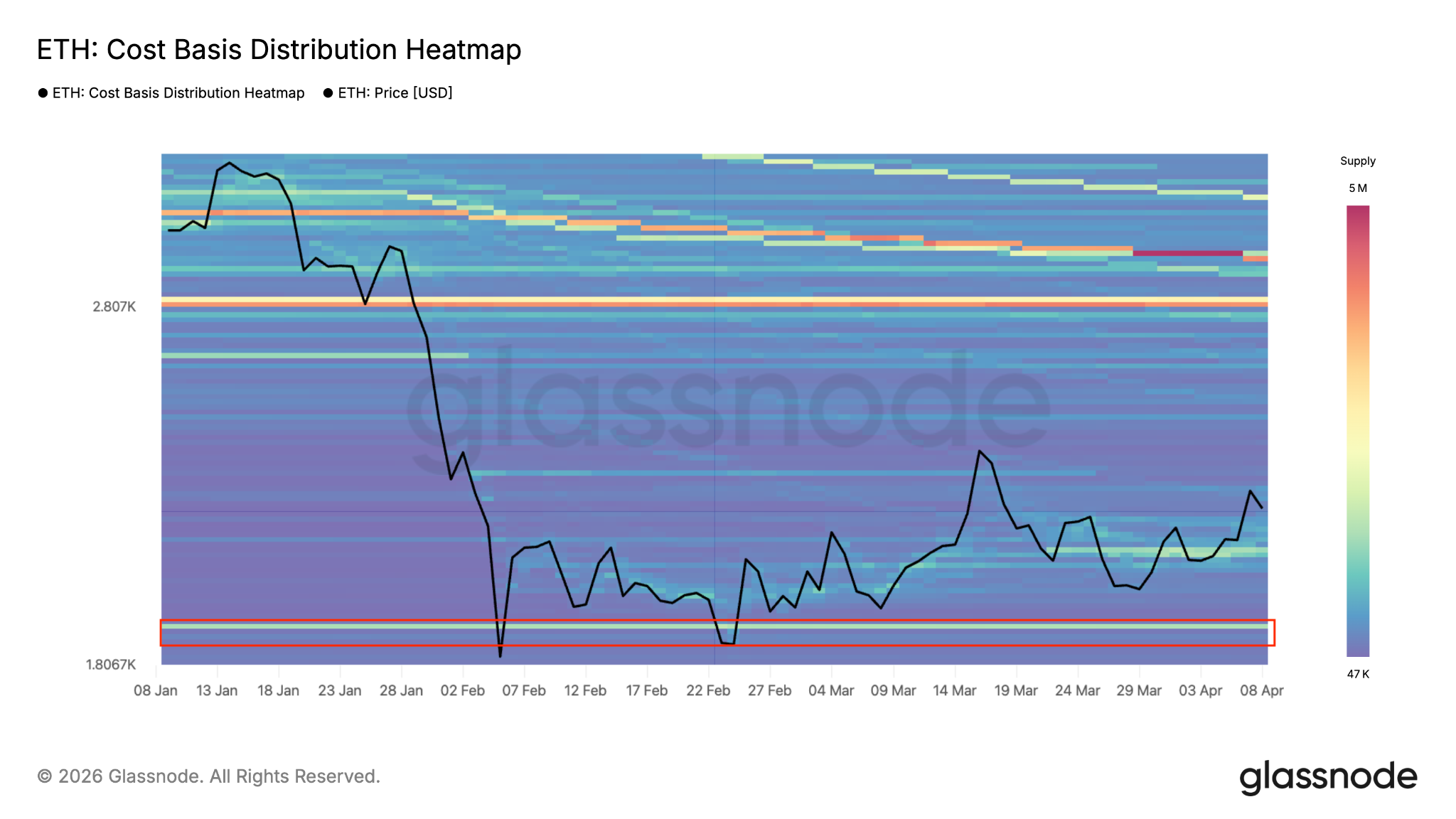
Data from TradingView shows that ETH price has successfully held above a key support zone over the last two months, as illustrated in the chart below.

This is the area around $1,800, where investors acquired more than 1.35 million ETH, according to Glassnode’s cost basis distribution heatmap.
ETH cost basis distribution heatmap. Source: Glassnode


This level aligns with a multi-year trendline that has historically marked the bottom for ETH/USD, as seen in 2022 and in April 2025.
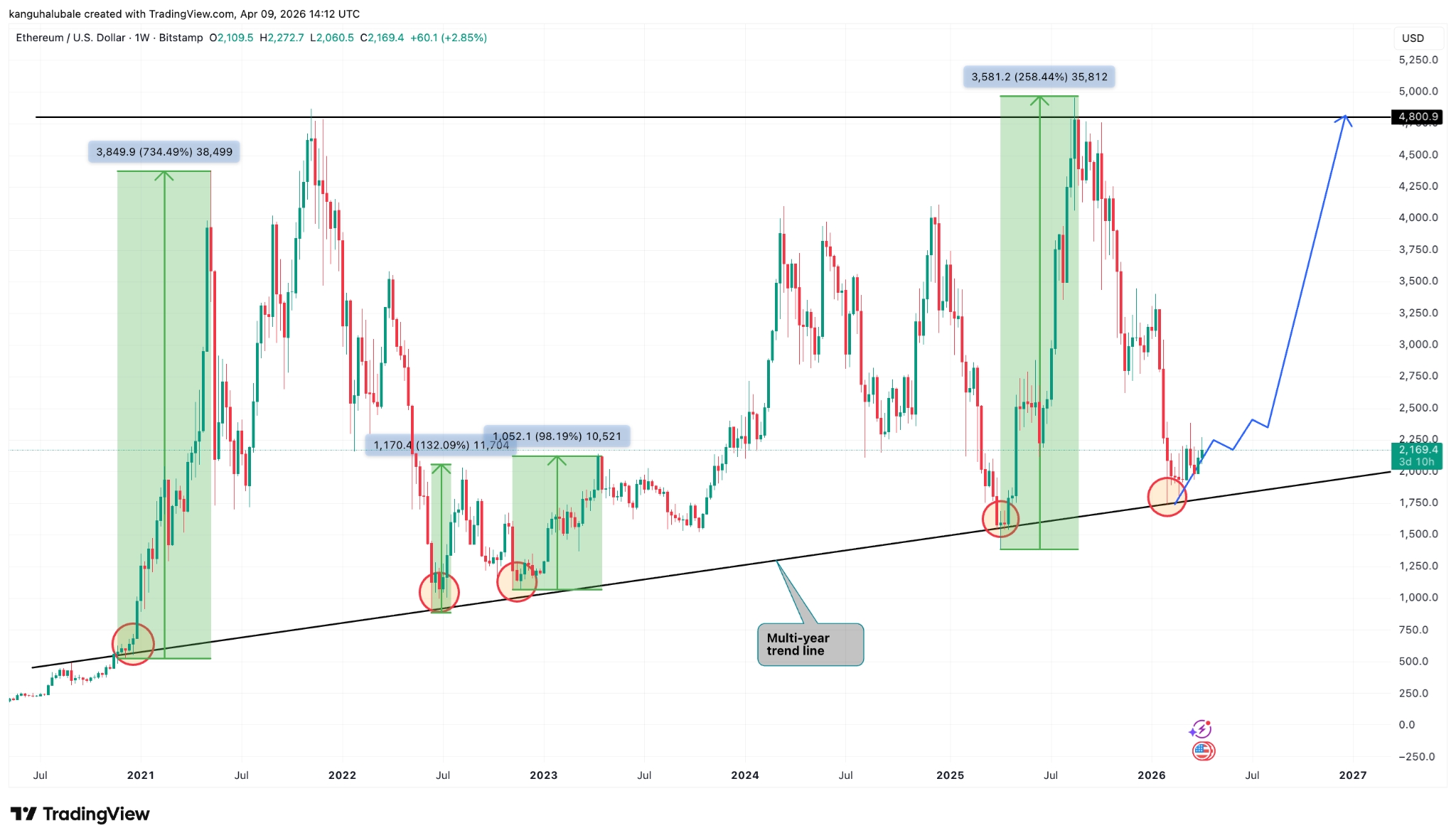
  ETH/USD weekly chart. Source: Cointelegraph/TradingView


Ether’s rebound from this level in early February suggests the trendline still holds as support, paving the way for a sustained recovery toward $4,800.

As Cointelegraph reported, a drop below $2,000, where the 20-day EMA and the 50-day SMA converge, could see the price drop toward the next major support at $1,750.

Comments

All Comments

Recommended for you

  • SK Hynix Completes 40 Trillion Won Share Buyback

    On October 21, according to Yonhap News Agency, SK Hynix's large-scale share buyback, following that of Samsung Electronics, also concluded on the 21st. SK Hynix announced that it completed a two-month share buyback worth 40 trillion won (approximately 30.213 billion USD) on the Korea Securities Exchange (KOSPI) on that day. Previously, SK Hynix had declared an investment of 40.0434 trillion won to repurchase 24.07 million shares of the company, with all shares to be canceled after the buyback is completed. This buyback represents about 3.3% of the company's total issued shares and is the largest share cancellation operation by a listed company in South Korea. The originally announced buyback period was from August 20 to November 19, but the actual buyback was completed approximately one month ahead of schedule.

  • BTC Surpasses $83,000

    Market data shows that BTC has surpassed $83,000, currently priced at $83,116.53, with a 24-hour increase of 1.81%. The market is highly volatile, so please ensure proper risk management.

  • Hang Seng Tech Index Declines by 1%

    On October 21, the Hang Seng Tech Index saw its decline widen to 1%, while the Hang Seng Index fell by 0.7%. Kuaishou Technology dropped over 12%, and CATL fell by more than 11%.

  • UK Government Debt Exceeds £3 Trillion for the First Time

    On October 21, the UK government's borrowing in the first six months of this fiscal year exceeded expectations, highlighting the constraints faced by Chancellor of the Exchequer Jeremy Hunt ahead of his first budget announcement next week. From April to September, the UK's fiscal deficit widened to £97.8 billion (approximately $130 billion), which is £6 billion higher than the forecast made by the Office for Budget Responsibility (OBR) in March. In September, government borrowing reached £24.5 billion, surpassing both the OBR's predictions and the levels from the same period last year. This set of data reflects the latest state of public finances ahead of the budget announcement on October 28, where Hunt must outline the policy direction for Prime Minister Rishi Sunak's new government while avoiding panic in the bond market, as concerns grow over the high level of UK government debt. The total UK government debt has now exceeded £3 trillion for the first time. Despite the UK economy demonstrating strong resilience against energy shocks caused by the Middle East conflict and tax revenues exceeding OBR forecasts, government borrowing has still been higher than expected for the fiscal year 2025 to 2026 so far.

  • Oman Crude Premium to Dubai Falls to Nearly 3-Month Low as Middle East Oil Exports Remain Resilient

    On October 21, a key crude oil benchmark in the Middle East dropped to its lowest level in nearly three months, indicating that despite escalating attacks on shipping by Iran, the region's oil exports are showing strong resilience. According to General Index data, this week, the premium of Oman crude over Dubai crude fell to around $4 per barrel, the lowest level since late July. This price difference reflects the strength of the physical crude oil market in the Gulf region. In the early stages of the conflict, this premium soared to over $60 per barrel as the Strait of Hormuz was nearly closed. Despite the risk of attacks, major oil-exporting countries in the Middle East have successfully allowed more tankers to pass through the waterway or completely bypassed the Strait of Hormuz via pipelines. These efforts have weakened Iran's attempts to leverage its position by disrupting global energy flows.

  • Korean Stocks Close Up Over 3%

    On October 21, the South Korean KOSPI index closed up 182.93 points, an increase of 3.29%, reaching 5735.67 points. Samsung Electronics rose by 5.67%, while SK Hynix increased by 5.8%.

  • President Trump: Large Data Centers Must Generate Their Own Power and Benefit Communities

    On October 21, President Trump stated that newly constructed large—sometimes even giant—data centers must generate their own power and either return excess electricity to the local community or sell it to the grid. This way, electricity prices are not only unlikely to rise but may actually decrease significantly! Other relevant parties should take similar measures! If businesses want their data centers to be welcomed, they should pay 'dividends' to the community and/or individuals within the community. I have closely observed this process: data centers that were initially very unpopular in certain areas became highly favored after reaching economic compensation agreements. Reaching agreements and building data centers is greatly beneficial for the United States!

  • Two Whales Open Long Positions on Nearly 30,000 ZEC in 15 Hours on Hyperliquid

    On October 21, according to on-chain analysis platform Lookonchain, two whale addresses opened long positions totaling 29,798 ZEC with 10x leverage on Hyperliquid within the past 15 hours, valued at approximately $37.57 million. The data shows that address 0x30af…6393e opened a long position of 14,800 ZEC at an average price of $1,243.28 (approximately $18.65 million, isolated margin), while address 0xbf73…5d58 opened a long position of 15,000 ZEC at an average price of $1,217.06 (approximately $18.91 million, full margin). Based on the current price of about $1,260.5, the unrealized profits for both addresses are approximately $255,000 and $655,000, totaling about $910,000.

  • French AI Planning Software Company Pigment Raises $250 Million at $2.3 Billion Valuation

    On October 21, Bloomberg reported that French AI business planning software company Pigment announced the completion of a $250 million funding round, reaching a valuation of $2.3 billion. This round was led by Scaleup Europe Fund, with participation from Nvidia, World Innovation Lab, Iconiq, IVP, and Meritech Capital. CEO Eléonore Crespo stated that the company plans to attract Asian investors to accelerate its business expansion in Asia. Founded in 2019, Pigment primarily offers a financial and business planning platform for enterprises and has launched agentic AI features; its annual recurring revenue (ARR) has surpassed $100 million.

  • Samsung Plans to Transition Xi'an Factory to 286-Layer Flash Chip Production by 2027

    According to reports, sources indicate that Samsung plans to transition its Xi'an factory in China to the production of 286-layer flash chips by 2027. Meanwhile, SK Hynix intends to produce chips with 240 layers and above at its factory in Dalian, China. (Golden Ten)