

Cointime

Download App
iOS & Android

Tezos Approaches The ‘Mumbai Upgrade’, What’s Next For XTZ?

Tezos (XTZ) network is readying itself for its latest upgrade, called the ‘Mumbai Upgrade.’ On January 17, Nomadic Labs, which is a blockchain developer within the Tezos community, mentioned the Tezos protocol proposal, Mumbai, which is headed toward the implementation process.

This will be the 13th upgrade made to the Tezos network. This upgrade will implement various new features. The main features include transfer tickets between accounts and a much shorter block time of 15 seconds.

Further, this upgrade will add Epoxy, a new technology on Mainnet, which is precisely a validity rollup that can also be referred to as a new layer 2 scaling solution.

The Mainnet will gain further strength due to Epoxy, which introduces SNARKs’ proof-of-validity, which will be the reason for quicker transactions.

This 13th upgrade, which is called the ‘Mumbai Upgrade’ will be implemented after a number of tests are carried out. However, once implemented, the system will get closer to Tezos’ target of achieving one million transactions per second, according to the Nomadic Lab’s report.

The implementation of the upgrade will, as a consequence, increase the value of Tezos’ native token XTZ. The price of the altcoin, XTZ, has reacted positively to this development. XTZ experienced a price reversal, but the altcoin has since resumed its bullish momentum.

Tezos Price Analysis: One-Day Chart
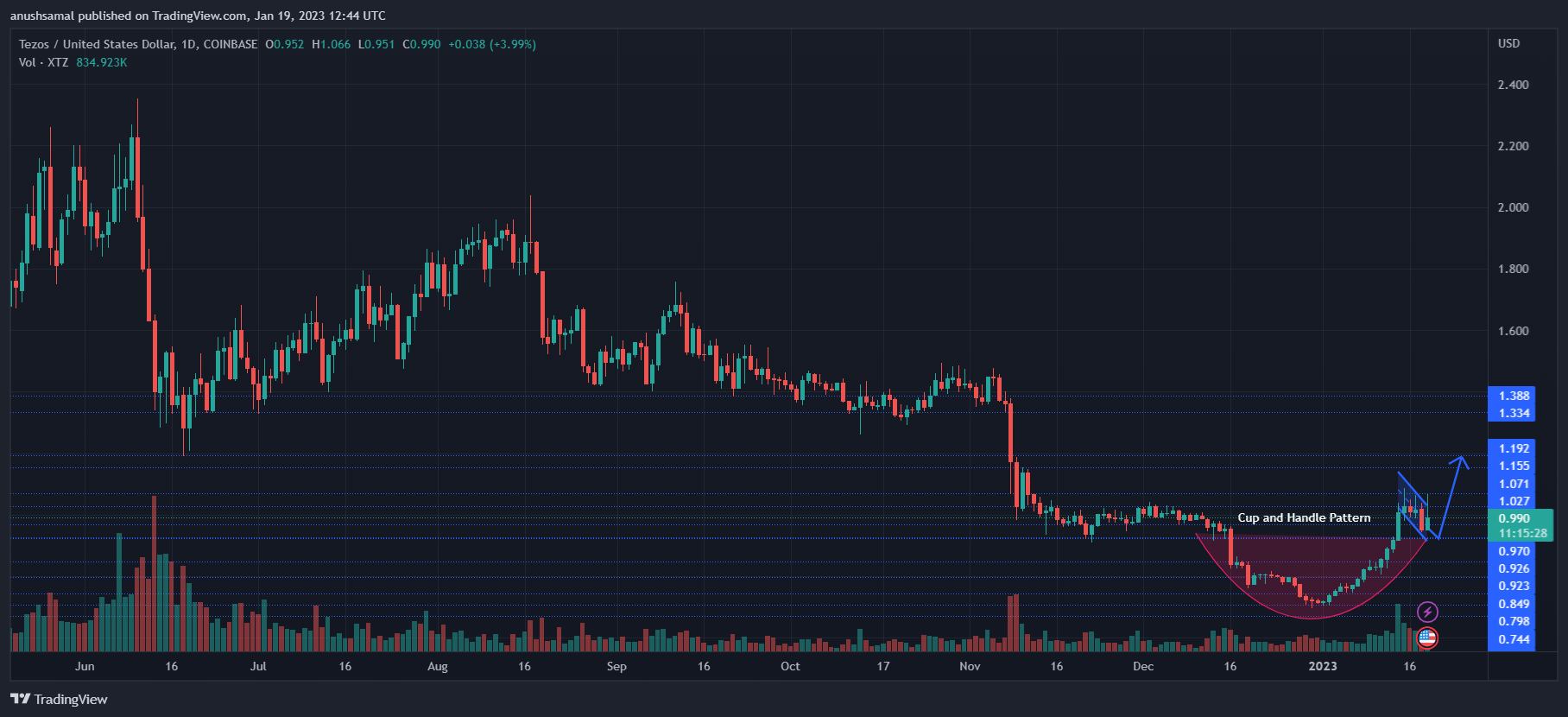
Tezos was priced at $0.99 on the one-day chart | Source: XTZUSD on TradingView

XTZ was trading at $0.99 at the time of writing. Although the coin started to retrace over the 48 hours, it has regained bullish momentum on the chart. The altcoin has formed a prominent cup-and-handle trading pattern, which is an extension of bullish momentum.

This change in price momentum can be attributed to the announcement of the ‘Mumbai Upgrade’. Immediate resistance to XTZ stands at $1.02, but the coin is expected to retrace to $0.97.

Once it reaches the $0.97 mark, Tezos can target $1.19, which will mean an 18% appreciation. Over the last week, the coin managed to surge over 8%. The amount of XTZ traded in the last session increased, signifying an increased amount of buying.

Technical Analysis
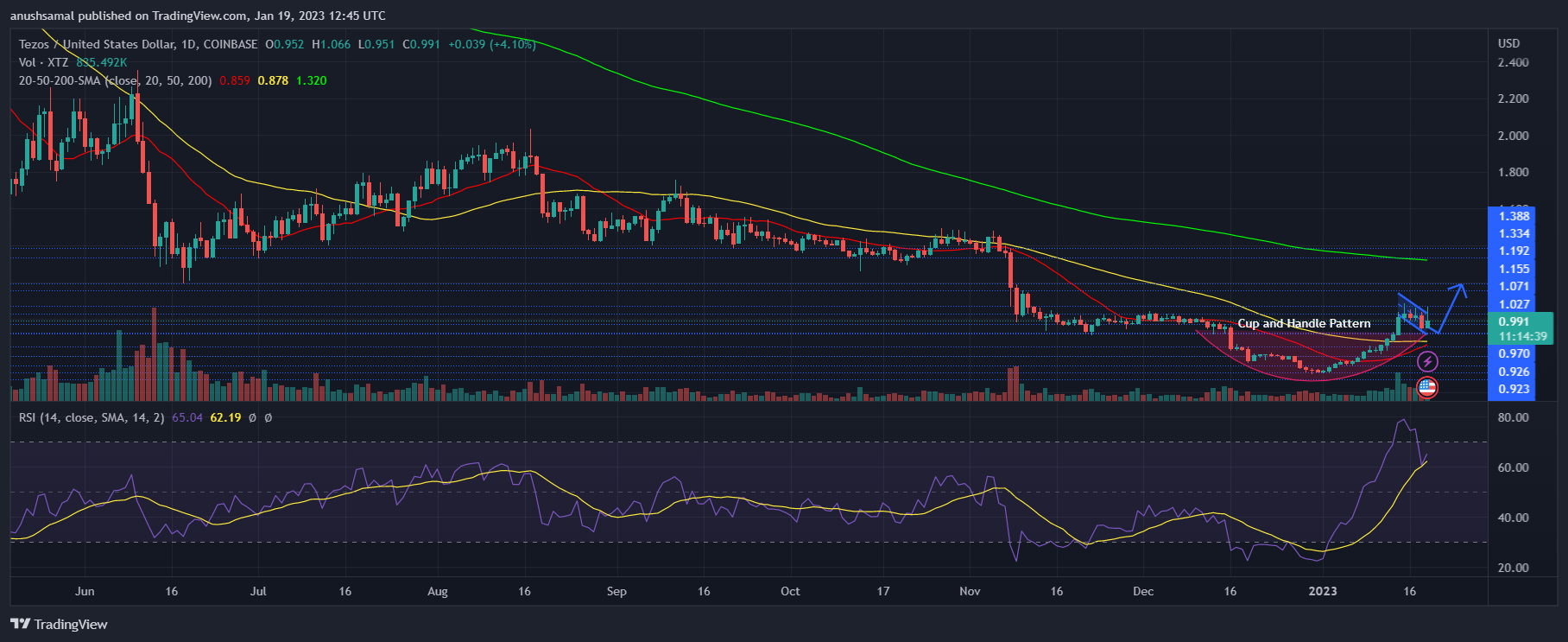
Tezos noted an uptick in buying strength on the one-day chart | Source: XTZUSD on TradingView

XTZ had secured a multi-month high with regard to the buying pressure it witnessed. The Relative Strength Index (RSI) touched the 80 mark a few trading sessions ago, signifying an overvalued tendency.

Often, a coin that is overbought experiences a price correction and a fall in demand; Tezos also displayed the same, but at press time, the RSI again noted an uptick.

This uptick could mean that the altcoin might head back close to the 80-mark. This unusual uptick can be because of the newest development.

On the same note, XTZ rose above the 20-Simple Moving Average (SMA), which indicated that buyers were driving the price momentum.

The coin was above the 50-SMA (yellow) line too. So with increased accumulation, XTZ can soon breach the 200-SMA (green) line.

Overall, Tezos remains quite optimistic on the chart; however, the coin has to remain above its local support line of $0.97 for the uptrend to continue.


Comments

All Comments

Recommended for you

  • Zhipu Launches and Open Sources GLM-5.3-Flash

    On August 26, Zhipu launched and open-sourced GLM-5.3-Flash (320B-A18B), the first native multimodal model in the GLM-5 series. It features a total of 320 billion parameters and surpasses GLM-5.2, achieving a score of 57 on the globally recognized Artificial Analysis Intelligence Index (AA Comprehensive Intelligence Index), placing it among the leading models worldwide, on par with Anthropic's popular model Claude Opus 4.8. In the self-developed Z.ai Code Bench evaluation, its programming performance is comparable to that of Claude Opus 4.8. Additionally, GLM-5.3-Flash is priced at 1/10 of GLM-5.3, and during a limited-time discount, it is priced at 1/20 of GLM-5.3, which is 1/40 of Opus 4.8. The same intelligence at 1/40 the price, cutting-edge capabilities without the need to hold back.

  • Zhipu Launches and Open Sources GLM-5.3-Flash

    On August 26, Zhipu launched and open-sourced GLM-5.3-Flash (320B-A18B), the first native multimodal model in the GLM-5 series. It has a total of 320 billion parameters and surpasses GLM-5.2, achieving a score of 57 in the globally recognized Artificial Analysis Intelligence Index (AA Comprehensive Intelligence Index), placing it among the leading models worldwide, on par with Anthropic's popular model Claude Opus 4.8. In the self-developed Z.ai Code Bench evaluation, its programming performance is comparable to that of Claude Opus 4.8. Meanwhile, GLM-5.3-Flash is priced at 1/10 of GLM-5.3, and during a limited-time discount, it is available for 1/20 of GLM-5.3's price, which is 1/40 of Opus 4.8's price. The same intelligence, at 1/40 the cost, provides cutting-edge capabilities without the need to hold back.

  • Ethereum Developers Propose Restructuring Validator Staking Contract to Prepare for Quantum Attacks

    On August 26, Ethereum researchers proposed a draft to rebuild the validator deposit contract in preparation for the future introduction of quantum-resistant signature mechanisms, allowing for a gradual phase-out of the existing BLS signature format. This proposal enables the deposit contract to support keys of different sizes and public key types, assigning labels for each cryptographic scheme, with the current BLS signature labeled as 0 and potential future quantum-resistant schemes receiving new labels. Currently, approximately 42.4 million ETH, worth around $10.4 billion, are staked in Ethereum, all relying on BLS validator keys. This draft is still in its early stages and must be implemented alongside subsequent consensus layer upgrades, with the Ethereum Foundation's overall quantum resistance roadmap targeting around 2029.

  • Ethereum Developers Propose Restructuring Validator Staking Contract to Prepare for Quantum Attacks

    On August 26, Ethereum researchers proposed a draft to rebuild the validator deposit contract in preparation for the future introduction of quantum-resistant signature mechanisms, allowing for a gradual phase-out of the existing BLS signature format. This proposal enables the deposit contract to support keys of different sizes and public key types, assigning labels for each cryptographic scheme, with the current BLS signature labeled as 0, and future quantum-resistant schemes to be assigned additional labels. Currently, approximately 42.4 million ETH, valued at around $10.4 billion, are staked in Ethereum, all relying on BLS validator keys. The draft remains in its early stages and must be implemented alongside subsequent consensus layer upgrades, with the Ethereum Foundation's overall quantum resistance roadmap targeting around 2029.

  • Spot Gold Falls Below $4600/Ounce

    On August 26, spot gold fell below $4600 per ounce, declining by 1.30% during the day.

  • Spot Gold Falls Below $4600/Ounce

    On August 26, spot gold fell below $4600 per ounce, declining by 1.30% during the day.

  • SEC Submits New Crypto Custody Regulations Proposal to White House

    On August 26, Bloomberg reported that the U.S. Securities and Exchange Commission (SEC) has submitted a proposal to the Office of Management and Budget (OMB) regarding new regulations for investment advisors holding client digital assets. The rule aims to 'clarify the framework for investment advisors and investment companies to custody crypto assets,' addressing inquiries from institutions on how to comply with the custody of digital assets. It plans to eliminate certain existing custody requirements that are considered 'outdated' due to market evolution and current trading and custody practices. This proposal is seen as a step by financial regulators to advance the current administration's crypto agenda while relevant legislation remains stalled in the Senate. It will take effect after review by the OMB, a vote by SEC commissioners, and a public comment period.

  • BTC Falls Below $78,000

    Market data shows that BTC has fallen below $78,000, currently priced at $77,983.75, with a 24-hour decline of 1.03%. The market is experiencing significant volatility, so please ensure proper risk management.

  • BTC Falls Below $78,000

    Market data shows that BTC has fallen below $78,000, currently priced at $77,983.75, with a 24-hour decline of 1.03%. The market is experiencing significant volatility, so please ensure proper risk management.

  • Alibaba Qwen Releases Qwen 3.8-Flash Model

    On August 26, Alibaba Qwen launched the Qwen 3.8-Flash model, which is a multimodal MoE model and an early preview of the Qwen 4 architecture. The production version of Qwen 3.8-Flash will soon be available through the Qwen Cloud API, priced at just $0.16 per million input tokens and $0.47 per million output tokens. The model features 125 billion parameters plus 51 billion N-gram embedding parameters, but activates only 6 billion parameters per token, achieving high cost-effectiveness.