

President Lee Jae-myung’s rise to South Korea’s highest office marks the return of a left-leaning populist with deep working-class roots and bold plans for institutional crypto integration.
Though crypto was not directly mentioned in Lee’s inauguration speech on June 4 after the impeachment of his predecessor, Yoon Suk Yeol, Lee now leads the country with a list of crypto promises made during his campaign.
His administration is expected to accelerate the integration of digital assets into Korea’s regulatory and financial systems on the back of the Democratic Party’s Digital Asset Committee.
Lee’s rise from a teenage factory worker to a human rights lawyer has shaped his reputation as a reformist. After narrowly losing the 2022 election, in which he campaigned on universal basic income, he returned with revised promises focused on a “basic society,” advocating shorter work weeks and targeted basic income.
Despite his victory, Lee begins his term under the shadow of ongoing controversies, including real estate scandals, alleged illegal funding to North Korea and a 2024 stabbing he survived.

President Lee backs crypto for big money
Lee is expected to oversee major crypto policy changes in South Korea, including the likely enactment of the Digital Asset Basic Act (DABA). The progress began under Yoon, who campaigned on it but couldn’t see it to fruition due to his premature dismissal.
Recently, the Democratic Party formed a Digital Asset Committee led by lawmaker Min Byoung-dug, who is aiming to pass DABA through the National Assembly this year. Min said in a recent local media interview that the bill will propose a legally recognized self-regulatory body, a stablecoin approval system and clearer rules for crypto service providers.
Lee also championed approving spot crypto exchange-traded funds (ETFs), which are currently banned under existing law, and allowing the National Pension Service to invest in digital assets.
Regulatory discussions on crypto ETFs were already heating up before the election, and the Financial Services Commission has launched a phased strategy to bring institutional investors into crypto. His main election rival, Kim Moon-soo, backed the same initiatives.
What set Lee’s crypto policies apart was his proposal to launch a won-based stablecoin. A flashy stablecoin can spark painful memories for South Korean investors who bet on a homegrown multibillion-dollar failure: the Terra project and its algorithmic stablecoins. Lee’s stablecoin contrasts with Terra as he proposed a centralized, fiat-backed currency consistent with global regulatory trends.
Digital Asset Committee leader Min said innovation should come from the private sector. He cited the example of promoting won-based stablecoins in Southeast Asia by leveraging K-culture: South Korean content like K-pop and K-dramas.
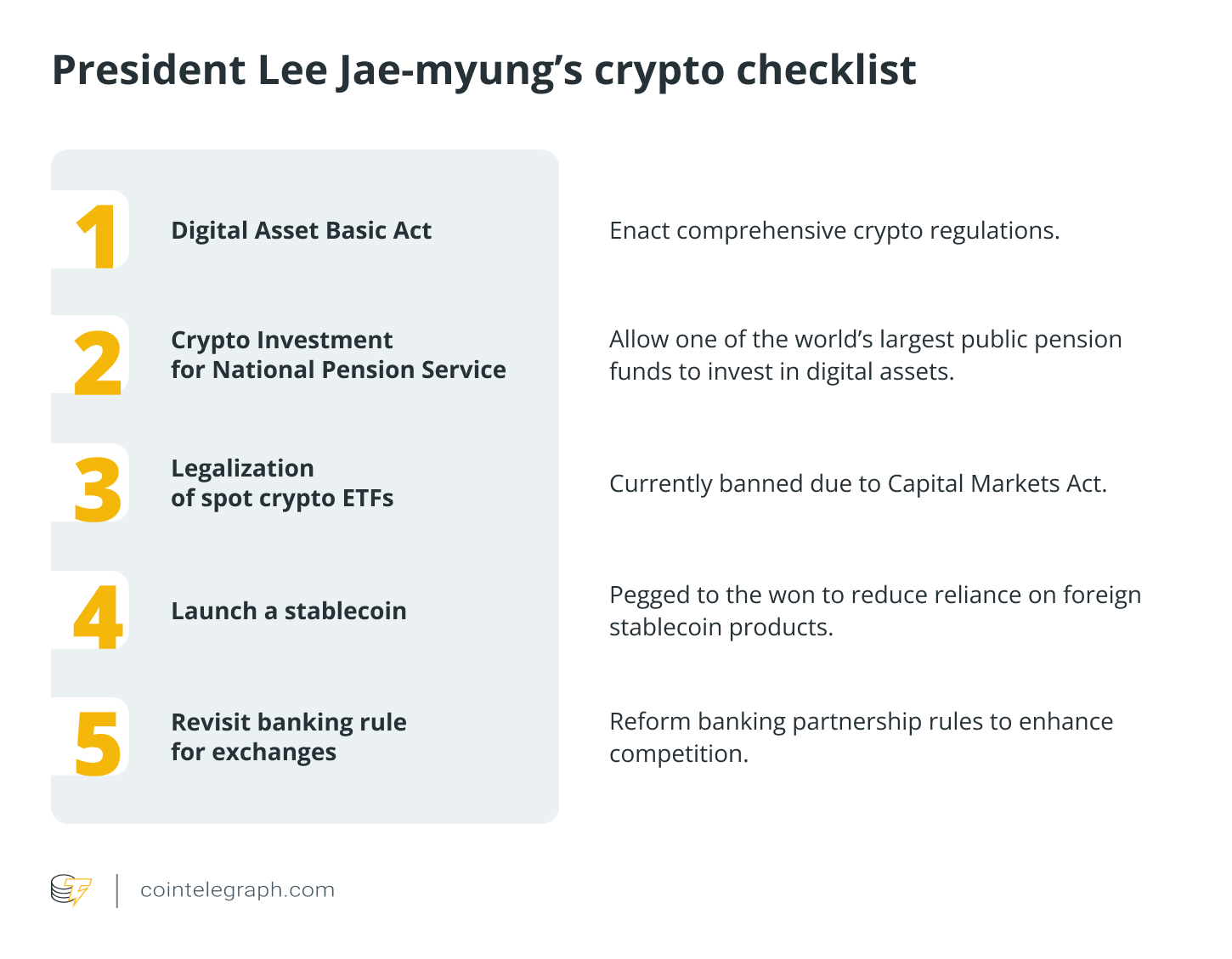
Lee has voiced support for small and medium-sized enterprises and startups, consistent with his underdog narrative. He also advocates revising the “one exchange, one bank” rule, which has resulted in a monopolistic environment for domestic crypto exchanges.
President Lee’s diplomacy and plans for North Korea
One of the key issues South Korean voters weigh when choosing a president is their stance on North Korea. Lee has pushed to open communications channels for dialogues and peace talks with the North.
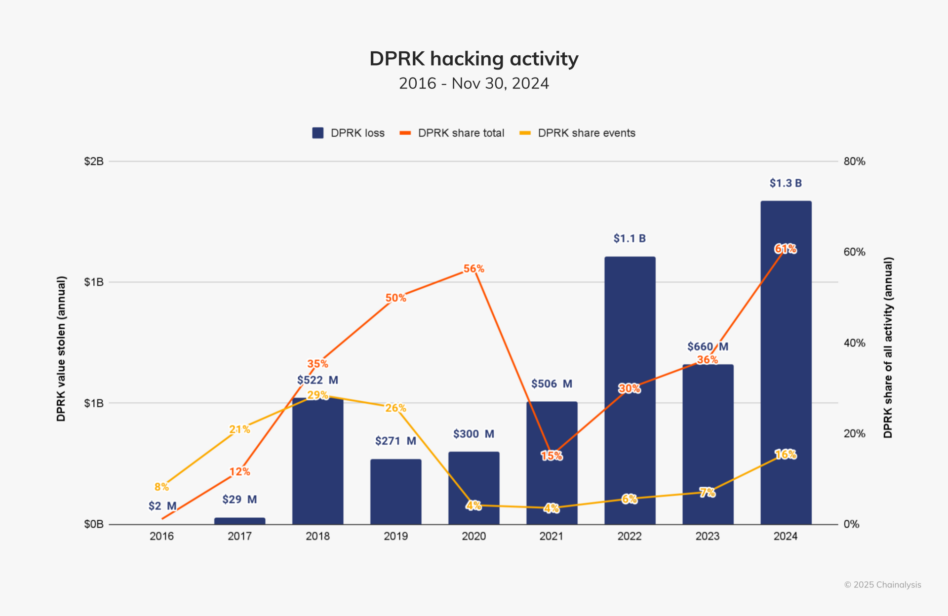
Pyongyang is a disruptive player in the global crypto space. It has been linked to the largest cryptocurrency heist in history, and its state-sponsored hackers have reportedly posed as freelancers and job applicants to infiltrate crypto firms — all to allegedly fund its weapons program.
Former president Yoon, a conservative, adopted a hardline approach to the North, reversing many of the diplomatic overtures made under his predecessor Moon Jae-in, who led from 2017 to 2022.
Lee has emphasized maintaining strong ties with the US and Japan while seeking better relations with China. Yoon’s administration was widely viewed as having alienated Beijing. Meanwhile, Lee’s calls for “balanced diplomacy” have drawn mixed reactions — seen by some as pragmatic, by others as a potential drift from South Korea’s traditional Western alliances.
Following Lee’s victory, Chinese President Xi Jinping vowed to strengthen relations between the two nations.
Lee will be under a microscope to keep his promise of easing political instability. Yoon’s controversial declaration of martial law before his impeachment shocked the international community. It marked South Korea’s second presidential impeachment in less than a decade.
In response, Lee has pledged to reinforce democratic institutions and prevent future abuses of power. His reform proposals include separating investigative and prosecutorial powers and amending the constitution to allow presidents to serve two four-year terms instead of a single five-year term.
New president’s ongoing legal hurdles
Lee rose as a populist outsider and built support by positioning himself against Korea’s elites and embracing working-class rhetoric. His combative style, especially online, has won over disaffected voters but has drawn criticism for fueling a toxic political climate and promoting conspiracy thinking.
That same polarizing approach has followed him into the courtroom. Lee’s political rise has been shadowed by a series of legal battles, with five major cases still ongoing.
- Election law violation: The Supreme Court ruled that Lee made false statements during his 2022 presidential campaign. The case has been remanded to the Seoul High Court, with a remand trial scheduled for June 18.
- Corruption charges: Prosecutors allege that during his tenure as Seongnam City mayor, Lee colluded with private developers in a property project, resulting in profits but losses for the city. This trial is ongoing at the Seoul Central District Court.
- Misuse of public funds: While serving as governor of Gyeonggi Province, Lee was accused of using public funds for personal expenses. This case is being heard at the Suwon District Court.
- Illegal money transfer to North Korea: Lee is alleged to have been complicit in transferring funds to North Korea in 2018, violating multiple laws, including the Foreign Exchange Transactions Act and the Inter-Korean Exchange and Cooperation Act. This trial is also at the Suwon District Court.
- Subornation of perjury: Lee is accused of inducing a witness to provide false testimony in a 2019 trial. Although a lower court acquitted him, prosecutors appealed, and the case is currently before the Seoul High Court.
President Lee’s first case is on June 18
For South Korea’s crypto industry, Lee Jae-myung’s presidency is a long-awaited regulatory green light, signaling legitimacy, fewer bottlenecks and a move beyond a compliance-first culture toward deeper integration with traditional finance.
Initiatives like spot crypto ETFs, pension fund exposure and a won-based stablecoin all point to one of the world’s most active retail crypto markets accelerating efforts to onboard the institutional sector that has long remained on the sidelines.
Many of these policies were already in motion before Lee’s campaign and were supported by both major parties. As a result, investors had broadly expected a crypto-friendly administration regardless of the election outcome.
Lee’s June 4 inauguration speech did not directly mention crypto or blockchain, but subtle references to AI and emerging technologies suggest that crypto may fall under the broader umbrella of fintech and digital infrastructure.

However, Lee enters office under the cloud of ongoing legal battles. The most closely watched is the retrial for violating the Public Official Election Act, with the first hearing scheduled for June 18.
It remains unclear whether the trials will proceed as scheduled. A key legal question is whether Article 84 of the Constitution — which grants the president immunity from criminal prosecution — also applies to trials that were already underway before the election.
Since this is the first time a South Korean president has taken office while already facing criminal charges, legal experts remain divided.


All Comments