

Cointime

Download App
iOS & Android

SEC crypto guidance puts the 'final nail' in the Gensler era: Analyst

The recent guidance from the United States Securities and Exchange Commission (SEC) and the Commodity Futures Trading Commission establishing a taxonomy for digital assets put a “final nail” in the coffin of SEC policy under former Chairman Gary Gensler, according to Alex Thorn, the head of firmwide research at investment firm Galaxy.

The SEC guidance, published on Tuesday, established a taxonomy for digital assets, dividing them into five categories, including digital commodities, digital collectibles like non-fungible tokens (NFTs), digital tools, stablecoins, and tokenized securities. 
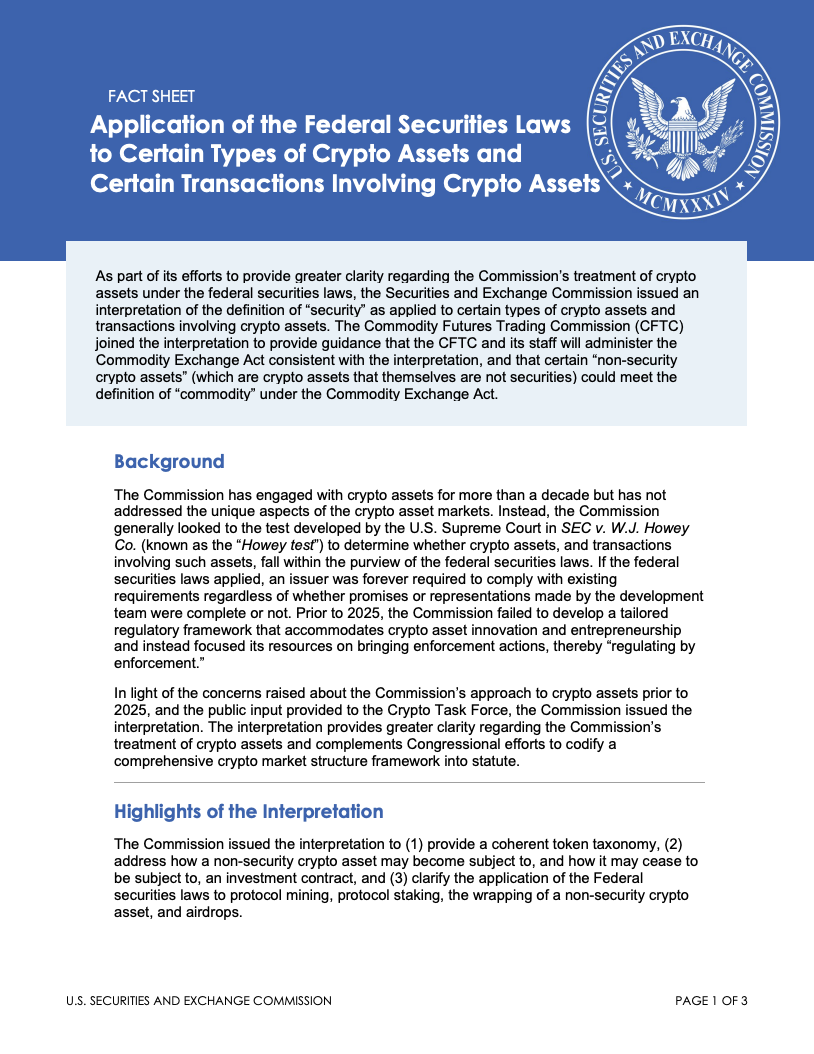
  The SEC guidance published on Tuesday establishes which digital assets qualify as securities. Source: SEC


Under the old SEC policy framework, the regulations governing which cryptocurrencies met the legal criteria of “investment contracts” were legislative rules, as opposed to the new 2026 guidance that was filed as an interpretive rule, Thorn said. He explained the significance:

“The distinction matters enormously under the Administrative Procedure Act (APA). A legislative rule or substantive rule goes through notice-and-comment rule-making, has the force and effect of law, and binds both the agency and regulated parties. 

An interpretive rule is exempt from notice-and-comment requirements, does not have the force of law, and merely explains how the agency understands existing statutory provisions,” he continued. 

The interpretive rule does not legally bind courts to enforce the policies, which gives the SEC and the crypto industry flexibility in adapting to future regulatory changes, he added.

The new regulatory approach gives the crypto industry much-needed clarity over the next 30 months, Thorn Said; however, he clarified that the CLARITY crypto market structure bill must be codified into law to cement the rules over the next several decades. 

The CLARITY Act stalls, but rumors emerge of a tentative deal between White House and lawmakers

The CLARITY Act stalled in January 2025, after crypto exchange Coinbase and other industry players voiced concerns over the prohibition on stablecoin yield and a lack of protections for open-source software developers.

Crypto companies and industry thought leaders also cited provisions that would effectively gut the decentralized finance (DeFi) sector by imposing reporting requirements and know-your-customer controls on DeFi as a major cause of contention. 
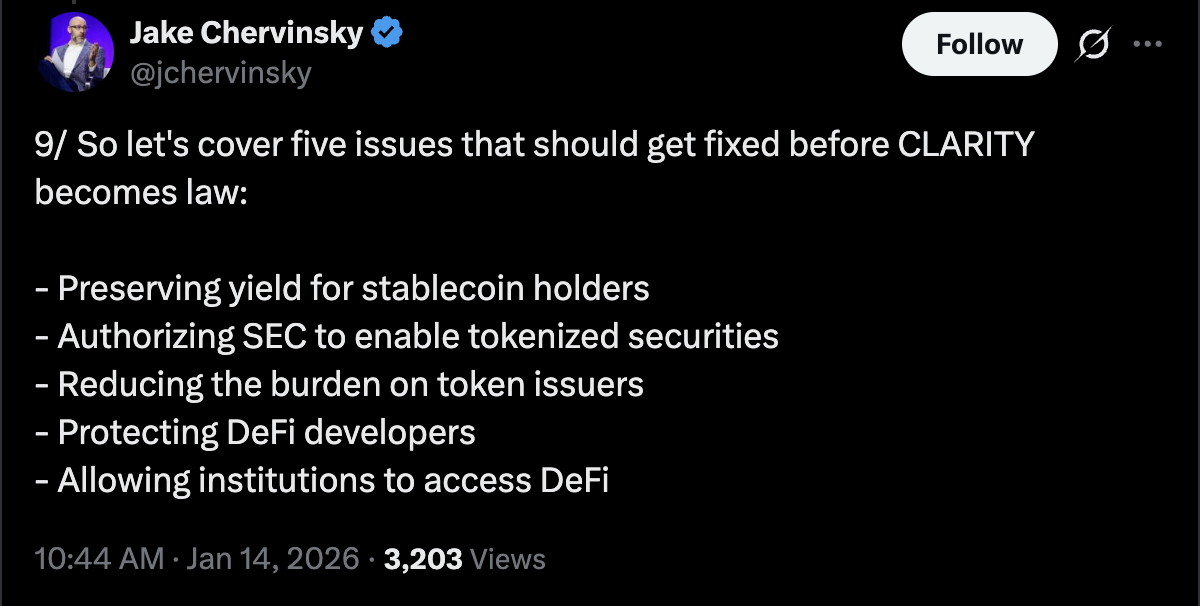
  Source: Jake Chervinsky


On Friday, Politico published a report of a tentative deal between the White House and lawmakers to move the CLARITY bill forward.

Specific details of the prospective deal have not yet been revealed, although Senator Angela Alsoboorks said the tentative deal includes a ban on stablecoin yield from “passive balances.” 

Comments

All Comments

Recommended for you

  • Trump Evacuated from White House Correspondents' Dinner Due to Security Incident

    On April 26, local time April 25, U.S. President Trump was urgently evacuated from the White House Correspondents' Dinner due to a security incident. (CCTV News)

  • Shooting Incident at White House Correspondents' Dinner; Gunman Dead

    On April 26, local time on April 25, a shooting incident occurred in the hall of the White House Correspondents' Dinner, and the gunman is now deceased. (CCTV News)

  • Trump States He Will Not Allow Banks to Undermine Cryptocurrency Market Legislation

    On April 26, CoinDesk reported, citing attendees at a Trump cryptocurrency event, that Trump stated he would not allow banks to undermine cryptocurrency market legislation.

  • Iranian Officials to Depart Pakistan Without Meeting U.S. Representatives

    On April 25, according to a reporter from the New York Post: The Iranian delegation is set to leave Islamabad, the capital of Pakistan, and has consistently emphasized that they did not meet with U.S. officials during their brief visit.

  • Foreign Media: Second Round of Iran-U.S. Talks Scheduled for April 27

    On April 25, according to New Delhi Television: The second round of talks between Iran and the United States is scheduled to take place on April 27.

  • Iranian Lawmaker: Comprehensive Plan for Managing the Strait of Hormuz Formed

    On April 25, according to a report by Iran's Mehr News Agency, Iranian Islamic Parliament member Behnam Saidi stated that Iran has developed a comprehensive plan for managing the Strait of Hormuz. In an interview with Mehr News Agency, Saidi mentioned that an important aspect of this plan is the exclusive recognition of the name 'Persian Gulf' in all correspondence and commercial documents, rejecting any other names. Vessels and ships navigating in the region must obtain permission from Iran. Sovereignty over the Strait of Hormuz will be entirely under Iran's control. He also stated that vessels identified as hostile by the Supreme National Security Council or the General Staff of the Armed Forces of Iran are not allowed to pass through the Strait of Hormuz, and Israeli vessels are absolutely prohibited from entering the area. Ships passing through the region must pay relevant fees concerning safety, environmental protection, shipping management, and licensing, with priority given to payments in rials.

  • DeepSeek Plans to Raise $1.8 Billion with a Valuation of Approximately $20 Billion

    Sources reveal that the main reason for DeepSeek's current fundraising effort is the significant recent talent loss. Several core researchers have left the company to join ByteDance, Tencent, Xiaomi, and autonomous driving company Yuanrong Qihang. Meanwhile, competitors Zhiyu Technology and MiniMax have listed on the Hong Kong Stock Exchange, and the company Dark Side of the Moon has completed three rounds of financing in the first three months of this year, with a valuation more than quadrupling since the end of last year.

  • Iran Warns U.S. Against Continuing Piracy Actions

    On April 25, according to CCTV International News, Iran's Khatam al-Anbia Central Command issued a statement today warning that if U.S. forces continue to implement 'blockades, maritime interceptions, and piracy actions' in the region, they will face a strong counterattack from the Iranian armed forces. The statement emphasized that the U.S. should recognize that Iran's military capabilities and preparedness in safeguarding national sovereignty, territorial integrity, and national interests are stronger than ever, as demonstrated in previous conflicts. The statement also noted that Iran will continue to monitor enemy actions and movements and maintain control over the Strait of Hormuz. Should the enemy take further actions, Iran will respond with even harsher strikes.

  • Sources: Iran's Stance is Tougher than in First Round of Negotiations

    On April 25, official sources from Pakistan stated that Iran has adopted a tougher position compared to the first round of negotiations, emphasizing that any plan to end the war must be implemented according to Iran's conditions, rather than those proposed by U.S. President Trump. (Xinhua News Agency)

  • Iran Open to Negotiations with the U.S. but Will Not Abandon Uranium Enrichment

    On April 25, the Wall Street Journal reported that a senior Iranian diplomat stated Iran is open to negotiations with the United States but will not abandon its uranium enrichment activities. Iran's ambassador to India, Mohammad Fathali, posted on social media on Saturday, saying, 'Negotiations can yield appropriate results only when our opponents recognize our country's right to peacefully utilize nuclear energy.' The report indicates that the U.S. is currently seeking to have Iran suspend its uranium enrichment program for up to 20 years.
