

Cointime

Download App
iOS & Android

SEC allows broker-dealers to take 2% 'haircut' on stablecoins

The US Securities and Exchange Commission (SEC) staff last week clarified that broker-dealers can apply a 2% “haircut” to their stablecoin holdings without objection from the SEC.

Previously, broker-dealers were uncertain whether to apply a 100% haircut to their dollar-pegged stablecoins, meaning that they did not count the tokens toward their net capital under existing regulations.

The clarification came in the form of a posting by the staff of the SEC’s Division of Trading and Markets as a “Frequently Asked Questions Relating to Crypto Asset Activities and Distributed Ledger Technology.”

In response, Commissioner Hester Peirce said: In my view, a 100% haircut would be unnecessarily punitive given the underlying reserve assets that back payment stablecoins.”

The SEC requires broker-dealers to maintain minimum levels of net capital to meet financial obligations and absorb potential losses from market downturns and volatility, according to the staff’s clarification. 
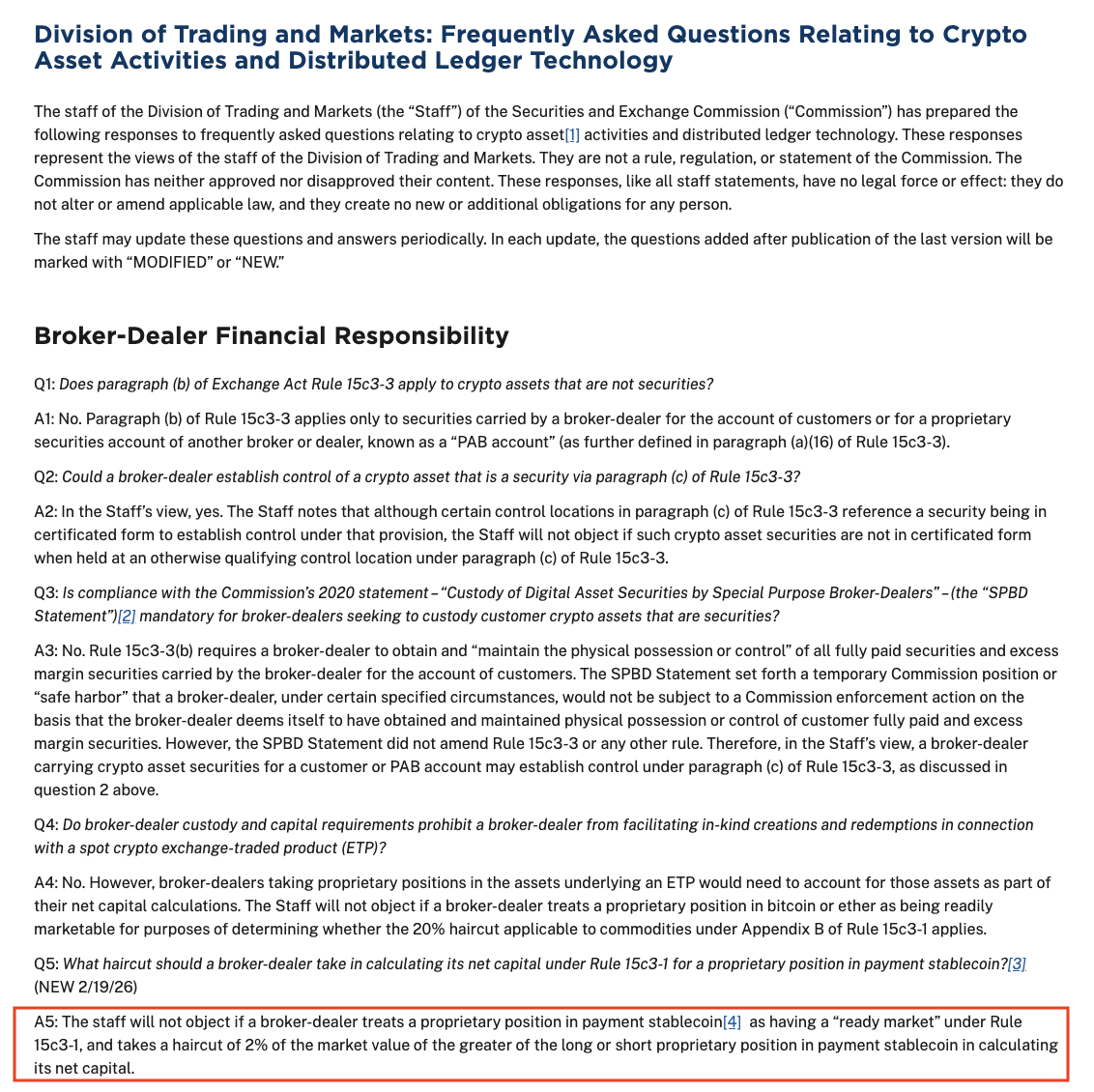
  The SEC’s response to frequently asked questions clarifying the 2% haircut rule for stablecoins held by broker-dealers. Source: SEC


For example, if a broker-dealer holds $100 million in stablecoins, a 2% haircut allows them to count $98 million toward their net capital requirements. Celebrating the clarification as positive for the financial system, Peirce said

“Stablecoins are essential to transacting on blockchain rails. Using stablecoins will make it feasible for broker-dealers to engage in a broader range of business activities relating to tokenized securities and other crypto assets.”  

The clarification means broker-dealers can hold stablecoins without worrying about excess net capital requirements, and can treat the tokens similarly to money market funds, vehicles that hold low-risk cash equivalents like US Treasurys and certificates of deposit. 

In a social media post over the weekend, Marc Baumann, CEO of crypto intelligence company 51, called the SEC staff communication “a big deal,” adding that “Wall Street can now actually hold and use stablecoins without destroying their capital ratios.”

Stablecoins gain traction in the United States, but not all US officials are convinced

The stablecoin market cap recently hit a snag, falling by about $6 billion from the December 2025 peak of over $300 billion.

However, the market still has a $295 billion market cap, which has steadily grown since 2023, according to data from RWA.XYZ.

United States President Donald Trump signed the GENIUS stablecoin bill into law in July 2025, which was considered a landmark moment for the crypto industry.
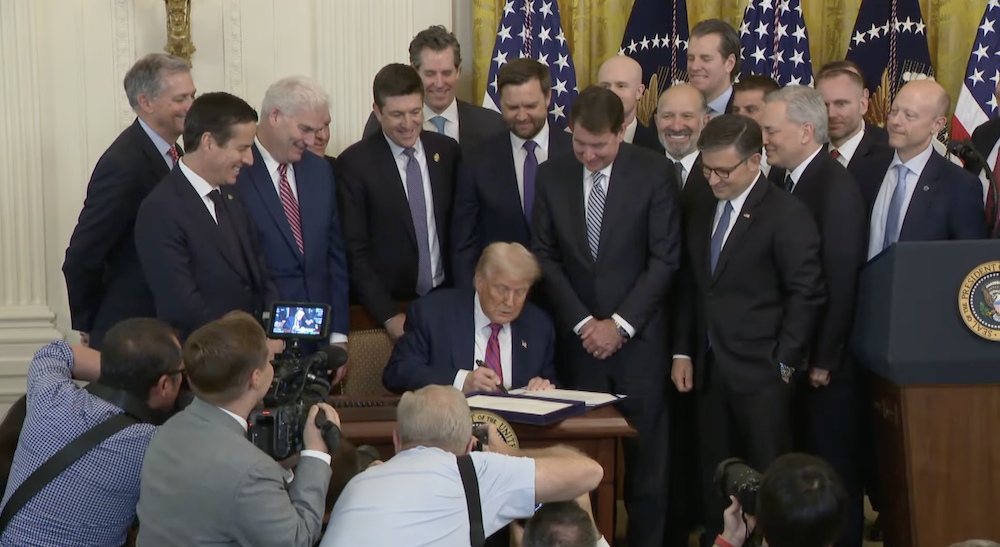
  President Trump signs the GENIUS bill into law. Source: Associated Press


The stablecoin market capitalization was just north of $252 billion at the time of signing and surged following the passage of the bill, according to data from RWA.XYZ.

Despite the meteoric surge in stablecoins and their implications for US dollar dominance in global financial markets, Neel Kashkari, president of the Federal Reserve Bank of Minneapolis, maintains that stablecoins and crypto have no real use cases.

“I could send any one of you $5 with Venmo, or PayPal, or Zelle, so what is it that this magical stablecoin can do? ” he said on Thursday.

Comments

All Comments

Recommended for you

  • Trump Evacuated from White House Correspondents' Dinner Due to Security Incident

    On April 26, local time April 25, U.S. President Trump was urgently evacuated from the White House Correspondents' Dinner due to a security incident. (CCTV News)

  • Shooting Incident at White House Correspondents' Dinner; Gunman Dead

    On April 26, local time on April 25, a shooting incident occurred in the hall of the White House Correspondents' Dinner, and the gunman is now deceased. (CCTV News)

  • Trump States He Will Not Allow Banks to Undermine Cryptocurrency Market Legislation

    On April 26, CoinDesk reported, citing attendees at a Trump cryptocurrency event, that Trump stated he would not allow banks to undermine cryptocurrency market legislation.

  • Iranian Officials to Depart Pakistan Without Meeting U.S. Representatives

    On April 25, according to a reporter from the New York Post: The Iranian delegation is set to leave Islamabad, the capital of Pakistan, and has consistently emphasized that they did not meet with U.S. officials during their brief visit.

  • Foreign Media: Second Round of Iran-U.S. Talks Scheduled for April 27

    On April 25, according to New Delhi Television: The second round of talks between Iran and the United States is scheduled to take place on April 27.

  • Iranian Lawmaker: Comprehensive Plan for Managing the Strait of Hormuz Formed

    On April 25, according to a report by Iran's Mehr News Agency, Iranian Islamic Parliament member Behnam Saidi stated that Iran has developed a comprehensive plan for managing the Strait of Hormuz. In an interview with Mehr News Agency, Saidi mentioned that an important aspect of this plan is the exclusive recognition of the name 'Persian Gulf' in all correspondence and commercial documents, rejecting any other names. Vessels and ships navigating in the region must obtain permission from Iran. Sovereignty over the Strait of Hormuz will be entirely under Iran's control. He also stated that vessels identified as hostile by the Supreme National Security Council or the General Staff of the Armed Forces of Iran are not allowed to pass through the Strait of Hormuz, and Israeli vessels are absolutely prohibited from entering the area. Ships passing through the region must pay relevant fees concerning safety, environmental protection, shipping management, and licensing, with priority given to payments in rials.

  • DeepSeek Plans to Raise $1.8 Billion with a Valuation of Approximately $20 Billion

    Sources reveal that the main reason for DeepSeek's current fundraising effort is the significant recent talent loss. Several core researchers have left the company to join ByteDance, Tencent, Xiaomi, and autonomous driving company Yuanrong Qihang. Meanwhile, competitors Zhiyu Technology and MiniMax have listed on the Hong Kong Stock Exchange, and the company Dark Side of the Moon has completed three rounds of financing in the first three months of this year, with a valuation more than quadrupling since the end of last year.

  • Iran Warns U.S. Against Continuing Piracy Actions

    On April 25, according to CCTV International News, Iran's Khatam al-Anbia Central Command issued a statement today warning that if U.S. forces continue to implement 'blockades, maritime interceptions, and piracy actions' in the region, they will face a strong counterattack from the Iranian armed forces. The statement emphasized that the U.S. should recognize that Iran's military capabilities and preparedness in safeguarding national sovereignty, territorial integrity, and national interests are stronger than ever, as demonstrated in previous conflicts. The statement also noted that Iran will continue to monitor enemy actions and movements and maintain control over the Strait of Hormuz. Should the enemy take further actions, Iran will respond with even harsher strikes.

  • Sources: Iran's Stance is Tougher than in First Round of Negotiations

    On April 25, official sources from Pakistan stated that Iran has adopted a tougher position compared to the first round of negotiations, emphasizing that any plan to end the war must be implemented according to Iran's conditions, rather than those proposed by U.S. President Trump. (Xinhua News Agency)

  • Iran Open to Negotiations with the U.S. but Will Not Abandon Uranium Enrichment

    On April 25, the Wall Street Journal reported that a senior Iranian diplomat stated Iran is open to negotiations with the United States but will not abandon its uranium enrichment activities. Iran's ambassador to India, Mohammad Fathali, posted on social media on Saturday, saying, 'Negotiations can yield appropriate results only when our opponents recognize our country's right to peacefully utilize nuclear energy.' The report indicates that the U.S. is currently seeking to have Iran suspend its uranium enrichment program for up to 20 years.
