

Cointime

Download App
iOS & Android

Bitcoin mining difficulty falls in first adjustment of 2026

The Bitcoin network mining difficulty, the relative computing challenge of adding a new block to the decentralized blockchain ledger, fell slightly to 146.4 trillion on Thursday, in the first difficulty adjustment of 2026. 

“The next Bitcoin difficulty adjustment is estimated to take place on Jan 22, 2026, 04:08:12 AM UTC, increasing the Bitcoin mining difficulty from 146.47 T to 148.20 T,” according to CoinWarz

Average block times are 9.88 minutes at the time of this writing, slightly below the 10-minute target, which means the next difficulty adjustment will increase slightly to align better with the target block time.
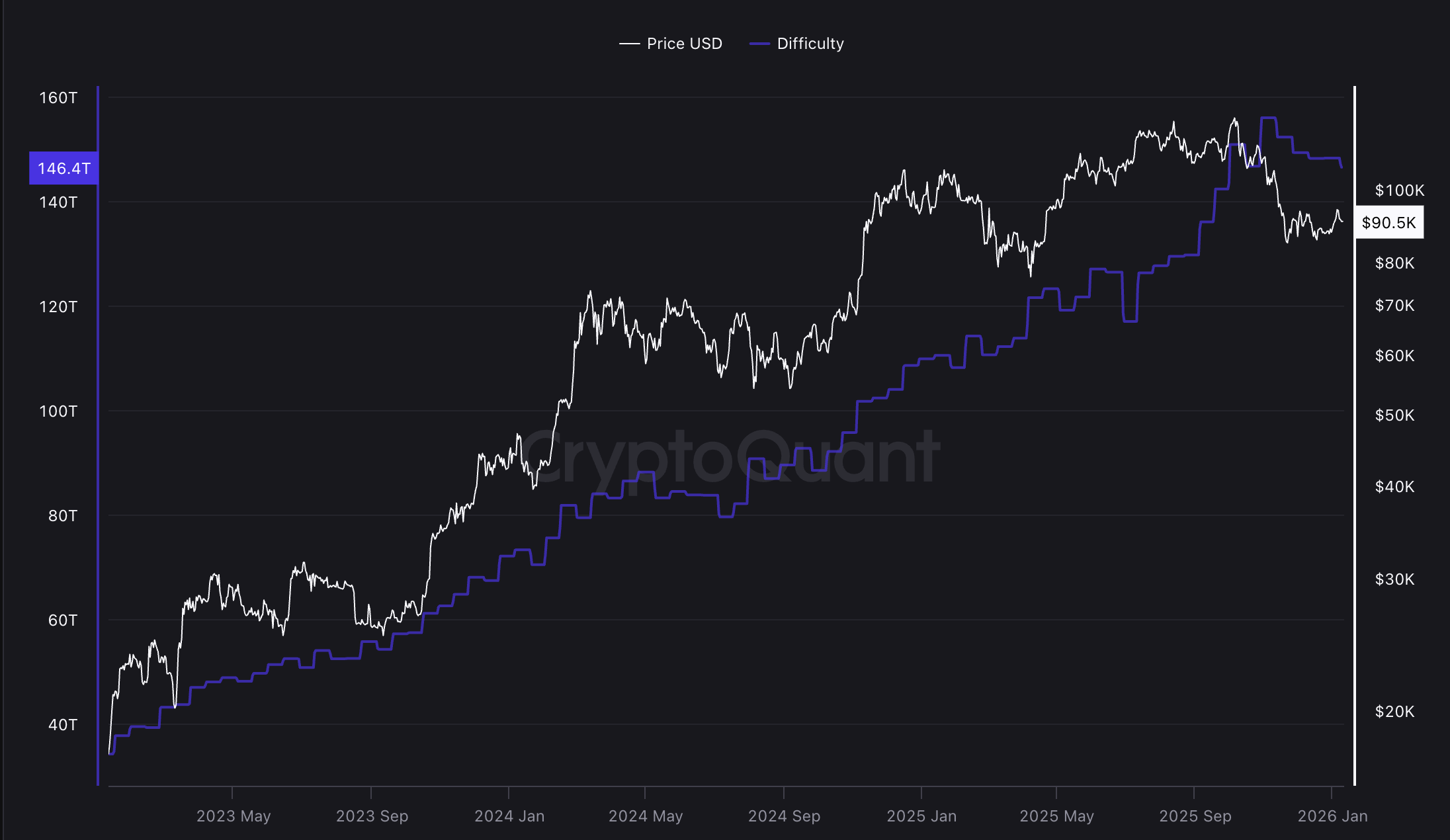
  The Bitcoin network mining difficulty. Source: CryptoQuant


Mining difficulty reached new all-time highs in 2025, with the final adjustment of the year slightly increasing the difficulty level. However, even with the slight increase, difficulty remained well below the all-time high of 155.9 trillion recorded in November.

The rising difficulty means increased competition to mine blocks on the network, presenting more challenges to the mining industry, which suffered from macroeconomic, regulatory, and financial headwinds in 2025.

2025 was the “harshest margin environment” on record for Bitcoin miners

Bitcoin miners experienced one of the toughest profitability environments on record, as profit margins eroded due to the April 2024 halving, which slashed the block subsidy by 50% and macroeconomic developments.

The crypto market downturn, which began in November, placed additional pressure on Miners and mining companies.

Miner hash price, a critical metric for miner profitability, which tracks expected revenue per unit of computing power expended to mine blocks, fell below breakeven levels in November 2025.
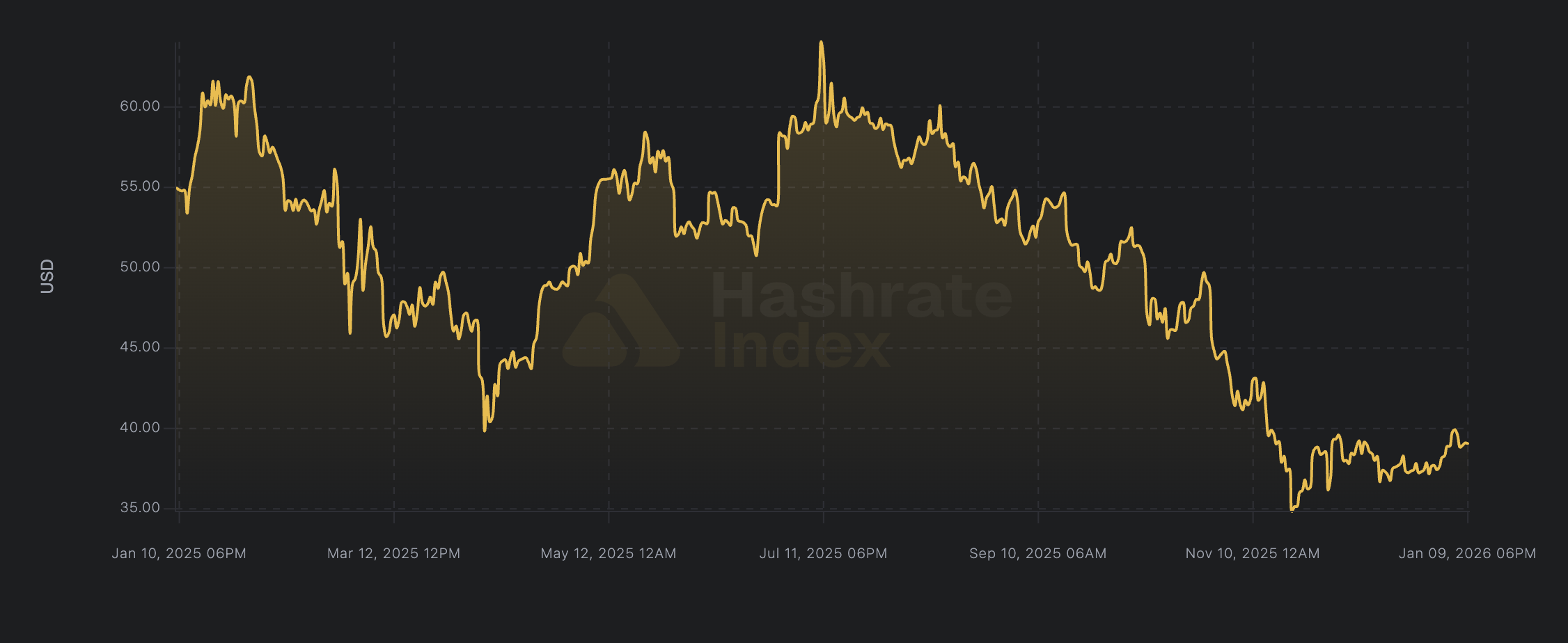
  Miner hash price over a 1-year period. Source: Hashrate Index


$40 per petahash-second per day is the level at which miners must decide whether to turn their rigs off or continue mining blocks. In November, this metric dropped below $35 — a multi-year low.

The tariffs enacted by US President Donald Trump also strained Bitcoin miners, creating fears of supply chain shortages.

A sharp crypto market downturn, sparked by a flash crash in October, discounted BTC prices by over 30% in November, when BTC hit a low just north of $80,000.

Although Bitcoin prices have rallied since that time, they are still far below the all-time high of over $125,000 reached in October.


Comments

All Comments

Recommended for you

  • Latest Progress on DeFi United Ecological Rescue Initiative: Over 100,000 ETH Raised at Designated Donation Address

    On April 26, the DeFi United ecological rescue initiative, led by Aave, continues to advance. The Arbitrum DAO has released 30,765 ETH that was frozen after the rsETH incident on April 18. Currently, the designated donation address has raised a total of 100,360 ETH to address the collateral asset gap caused by the rsETH incident. The plan aims to restore the backing assets of rsETH through multi-party collaboration, stabilize the market, and prevent the spread of bad debts across protocols. The funds will be used to support the restoration of collateral rates and to gradually normalize the market in conjunction with relevant protocols. Key contributors or participants currently include: Arbitrum DAO releasing 30,765 ETH frozen after the rsETH incident, Mantle proposing to contribute 30,000 ETH, Aave DAO proposing to contribute 25,000 ETH, Aave founder Stani Kulechov confirming a contribution of 5,000 ETH, EtherFi proposing to provide 5,000 ETH, Lido proposing to provide 2,500 stETH, and the Golem Foundation and related projects contributing a total of 1,000 ETH, among others. Additionally, LayerZero, Ethena, Frax Finance, and Ink Foundation have also confirmed their participation, although the specific amounts have not yet been disclosed. It is important to note that the progress of this rescue initiative still relies on several external key conditions, including KelpDAO's restoration of rsETH redemptions and the Arbitrum Security Council's release of frozen assets, resulting in uncertainty regarding the overall recovery time and effectiveness.

  • Trump Evacuated from White House Correspondents' Dinner Due to Security Incident

    On April 26, local time April 25, U.S. President Trump was urgently evacuated from the White House Correspondents' Dinner due to a security incident. (CCTV News)

  • Shooting Incident at White House Correspondents' Dinner; Gunman Dead

    On April 26, local time on April 25, a shooting incident occurred in the hall of the White House Correspondents' Dinner, and the gunman is now deceased. (CCTV News)

  • Trump States He Will Not Allow Banks to Undermine Cryptocurrency Market Legislation

    On April 26, CoinDesk reported, citing attendees at a Trump cryptocurrency event, that Trump stated he would not allow banks to undermine cryptocurrency market legislation.

  • Iranian Officials to Depart Pakistan Without Meeting U.S. Representatives

    On April 25, according to a reporter from the New York Post: The Iranian delegation is set to leave Islamabad, the capital of Pakistan, and has consistently emphasized that they did not meet with U.S. officials during their brief visit.

  • Foreign Media: Second Round of Iran-U.S. Talks Scheduled for April 27

    On April 25, according to New Delhi Television: The second round of talks between Iran and the United States is scheduled to take place on April 27.

  • Iranian Lawmaker: Comprehensive Plan for Managing the Strait of Hormuz Formed

    On April 25, according to a report by Iran's Mehr News Agency, Iranian Islamic Parliament member Behnam Saidi stated that Iran has developed a comprehensive plan for managing the Strait of Hormuz. In an interview with Mehr News Agency, Saidi mentioned that an important aspect of this plan is the exclusive recognition of the name 'Persian Gulf' in all correspondence and commercial documents, rejecting any other names. Vessels and ships navigating in the region must obtain permission from Iran. Sovereignty over the Strait of Hormuz will be entirely under Iran's control. He also stated that vessels identified as hostile by the Supreme National Security Council or the General Staff of the Armed Forces of Iran are not allowed to pass through the Strait of Hormuz, and Israeli vessels are absolutely prohibited from entering the area. Ships passing through the region must pay relevant fees concerning safety, environmental protection, shipping management, and licensing, with priority given to payments in rials.

  • DeepSeek Plans to Raise $1.8 Billion with a Valuation of Approximately $20 Billion

    Sources reveal that the main reason for DeepSeek's current fundraising effort is the significant recent talent loss. Several core researchers have left the company to join ByteDance, Tencent, Xiaomi, and autonomous driving company Yuanrong Qihang. Meanwhile, competitors Zhiyu Technology and MiniMax have listed on the Hong Kong Stock Exchange, and the company Dark Side of the Moon has completed three rounds of financing in the first three months of this year, with a valuation more than quadrupling since the end of last year.

  • Iran Warns U.S. Against Continuing Piracy Actions

    On April 25, according to CCTV International News, Iran's Khatam al-Anbia Central Command issued a statement today warning that if U.S. forces continue to implement 'blockades, maritime interceptions, and piracy actions' in the region, they will face a strong counterattack from the Iranian armed forces. The statement emphasized that the U.S. should recognize that Iran's military capabilities and preparedness in safeguarding national sovereignty, territorial integrity, and national interests are stronger than ever, as demonstrated in previous conflicts. The statement also noted that Iran will continue to monitor enemy actions and movements and maintain control over the Strait of Hormuz. Should the enemy take further actions, Iran will respond with even harsher strikes.

  • Sources: Iran's Stance is Tougher than in First Round of Negotiations

    On April 25, official sources from Pakistan stated that Iran has adopted a tougher position compared to the first round of negotiations, emphasizing that any plan to end the war must be implemented according to Iran's conditions, rather than those proposed by U.S. President Trump. (Xinhua News Agency)