

Cointime

Download App
iOS & Android

Hackers impersonated eth.limo team to hijack its domain: Post-mortem

Ethereum Name Service gateway eth.limo has revealed that the domain hijacking on Friday was caused by a social engineering attack directed against EasyDNS, its domain name service provider. 

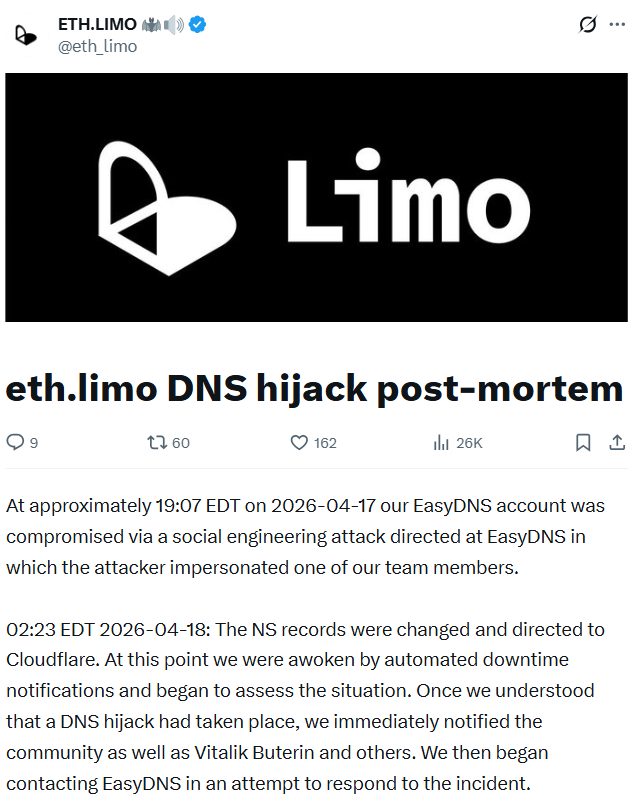
According to a postmortem published by eth.limo on Saturday, an attacker impersonated one of its team members to initiate an account recovery process with easyDNS, granting access to the eth.limo account and allowing them to alter domain settings.

“The NS records were changed and directed to Cloudflare… Once we understood that a DNS hijack had taken place, we immediately notified the community as well as Vitalik Buterin and others. We then began contacting EasyDNS in an attempt to respond to the incident,” the company said.

Eth.limo serves as a Web2 bridge, providing access to around 2 million decentralized websites using the .eth domain name. Hijacking the service could allow an attacker to redirect users to malicious websites. Ethereum co-founder Vitalik Buterin warned users Friday to avoid his blog until the incident was resolved.

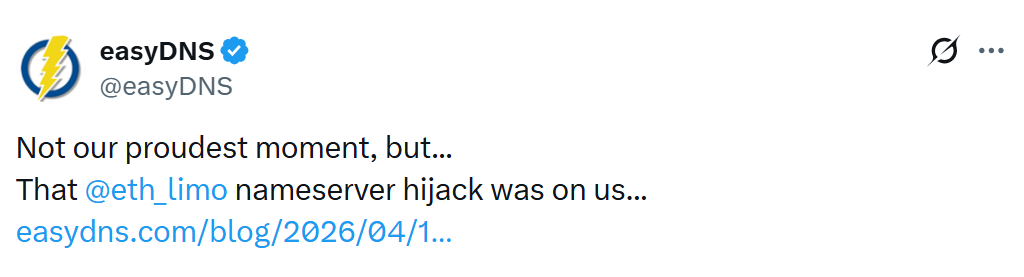
Mark Jeftovic, CEO of easyDNS, has publicly accepted responsibility for the incident in its own postmortem report. 

“We screwed up and we own it,” said Jeftovic on Saturday. 

“This would mark the first successful social engineering attack against an easyDNS client in our 28-year history. There have been countless attempts.”  

Both companies have pointed to the Domain Name System Security Extension (DNSSEC) in thwarting the hacker’s attempts to do further damage. 

The attacker couldn’t produce valid cryptographic signatures, so Domain Name System resolvers rejected the attacker’s forged DNS responses, causing users to see error messages instead of being redirected to malicious sites. 

“DNSSEC was enabled for their domain when the attackers attempted to flip their nameservers, presumably to effect some manner of phishing or malware injection attack, DNSSEC-aware resolvers, which most are these days, began dropping queries,” Jeftovic said. 
  Source: eth.limo


In its postmortem, eth.limo noted that because the attacker lacked the signing keys, they were unable to bypass the safeguards, which likely “reduced the blast radius of the hijack. We are not aware of any user impact at this time. We will provide updates if that changes.”

easyDNS makes changes since the attack

Jeftovic described the social engineering attack as “highly sophisticated,” and said easyDNS is still conducting a post-mortem on how the breach occurred, and has already begun rolling out changes to prevent a recurrence.
  Source: easyDNS


“In eth.limo’s case, we will be migrating them to Domainsure, which has a security posture more suited toward enterprise and high-value fintech domains, TLDR there is no mechanism for an account recovery on Domainsure, it’s not a thing,” he added.

“On behalf of everyone here, I apologize to the eth.limo team and the wider Ethereum community. ENS has always had a special place in our heart as the first registrar to enable ENS linking to web2 domains and we’ve been involved in the space since 2017.”

The eth.limo incident is the latest in a series of domain hijackings targeting crypto projects. Days earlier, decentralized exchange aggregator CoW Swap lost control of its website after an unknown party hijacked its domain. 

Steakhouse Financial, a DeFi advisory and research firm, similarly disclosed at the end of March that it had lost control of its domain to an attacker.

Comments

All Comments

Recommended for you

  • Russian Foreign Minister Lavrov: Meeting with U.S. Secretary of State Rubio Scheduled for Tomorrow

    On July 22, Russian Foreign Minister Lavrov stated that the meeting with U.S. Secretary of State Rubio has been scheduled for tomorrow.

  • Supermicro Surges Over 14% Pre-Market as Q4 Gross Margin Doubles Guidance, New Orders Exceed $60 Billion

    On July 22, AI server manufacturer Supermicro (SMCI.US) surged over 14% in pre-market trading to $29.17. On the news, the company released preliminary results for the fourth fiscal quarter ended June 30. The company's GAAP and non-GAAP gross margins are expected to be between 15% and 17%, nearly double the previously guided range of 8.2% to 8.4%. Management attributed this better-than-expected performance to favorable customer structure and product mix. Meanwhile, the company's total new orders for the quarter exceeded $60 billion, a record high.

  • US Optical Communication Stocks Fall in Pre-market, Marvell Down Over 2%

    On July 22, US optical communication concept stocks fell collectively in pre-market trading, with Astera Labs, Coherent, Credo Technology, Ciena, AXT Inc, and MaxLinear falling more than 3%, and Fabrinet, Lumentum, Corning, Applied Optoelectronics, Tower Semiconductor, Marvell Technology, POET Technologies, and GlobalFoundries falling more than 2%.

  • US AI chip stocks fall pre-market, Intel down 3%

    On July 22, US stock market AI chip stocks generally fell before the market open, with Intel down 3%, TSMC, AMD, and Qualcomm down over 2%, Broadcom down nearly 2%, and NXP and Nvidia down over 2%.

  • Russia Develops 150nm Lithography Machine, Performance Comparable to Pentium 4 from 20 Years Ago

    On July 22, according to Fast Technology, Russia's Green City Nanotechnology Center (ZNTC) has successfully developed a prototype of an electron beam lithography machine (ELL) with a design standard of 150nm. The project is a key research and development task under the framework of Russia's national plan for scientific and technological development, codenamed Progress ELL 150. This device is mainly used for manufacturing photomasks, and can also directly draw circuit patterns on substrates without using masks. The 150nm process roughly corresponds to the performance level of Intel's Pentium 4 from 20 years ago. In 2025, ZNTC demonstrated a similar device with 350nm resolution, and has now advanced to 90nm and 130nm technology nodes. Industry experts point out that such equipment is only suitable for small batch production of specialized chips in fields such as aerospace and defense.

  • Beijing State-owned Capital: Nearly 10 Billion Yuan Allocated to Stock Market from Own Funds

    On July 22, Beijing State-owned Capital Operation and Management Co., Ltd. announced that, as of now, it has allocated nearly 10 billion yuan from its own funds to invest in the stock market. Going forward, the company will continue to support listed company stocks using its own funds and through its subsidiaries, including securities firms and public funds, while also backing the development of the Beijing Stock Exchange. Rooted in its functional role as a state-owned capital operator, the firm is committed to safeguarding the strategic value of core assets of listed companies and contributing to the stable and healthy growth of the capital market through concrete actions, as a state-owned enterprise based in Beijing. (Beijing State-owned Capital)

  • U.S. Stock Futures Fall, Major Indices Decline

    U.S. stock futures are lower, with Nasdaq 100 futures down 1%, S&P 500 futures down 0.4%, and Dow futures down 0.3%.

  • Japan's Two-Year Government Bond Yield Rises to 1.47%, First Time Since 1995

    Japan's two-year government bond yield rose to 1.47%, the first time since 1995.

  • WTI and Brent Crude Surge Over 4%

    On July 22, international oil prices surged rapidly. WTI crude oil futures rose over 4% to $87.77 per barrel; Brent crude oil futures rose over 4% to $94.71 per barrel.
