

Cointime

Download App
iOS & Android

Crypto hackers steal $169M from 34 DeFi protocols in Q1: DefiLlama

Crypto hackers stole over $168.6 million in cryptocurrency from 34 decentralized finance (DeFi) protocols in the first quarter of 2026, falling significantly from the same period last year, according to data from DefiLlama. 

The $40 million private key compromise of Step Finance in January was the largest exploit of the quarter, the data shows, followed by a smart contract manipulation that drained $26.4 million in ether 

ETH$2,064from Truebit on Jan. 8. The third-largest was a private key compromise targeting stablecoin issuer Resolv Labs on March 21.

The quarterly figure is low given that the industry saw $1.58 billion stolen in the first quarter of 2025, with the bulk coming from the $1.4 billion Bybit exploit. However, experts warn that crypto hacks aren’t tied to specific periods within a year.
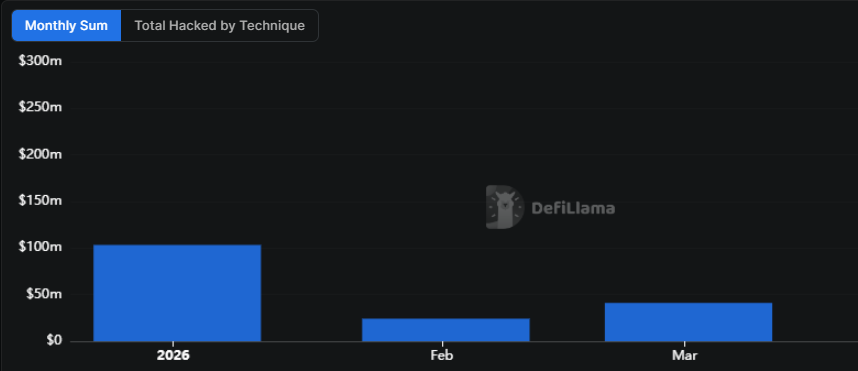
  The first three months of 2026 saw less stolen compared to the prior year period.  Source: DefiLlama


Hackers are more active when industry is booming

Nick Percoco, the chief security officer at crypto exchange Kraken, told Cointelegraph that cybercriminal activity in crypto tends to rise around market and event-driven cycles rather than fixed periods.

Threat actors are also drawn to areas where liquidity is concentrated, meaning attack spikes often follow wherever value is accumulating fastest, according to Percoco.

“Bull markets, major product launches and fast-moving growth phases all create more attractive conditions for attackers because more value is at stake and new infrastructure can introduce risk,” he said.  

“That said, attacks are not confined to just these periods. Vulnerabilities can be exploited in any market environment, particularly in complex or rapidly evolving systems, underlining that security in crypto must be continuous.”

Crypto attackers are a “broad and evolving mix”

North Korea-linked actors have been a persistent threat to crypto investors and Web3-native companies alike. 

Hackers affiliated with the organization have been suspected of numerous attacks, including the Wednesday attack on Drift Protocol, a decentralized cryptocurrency exchange that lost an estimated $285 million to a private key leak.

Percoco said the threat landscape is a mix of actors with different levels of sophistication, highly coordinated groups targeting core infrastructure, organized cybercriminal networks and opportunistic hackers scanning for weaknesses in smart contracts and client-facing systems.

“It is a broad and evolving mix, but they are ultimately targeting the same thing: global, liquid and accessible value. Targeting is rarely purely random. In many cases, attackers are deliberate in how they assess infrastructure, code, access controls and even human behavior,” he said.

“At the same time, crypto’s transparency makes it easier for opportunistic actors to spot weaknesses as they emerge. The most attractive targets tend to be those combining large concentrations of value, technical complexity and gaps in operational security.”

Security experts previously told Cointelegraph that 2026 would likely see an increase in sophisticated credential theft, social engineering, and AI-powered attacks. 

Comments

All Comments

Recommended for you

  • Binance Wallet to Launch 46th TGE Project OpenGradient (OPG)

    On April 20, Binance Wallet will launch the 46th exclusive TGE project OpenGradient (OPG). The subscription period is from April 21, 17:00 to 19:00 (UTC+8), and users must participate using Binance Alpha Points and meet the corresponding qualifications. According to the official announcement, OPG tokens will be available for collection and trading starting at 19:00 (UTC+8) on the same day. Additionally, 23,000,000 OPG tokens are reserved for future activities, with specific rules to be announced later.

  • CoinShares: $1.4 Billion Inflows into Digital Asset Investment Products Last Week

    On April 20, CoinShares reported that inflows into digital asset investment products reached $1.4 billion last week, marking the highest weekly inflow since January and achieving positive growth for the third consecutive week. Bitcoin saw inflows of $1.116 billion, bringing the total inflows for the year to $3.1 billion. The price of Bitcoin has surpassed the $76,000 mark, indicating a significant technical breakthrough after two months of range-bound trading. In contrast, inflows into Bitcoin short products were only $1.4 million, suggesting that while there is still hedging demand, it remains limited. Ethereum attracted $328 million in inflows, the strongest week since January, bringing its total inflows for the year to $197 million, while XRP and Solana recorded outflows of $56 million and $2.3 million, respectively.

  • Sources: Bank of Japan Unlikely to Raise Interest Rates in April Meeting

    On April 20, sources familiar with the Bank of Japan's thinking revealed that the central bank is unlikely to raise interest rates next week. The diminishing hope for a swift end to the Middle East conflict has left Japan's economic and price outlook fraught with uncertainty. Although the final decision still carries some uncertainty and will depend on the progress of peace negotiations between the U.S. and Iran, the sources indicated that the bank prefers to maintain the status quo this month to allow more time to assess the impact of the conflict. One source stated, 'Given the current level of uncertainty, the Bank of Japan may consider it feasible to hold steady this month.' Another source echoed this sentiment. A third source noted that the Bank of Japan is unlikely to raise rates, as the market has already fully priced in the possibility of no rate hike this month. These sources mentioned that even if the Bank of Japan keeps rates unchanged next week, it is likely to signal readiness to raise rates as early as June, given the escalating inflationary pressures.

  • Hong Kong SFC Announces New Regulatory Framework for Trading Tokenized Investment Products in Secondary Market

    On April 20, the Hong Kong Securities and Futures Commission (SFC) announced a new regulatory framework to promote the trading of tokenized investment products recognized by the SFC in the secondary market, aiming to enhance digital asset trading activities in Hong Kong and support the further development of the ecosystem. The first batch of products is expected to primarily consist of tokenized money market funds. The SFC will review the operation of these products and will consider expanding the range of products in due course.

  • Hackers impersonated eth.limo team to hijack its domain: Post-mortem

    EasyDNS CEO Mark Jeftovic said the social engineering attack was highly sophisticated and the company is conducting further investigation to determine how the breach occurred.

  • Saylor teases 'bigger' BTC buy days after floating semi-monthly dividends

    Strategy’s Michael Saylor posted “Think Even Bigger” on Sunday, coming just a week after it disclosed $1 billion of Bitcoin buying.

  • Aave's TVL tanks $8B a day after $293M Kelp DAO hack

    The Aave token fell nearly 20% to $89.5 in just over 24 hours as users withdrew billions of dollars from the lending protocol.

  • Iranian Foreign Ministry Spokesman: No Decision Yet on Next Round of Talks with the U.S.

    On April 20, Iranian Foreign Ministry spokesman Baghaei stated that there are currently no plans for a second round of negotiations with the United States. He emphasized that the U.S. has not learned from past experiences, and such an approach will not yield positive results.

  • BTC Falls Below $75,000

    Market data shows that BTC has fallen below $75,000, currently priced at $74,994.16, with a 24-hour decline of 0.09%. The market is experiencing significant volatility, so please ensure proper risk management.

  • ETH Falls Below $2300

    Market data shows that ETH has fallen below $2300, currently priced at $2299.87, with a 24-hour decline of 0.2%. The market is experiencing significant volatility, so please ensure proper risk management.
