

Cointime

Download App
iOS & Android

Hacking Private Data in Smart contracts | QuillAudits

Validated Project

In solidity, “Private” variables can only be read by the contracts and is not accessible to the outside world. But, it is possible to access these data from outside the blockchain. Let’s see how we can read private data from smart contracts.

Table of Contents:

1. State Variable Visibility2. Storage layout in EVM3. Accessing private data using Ethers4. A small challenge5. Remediation6. Reference

State Variable Visibility

According to Solidity Docs, There are three visibility modifiers that users can use: public, internal, or private.

  1. Public: Public means that the variable can be accessed by the contract and by other smart contracts.
  2. Internal: Internal means that the variable can only be used with the contract it is defined in and its subclasses.
  3. Private: Private means that the variable can only be accessed within the contract it is defined. Trying to access it outside this contract gives a compilation error.

In Solidity, “Private” variables are not accessible to the outside world. But wait, if private data can only be accessed within the contract then how can we access these data from outside of the blockchain?We will come to it but let’s first understand storage layout in solidity.

Storage Layout in EVM:

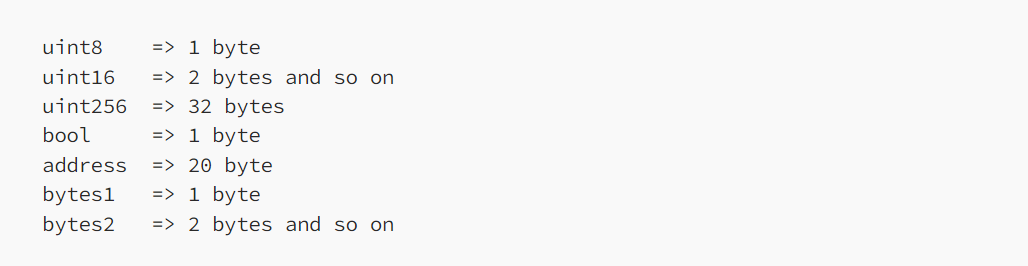
The EVM (Ethereum Virtual Machine) stores smart contract data in a large array with a length of 2**256 in slots on the blockchain. Each memory slot can hold up to 32 bytes of data. The EVM stores smart contract state variables in the order that they were declared in slots on the blockchain. The default value of each slot is always 0, so we do not need to assign a value to 0 when the new declaration is.

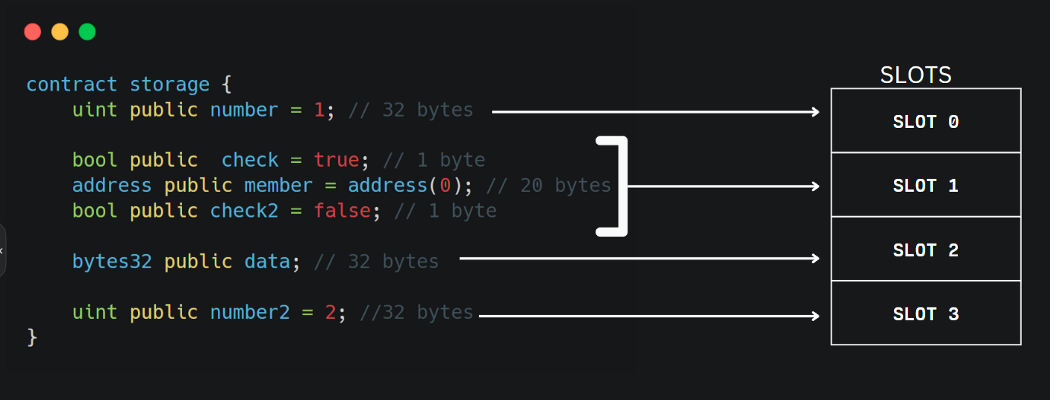
Smart contract storage is optimized to minimize space. If two or more variables fit into a single 32-byte slot, they are packed into the same slot, beginning on the right.
Look at the following example for a better understanding of how storage works in EVM.
Storage for Dynamic data types:

Mappings and dynamically-sized array types cannot be stored “in-between” the state variables before and after. Instead, they are considered to occupy only 32 bytes and a different storage slot that is computed using a Keccak-256 hash of the elements they contain.

Accessing Private data from Blockchain:

To access Solidity smart contract private data we can follow the following steps. Here we will be using ethers.js for extracting data.

  1. First, we need to read the contract and understand the order in which the state variables are declared. Let’s suppose we want to access slot0.
  2. We can use ethers.js to read the memory slots of the contract on the blockchain. Use the below function:await ethers.provider.getStorageAt(contract_address, 0);
  3. It will return hex encoded value, we can simply decode it or use ethers utils functions or some sort of hex decoder to decode it.

Ethers.js Script:

You can also use the following js script to fetch private data from the blockchain.
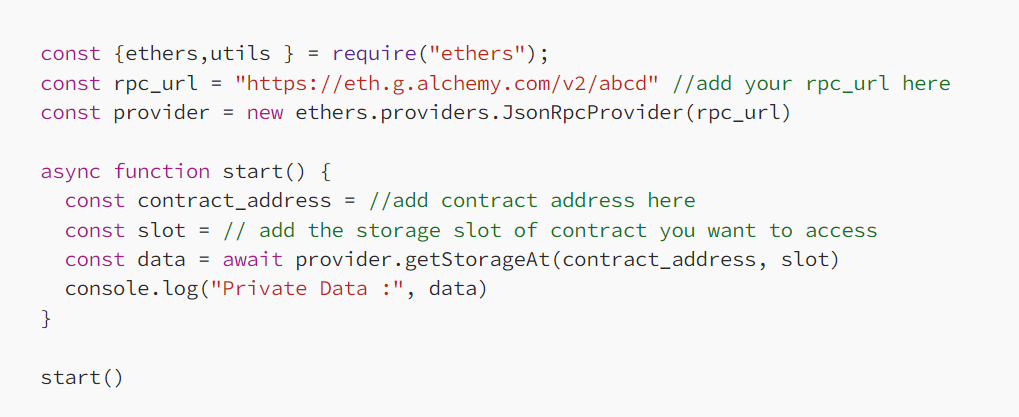
Guide for running script:

  1. Install ethers from npm: npm install ethers
  2. Get a rpc_url of the required network from alchemy and add it to the above script.
  3. Change the contract address and slot in the below script and simply run the js code. Decode the returned hex value.

A small challenge:

Goerli link: 0x4c77de8a0ec0390826f87f227bb8762ab2189194

Objective: Change the value of pwned to true. You can use the above script to extract private data.

Remediation:

In the current state of the blockchain, do not keep sensitive private data in smart contracts. The safest method to keep your private information safe is to avoid storing it on a public blockchain.


Further Reads:

Comments

All Comments

Recommended for you

  • US Lawmakers Propose Bill to Ban Chinese Optical Transceivers in National Security Systems

    On September 26, a bipartisan group in the U.S. Senate proposed a bill on September 25 aimed at prohibiting the federal government from installing Chinese-made components used for data transmission in artificial intelligence data centers within sensitive systems. The bill was jointly initiated by Republican Senators John Cornyn and Mike McCaul, along with Democratic Senators Jon Tester and Alex Padilla, and primarily targets optical transceiver modules produced by Chinese companies such as New H3C Technologies. Currently, Chinese optical transceiver manufacturers dominate this core component market in AI data centers.

  • SEC and CFTC Update Crypto FAQs: Token Buybacks and Network Upgrades Not Necessarily Securities, CFTC Allows On-Chain Record Keeping

    On September 26, the U.S. Securities and Exchange Commission's Division of Corporation Finance released an updated FAQ on September 25, clarifying that token buybacks, network upgrades, and marketing statements do not automatically make crypto assets securities. SEC staff noted that announcing a buyback plan for an operational crypto network does not, by itself, make the associated tokens investment contracts; however, if the network is not operational and the issuer promotes the buyback as a source of returns for holders, it may be a different case. The FAQ also clarified that services provided once a crypto system is operational, aimed at securing, maintaining, improving, or enhancing the system or its functions, or promoting network effects, do not constitute managerial efforts under the Howey test. Marketing existing uses of the network typically does not create profit expectations, and statements about future functionalities do not either, provided there is no promotion of profit potential. This update reiterates that conclusions will still heavily depend on specific cases and are based on the SEC's interpretative release regarding the applicability of securities laws to crypto assets issued in March this year. On the same day, the Commodity Futures Trading Commission updated its crypto FAQ, allowing futures firms and clearinghouses to invest customer funds in tokenized versions of previously permitted assets, provided they meet investment and custody requirements. CFTC staff also indicated that regulated companies may use blockchain for record keeping but must still be able to provide records if the blockchain or its block explorer is non-operational. These updates come as the CLARITY Act failed to advance in the Senate, with regulators continuing to push forward with the crypto regulatory framework based on existing laws.

  • BTC Surpasses $84,000

    Market data shows that BTC has surpassed $84,000, currently priced at $84,004, with a 24-hour decline of 0.25%. The market is experiencing significant volatility, so please ensure proper risk management.

  • BTC Falls Below $84,000

    Market data shows that BTC has fallen below $84,000, currently priced at $83,988.06, with a 24-hour increase of 0.52%. The market is experiencing significant volatility, so please ensure proper risk management.

  • ETH Falls Below $2700

    Market data shows that ETH has fallen below $2700, currently priced at $2699.7, with a 24-hour increase of 1.95%. The market is experiencing significant volatility, so please ensure proper risk management.

  • BTC Surpasses $85,000

    Market data shows that BTC has surpassed $85,000, currently priced at $85,000.02, with a 24-hour increase of 1.72%. The market is highly volatile, so please ensure proper risk management.

  • ETH Surpasses $2700

    Market data shows that ETH has surpassed $2700, currently priced at $2700.14, with a 24-hour increase of 1.23%. The market is experiencing significant fluctuations, so please ensure proper risk management.

  • Yushu Technology's Wang Xingxing: Key to Breakthrough in Embodied Intelligence Lies in Solving Millimeter-Level Error Issues

    On September 25, the 5th Global Digital Trade Expo was held in Hangzhou, where Wang Xingxing, founder of Yushu Technology, delivered a keynote speech titled "From Machinery to Intelligence - The Evolutionary Theory of Embodied Future." Wang stated that the embodied intelligence industry may soon experience a critical breakthrough similar to that of ChatGPT. He believes that when robots can complete approximately 80% of tasks through voice interaction and embodied intelligence capabilities in about 80% of unfamiliar environments, the industry will enter a critical phase of large-scale application. He pointed out that the ability for robots to understand and execute specific tasks based on voice commands has already made breakthroughs last year, but the industry still faces a core technological bottleneck, namely the precise matching issue between artificial intelligence models and the real physical world. Wang noted that currently, robots still have a few millimeters of error during actual operations, which limits their stability and reliability in complex environments. "In the future, whoever can solve this problem will fundamentally resolve the issues with robots."

  • Swissquote Analyst Warns AI Narrative is a Core Pillar of US Stocks, Potential Break Could Trigger Significant Correction

    On September 25, Ipek Ozkardeskaya, a senior analyst at Swissquote Bank, stated that broad market indices and retirement funds are now deeply tied to the AI wave, with technology stocks accounting for about 40% of the S&P 500 index. She pointed out that the market capitalization weight of just three chip manufacturers makes up over 25% of the MSCI Emerging Markets Index. Ozkardeskaya indicated that AI has become the 'core pillar' of the market, and this pillar 'must not show any cracks.' She believes that, in the short term, the US stock market will continue to be supported by seasonal factors, and the current market uptrend may extend until the end of the year. However, she also warned that the worst-case scenario would be a shake in the investment logic surrounding AI, which could undermine market confidence in the AI narrative, potentially triggering a significant market correction.

  • U.S. Stock Index Futures Turn Positive; Chip Stocks Rally in After-Hours Trading

    On September 25, U.S. stock index futures rose into positive territory, with Nasdaq futures up 0.36%. In after-hours trading, storage and semiconductor stocks saw widespread gains, with AMD, Intel, and SanDisk all rising by 2%.