

Cointime

Download App
iOS & Android

USDC issuer Circle to launch new layer-1 Arc blockchain this year

Circle, a publicly traded US company and the issuer of USDC stablecoin, said it will launch a layer-1 (L1) blockchain compatible with the Ethereum Virtual Machine (EVM) later this year.

The company released its second-quarter results on Tuesday and announced the introduction of Arc, a new network designed to offer an “enterprise-grade foundation” for stablecoin payments, foreign exchange and capital markets applications.

Expected to launch in public testnet, Circle’s Arc will feature USDC 

USDC$0.9997as its native gas token, enabling users to paytransaction feeswith the stablecoin.

Alongside the launch of Arc, Circle disclosed a 53% year-over-year increase in total revenue and reserve income in Q2, reaching $658 million.

“Full-stack platform for the internet financial system”

According to Circle, its upcoming Arc blockchain is “purpose-built for stablecoin finance,” marking a major milestone in the company’s mission to deliver a “full-stack platform for the internet financial system.”

In addition to featuring USDC as native gas, Arc will provide an integrated stablecoin foreign exchange engine, sub-second settlement finality and opt-in privacy controls, the announcement said, adding:

“Arc will be fully integrated across Circle’s platform and services, which will also remain fully available and interoperable with the dozens of other partner blockchains that Circle supports.”

At the time of writing, USDC had a $65.6 billion market capitalization, with the stablecoin running on a total of 24 networks.

Ethereum is now the largest network for USDC, with total USDC supply on the network amounting to $42.6 billion, according to Circle data.

Net loss of $482 million impacted by IPO

Reporting on quarterly financial performance, Circle mentioned that its Q2 net loss amounted to $482 million — a massive 93% increase from around $33 million in Q4 2024.

The net loss in Q2 was significantly impacted by expenses from Circle’s initial public offering (IPO), the company mentioned, referring to $591 million in IPO-related non-cash charges.
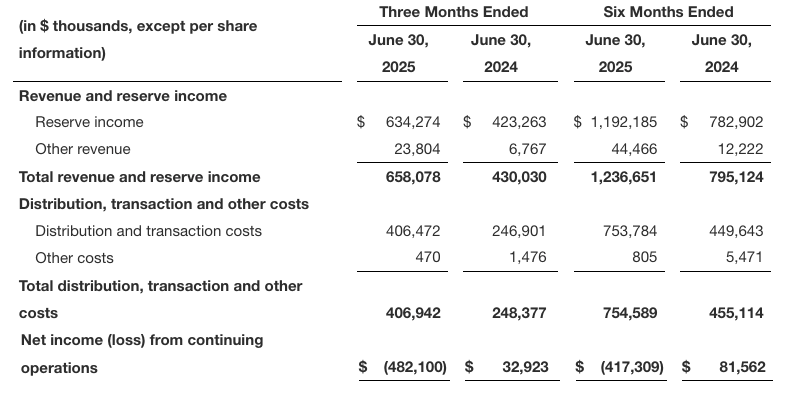
Data from Circle’s unaudited condensed consolidated statements of operations. Source: Circle

The charges specifically included $424 million for stock-based compensation related to vesting conditions and another $167 million increase in the fair value of convertible debt caused by the increase in Circle’s (CRCL) share price.

After raising $1.05 billion in an IPO, Circle debuted public trading on the New York Stock Exchange on June 5 at the price of $69 per share.

The stock experienced a meteoric rise soon after listing, surging to an all-time high of $292.8 on June 23, according to TradingView data.
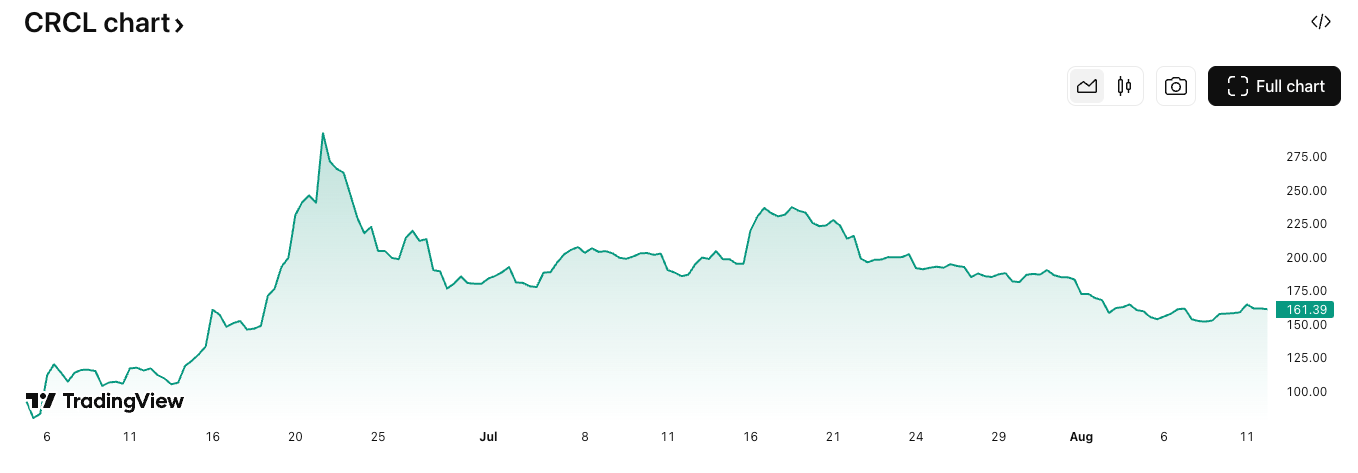
Circle (CRCL) price chart since listing on NYSE. Source: TradingView


The stock has been losing steam since, closing at $161.2 on Monday, down more than 21% over the past 30 days.

Blockchain race in crypto and TradFi

Circle’s Arc announcement marks the growing trend for launching new blockchain networks by major crypto industry companies and institutions in traditional finance.

On Monday, Fortune reported that fintech giant Stripe is building a new blockchain network called Tempo in collaboration with the crypto venture capital platform Paradigm.

In late June, crypto-friendly trading app Robinhood officially announced the launch of a layer-2 (L2) blockchain focused on tokenization.

Previously, global e-commerce company Shopify launched early access to USDC stablecoin payments on Coinbase’s L2 network Base in mid-June.

Comments

All Comments

Recommended for you

  • Amazon Shares Surge 15.2%, Biggest Gain Since 2012

    On July 31, Amazon shares surged 15.2% to $271.255 per share, marking their biggest gain since 2012, with a total market value of $2.92 trillion.

  • US Treasury Secretary Bessent Vows to Track Down Iranian Assets Globally for Terror Victims

    US Treasury Secretary Bessent said the US will actively track down Iranian assets worldwide to ensure compensation funds for victims of Iran-backed terrorist activities. Bessent stated that the US government's military and economic blockade measures against the Iranian regime will continue and will not be relaxed. (Jinshi)

  • Apple Plunges Nearly 10%, Q4 Revenue Guidance Misses Expectations

    On July 31, Apple (AAPL.US) plunged nearly 10% to $300.33, marking its biggest drop since April 2025. In terms of fundamentals, Apple's third-fiscal-quarter revenue rose approximately 16% year-over-year to $109.42 billion, slightly above analyst expectations. Among the details, product revenue came in at $78.68 billion, beating the expected $77.25 billion. However, services revenue—a key driver of its valuation re-rating in recent years—totaled $30.74 billion, missing the consensus estimate of $31.36 billion. Additionally, Greater China revenue reached $18.82 billion, with year-over-year growth slowing to 22%, also below analysts' forecast of $19.58 billion. During the earnings call, Apple guided fourth-fiscal-quarter revenue growth in the range of 9% to 11%, overall below the 12.1% analysts had expected. CFO Parekh noted that component supply constraints would impact iPhone, Mac, and iPad businesses in the fourth fiscal quarter, with currency fluctuations also constraining growth.

  • Three Fed Officials Back Rate Hike, Hawkish Pressure Builds

    On July 31, three Federal Reserve policymakers said that dissenting votes in favor of a rate hike this week stemmed from stubborn inflationary pressures, highlighting rising internal pressure on Fed Chair Warsh to act. In statements released Friday morning, Hammack and Kashkari said they worry that although the current round of price increases may stem from short-term factors such as President Trump's tariff policies and the Iran war, the inflation situation already warrants Fed action. Logan also joined in, saying that even if inflation cools, if the Fed does not raise rates, inflation is unlikely to fully fall back to the Fed's 2% target; without any policy constraints, inflation could continue to run above target until an unexpected shock occurs. Kashkari said that if inflation remains persistently stubborn, he might support a series of rate hikes, not just a single increase, to prevent inflation from becoming further entrenched. He said: "A series of small policy adjustments may be preferable to waiting for developments to unfold and ultimately having to take more forceful action." Hammack said that if the Fed does not tighten policy, price increases could continue to accelerate. She said: "Inflation has been stubbornly above 2% for more than five years, and I have no confidence that it will return to our target on its own." (Jin Shi)

  • US 10-Year Treasury Yield Rises to 4.7388%, Highest Since January 2025

    On July 31, the US 10-year Treasury yield rose to 4.7388%, the highest level since January 2025.

  • Spot Gold Intraday Decline Widens to 2%, at $4,021.08 per Ounce

    On July 31, spot gold's intraday decline widened to 2%, reported at $4,021.08 per ounce.

  • BTC Falls Below $63,000

    Market数据显示,BTC has fallen below $63,000, currently reported at $62,985.99, with a 24-hour decline of 2.99%. Market volatility is significant, please exercise risk control.

  • Fed's Logan: Leaning Toward 25 Basis Point Rate Hike

    On July 31, Federal Reserve Governor Logan said she leans toward a 25 basis point rate hike, believing inflation has not yet entered a sustainable path back to the Fed's 2% target. Logan stated that taking moderate action now would reduce the risk of needing more aggressive tightening in the future, while emphasizing that the Fed cannot rely on unexpected shocks to achieve its inflation target.

  • Fed's Logan: Taking Modest Actions Now Reduces Likelihood of Needing Stronger Action Later

    On July 31, Dallas Fed President Lorie Logan said that taking modest actions in the near term would reduce the likelihood of needing to take stronger action in the future.

  • Philadelphia Semiconductor Index Erases 5% Gain, Turns Lower

    On July 31, U.S. chip and semiconductor stocks rapidly weakened, with the Philadelphia Semiconductor Index wiping out a 5% gain and turning lower. Micron Technology, which had risen 6%, is now down 4.2%. SanDisk, which had gained nearly 10%, is now down over 6%. SK Hynix and Seagate Technology, which had risen over 8%, are now down 2%. TSMC, which had gained 4%, is now down nearly 1%.
