

On October 25th, Polygon Labs officially launched the new Polygon token, POL. The POL contract has been deployed to the Ethereum mainnet, marking the official launch of the Polygon 2.0 upgrade.
Currently, we are in the initial phase of Polygon 2.0, where users and node validators have the option to migrate their MATIC tokens 1:1 to POL through a contract, but it's not mandatory. POL is not yet being used in any systems within the Polygon network. Additionally, staking for Polygon PoS and Polygon zkEVM is still done using the old token, MATIC, and gas fees on the PoS network continue to be paid in MATIC.
So, what exactly is Polygon 2.0? What is the value potential of the POL token? The following will provide an introduction for you.
A brief introduction of Polygon2.0。
Polygon 2.0 is an innovative network concept primarily driven by ZK technology, forming an interconnected L2 chain network. In simple terms, this network not only significantly expands Ethereum's block space but also creates an entirely new domain known as the "Internet of Value Layer." This means that in Polygon 2.0, various chains can seamlessly interact with each other, providing users with unified access to block space across all Polygon chains, while also having almost limitless scalability.
What's even more exciting is that the vision of Polygon 2.0 is to expand Ethereum's block space to resemble more closely the familiar structure of the internet, forming a mesh-like network. The introduction of ZK technology makes this vision possible because it allows Ethereum's block space to have the potential for the first time to scale to internet-scale proportions.
In the advancement of technology, we often witness successive generations of innovations bringing us unprecedented opportunities. The Polygon team deeply understands that from Linux to the internet, our modern society heavily relies on open-source software and protocols. However, open-source projects often face a challenge: how to coordinate and incentivize those who contribute to the project? This is where the allure of blockchain protocols and native tokens comes into play; they provide a self-sustaining way for open-source protocols, making them more robust.
First, we have Bitcoin's BTC, which was the first successful native token. However, BTC has limited functionality and does not provide holders with opportunities or incentives to participate in the Bitcoin protocol.
Then came Ethereum with ETH, marking the birth of the second generation of native tokens. These "productive tokens" not only allow holders to participate in validation but also reward them, encouraging their contributions to the network.
Now, Polygon introduces POL, which is the third generation of native tokens, also known as "super productivity tokens." POL not only inherits the advantages of ETH but also brings two revolutionary innovations:
Validators are no longer restricted to validating a single chain; they can validate multiple chains, essentially any chain they wish to validate. Each chain provides validators with various roles and corresponding reward opportunities.
This means users can use a single token to validate on hundreds of chains and take on multiple roles on these chains, such as validators, sequencers, data availability providers, and more. This is the concept of a "Work Token," where users can use this token to work across a broader network, providing value to the network.
In blockchain projects, the economic model is crucial as it determines the value, distribution, and circulation of tokens. Polygon has introduced some innovative designs in this regard.
First, let's understand Matic. Matic is the native token of the Polygon mainnet, with a limited total supply capped at 10 billion tokens. However, with Polygon's upgrade, Matic will be replaced by a new token called Pol. Pol has an initial supply of 10 billion tokens as well, and these tokens are primarily used for a 1:1 swap with Matic.
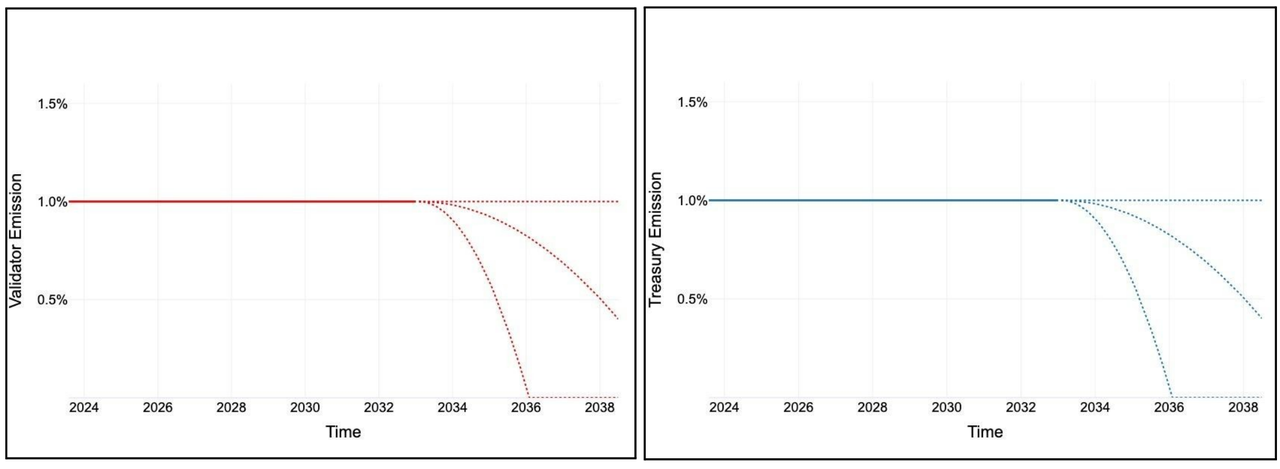
The economic model of Pol is different. Firstly, 2% of new Pol tokens are generated through the PoS mechanism every year, and this annual inflation rate is fixed for the first ten years. These 2% newly created tokens will be distributed as follows: half to the node validators providing validation services for the network, and the other half goes into the ecosystem fund.
After ten years, this inflation rate can be adjusted, but with a limitation: it can only decrease, not increase. This means that the supply growth rate of Pol will only slow down, not speed up. Furthermore, Pol tokens in the ecosystem fund are not permanent; they can be burned through community governance proposals, further ensuring the scarcity and value of the tokens.
In the Polygon network, validators play a crucial role in ensuring the security and stability of the network. To incentivize these validators, Polygon provides them with a series of reward mechanisms:
1. Protocol Rewards: As long as validators stake POL tokens, they enter the validator pool and become eligible to validate any Polygon chain. Each active Polygon validator receives a basic protocol reward. These rewards are distributed proportionally based on the amount of POL tokens staked by the validator.
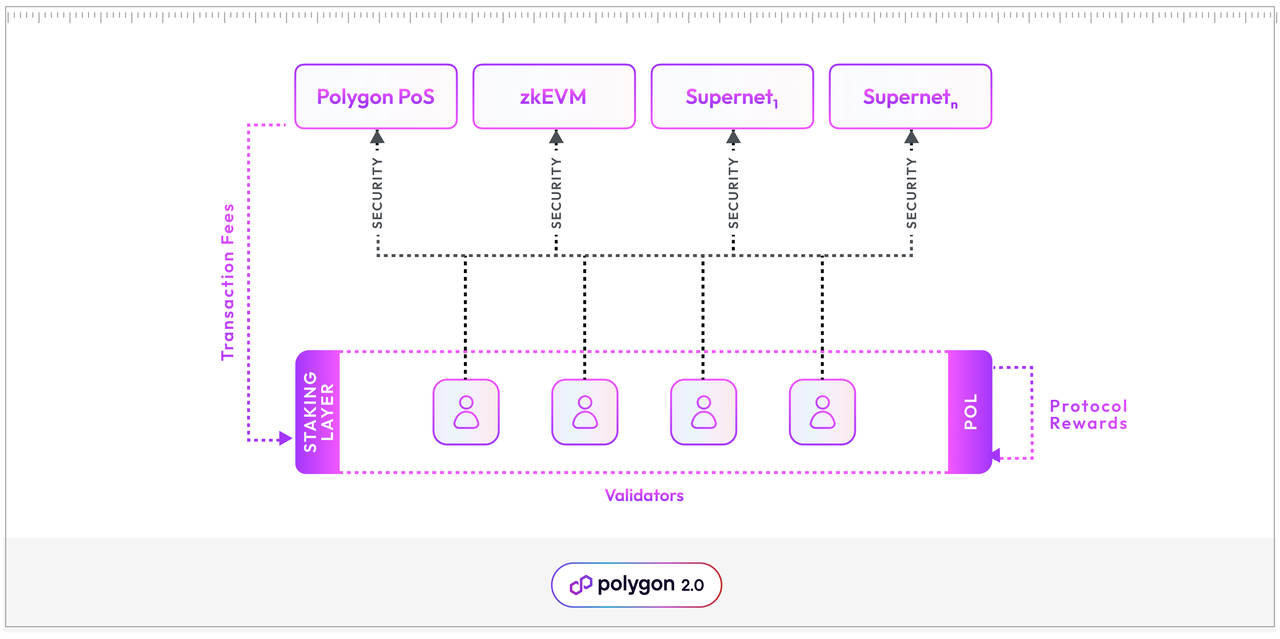
2、Transaction Fee Rewards: Polygon's design allows validators to validate any number of Polygon chains. As a reward for their services, these chains may reward validators with some or all of the transaction fees. It's worth noting that the allocation of transaction fees within the Supernet can be customized and may depend on factors such as the actual transaction volume on the public chain, the actual transaction volume on the Supernet, and the number of chains within the Supernet.
3、Additional Incentives: In order to attract more validators, certain Polygon chains may offer additional incentives. These incentives can be in various tokens, including not only POL but also stablecoins or the native tokens of a specific Polygon chain.
The vision of the Polygon team is to create a truly scalable network, and the launch of Polygon 2.0 is a step further toward achieving this vision.
Their co-founder has explicitly stated that they aim to end the era of Web3 infrastructure and instead make applications the center of the ecosystem. He believes that only when we have Web3 infrastructure powerful enough to support hundreds of millions of users can this transition truly take place. This is not just a technical challenge but also a firm commitment from the Polygon team for the future.


All Comments