

In late October, dYdX quietly launched its V4 upgrade, which is not just an enhancement of existing features but a fundamental transformation. dYdX V4 will utilize a brand-new L1 blockchain based on the Cosmos SDK called dYdX Chain, further strengthening its decentralization features. Additionally, dYdX Trading has open-sourced the code for V4, taking a step towards complete decentralization.
Charles d'Haussy, CEO of dYdX, said, "This is a milestone for the dYdX ecosystem, marking the beginning of a truly decentralized era. Since our inception, we have achieved $1 trillion in trading volume, accounting for approximately 1% of the global derivatives trading volume. With the arrival of V4, we expect our market share to grow to 7%."
Since its founding in 2017, dYdX has evolved from an emerging decentralized platform into a leading exchange that integrates lending, leveraged trading, and perpetual contract functionality. Through four funding rounds, it has gained support from heavyweight investors like Paradigm and A16Z. In 2021, dYdX's migration to Starkware significantly improved its transaction processing speed and greatly reduced gas fees, ensuring its leading position in the decentralized derivatives trading market, with a daily trading volume exceeding $800 million.
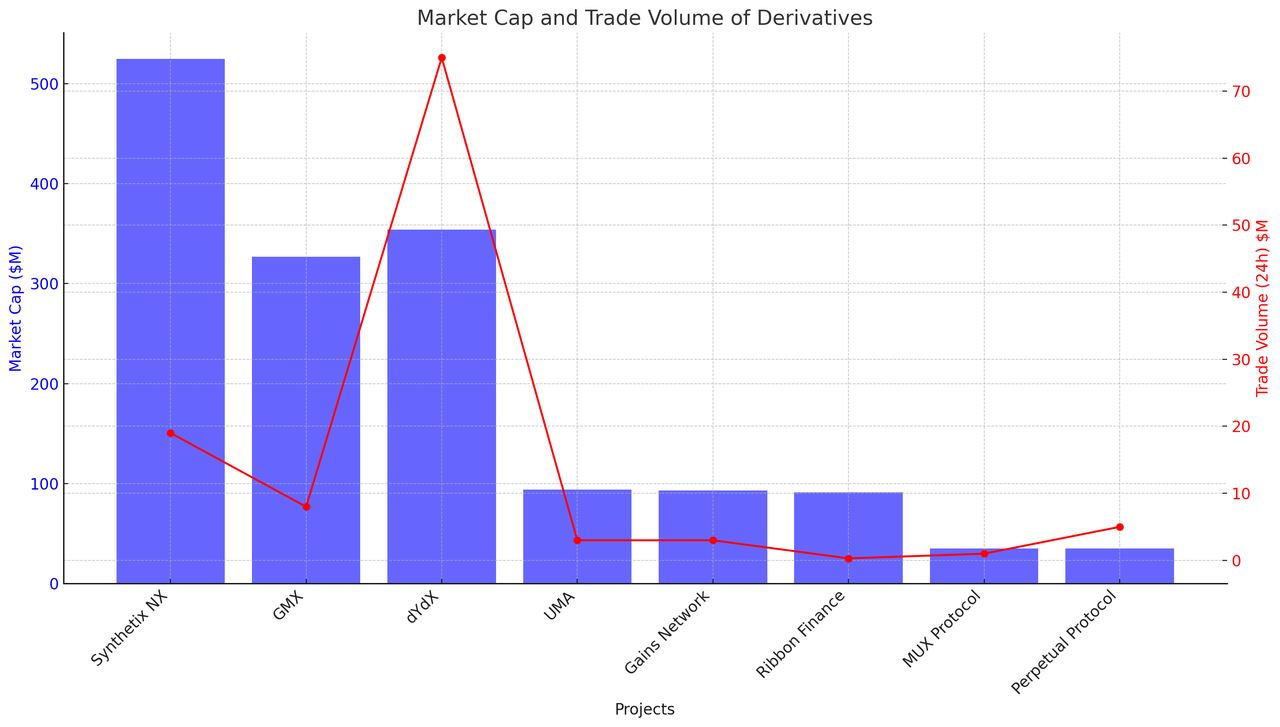
In this favorable context, can dydx V4 add value to the project? Let's analyze this in detail.
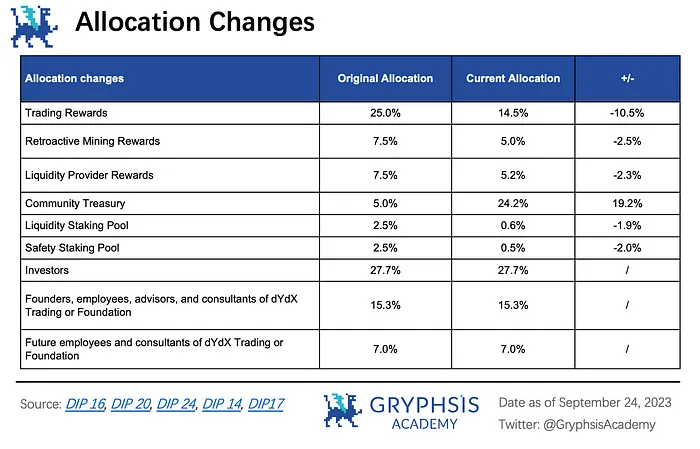
dYdX V4 has made careful improvements to its economic model. The total supply of $DYDX tokens is set at 1 billion, and starting from August 2021, these tokens will gradually unlock over a period of five years. However, with adjustments through several governance proposals (such as DIP 14, DIP 16, DIP 17, DIP 24), there have been significant changes in the initial token allocation.
Under the new allocation model, 50% of the $DYDX supply is specifically reserved for the community. Among this allocation, 14.5% is allocated for trading rewards, 5% for retroactive mining rewards for historical trades, and 5.2% goes to liquidity providers as incentives. Additionally, 24.2% will be held in a community treasury, 0.6% as USDC collateral rewards, and 0.5% as $DYDX security pool collateral rewards. At the same time, the remaining 50% is primarily allocated to investors and company employees.
To ensure the continued development of dYdX and provide ample resources for the community, the economic model also includes an inflation mechanism. Starting from the fifth year, a maximum annual inflation rate of up to 2% can be utilized by the Governance to increase the supply of $DYDX tokens. However, this inflation is not automatic; each instance of inflation must be decided through a governance proposal, and the annual limit is strictly controlled at 2%. This ensures both token value stability and the needs of dYdX's ongoing development.
dYdX offers three main functionalities: lending, leveraged trading, and perpetual contracts. Particularly in leveraged trading, when users have insufficient funds, the system automatically borrows from the liquidity pool and calculates corresponding interest, providing users with a seamless trading experience. Additionally, dYdX attracts a significant amount of liquidity by offering lower fees to Makers, especially beneficial for institutional and professional traders conducting large volume trades. According to Gryphsis's data analysis, dYdX's fees are significantly lower than those of other trading platforms.
In the V4 upgrade, the fee and reward structure has been carefully adjusted. The existing V3 reward mechanism will gradually be replaced by the new V4 mechanism. This transition will go through four main steps: firstly, V3 rewards will gradually decrease and eventually cease; then, the community and reward vault contracts will be upgraded; next, rewards will be migrated to the V4 network; finally, assets in the V3 network will be migrated to the V4 mainnet through cross-chain bridges. Throughout this series of processes, asset migration will be facilitated through specific burning mechanisms.
To stimulate users to migrate to V4, dYdX has introduced a series of incentive measures. For instance, as part of the community plan, they will allocate $20 million worth of $DYDX tokens to early V4 adopters over a six-month period. Additionally, for the first 120 days after the launch of V4, Makers will receive a 1.1 basis point (bps) trading reward, after which they will be subject to fees unless specific trading volume conditions are met.
This new fee and reward structure is designed to accelerate the adoption of dYdX V4 and enhance its fee competitiveness in the market. The calculation of rewards is based on specific formulas, including trader reward scores, the sum of all trader scores, and reward distribution for each block, among other factors.
Ultimately, through these new measures, dYdX aims to encourage trading activity while reducing inflationary emissions compared to V3, making its economic model more robust.
The calculation of trading rewards is based on specific formulas and parameters. Rewards are distributed from a pool called the "reward vault," with rewards being calculated and distributed for each block. Each trader's reward score is calculated using a specific formula that takes into account their trading behavior within a given block.
In each block, rewards are distributed in proportion to the scores of all traders. The specific reward calculation formula consists of three main components, including the trader's reward score, the sum of all trader scores, and the reward amount allocated to traders in each block.
Trader's Reward Score Formula:

Sum of Trader's Scores:

The reward amount allocated to traders in each block:

Parameters:
T: The number of tokens in the reward pool.
A: The amount of rewards allocated to traders in a given block.
C: A constant configurable by the governance community.
S: The total sum of rewards earned by all traders.
In the previous model before dYdX, the off-chain order book was hosted on AWS, and users could access it at any time. However, the V4 upgrade brought significant changes. dYdX Chain introduced a brand-new architecture, opting not to use the previous off-chain order book approach. In this new model, the order book is embedded in the validator's memory, which means that transactions can be processed in real-time without waiting for confirmation of each block.
Most importantly, this new processing method comes with a significant advantage: in the V4 version, users will no longer need to pay any GAS fees when placing or canceling orders. This greatly reduces transaction costs and provides users with a more user-friendly and cost-effective trading experience.
Compared to the V3 version, V4 places a stronger emphasis on creating value for users in its economic model.
In the V3 version, the primary functions of the $DYDX token were focused on governance, fee discounts, and staking. However, with a proposal in October 2022, the security staking module was deactivated. The V4 upgrade further expands the functionality of $DYDX, making it the core staking token of the PoS (Proof-of-Stake) chain and distributing transaction fees of the system to traders, stakers, and validators.
With the launch of dYdX V4, dYdX Chain is transitioning into a PoS (Proof-of-Stake) blockchain. In this new architecture, V4 requires a dedicated L1 protocol token for validator staking, ensuring the security of the chain and managed by Stakers. After community discussions, it has been decided to use $DYDX as the L1 token for the dYdX chain. Under the PoS mechanism, the primary role of the L1 token is for node staking, and anyone can become a staking node as long as they meet a certain token quantity, thereby maintaining the network's security.
dYdX not only enhances the practical utility of the token through fee rewards but also is likely to make $DYDX the primary way to pay transaction fees, creating real demand for the token. Additionally, the fee distribution strategy is entirely community-driven. If the community decides to allocate more income to $DYDX token holders, the token will have a more direct avenue to derive value from the protocol's growth. This establishes a solid economic foundation for $DYDX and is expected to further increase its market value.
The dYdX team firmly believes that openness and cooperation are key to achieving greater success. Therefore, they have chosen the open-source path, hoping to encourage more users and developers to get involved. This strategy is not just about expanding the user base but also about transforming dYdX from an application into a widely adopted foundational protocol, ultimately evolving into a public product for derivative contracts.
When third-party applications can build their own services based on dYdX's open protocols, dYdX can focus more on optimizing and improving its core protocol. However, there is indeed a challenge in achieving fair value distribution between the application layer and the protocol layer.
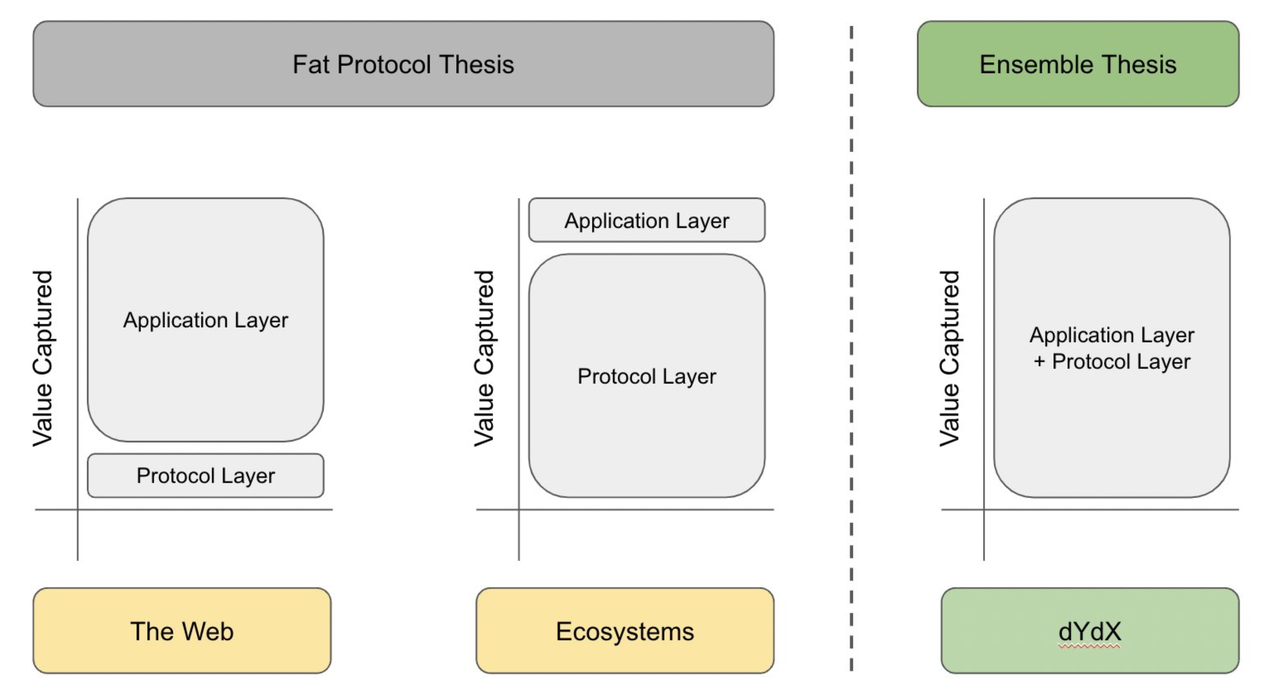
Traditionally, according to the Fat Protocol Theory, the value captured at the protocol layer is usually much greater than that at the application layer. However, dYdX's strategy has brought a new interpretation to this theory. Through the open-source and newly created dYdX Chain, dYdX has strengthened the value-capturing capability at the application layer, thereby encouraging more developers to innovate at the application layer.
In the end, dYdX's vision is to create a truly decentralized ecosystem where every participant can fairly share the value. To achieve this goal, dYdX realizes that as protocol builders, they must be willing to share more profits and opportunities. This is the direction that dYdX is currently pursuing, as they firmly believe it will bring a more prosperous future to the entire ecosystem."
In the past, DEX (Decentralized Exchanges) faced various challenges in competition with CEX (Centralized Exchanges), including MEV (Miner Extractable Value), insufficient price competitiveness, high gas fees, and issues with liquidity providers' profits. However, with rapid technological advancements, especially innovations like Uni4 and dYdX V4, these problems are being addressed, making DEX's fee advantages more pronounced.
On the other hand, CEX is facing increasingly stringent regulatory pressures. Meanwhile, in the V4 version, dYdX has chosen a fully decentralized path. This means that dYdX Trading, Inc. no longer operates any centralized components, and all decisions and management are handed over to the community. This fully decentralized model helps dYdX avoid the risk of being labeled a "centralized exchange" and provides greater room for growth in the global market.
More importantly, with the open-sourcing of the dYdX protocol and strategic adjustments at the application layer in the V4 version, we may witness the arrival of the "dealer era" of DEX. In this landscape, various applications and services will be developed based on the dYdX protocol, benefiting from protocol-layer incentives. This can help the protocol compensate for shortcomings at the application layer, such as disadvantages in marketing and customer acquisition, further promoting the rapid growth of the entire ecosystem.


All Comments