


Author: Chainlink
With 5.56 billion Internet users, much of the world’s economic activity now takes place online. While businesses and individuals have rapidly embraced digital transformation, government processes have been relatively slow to adapt. Though there are valid reasons for a cautious approach, there are also significant opportunities for modernization in the public sector.
Many government systems operate with outdated processes, leading to inefficiencies, delays in services, and potential security vulnerabilities. Blockchain technology offers a solution to modernize public services by enhancing efficiency, security, and transparency. Decentralization, transparency, and immutability—blockchain technology’s core benefits—make it a powerful tool to help streamline bureaucratic operations, prevent fraud, and ensure trust in public institutions.
In this post, we examine 7 blockchain use cases for the government and the public sector.
Blockchain Use Cases in Government and the Public Sector
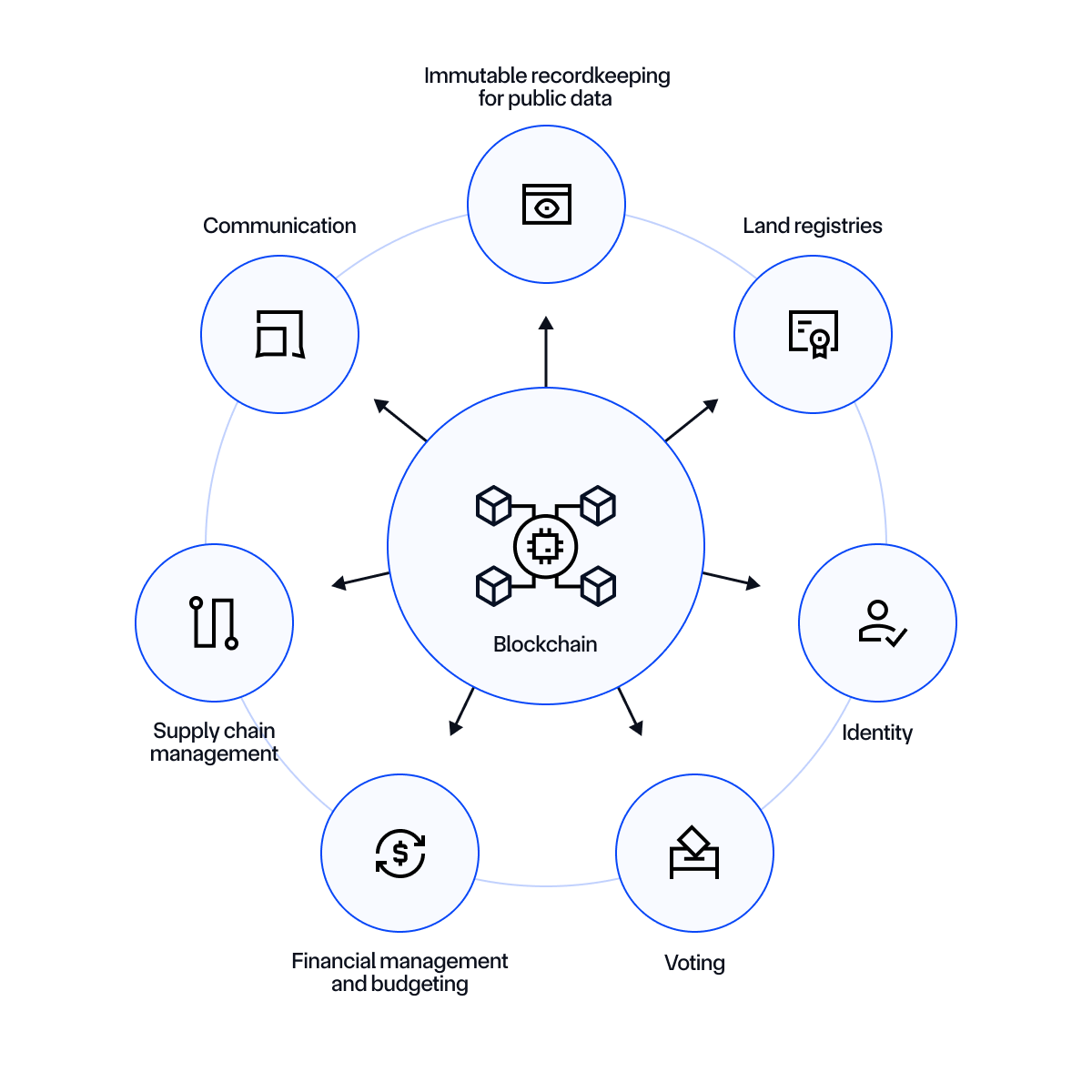
Blockchains offer a multitude of benefits for the public sector across various industries.
1. Immutable recordkeeping for public data
Rapid technological change over the last few decades has triggered a global surge in data, with an estimated 402.74 exabytes (402.74 million terabytes) of data being created every day. This explosion of information includes vast amounts of public and governmental data, making it increasingly critical to ensure transparency, security, and trust in the management of this data.
Ensuring authenticity verification, speed, and integrity in shared information is essential for effective governance and for government institutions to serve their citizens. Blockchain and other distributed ledger technologies (DLTs) offer valuable tools that institutions and governments can use to streamline governance processes and leverage the immutable recordkeeping properties of blockchain to more effectively store, manage, and authenticate highly sensitive information.
Estonia—the first country to use blockchain on a national level—implemented an e-Estonia initiative that uses its own KSI blockchain “to ensure networks, systems, and data are free of compromise, all while retaining 100% data privacy”.
2. Land registries
Land title registries track the ownership of land and property within a given region, serving as a fundamental component of property rights protection. Efficient land registration is essential for ensuring legal ownership, reducing disputes, and facilitating economic development. However, traditional land registry systems often suffer from inefficiencies, data inconsistencies, and security vulnerabilities.
Blockchain and other distributed ledger technologies offer a more secure and transparent solution for maintaining land records. By leveraging a tamper-proof, decentralized ledger, governments can improve the efficiency, accuracy, and accessibility of land registration while reducing fraud and administrative bottlenecks.
Some countries have already seen positive outcomes from integrating DLT into land registration. For example, in Georgia—where property disputes were historically common—the government implemented blockchain-based land registration. As of 2018, over 1.5 million land titles had been registered on the blockchain, allowing citizens to receive digital certificates with timestamps and cryptographic proof of ownership.
3. Identity
Government-issued identification is a cornerstone of modern nation-states, enabling citizens to access essential services such as healthcare, financial aid, and social benefits. Likewise, international passports facilitate global mobility, allowing customs officials to verify identity, citizenship, and applicable travel privileges.
Despite its importance, an estimated 850 million people worldwide lack any form of legal identification, according to the World Bank. This gap limits access to essential services and restricts economic and social opportunities. Digital identity solutions powered by blockchain and other DLTs offer a potential solution by providing immutable, verifiable identification for those without traditional identity documents while also strengthening the security of existing identification systems.
Blockchains’ ability to securely store and authenticate digital identities could be particularly valuable in situations where physical documents are lost, destroyed, or inaccessible—such as during refugee crises or natural disasters. By leveraging blockchain-based identity systems, governments can improve the delivery of public services and empower individuals with greater control over their personal data.
Beyond traditional identity systems, blockchain technology has the potential to enhance verification processes across various government functions. One application is the authentication of government personnel, vehicles, and equipment. By leveraging onchain identity verification, governments can ensure that only authorized individuals operate sensitive infrastructure, such as military or emergency response vehicles, and that all personnel meet the required credentials before accessing restricted areas or classified systems.
4. Voting
Traditional voting systems are vulnerable to tampering and fraud, raising concerns about election integrity and public trust. Manual vote counting, centralized databases, and outdated digital systems can create opportunities for manipulation, miscounts, or cyberattacks. Additionally, logistical challenges such as long wait times, lost ballots, and limited accessibility can discourage voter participation.
Blockchain technology offers a potential solution by providing a secure, decentralized platform for recording and verifying votes. By ensuring that each vote is transparently recorded and immutably stored onchain, this technology can enhance the accuracy and security of election systems. A decentralized approach reduces the risk of single points of failure or centralized interference, making elections more resilient against fraud and cyber threats.
Moreover, blockchain-based voting systems could improve accessibility and convenience, allowing eligible voters—including those in remote locations or with mobility challenges—to cast their votes securely, from a digital device that uploads their vote onchain. This could increase voter turnout and make the democratic process more inclusive.
While blockchain presents a promising alternative for election security and transparency, challenges remain, such as ensuring voter anonymity and addressing other technical barriers.
5. Financial management and budgeting
Blockchain technology has the potential to enhance the fairness, efficiency, and transparency of government financial systems while reducing opportunities for corruption. By leveraging blockchain’s immutable ledger for transparency, governments can create more accountable and efficient financial processes, ensuring that public funds are allocated and spent as intended.
One key challenge in public financial management is ensuring accountability in budgeting, procurement, and expenditures. Traditional systems can lack transparency, making it difficult for citizens to track where funds are allocated, how they are used, and whether they reach their intended destination.
By integrating blockchain technology, government agencies can create tamper-proof records of financial transactions, making all expenditures verifiable onchain. Smart contracts and oracle networks can automate budgeting processes, ensuring that funds are only released when specific conditions are met. Additionally, decentralized ledgers can improve auditability, allowing oversight bodies, journalists, and citizens to track government spending with greater transparency.
Beyond improving oversight, blockchain can help reduce administrative costs and inefficiencies. Automating financial workflows, reducing manual recordkeeping, and streamlining transactions can lower operational expenses and free up resources for other public services.
6. Supply chain management
Governments rely on complex supply chains to procure and distribute essential goods, including infrastructure materials, military equipment, medical supplies, and more. However, traditional supply chain management systems often suffer from inefficiencies, lack of transparency, and vulnerabilities to fraud and mismanagement.
Blockchain technology offers a solution by providing a secure, tamper-proof, and transparent ledger for tracking goods and services throughout the supply chain. For example, it can enable onchain registration of goods at their point of origin or use cryptographic verification to ensure that vehicles reach every designated checkpoint before arriving at their destination. Unlike traditional databases, which can be manipulated by insiders, blockchain ensures that records remain immutable, eliminating internal threats such as unauthorized modifications to airline bag-tracking databases.
By integrating blockchain into supply chain management, government agencies can enhance visibility and accountability at every stage of procurement and distribution. Each transaction—from sourcing raw materials to final delivery—can be recorded on an immutable ledger, ensuring that all stakeholders have access to accurate, real-time data. This transparency can help prevent corruption and improve resource allocation.
7. Communication
Effective government communication is crucial for security, transparency, and public trust. However, traditional systems are often vulnerable to unauthorized access and cyber threats. Blockchain offers a secure, tamper-proof solution for authenticating messages up, down, and throughout departments and verifying official communications—both within government departments and between governments and citizens—ensuring information remains verifiable and resistant to manipulation.
Additionally, blockchain-based identity verification can prevent impersonation of government officials, ensuring that only verified representatives issue official communications.
How Chainlink Can Support Efficient Government Operational Processes
Chainlink is the backbone infrastructure of the blockchain industry, enabling businesses and financial institutions to stay at the forefront of technological innovation by modernizing systems for a more resilient economy. Chainlink decentralized oracle network technology has enabled over $19 trillion in onchain transaction value and has played a pivotal role in expanding blockchain adoption across industries.
Already, the Chainlink standard is being leveraged by government monetary authorities and central banks. Chainlink is powering three major use cases under the Monetary Authority of Singapore (MAS) Project Guardian, while Brazil’s central bank is using Chainlink to build a CBDC project for trade finance. Chainlink empowers institutions and governments to leverage blockchain technology and modernize at their preferred pace using their existing infrastructure.
Notably, Chainlink Proof of Reserve (PoR) can enhance financial transparency and security in critical government-backed digital assets. Governments establishing strategic digital asset reserves can use Chainlink PoR to provide real-time, cryptographic verification of assets, ensuring accountability towards citizens, users, and other governments. Similarly, Chainlink PoR can be leveraged in USD-backed stablecoins and CBDCs, allowing central banks to offer publicly verifiable proof about the backing of assets. By integrating Chainlink PoR, governments can build more transparent and efficient digital financial systems onchain.
Conclusion
As governments worldwide seek to modernize their systems, blockchain technology presents an opportunity to enhance transparency, security, and efficiency in public services. From immutable recordkeeping to streamlined supply chain management and financial oversight, blockchain technology can help build more accountable and resilient government operations that not only improve service delivery but also foster greater trust and engagement among citizens.


All Comments