

Cointime

Download App
iOS & Android

US home mortgage regulator considers Bitcoin amid housing crisis

The US federal home loan regulator is looking into how crypto holdings could help mortgage seekers qualify for home loans. The move comes amid a decline in the number of mortgage applications in recent years as the US experiences a housing crisis. 

In a statement on X on June 23, Bill Pulte, head of the Federal Housing Finance Agency (FHFA), said his agency will “study the usage of [sic] cryptocurrency holdings as it relates to qualifying for mortgages.”

Homeownership has remained relatively stable over the last 50 years in the US, with around 62% of the population owning homes. However, the number of new applicants has seen a sharp decline in recent years.

While some boutique lenders already allow borrowers to use their crypto as collateral, study and acknowledgement from the FHFA would represent a major step forward for crypto adoption, particularly amid flagging mortgage application numbers. 

FHFA goes pro-crypto on mortgages, while housing rates decline

While scant on details, Pulte’s pro-crypto comments come at a time when the US housing market is experiencing serious difficulties. 

The number of mortgage originations — i.e., the process in which a lender works with a borrower to form a mortgage loan — dropped to near record lows in the middle of 2024 and has improved little in the first quarter of 2025. The drop in originations, and particularly in refinancing, has been attributed to several factors. 

Firstly, the supply of housing is not growing sufficiently to address demand. Construction is lagging, more housing is being purchased by investors, rather than by would-be homeowners, and elderly homeowners are still living at home rather than moving to senior living accommodations. 

Borrowing is also getting more expensive, and many have attributed the slump in originations to the Federal Reserve’s higher interest rates to combat inflation. Pulte has criticized the Fed’s rate policies, going so far as to call for the resignation of Chair Jerome Powell, who will be testifying before Congress on June 26. 

Amid these headwinds, Pulte is looking for ways to make borrowing more feasible for homeowners.

FHFA approval could open up lenders to crypto

Acknowledging crypto officially at the FHFA could open up sizeable federal lending programs for more borrowers. In 2024, the FHA alone issued over 760,000 single-family mortgages worth $230 billion. 

Until Jan. 23, 2025, most banks couldn’t offer crypto-backed loans or mortgages due to Staff Accounting Bulletin No. 121, a banking rule from the Securities and Exchange Commission that required financial institutions to count cryptocurrencies as a liability rather than an asset on their balance sheet. The rule was repealed quickly after President Donald Trump took office. 

Related: SAB 121 rescinded: What it means for crypto custody and regulation in 2025

Still, loans secured through federal programs like FHA, VA and USDA currently do not let borrowers use their crypto as collateral. Indeed, some federal loans may not even allow dollar liquidations from crypto sales to be used for down payments, according to 99Bitcoins editor Sam Cooling. 

Personal finance expert Andrew Lokenauth said that would-be homeowners looking to buy with their Bitcoin proceeds need to “be careful to document everything and save the paperwork.” 

Bitcoin advocates lauded Pulte’s openness to Bitcoin (BTC), with some stating that there are already features that lenders prefer — e.g., a transparent paper trail — built into the digital asset.

Mitchell Askew, an analyst at Bitcoin mining-as-a-service Blockware, said that the asset’s liquidity and transparent custody, namely its public blockchain, make it a “perfect collateral” for home loans. 

CJ Konstantinos, founder of Bitcoin mortgage and bond company People’s Reserve, said that Bitcoin could further help derisk the mortgage-backed securities market the FHFA oversees by regulating Fannie Mae and Freddie Mac. “This is a no brainer.”

Who wants crypto loans?

There are already a small number of lenders that let borrowers offer up their crypto as collateral, but they are few and far between. These cater more toward the investor class of home buyers and carry risks some may not be ready to stomach.

Milo (formerly MiloCredit) approves loans for borrowers instantly, but they first need to show that they have enough crypto to cover the entire value of the loan. Milo CEO Josip Rupena said that many clients were buying their second homes, vacation properties or investment properties.

“Many have strong incomes, but traditional banks wouldn’t have qualified them for the full value of these homes,” he said. 

Strike, another company offering Bitcoin-collateralized loans, states that there are some risks to crypto loans in their current form. Volatility is a major factor. If BTC’s price decreases dramatically, the loan-to-value rate increases, “which can trigger margin calls or liquidations — forced sales at inopportune times.”

Lenders are open to risk as well. One commenter stated, “The risk models for this will be insane. Traditional mortgages assume relatively stable income and assets. Now you’re dealing with borrowers whose net worth can swing 50% in a week. How do you stress-test a portfolio when your collateral includes everything from Bitcoin to random DeFi tokens?”
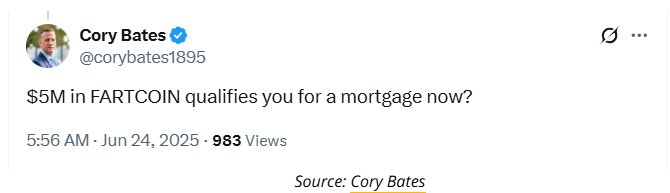
  Source: Cory Bates

But crypto ownership in the US is growing increasingly common, with lawmakers and regulators in Washington moving apace to implement rules and legal frameworks that are friendly to the industry. 

Recent studies show that crypto is no longer just the remit of uber-rich crypto bros but is increasingly seen as a legitimate retail asset among normal investors. Some 20% of Americans, around 65 million people, are estimated to now own crypto, according to the National Cryptocurrency Association’s “2025 State of Crypto” report.

Their investments aren’t astronomical either; some 74% of crypto portfolios in the US are worth less than $50,000. 

Allowing crypto for downpayments or as collateral could unlock homeownership for the growing number of investors if Bitcoin joins the list of other securities they can use to get a mortgage. 

Comments

All Comments

Recommended for you

  • NVIDIA's Market Value Surpasses $5 Trillion Again

    On April 24, NVIDIA's stock price rose by 3.08%, reaching $205.790 per share, with a total market value of $5.00 trillion. The stock price hit a new high since late October 2025.

  • Ethereum Foundation to Sell 10,000 ETH to BitMine

    On April 24, the Ethereum Foundation announced the finalization of a sale of 10,000 ETH to BitMine, the first treasury company of Ethereum, through an over-the-counter (OTC) trading platform, at an average price of $2,387 per ETH.

  • Sources: U.S. Justice Department Expected to Drop Criminal Investigation into Powell

    On April 24, multiple informed sources revealed that the U.S. Justice Department is expected to conclude its criminal investigation into Federal Reserve Chairman Jerome Powell as early as Friday, thereby ending a stalemate that could have delayed the appointment of Powell's successor. Sources indicated that senior officials from the Justice Department recently contacted several senators, including Republican Senator Thom Tillis, a member of the Senate Banking Committee, to inform them of the plan to abandon the investigation into alleged cost overruns related to the renovation of the Federal Reserve's Washington headquarters, and to refer the matter to the Federal Reserve's internal oversight body. Powell's term is set to end next month, but he stated in March that he would remain until Trump's nominee for Federal Reserve Chair, Waller, is confirmed. (ABC News)

  • U.S. Stock Indices Open Higher; Intel Surges Approximately 23% to Record High

    On April 24, U.S. stock indices opened higher across the board, with the Dow Jones up 0.02%, the S&P 500 rising 0.4%, and the Nasdaq increasing by 0.73%. Intel surged approximately 23%, reaching a record high; the company expects second-quarter revenue between $13.8 billion and $14.8 billion, while the market estimate is $13.04 billion. AMD rose over 10%, and Arm increased more than 8%. Nvidia's stock price rose by 0.11%, while Google's Class A shares fell by 0.49%. Apple's stock price decreased by 0.61%, Microsoft’s stock rose by 0.47%, Amazon's stock increased by 1.42%, Meta Platforms Inc Class A shares fell by 0.34%, Tesla's stock remained unchanged, and Netflix's stock dropped by 0.92%.

  • BTC Surpasses $78,000

    Market data shows that BTC has surpassed $78,000, currently priced at $78,013.14, with a 24-hour increase of 0.7%. The market is experiencing significant volatility, so please ensure proper risk management.

  • Central Bank and Eight Departments: Prohibit Online Marketing Services for Virtual Currency Issuance and Trading

    On April 24, the People's Bank of China and eight other departments jointly issued the "Regulations on the Management of Online Marketing of Financial Products," which will take effect on September 30, 2026, systematically regulating online marketing activities for financial products. The regulations specify that only approved financial institutions and their self-operated platforms, as well as entrusted third-party internet platforms, may engage in online marketing of financial products. It prohibits providing online marketing services for illegal financial activities such as illegal fundraising, virtual currency issuance and trading, and illegal foreign exchange margin trading. The regulations detail requirements regarding the authenticity of marketing content, risk disclosure, algorithm recommendations, pop-up advertisements, account naming, trademark usage, cooperation models, and the protection of data and personal information. They also clarify the regulatory responsibilities and penalties for financial management departments, internet information, telecommunications, and market supervision departments.

  • BTC Surpasses $78,000

    Market data shows that BTC has surpassed $78,000, currently priced at $78,049.83, with a 24-hour increase of 0.04%. The market is experiencing significant volatility, so please ensure proper risk management.

  • DeepSeek-V4 Preview Version Officially Launched and Open-Sourced

    On April 24, DeepSeek announced via its official WeChat account that the preview version of the new model series DeepSeek-V4 is officially online and open-sourced. DeepSeek-V4 features a million-word ultra-long context and leads in agent capabilities, world knowledge, and reasoning performance in both domestic and open-source fields. The model is available in two versions based on size. Starting today, users can log in to the official website chat.deepseek.com or the official app to interact with the latest DeepSeek-V4 and explore the new experience of 1M ultra-long context memory. The API service has also been updated; by changing the model_name to deepseek-v4-pro or deepseek-v4-flash, users can access it.

  • Intel CEO: Semiconductor Potential Market Size Approaching $1 Trillion

    On April 24, local time, after the U.S. stock market closed on April 23, Intel officially released its Q1 fiscal year 2026 financial report and held an earnings call. The company delivered its sixth consecutive quarter of better-than-expected results, with revenue, gross margin, and earnings per share all surpassing guidance. The AI business has become the core growth engine, with a surge in demand for server CPUs and advancements in advanced processes and packaging exceeding expectations. Following this financial report, Intel's stock price surged nearly 20% in after-hours trading. During the earnings call, Intel CEO Pat Gelsinger stated that despite continuous improvements in factory capacity, demand across all business segments remains higher than supply, particularly for Xeon server CPUs, which are expected to maintain strong growth momentum over the next two years. Gelsinger also noted, 'In recent years, the focus in high-performance computing has been almost entirely on graphics processors and other accelerators. In recent months, clear signs have shown that central processing units are becoming an indispensable foundation in the era of artificial intelligence.' Looking at the overall market, Gelsinger anticipates that driven by explosive growth in AI demand, the overall potential market size of the semiconductor industry is approaching $1 trillion. However, Intel's management also warned that the company still faces multiple pressures, including declining demand in the PC market, rising costs, expanding capital expenditures, and supply constraints. (Dongxin News Agency)

  • Trump: U.S. to Soon Capture Nearly 50% of Chip Market

    On April 24, U.S. President Trump declared on the 23rd that the United States will soon capture nearly 50% of the chip market, warning that chip companies that do not manufacture in the U.S. will face very high tariffs in a year and a half to two years. U.S. Secretary of Commerce Gina Raimondo stated that the U.S. previously held only 3% to 4% of the chip market while having the largest demand for chips. Under Trump's directive, the U.S. is requiring semiconductor fabs to return to domestic production, with expectations that fabs worth $1 trillion will come to the U.S. Raimondo emphasized that this is not about tech giants purchasing chips, but rather about chip manufacturing. She mentioned commitments from Micron Technology to invest $200 billion and TSMC to invest $165 billion, along with $500 billion in funds from Taiwan expected to flow into the U.S. Raimondo also indicated during a congressional hearing on the 23rd that investments in the U.S. semiconductor industry during Trump's term are expected to reach $1 trillion. (Dongxin News Agency)
