

Cointime

Download App
iOS & Android

ETF filings explode in 2025, heating hopes of an ‘altcoin summer’

Regulatory optimism in the US has led to at least 31 altcoin exchange-traded fund (ETF) applications to the US Securities and Exchange Commission in the first half of 2025.

The SEC has approved futures and spot ETFs for Bitcoin and Ether, but past attempts to list altcoin-related instruments have withered on the vine. Now, renewed optimism after the 2024 elections has led to several new applications that are expected to be approved.

The list includes filings from familiar names such as VanEck, which applied to list ETFs in BNB and Avalanche. WisdomTree and Franklin Templeton both have XRP ETFs pending. Memecoins are also represented, with REX-Osprey applying to list an ETF of US President Donald Trump’s token.

ETF and crypto analysts are optimistic that at least 10 applications will pass muster with the SEC, which has onlookers hyped about an “altcoin summer.”

ETF filings heat up hopes of an “altcoin summer”

Spot Bitcoin ETFs were first approved in the US in January 2024. Months later, in July, spot Ether ETFs followed.

This nod was seen as a pivotal moment for the adoption of cryptocurrencies, as it gave institutional investors exposure to the market through a financial instrument they were already comfortable with: an ETF. 

Now, altcoins (any crypto that isn’t Ether or Bitcoin) may be getting their shot at institutional adoption.

As shown by Cointelegraph Research, there have been at least 31 spot altcoin ETF filings in 2025. Among the applications, ETFs containing Ripple’s payments-focused crypto, XRP, and the seminal memecoin Dogecoin appear most prominently. 

According to Bloomberg ETF analyst Eric Balchunas, a “potential Alt Coin summer” is on the way, with a Litecoin ETF likely to be the first approved — although SolanaSOL could be close behind.

“[A Litecoin ETF is] def among the most likely to be out first, but Osprey forcing their Solana 40 act filing effective may have sparked the SEC to act faster on the Solana ones,” he said.

“Commission staff continues to have unresolved questions about whether the Funds, if structured and operated as proposed, would be able to meet the definition of ‘investment company’ under the Investment Company Act,” the SEC stated. 

Still, Balchunas said that REX-Osprey lawyers are certain they can work things out with the commission, and the fund’s legal team is pushing the envelope in an effort to be first to market.

Analysts showed further cause for optimism after the SEC reportedly asked would-be Solana ETF issuers to update and clarify filing language regarding in-kind redemptions and staking. This supposedly shows that the SEC is open to staking — a key component of many altcoin ecosystems. 

According to a Bloomberg Terminal snapshot shared by Balchunas, chances for altcoin ETF approval are good overall, tipping approval changes for 10 ETFs at 60% or above. 
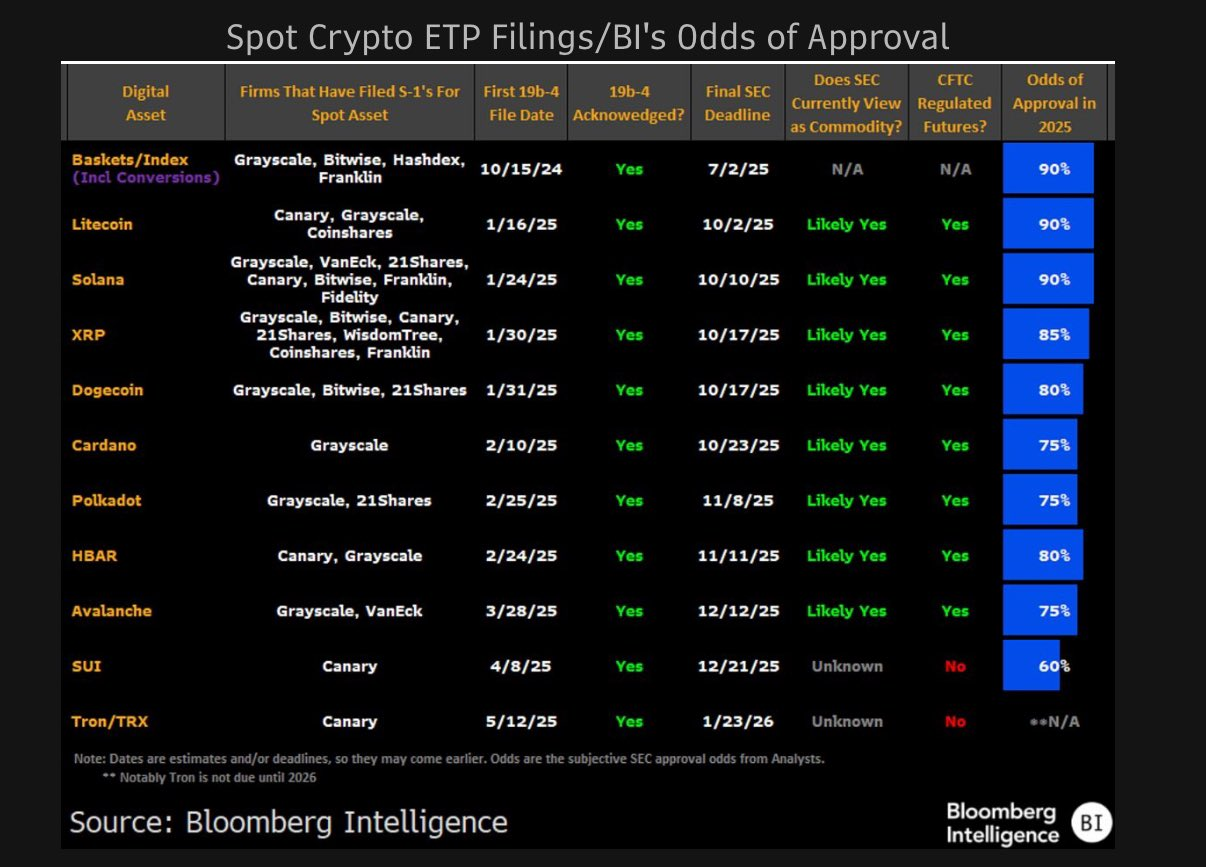
  Source: Eric Balchunas


Is it altcoin summer or winter?

Still, ETF approval does not guarantee prices going to the moon. Nearly a year after approval, ETH’s price has not seen the same meteoric price action as its counterpart, Bitcoin. 

Last month witnessed positive inflows and not a single day of net outflows to ETH ETFs, but critics and observers are concerned about relatively low network fees and the Ethereum network losing ground on decentralized exchanges. 

Related: SOL price toward $300 next? Solana ETF approval chances jump to 91%

Demand for altcoin ETFs may be even less than for ETH ETFs, as Balchunas stated, “Nothing will compare to bitcoin. We have a little saying on the team: ‘The further away you get from btc, the less assets there will be.’”

Dreams for an “altcoin summer” may further dampen as altcoins’ dominance wanes. Crypto market observer Daan Crypto Trades wrote in February about decreasing altcoin dominance but noted that “the decline was quicker and more severe” than previous cycles.
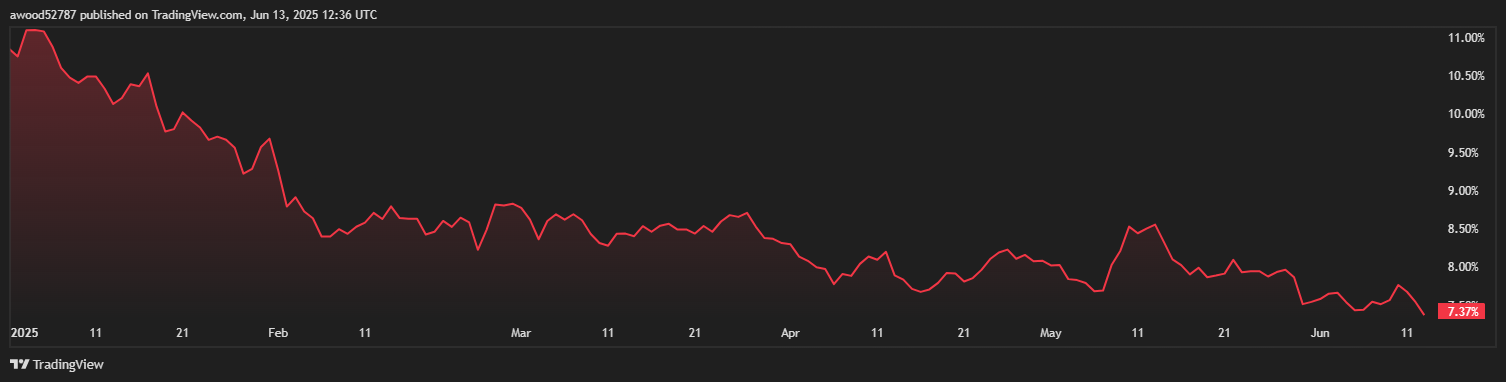
Altcoin dominance is sliding this year. Source: TradingView

Two independent “altcoin season indexes” from Blockchain Center and CoinMarketCap show the indicator firmly in “Bitcoin season.” 

Still, others see an opportunity. Analyst Michaël van de Poppe wrote on June 1 that the altcoin market hasn’t even begun: “The biggest bull market ever on crypto is about to happen, as the expansion after such a long bear market is going to be bigger than before.”

Even as Israel’s attack on Iran shook crypto prices on June 13, van de Poppe remained optimistic of upward momentum, stating that gold breaking downward was a signal for altcoin growth. 

“Buying the dip for opportunities. This should quickly fade away,” he said in a subsequent post. 

SEC 180s, while CFTC on deck for regulation

On April 10, the SEC got its new chairman, businessman Paul Atkins, following a lengthy confirmation process in the Senate. 

Atkins’ priorities were to reverse the actions of his predecessor, Gary Gensler, whom the crypto industry accused of stifling its potential.

Atkins’ SEC has wasted no time reversing a number of policies and implementing new, crypto-friendly rules.

On June 12, the SEC announced that it would be “withdrawing certain notices of proposed rulemaking” made under Gensler. Among them was Rule 3b-16, which expanded the definition of the term “exchange” to include DeFi protocols. 

It also axed a rule that required investment firms to hold client assets with a “qualified custodian,” a definition from which crypto exchanges and wallet providers were typically excluded. 

Atkins has also directed staff to work on a so-called “innovation exemption.” This new exclusion for certain crypto- and blockchain-related financial products would supposedly allow new onchain products to come to market more quickly. 

The SEC chair’s new approach of “notice and comment” rather than “regulation by enforcement” has been lauded not just by the crypto industry but by fellow regulator Caroline Pham, acting chair of the Commodity Futures Trading Commission. 

With regulatory restructuring just getting started — be it from new laws to agency shakeups — the crypto industry is optimistic for future growth in the US. ETFs may be set to take off in this changing landscape. 

Comments

All Comments

Recommended for you

  • Iranian Official: US Provocation on Strait of Hormuz is a Reactive Response

    According to IRNA, Hussein Nushabadi, the Director General of the Iranian Foreign Ministry's Parliamentary and Legal Affairs Department, stated in an interview that Washington's controversial claims regarding control over the Strait of Hormuz are primarily driven by domestic political needs and are a reactive response to Iran's demonstrated strength and strategic actions in this waterway. He noted that the baseless assertions made by the US President regarding the Strait of Hormuz do not align with international shipping regulations or the relevant provisions of the United Nations Convention on the Law of the Sea. Nushabadi also pointed out that Iran possesses political and military dominance over the Strait of Hormuz, a vital lifeline for global energy and economy, making it a powerful lever and strategic trump card in responding to external threats.

  • Jensen Huang Collaborates with Wall Street Giants to Support AI Computing Market

    On August 15, a rare scene unfolded as Jensen Huang joined forces with six major Wall Street asset management giants to endorse the idea of establishing AI computing as an independent asset class. Analysts believe this reflects Huang's commitment to the concept of token economics, marking a shift in the AI boom from a technological competition to a capital competition. However, the latest plan has raised concerns among investors regarding 'circular financing' and debt risks. In response to these doubts, Huang personally stepped in to reassure the market, stating that Nvidia may provide a residual value support mechanism of up to 25% for individual investment projects and will carefully evaluate each project. Following this, market sentiment showed slight improvement. (CCTV Finance)

  • DJI Added to 'Blacklist', US Court Orders Rehearing

    On August 15, according to the Russian Satellite News Agency, the U.S. Court of Appeals recently ruled that a lower court must rehear the case regarding the inclusion of Chinese drone manufacturer DJI on the Pentagon's 'Chinese Military Industrial Enterprises' blacklist, stating that the previous ruling was based on non-confidential information and contained flaws. The report indicated that the D.C. Circuit Court of Appeals pointed out that the lower court's conclusion that DJI 'contributes to China's defense industrial base' was erroneous, as it relied solely on publicly available information. The court has mandated that during the rehearing, the lower court may review classified documents and decide whether to uphold the Department of Defense's designation based on that information.

  • Iran Claims Undisputed Ownership of Strait of Hormuz

    On August 15, according to CCTV International News, Iran's Chief Justice Ejei stated today that the absurd remarks made by the U.S. President regarding the Strait of Hormuz are entirely based on his personal delusions. In the real world, the true owner and dominant power of this important international waterway is Iran. Ejei emphasized that Iran has proven militarily that the Strait of Hormuz is an inseparable part of Iranian territory and sovereignty.

  • US Spot Bitcoin ETF Sees Net Outflow of $56.2 Million Yesterday

    On August 15, according to data monitored by Farside Investors, the US spot Bitcoin ETF experienced a net outflow of $56.2 million yesterday.

  • No Net Inflow or Outflow for US Spot Ethereum ETF Yesterday

    On August 15, according to monitoring data from Farside Investors, there was no net inflow or outflow for the US spot Ethereum ETF yesterday.

  • Charles Schwab: Low Probability of CLARITY Act Passing Before U.S. Midterm Elections

    On August 15, Charles Schwab stated in its 'Weekly Trader Market Outlook' that as of the time of writing, the Bitwise Top 10 Large Cap Crypto Index has fallen 3% since last Friday; Bitcoin has dropped 3% during the same period, while Ethereum is down 2%. Bitcoin continues to exhibit characteristics of a low-correlation asset, with limited impact on its price from the CPI and PPI data released this week. Last week, the U.S. Senate entered its summer recess without voting on the CLARITY Act. Although the final debate vote for the bill is scheduled for September 14, the probability of it passing before the midterm elections remains low.

  • Sources: Trump to Attend Closed-Door Meeting with Crypto Executives at the White House

    On August 15, sources revealed that U.S. President Trump is expected to attend a White House meeting held by the newly established Innovation Committee on Wednesday. The committee consists of executives from the crypto industry as well as leaders from prediction markets and artificial intelligence companies. Sources indicated that the CEOs of companies such as Coinbase, Ripple, Gemini, Robinhood, Polymarket, and Kalshi are members of the U.S. CFTC Innovation Advisory Committee. Before attending the committee's first official meeting on Thursday, these crypto industry CEOs will gather at the White House for the meeting on Wednesday. Attendees learned that Trump plans to participate in this meeting. The meeting is expected to take place at the Eisenhower Executive Office Building next to the White House, aiming to initiate policy discussions on several key directions in the U.S. innovation sector. Sources also stated that CFTC Chairman Mike Selig and other policy advisors are expected to attend the meeting. One source further revealed that U.S. Treasury Secretary Scott Bessent and Commerce Secretary Howard Lutnick may also be present. The White House spokesperson has not yet responded to requests for comments regarding the meeting arrangements.

  • U.S. Optical Communication Stocks Rise, Lumentum Up Over 6%

    On August 14, U.S. optical communication stocks collectively rose, with Applied Optoelectronics increasing by over 14%, AXT Inc and MaxLinear rising by over 7%, POET Technologies and Lumentum up by over 6%, and Lightwave Logic increasing by over 5%. Corning and Tower Semiconductor also saw gains of over 4%.

  • Dunamu Reports 73% Decrease in Q2 Operating Profit to 23.5 Billion Won

    On August 14, Upbit operator Dunamu announced its Q2 2026 performance, reporting quarterly revenue of 173.5 billion won (approximately 123 million USD) and an operating profit of 23.5 billion won (approximately 16.65 million USD), representing declines of about 26% and 73% respectively compared to Q1. In the first quarter, Dunamu's revenue was 234.6 billion won (approximately 166 million USD) with an operating profit of 88 billion won (approximately 62.34 million USD). Dunamu stated that the decline in performance this quarter was primarily influenced by the overall contraction in liquidity in the global digital asset market, which weakened investor sentiment.
