



September 12th, 2023 | BMAN & Kris
GasZero is the first gas-free Layer 2 blockchain network that allows trusted users to transfer funds and use on-chain applications without any gas fees. GasZero’s vision is to bring a billion users to web3 and provide them with a frictionless interaction experience with zero gas fees.
In the test deployment of GasZero in Web2, it significantly improved the conversion rate of users onboarding to Web3 compared to blockchain deployments with gas fees, with an efficiency increase by 146 times. Furthermore, in the 0 gas blockchain environment, users’ lifecycle within dApps is greatly extended as gas fees have been a significant cost associated with using blockchain.
ABCDE led the angel round investment in GasZero.
1. GasZero Increases Web2 to Web3 Conversion Rate by 146 times.
We have been striving to bring Web2 users into Web3, but they face three major obstacles:
1. Mnemonic phrases
2. Fiat currency channels
3. Gas fees
These three hurdles pose significant learning costs for Web2 users and often discourage many users from proceeding. When testing the conversion rate of traditional blockchains in Web2, the conversion rate was only 0.15%. However, in the GasZero environment, this conversion rate can exceed 22% (as shown in the figure below).
So, when can we enable our parents to use blockchain with zero learning costs? When can blockchain truly achieve massive adoption? Currently, there are already MPC/AA products like Particle Network addressing the mnemonic phrase challenge and payment solutions like Moonpay for fiat currency channels. However, there is still no systematic solution for gas fees. GasZero is the first solution that delves into the underlying layers of the blockchain to address this issue.
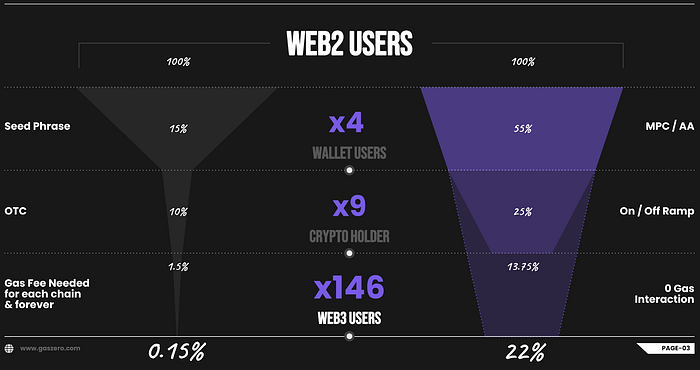
GasZero integrates Particle Network’s MPC/AA solution, fiat payment solutions like Moonpay, and a 0 gas blockchain solution. In testing with platforms like Google and Facebook, the same advertisement conversion rate increased from 0.15% to over 22%, resulting in a 146 times improvement. GasZero eliminates barriers for Web2 users entering Web3, making the product experience indistinguishable between the two and allowing users who have never used blockchain, including our parents, to seamlessly enter Web3.
2. GasZero Technical Features

In the GasZero network, gas fees for trusted end-users are subsidized through a “backend subsidy” mechanism. “0 Gas” refers to trusted end-users being exempt from gas fees during transactions and contract interactions.
The waived gas fees are recorded on the network and are paid by dApp developers or GasZero itself through Infra Fees. If a user’s transaction does not meet the criteria for fee exemption, they can still choose to pay the gas fees themselves to complete the transaction.
When users initiate on-chain interactions in GasZero, their MetaID, MetaShield, and credibility oracle are comprehensively analyzed to determine their eligibility for gas fee exemptions. This analysis includes factors such as:
- Whether the user is a whitelist user for contracts.
- Whether they are flagged as malicious attackers or spammers.
- Whether they interact with different EVM chain assets.
Qualified users can enjoy the benefits of fee exemption (with customizable time periods, frequencies, and contract interaction options).
Note: GasZero’s 0 Gas solution is different from AA Wallet’s delegation payment method. It operates at the node level, providing higher levels of flexibility and security. Compared to the prepayment reimbursement approach, it also offers a better user experience.
To achieve 0 gas, GasZero’s technical solution involves saving gas on traditional blockchains. The GasZero team adopts an optimized architecture for zkEVM, which inherently reduces the cost of zk. Additionally, the team can further lower costs by employing a self-built DA approach. Some costs are covered by node miners to achieve the goal of 0 gas.
To prevent abuse, GasZero has collaborated with some DID projects. For existing web3 users, they can verify whether they are genuine users through ZK Me or by integrating with Worldcoin’s SDK. For new web2 users, transaction limits are imposed within a specified time period to prevent network congestion and waste. Additionally, a reinforced security version of the RPC node is designed to ensure transaction security. The team has accumulated extensive experience in anti-fraud measures from previous game experiences, which helps reduce incidents involving abuse and attacks.
Key elements in the product:
MetaID:

MetaShield:
MetaShield is a crucial auditing mechanism for the 0 GAS service on the GasZero platform. When users initiate transactions in any dApp, it triggers a comprehensive evaluation by MetaShield, including:
1. First-level dynamic policies: Filtering out users engaged in fraudulent activities or operating multiple accounts.
2. Application whitelist: Checking if the user initiating the transaction is whitelisted by the dApp.
3. Credibility oracle: The main logic of the credibility system evaluates users’ historical behavior data on and off the chain to provide a comprehensive score indicating user quality.
4. Second-level dynamic policies: Providing more flexible customization options, such as daily upper limits for platform-covered transaction fees.
5. Contract whitelist: Checking if the user interacting with the contract is on the whitelist.

Credibility Oracle:
The GasZero Credibility Oracle evaluates and rates GasZero users based on multiple dimensions. These dimensions include the integrity of account information, wallet address activity, platform contributions, and other factors. The Oracle performs comprehensive analysis on the collected data, assigns scores based on different dimensional weights, and ultimately provides corresponding scores for all GasZero users. When a user’s score reaches a designated threshold, they are entitled to the privilege of 0 gas transaction fees.

3. Restructuring the Business Model of Web3 Chains

The previous business model of Web3 blockchain relied on a rent-seeking approach, where users and dApps paid transaction fees like tolls, with each transaction requiring the payment of gas fees that served as income for the chain and miners. However, this rent-seeking model significantly impacted the value experience for users and dApps. Who would want to pay fees for every single operation? This is one of the reasons hindering Web3 from achieving massive adoption.
GasZero aims to restructure the business model of blockchain by subsidizing users’ gas fees to achieve a zero-entry barrier, capturing a large user base, and then realizing backward monetization. This model has been repeatedly observed in the history of the internet:
In 2005, SNDA pioneered the “free game, paid value-added services” model through its game “Legend.” The company implemented a comprehensive free-to-play model, creating a new profit model for the online gaming industry called “CSP” (come-stay-pay), and became the strongest player in the online gaming market.
Qihoo 360’s antivirus software defeated competitors like Rising Antivirus and Kingsoft Antivirus through its free model. By adopting the “software free, advertising revenue” model, it became the antivirus software with the largest market share.
We believe that by implementing backward monetization and subsidizing users, it will truly change the user growth pattern in blockchain. Only with a sufficient number of users can we generate enough social value and allow the innovations of blockchain to truly be implemented.
4. Project Roadmap:
Gaszero deployed its testnet on August 24th and has already completed 300,000 transactions with zero gas fees. They estimate a polishing period of 3–6 months, with plans to launch the Beta testnet in Q1 2024 and the Alpha mainnet in Q2 2024.
(1) Testnet Phase 1:
Testing Objective: Era7 game transactions using zk-rollup + 0 gas
Architecture: zkEVM + Opside
dApp: Era7: Game of Truth
Browser: https://era7.zkevm.opside.info/
Official Marketplace Test URL: https://marketplace-freegas.era7.io/
Game Test URL: https://game-freegas.era7.io/
ERA Token Contract Address: 0xe9Ab1d84a314E7aFf0B06D0Ad39D5F70e0B98988
GOT Token Contract Address: 0x50E84dF0559F4515a88920366d7C623008222BEd
0 Gas Fee Test Experience Manual: https://docs.google.com/document/u/1/d/e/2PACX-1vTfFFA6t4ZuOsBWNEqZCN8hUsaJXOSsPqemx4BwOMNctmv2912WtEVaifBKeI_bkA-abEBgb8U3UH_P/pub
(2) Testnet Phase 2: (Internal Testing on August 24th)
Testing Objective: Era7 game with MetaID login (social login + MPC-AA wallet) + 0 gas + stress testing
Architecture: zkEVM + ETHGoreli
dApp: Era7: Game of Truth
Browser: https://scangoerlitest.gaszero.com/
Official Marketplace Test URL: https://goerli-era7-marketplace.gaszero.com
Game Test URL: https://goerli-era7-game.gaszero.com
ERA Token Contract Address: 0xe9Ab1d84a314E7aFf0B06D0Ad39D5F70e0B98988
GOT Token Contract Address: 0x50E84dF0559F4515a88920366d7C623008222BEd
0 Gas Fee Test Experience Manual: https://docs.google.com/document/d/e/2PACX-1vTTq2Q_3T3IZCWVqjA8c0WXePUOGhSaSVqvIgsIFkPmHHP71_ocUB9AlfxMphJPgqxPsO72sooJZv6f/pub
Attachment:
Network Name: GasZero-Goerli-L2
RPC URL: https://goerlitest.gaszero.com
Chain ID: 12021
Currency Symbol: GAS0
5. Team Overview
Adam Zhao, CEO, MBA
● LinkedIn: https://www.linkedin.com/in/adamziyuan/
● Cambridge University EMBA
● CEO & Co-Founder of TCG Trading Card Game ERA7
● COO & Co-Founder of Proton Network, an efficient data interoperability public chain
● Previously worked in high-frequency trading networks exclusive to the financial industry at British Telecom, founded programmatic advertising platform Proton Cloud upon returning to China, focused on traffic acquisition and monetization in the gaming industry.
● Web3 experience:
■ Entered the blockchain industry in late 2017 and founded the efficient data interoperability public chain Proton Network, which once ranked in the CMC top 100.
■ In late 2020, transformed the web2 game “Fist of Truth” into the web3 card game Era7: Game of Truth, ranking in the top three for DAU, transaction volume, and NFT generation on the BNBChain for six consecutive months.
XianRui Meng, CTO, PhD
● LinkedIn: https://www.linkedin.com/in/xianruimeng/
● Website: https://www.xianruimeng.org/
● 2016–2021:
■ Served as a scientist and tech leader at companies including Amazon, Facebook, and Apple.
● 2015:
■ Microsoft Research
● During their time at Boston University, they were members of the Computer Science Department’s DBLab and BUSec. Their doctoral dissertation focused on privacy-preserving queries in encrypted databases.
● Past research areas have included HE, MPC, ZKP, and more.
● They have published numerous papers on privacy and databases.

6. Summary
After 15 years of development, the blockchain industry has been unable to overcome the pain point of reaching 400 million active users, which is strikingly similar to the user scale under the early internet license service mechanism. With free software and applications, the internet achieved a qualitative change from 400 million to 5 billion users and gave birth to a new internet model. We also believe that the free model is a way to attract new users to web3, and the demand for blockchain with 0 gas fees has emerged.
GasZero has eliminated the barriers for Web2 users to enter Web3 by providing DApps without the need for mnemonic phrases and gas fees. This ensures that the product experience in Web2 and Web3 is indistinguishable. We have high hopes that this zero-barrier, zero-difference product experience will lead Web3 users towards true massive adoption.


About ABCDE
ABCDE is a VC focused on leading investment in top Crypto Builders. It was co-founded by Huobi Cofounder Du Jun and former Internet and Crypto entrepreneur BMAN, who both have been in the Crypto industry for more than 10 years. The co-founders of ABCDE have built multi-billion dollar companies in the Crypto industry from the ground up. Because we are builders, we understand builders better. Moreover, we have built an end-to-end ecosystem for our builders, including listed companies(1611.HK), exchanges(Huobi), SAAS companies(ChainUP.com), media(CoinTime.com), and developers platforms(BeWater.xyz). If you are a Builder with the dream of changing the world, join us to build the next-generation encrypted network.
Twitter:https://twitter.com/ABCDECapital
Website:www.ABCDE.com



All Comments