

The founder of Blur Pacman introduced the points system to the Layer2 market after harvesting success in the NFT market. Blast, a Layer2 project launched on November 21, 2023, soared to $2.2 billion in TVL in just a few months.

Pacman is not the first person to introduce the points system into Web3. Friend.tech, the most popular social project last year, also combined points in its mechanism. In the first half of 2022, one project linked points with its airdrop. There is no denying that the points system, which strongly empowered Blast to stand out in the Layer2 market, has taken the operation approach in Web3 in another direction. More and more projects are starting to build their own points system to improve community retention and engagement.
- After Manta launched the points system, its TVL overtook Starknet and zkSync in a very short time and currently ranks 10th in TVL among all public chains.
- Under the effect of Jito, Solana ecological projects have launched their point system, and various crypto communities and individuals in the market have come to actively engage to accumulate points.
For both crypto projects and users, 2024 sees a bull market, acting as a year of airdrops and points. There are many ways to increase community retention and engagement. Why are more and more projects choosing to introduce a points system? How to quickly build a point system suitable for the project? This article provides you with some clues.
For projects that have already issued tokens, points can help the project build a dual token model, which was initially used in the GameFi field. GameFi projects like StepN and Axie achieved rapid growth with excellent token model design.
Dual tokens are composed of equity tokens and functional tokens. The tokens issued by the project act as equity tokens, and the points act as functional tokens. The equity token brings returns and benefits to its holders, while points can be attached to community participation and loyalty. The project defines the rules for the issuance of points and uses the exchange mechanism to connect points and functional tokens, giving incentives to loyal community participants, thus bringing new vitality to the community and ecology.
For projects that have not issued tokens, points can help design a more rational token economy model. By taking into account the total number of points and the user's point holdings, the project can cleverly plan the token economy model and community airdrop rules. A well-designed token economy model helps projects operate in the long run. Many projects suffer from plummeting quantity and quality of community engagement after airdrops, losing competitiveness in a fierce market.
The introduction of a points system provides an effective means for projects to more accurately manage user expectations of airdrop benefits. In the past practice, a large number of users felt that their investment was not proportional to the return after the airdrop and no longer supported the project. By introducing a points system, the project defines the value of each behavior and designs the corresponding points to manage user expectations effectively; Open and transparent rules are conducive to a just and sustainable community ecology.
Attention is a scarce resource in a bull market. The user's patience for each project is limited. How to get continuous attention from users without an issued token? The answer is the points system. With the consumption of time and the accumulation of points, the higher the cost the user invests, the higher the stickiness and expectations the user gives the project.
How to design the points system to better motivate your community and increase retention?
In the early stage of the design, especially when defining the point corresponding to each action, it is necessary to clarify what kind of user behavior the project encourages. There are two categories of user behavior including transaction behavior and non-transaction behavior.
The allocation of points can take into account such factors in transaction behavior as the number of transactions, trading volume, and time for users to deposit funds. As far as possible, users can keep their funds on the project platform for a long time, which will help improve the transaction scale of the project, increase the liquidity of the platform, and increase users’ cost in time and resources on the project platform, which is more conducive to the project to establish a more stable and lasting user base.
For projects with non-transaction behaviors, users' daily behaviors should be considered in the design, and SocialFi should pay attention to communication among users in forms like knowledge sharing and platform promotion to increase the engagement enthusiasm of community users and improve retention rate.
Even though we are aware of the advantages of the points system, it is not easy to set up a point system and determine the point of each behavior. Most projects in the market currently lack operational resources and professionals. It’s easy to miss the opportunity to seize users if a proper points system is not in place since the current market is very fast-paced. In this case, third-party platforms have a role to play in helping projects build communities to promote user enthusiasm and retention. Projects like Wormhole and Zeroland are examples.
- Platforms, like TaskOn Community, provide comprehensive tools to help projects develop a points system. Once a project has created a community on the platform, it can quickly design the points system required for each level and display the upgrade process.
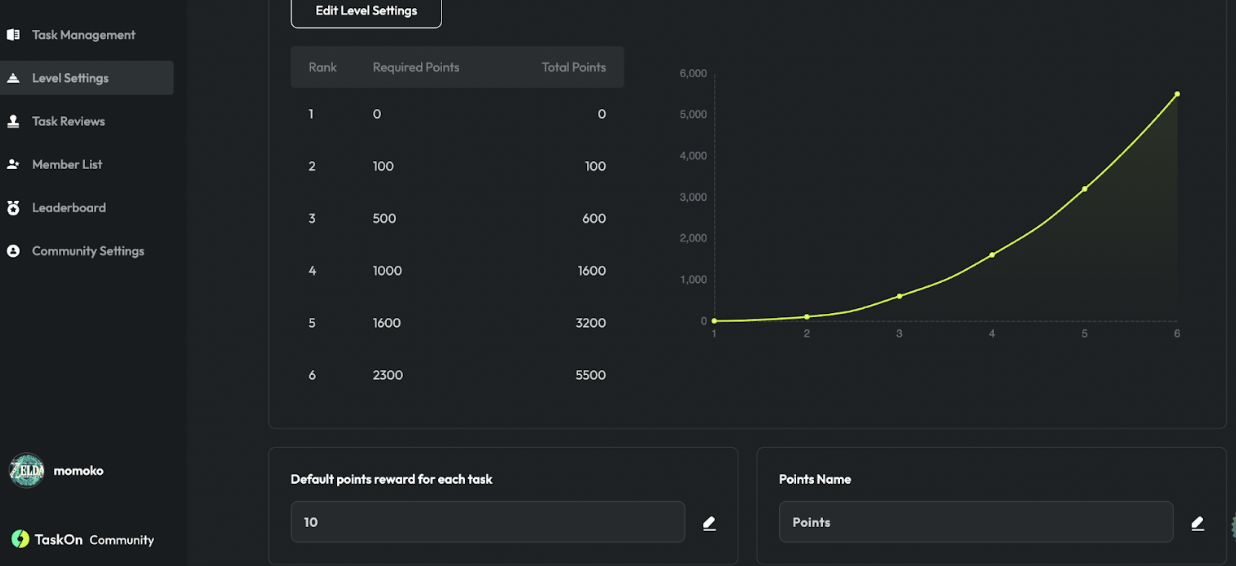
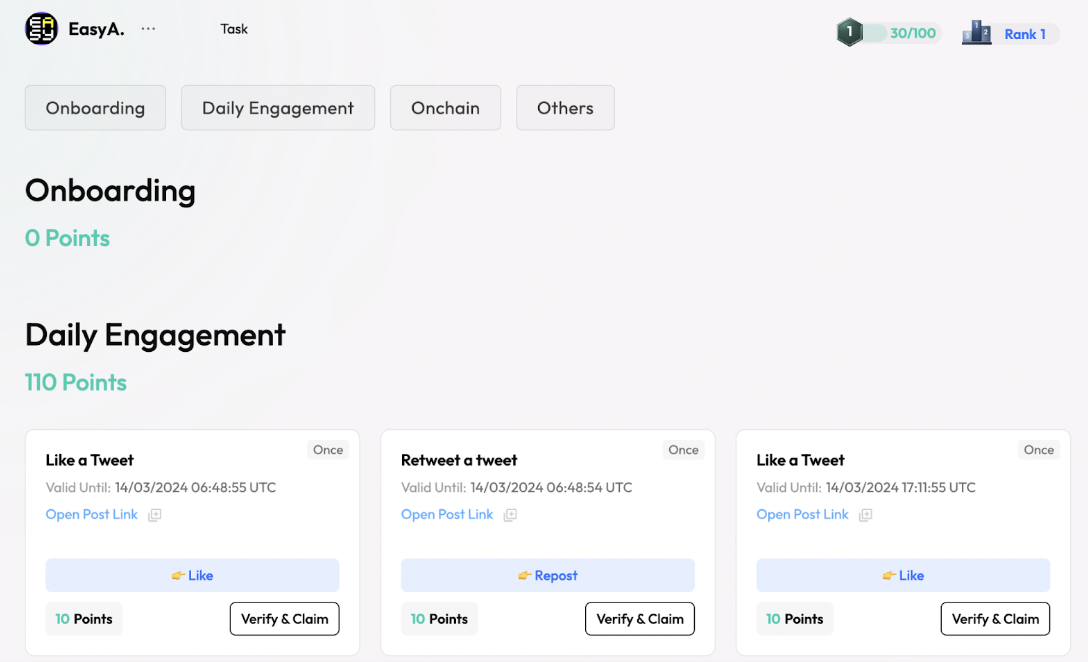
- These platforms support the classification of tasks, whether transaction behavior or non-transaction behavior, which is very easy to use. Moreover, projects can set the number of repetitions of tasks, avoiding a lot of duplication of manual work to set up tasks from scratch.
- Compared with the project's official design of the point system, the involvement of a third party helps enhance user trust. Users are assured that the point system is guaranteed by a third party.
- Projects with sufficient resources will embed the points system directly on the product page, while those without sufficient resources will mostly use the Discord and Telegram communities to post tasks by administrators, which incurs a large amount of repetitive work. The points are manually and cannot be updated in real-time, while users are sensitive to their investment and timely return. The Leaderboard on the third-party platform can meet the demand for real-time feedback.
The points system is a trend and has proved its success in Web2. The adoption and outstanding performance of the point system by Blast, Linea, and other projects demonstrates the benefits of the points system. Third-party tools will be a great choice, especially for projects without templates or extra resources to build the points system, to earn the user's trust and energize the community.


All Comments