

Cointime

Download App
iOS & Android

White House clears review of proposal to allow crypto in 401(k) retirement plans

Validated Media

The White House’s Office of Information and Regulatory Affairs (OIRA) has completed its review of a Department of Labor (DOL) proposal that could reshape how 401(k) fiduciaries evaluate alternative assets, including digital-asset exposure.

The OIRA’s website shows the review concluded on March 24, with the action marked “consistent with change” and the proposal classified as “economically significant.” The DOL is now expected to publish the proposed rule for a standard 60-day public comment period, which is usually followed by revisions and the issuing of a final rule.

The proposal follows President Donald Trump’s Aug. 7, 2025, executive order directing federal agencies to expand access to alternative assets in 401(k) plans, including exposure to digital assets through certain investment vehicles.

The order directed the DOL to reevaluate restrictions around alternative assets in defined-contribution plans, including digital assets, private equity and real estate. It also called for inter-agency collaboration between the US Treasury Department and the Securities and Exchange Commission on supporting rule changes.

The completed review clears an interagency hurdle for a proposal that could widen the path for alternative assets in US defined-contribution retirement plans.

Crypto-linked exposure moves closer to 401(k) market

On May 28, 2025, the DOL rescinded a 2022 compliance release that urged fiduciaries to be “extremely cautious” when considering crypto for 401(k) retirement plans, signaling a broader shift in the federal government’s stance toward retirement-plan exposure to digital assets. 
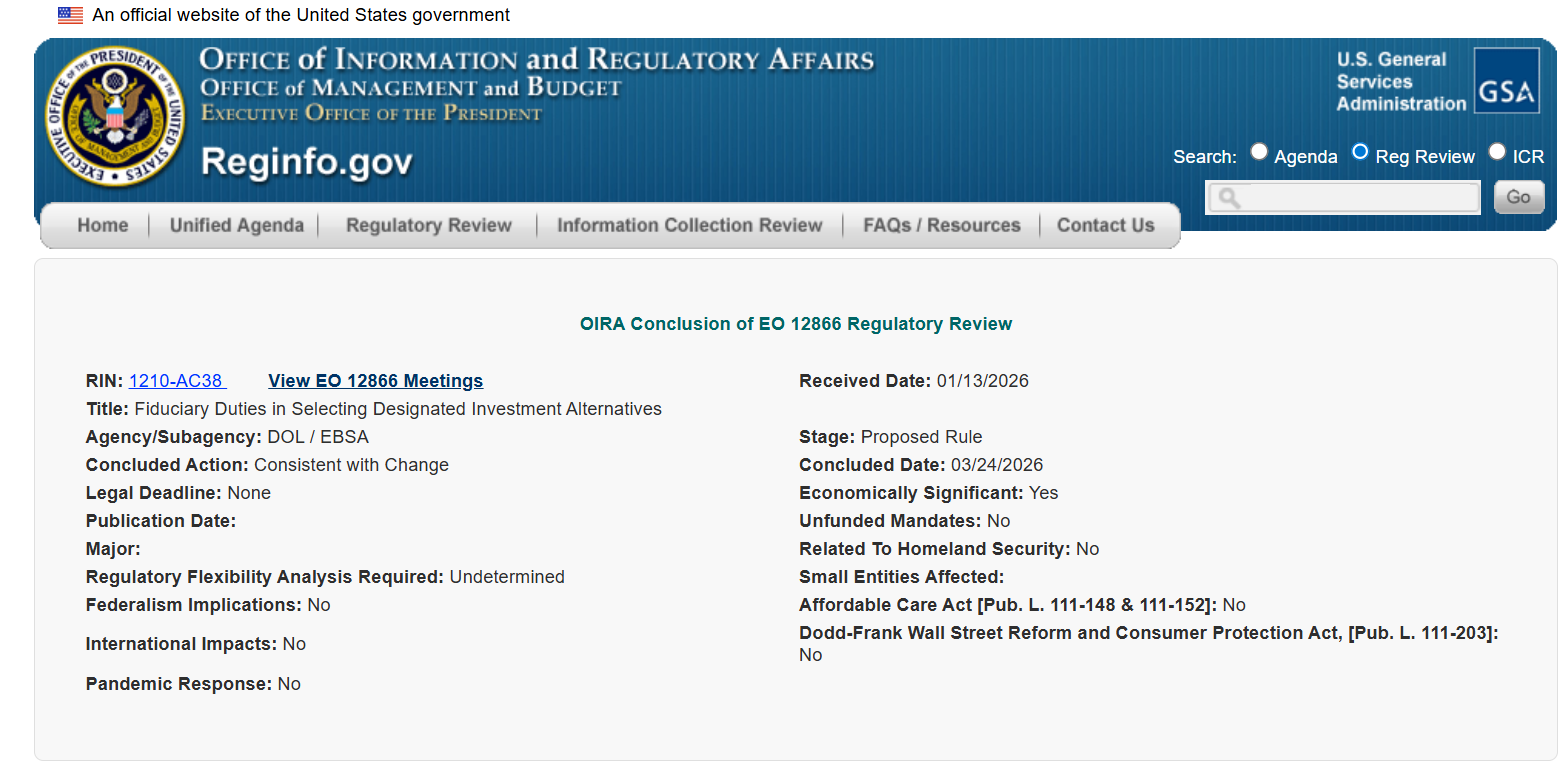
  White House’s Office of Information and Regulatory Affairs concluded its review of the Department of Labor’s rule on alternative investments in retirement plans. Source: Reginfo.gov


The US retirement market reached a record $48.1 trillion in financial assets on September 30, 2025, according to a report by the Investment Company Institute (ICI).
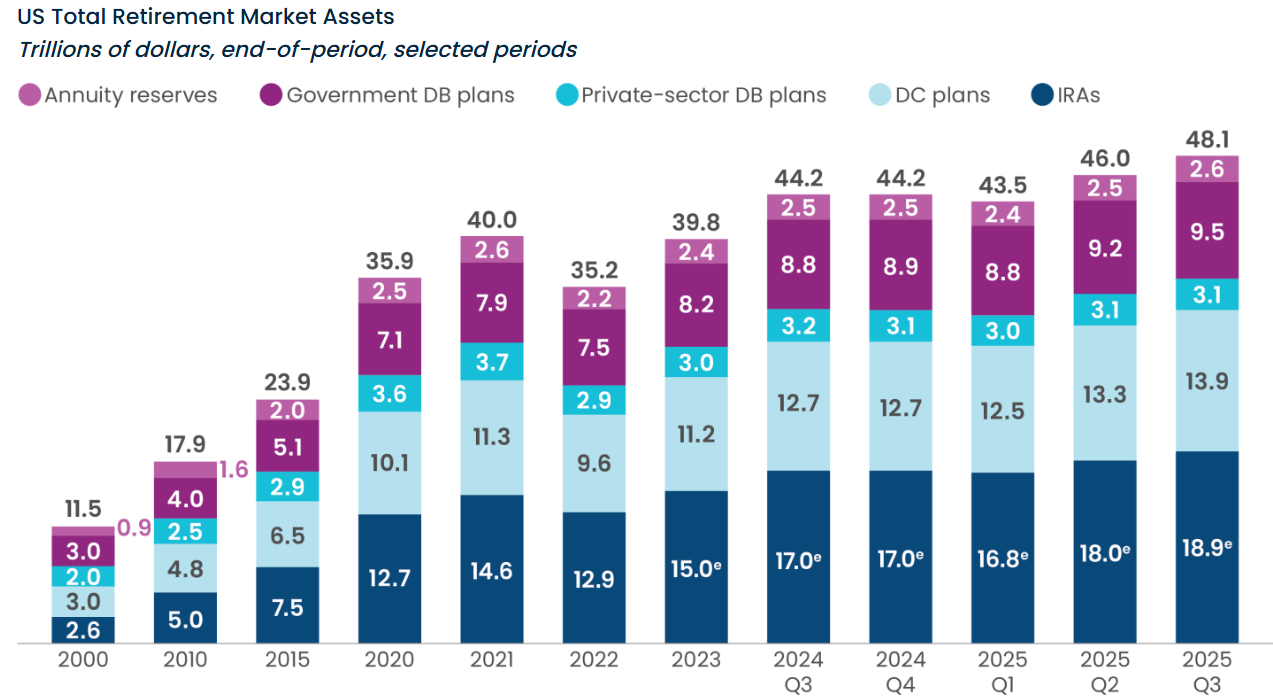
US retirement market assets by quarter, in USD trillion. Source: ICI.org 


Indiana advances crypto retirement access

Other US states have launched their own legal initiatives to make digital assets a retirement plan asset.

On Feb. 25, Indiana lawmakers passed a bill that would require certain state retirement and savings plans to offer a self-directed brokerage option with at least one crypto investment option by July 1, 2027.

The bill would allow Indiana citizens to hold Bitcoin and digital assets as part of their retirement plans for the first time. 

Comments

All Comments

Recommended for you

  • PBOC: Actively and Prudently Address Financial Risks in Key Areas, Orderly Reduce Existing Risks

    Beijing, March 27th – The People's Bank of China (PBOC) recently convened its 2026 Financial Stability Work Conference. The meeting emphasized that in 2026, financial stability work must adhere to political guidance, strengthen theoretical understanding, establish and practice a correct view of performance, and deeply integrate Party building with business operations to ensure a high-standard start and high-quality progress for financial stability work during the "15th Five-Year Plan" period. The PBOC will continuously improve the system for preventing and resolving systemic financial risks, promote the in-depth and practical application of technology, strengthen financial risk monitoring, assessment, early warning, and early correction, and persistently curb the accumulation of new risks. Adhering to market-oriented and law-based principles, the PBOC will actively and prudently address financial risks in key areas and orderly reduce existing risks. Efforts will be made to deepen reforms of key financial institutions and promote increased capital replenishment through multiple channels. The capacity to prevent and control financial risks within an open framework will be enhanced to safeguard national financial security. A robust financial stability assurance system will be built, risk disposal resources and tools will be enriched, and the bottom line of preventing systemic financial risks will be resolutely maintained. (Source: People's Bank of China)

  • PBOC: Actively and Prudently Address Financial Risks in Key Areas, Orderly Reduce Existing Risks

    On March 27, the People's Bank of China (PBOC) recently convened the 2026 Financial Stability Work Conference. The conference emphasized that in 2026, financial stability work must adhere to political guidance, strengthen theoretical armament, establish and practice a correct view of performance, deeply integrate Party building with business operations, and ensure a high-standard start and high-quality progress for financial stability work during the "15th Five-Year Plan" period. The PBOC will continuously improve the system for preventing and resolving systemic financial risks, promote the in-depth and practical application of technology, strengthen the monitoring, assessment, early warning, and early correction of financial risks, and continuously curb the emergence of new risks. Adhering to market-oriented and law-based principles, the PBOC will actively and prudently address financial risks in key areas and orderly reduce existing risks. The central bank will deepen reforms of key financial institutions and promote multi-channel capital replenishment efforts. It will enhance financial risk prevention and control capabilities within an open framework and safeguard national financial security. The PBOC will solidify the financial stability guarantee system, enrich risk disposal resources and tools, and resolutely uphold the bottom line of preventing systemic financial risks from occurring. (People's Bank of China)

  • U.S. 2-Year Treasury Yield Rises to 4.017%, Highest Since June 2025

    On March 27, the yield on U.S. 2-year Treasury bonds rose to 4.017%, marking the highest level since June 2025. (Jin Shi)

  • BTC Falls Below $68,000

    Market data shows that BTC has fallen below $68,000, currently priced at $67,986.63, with a 24-hour decline of 2.68%. The market is experiencing significant volatility, so please ensure proper risk management.

  • COSCO Shipping Lines Denies Reports of Container Ships Transiting Strait of Hormuz

    On March 27th, reports emerged claiming that two 20,000 TEU container ships belonging to COSCO Shipping Lines, the 'COSCO India Ocean' and 'COSCO Arctic Ocean', which were reportedly stranded in the Persian Gulf west of the Strait of Hormuz, had begun transiting the strait to return to China. A relevant负责人 (responsible person) from COSCO Shipping Lines stated that the aforementioned news is false and should not be believed. A check on ShipView reveals that both vessels are currently still within the gulf. (Shanghai Securities News)

  • 80% of Strategy's ‘Stretch’ buyers are mom-and-pop investors

    Stretch shares are an on-ramp for people who believe Bitcoin will be around for the long term but can’t handle the near-term volatility, explained Michael Saylor.

  • Goldman Sachs Signals Bottom in Crypto Market and Upgrades Related Stock Ratings

    On March 27, Goldman Sachs released a tactical research report indicating that the long-term adjustment of digital assets may be nearing its bottom. Chief Analyst James Yaro noted that since October 2025, crypto-related stocks have fallen by 46%, and the current valuations are becoming 'increasingly attractive' for long-term investors. This shift in Goldman Sachs' stance comes as Bitcoin experiences a period of 'volatile but overall sideways' movement. In the first quarter of 2026, Bitcoin has established strong support in the range of $60,000 to $75,000. The bank pointed out that the significant reduction in 'passive selling' by ETFs and large institutional investors is one of the main drivers for market stabilization. Despite the Federal Reserve's hawkish stance and ongoing geopolitical uncertainties, Goldman Sachs believes the market has successfully absorbed the effects following the 'frenzy' of 2025 and is now entering a constructive consolidation phase. This 'bottoming logic' is further supported by Goldman Sachs' own 13F holdings data: by the end of 2025, its total exposure to Bitcoin and Ethereum ETFs was nearly $2.36 billion. Additionally, Goldman Sachs upgraded the ratings for Coinbase and Figure Technologies to 'Buy' and reallocated to XRP, signaling a return of institutional confidence.

  • US Spot Ethereum ETF Sees Net Outflow of $92.97 Million

    On March 27, according to monitoring by Trader T, the US spot Ethereum ETF experienced a net outflow of $92.97 million yesterday.

  • US Spot Bitcoin ETF Sees $171.44 Million Net Outflow Yesterday

    On March 27, according to monitoring by Trader T, the US spot Bitcoin ETF experienced a net outflow of $171.44 million yesterday.

  • Federal Reserve Officials Warn: Iran War Poses 'Greater Risk' to Inflation

    On March 27, three Federal Reserve officials expressed growing concerns about the impact of the Middle East war on the U.S. economic outlook. One policymaker indicated that the surge in oil prices has shifted the balance of risks, making inflation a greater concern than employment. Federal Reserve Governor Lisa Cook stated during a speech in New Haven, Connecticut, that "I believe the risk of inflation is now greater due to the Iran war. In terms of the labor market, I think it is in a balanced state, but that balance is fragile." Cook did not disclose how she believes policymakers should respond, but her two colleagues indicated in their remarks on Thursday that they prefer to keep interest rates unchanged while assessing the war's impact on inflation and growth. Federal Reserve Governor Michael Barr mentioned at an event in Washington, "It is reasonable to take some time to assess the situation. Our current policy stance puts us in a favorable position to maintain stability while evaluating new data." Federal Reserve Governor Stephen Miran stated at an event in Miami that he still believes the underlying inflation rate will trend towards 2% over the next 12 months. Miran also noted that the Federal Reserve could potentially reduce its balance sheet by $1-2 trillion without causing turmoil in financial markets. However, he warned that many accompanying measures would be needed, and this process could take years. "Once this process starts, I suggest proceeding with a slow pace to ensure the private sector can absorb all the securities we are shedding from our balance sheet. I am excited about the possibility, but if it does happen or once it happens, I expect progress to be slow."
