

Author: [email protected]
Imagine yourself gliding through the bustling aisles of a grocery store. With each item you place in your cart,you might not realize that each product you select has its own unique barcode, which could be seen as reference data in the data field that can hold the power to streamline your entire shopping experience. They serve as a universal language, allowing the cashier to swiftly and precisely identify each product, ensuring a seamless and error-free checkout process.
In the traditional financial market, we have a well-established system with a unified, global framework for data formatting and messaging standardization. Contrastingly, the rapid growth of the crypto market and the absence of a centralized governing body have led to a decentralized and distributed landscape.
With the influx of new digital assets and market participants, the task of monitoring, extracting, analyzing, and standardizing data has fallen far behind the pace of the market’s evolution.
Crypto reference data serves as the fundamental building block in the intricate world of blockchain technology. It can be compared to the cornerstone of a grand structure, providing a set of predefined values and standardized information that act as reference points within the blockchain system. Its significance lies in offering context, maintaining data consistency, and validating the vast array of data circulating within the blockchain network.
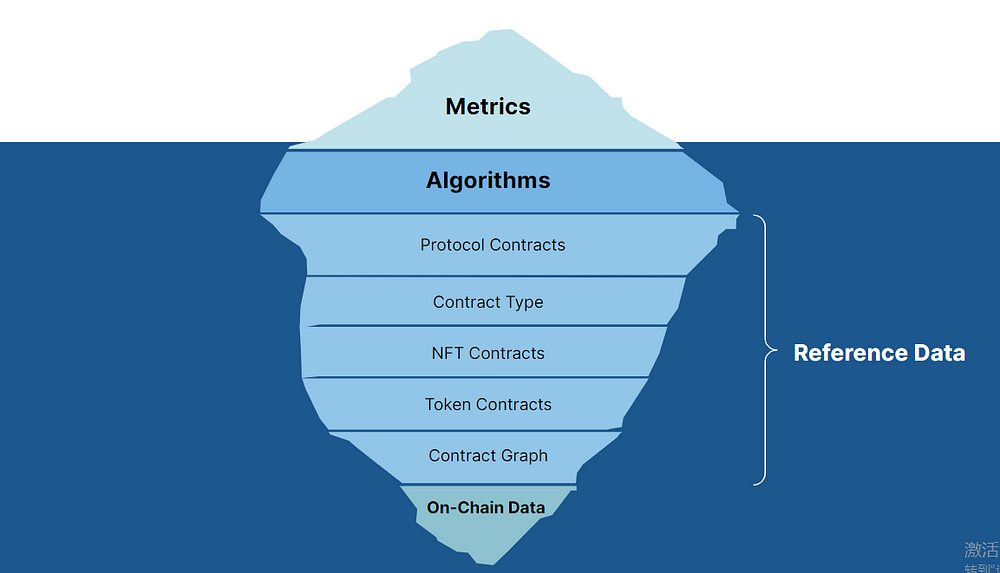
In essence, crypto reference data encompasses a standardized repository of information covering a wide spectrum, from crypto assets and protocols to on-chain activities and market data.
This data encompasses a wide array of information, ranging from off-chain details such as Twitter accounts and project metadata to essential on-chain components like smart contracts, contract deployers, wallet addresses, wallet graphs, and wallet labels. This comprehensive dataset is invaluable for a myriad of reasons.
Some examples of reference data usage in blockchain include:
- Smart Contracts: Reference data is used in smart contracts to define and validate inputs, outputs, and conditions. It can include data such as time zones, currency codes, or industry standards to ensure accuracy and consistency within the contract.
- Identity Verification: In blockchain-based systems, reference data is used for identity verification. It can include government-issued ID numbers or biometric data, acting as a standard for verifying participants’ identities securely.
- Data Validation: Reference data is essential for validating and verifying data stored on the blockchain. It ensures that the data added to the blockchain meets certain criteria or standards. For example, in supply chain management, reference data can be used to validate product codes, certification numbers, or origin details.
- Consensus Mechanism: Blockchain networks often use consensus mechanisms to validate transactions. Reference data plays a role in determining the rules and conditions for validating transactions. Consensus algorithms rely on reference data to ensure agreement among participants on the transaction’s validity.
- Interoperability: Reference data enables interoperability between different blockchain networks or systems. It provides a common set of standards and definitions, allowing data to be exchanged and understood across different platforms. This is especially important in enterprise-level blockchain solutions involving multiple organizations.
Reference data plays a pivotal role in the realm of blockchain and cryptocurrency for a multitude of reasons. Let’s delve into its significance step by step:
- Unique Identifiers: One of its primary functions is to offer unique identifiers for various assets within the crypto sphere. This is crucial for distinguishing between different coins, tokens, and protocols. These unique identifiers, such as tickers, addresses, logos, and genesis data, are the equivalent of digital fingerprints, ensuring each asset is easily recognizable and distinguishable.
- Standardization: Reference data serves as a standardization tool for information in the crypto ecosystem. It categorizes assets into specific sectors, tags, and classifications, making it easier to organize and categorize the vast array of cryptocurrencies. This standardization simplifies the process of comparing and contrasting different assets, especially when assessing portfolio composition.
- Data Integration: It enables the integration of on-chain data, pricing data, and qualitative data for comprehensive analysis. This means that investors and analysts can pull together data from various sources, allowing for a more holistic assessment of assets. It is this integrated approach that empowers better decision-making and more accurate predictions.
- Relationship Modeling: Reference data provides the framework for modeling relationships between different entities within the blockchain world. It facilitates the connection between protocols, wallets, and exchanges. This, in turn, enables a deeper understanding of how these entities interact and influence one another.
- Quantitative Analysis and Risk Management: Perhaps most importantly, reference data is critical for quantitative analysis, trading, portfolio management, and risk monitoring. It serves as the foundational information for assessing the performance of assets, constructing and managing portfolios, and monitoring risk. Without reference data, much of the quantitative analysis that drives investment decisions in the crypto space would be severely compromised.
In a world where the cryptocurrency market is constantly evolving, reference data acts as the glue that holds together the diverse elements of this digital financial landscape. It provides structure, consistency, and the tools necessary to make informed investment decisions and effectively manage portfolios. In essence, it’s the compass guiding investors and analysts through the intricate and rapidly changing world of cryptocurrencies.
The importance of reference data lies in its ability to offer unique identifiers, promote standardization, facilitate data integration, enable relationship modeling, and empower quantitative analysis and risk management.
In a landscape where Gaming, NFT, Tokens, and Web3 protocol form the heart of innovation, reference data emerges as the cornerstone of knowledge, connecting participants and providing insights to navigate the ever-evolving crypto world.
In the absence of a centralized governing body, reference data provider like MetaMosaic will empower us to make informed decisions, manage portfolios, and stay ahead in this exciting journey through the digital financial landscape. In essence, crypto reference data is the compass guiding us through the complexities and rapid changes of the cryptocurrency universe.
Metamosaic is a platform for blockchain reference data, where everyone can access protocol-centric metadata, classifications, and relation graphs with API and explorer.Metamosaic’s mission is to build a Single Source of Truth (SSOT) for crypto.
Website: https://www.metamosaic.io/
Contact: [email protected]


All Comments