

US President Donald Trump says he has convinced most of the Republican lawmakers who pulled support from three crypto bills to vote in favor of them when the House meets again on Wednesday.
Trump said in a post on his Truth Social platform on Tuesday that he met with 11 of the 12 representatives in the Oval Office and convinced them to vote in favor of the legislation.
“I am in the Oval Office with 11 of the 12 Congressmen/women necessary to pass the GENIUS Act and, after a short discussion, they have all agreed to vote tomorrow morning in favor of the Rule,” Trump said.
A re-vote on the three crypto bills was canned on Tuesday, as 13 Republican lawmakers pulled support, wanting to add a ban on central bank digital currencies (CBDCs).
Some Republicans wanted the stablecoin-regulating GENIUS Act amended or bundled in with two other crypto bills up for a vote this week — the CBDC-banning Anti-CBDC Surveillance Act and a sweeping crypto market structure bill dubbed the CLARITY Act.
The move to pass the bills is the Republican-led effort dubbed “Crypto Week” to have crypto laws in action before Congress goes on a month-long break in August. Democrats have meanwhile declared an “anti-crypto corruption week” to oppose the bills.
“I’m thankful for President Trump getting involved tonight to ensure that we can pass the GENIUS Act tomorrow, and agreeing again to help us advance additional crypto legislation in the coming days,” House Speaker Mike Johnson posted on X.
CBDC concerns stall legislation
House Majority Leader Steve Scalise joined 12 other Republican lawmakers in voting no on considering the bills on Tuesday. The other dissenters were Andrew Clyde, Tim Burchett, Andy Biggs, Eli Crane, Michael Cloud, Marjorie Taylor Greene, Andy Harris, Anna Paulina Luna, Scott Perry, Victoria Spartz, Chip Roy and Keith Self.
Another vote to move the bills forward was expected, but the House adjourned before any further action was taken.
Representatives Biggs, Burchett, Green, Luna and Spartz took to X after the vote and said they were not against the crypto bills but didn’t want to pass the GENIUS Act unless it had a specific ban on a CBDC.
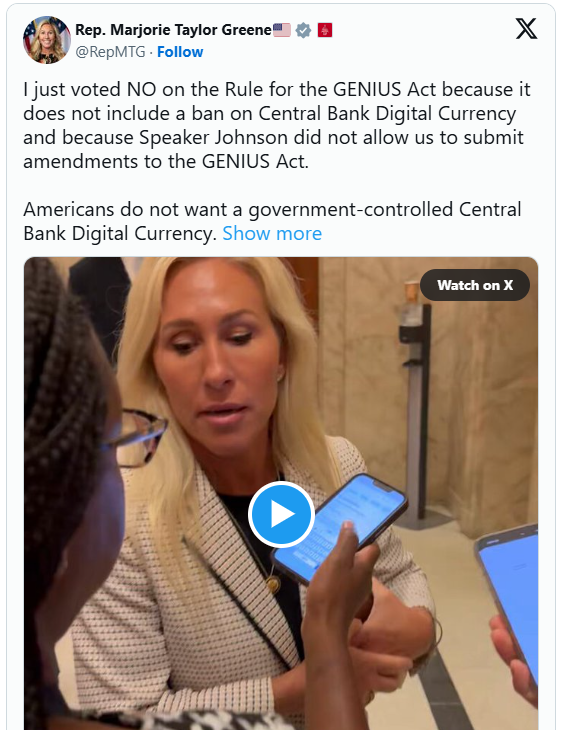
“I just voted NO on the Rule for the GENIUS Act because it does not include a ban on central bank digital currency and because Speaker Johnson did not allow us to submit amendments to the GENIUS Act,” Green said.
Biggs said he was concerned the GENIUS Act had a framework for a layered CBDC and doesn’t guarantee self-custody. He is calling for amendments.
“House Leadership must allow an open amendment process so Members can freely debate and improve the bill,” Biggs added.
Trump included a ban on the Federal Reserve creating a CBDC in a January executive order.
Number of bills was also a sticking point
Politico reported that Johnson had earlier said he hopes to try to pass a procedural vote for the bills on Wednesday, adding it’s “a priority of the White House, the Senate and the House to do all of these crypto bills.”
However, he added that “we have to do them in succession,” suggesting that the Senate wouldn’t pass the bills if they were all tied together.
Johnson was also talking to the Republican holdouts to advance the legislation, which was complicated by the Republican “no” voters demanding that the three crypto bills be combined into one.
“I think everybody is insistent that we’re going to do all three, but some of these guys insist that it needs to be all in one package.”
House meets again Wednesday
The House is scheduled to meet again on Wednesday for a morning hour debate and other “legislative business.”
Caitlin Long, founder and CEO of Custodia Bank, said in an X post on Tuesday that the legislation failing to pass on the first go is nothing to be concerned about because the GENIUS Act failed to pass the Senate initially as well.
“BEFORE Y’ALL FREAK OUT, don’t forget that the first procedural vote in the Senate on the GENIUS Act failed as well...the second one passed 11 days later,” she said.
The GENIUS Act passed through the Senate in June with bipartisan support, but it initially failed a cloture vote in the Senate in May because of Democratic opposition to Trump’s growing connections to the crypto industry.
Meanwhile, Eleanor Terrett, the host of the Crypto in America podcast, said the GENIUS Act already prohibits the Fed from creating a retail CBDC.
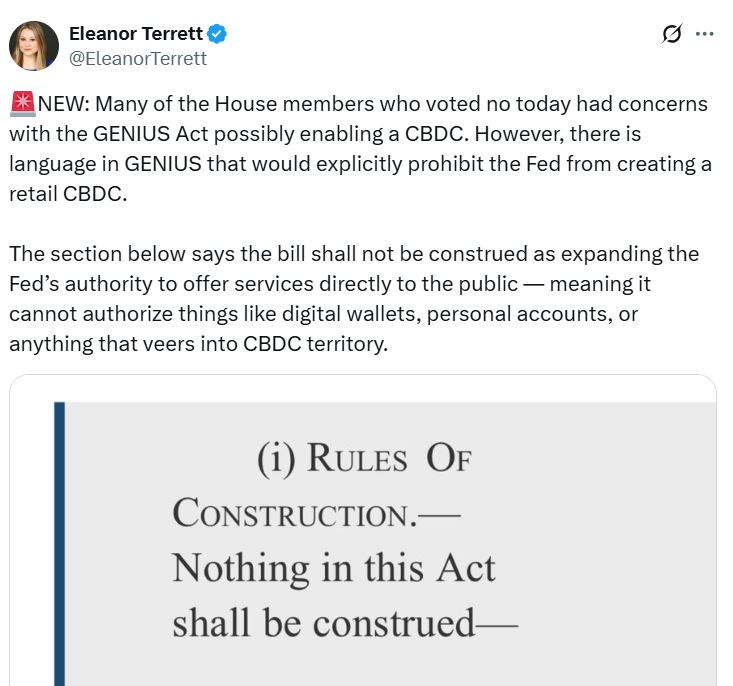
“The section below says the bill shall not be construed as expanding the Fed’s authority to offer services directly to the public — meaning it cannot authorize things like digital wallets, personal accounts, or anything that veers into CBDC territory,” she said.


All Comments