


Crypto has recreated the worst aspects of multi level marketing schemes, but with native internet marketing and worse transparency. Tokens have, for the most part, evolved into a sophisticated pyramid where those at the top extract maximum value while retail investors get left holding worthless bags.
This isn't a coincidence, it's structural.

In traditional MLM schemes like Herbalife or Mary Kay, you have overpriced products that don't work particularly well compared to alternatives. The key difference from normal products lies in distribution: instead of selling through stores, individual distributors buy products upfront and then struggle to find actual customers who want to use them.
The focus quickly shifts from improving products to recruiting new participants. Everyone's buying because they expect to sell for more, not because they want to use the product. Eventually you run out of buyers because everyone purchasing hopes to flip for profit while nobody actually wants to use the product. The people at the top capture all the asymmetric gains while those at the bottom hold worthless inventory.
The Token pyramid
Crypto tokens operate on identical principles. The token is the product: an overpriced digital asset with questionable utility beyond speculation. Like MLM distributors, token holders aren't buying to use; they're buying to sell to the next person at a higher price.
The pyramid structure is similar to traditional MLMs, but with crypto's unique stakeholders forming its distinct levels. Tokens are a much better vehicle than traditional MLM products because they leverage the internet and networks much, much better. They're also easier to transact with and acquire. Flow goes something like this:
In trad MLM if you refer others and they sell, you profit from whatever they sell to others or purchase. Same thing happens with tokens. You get people to buy your bags + others who got in at a 'later' date than you did. This is good for you and everyone on top of them since it provides exit liquidity and makes number go up. By doing this you're also giving newly onboarded tokenholders an incentive to shill (Now they have bags!) and previous tokenholders an incentive to sell (their multiples go up!). Identical to MLM schemes, just much more powerful.
The higher you are in the pyramid, the more incentivized you are to keep launching tokens and engaging in this behavior.
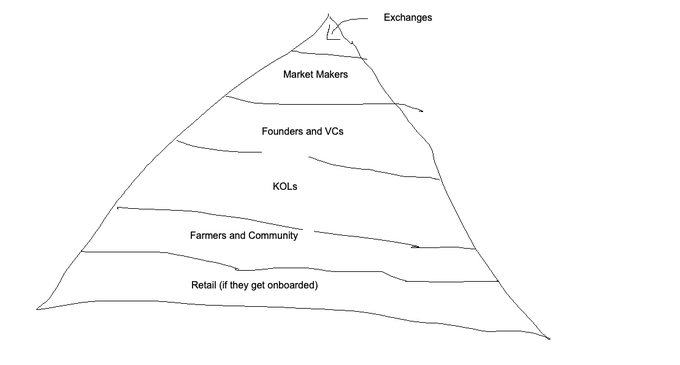
The Gods: Exchanges
At the apex sit the exchanges, crypto's true gods. Almost all 'successful' tokens are highly influenced by exchanges and their affiliated market makers. They control distribution and liquidity, forcing projects to pay tribute in the form of free tokens to access their platforms and their distribution.
If you don't comply with their demands, your token doesn't get listed, gets stuck in a low liquidity limbo and dies. Exchanges can kick out market makers, demand token loans for employees to dump, or change terms for service providers at the last minute. Everyone tolerates this because there's no choice, it's the price we must pay for liquidity and distribution.
Exchanges are particularly hard to navigate as a founder because whether you get a top tier listing or not is mostly based on connections. I guess this is also why there's a big proliferation of shadow cofounders and previous exchange employees advising projects. The process of getting listed on an exchange is highly opaque and hard to navigate unless you have experience with or connections to exchanges.
The Demigods: Market Makers
Market makers, theoretically providing liquidity, actually help foundations sell tokens OTC while using their information advantage to trade against users. They hold significant a significant percentage of a token's supply (sometimes several percentage points) and leverage this position for asymmetric trading opportunities. On low-float tokens, this gets even more magnified. They're in a very advantageous position to trade. There's very little money to be made from providing liquidity and a lot of money to be made from trading against less informed flow. Flow doesn't get more informed than token market makers as they know the exact float of the token and hold a big supply.
Market makers are also very hard for founders to price. Unlike normal services like haircuts, which have a fixed price, market making services can vary depending on who's asking. As a first time founder, you have no idea what's expensive or cheap and what the terms should be. This leads again to favorable shadow cofounder and market making advisor dynamics, adding an extra layer of complexity to launching a token.
The kings: VCs and Founders
Below the exchanges sit founders and VCs who capture most value during private price discovery phases. They get tokens at massive discounts before most people even know the projects exist, then craft narratives to create exit liquidity.
The Crypto VC model has become particularly perverse. It's easy to get a liquidity event as a crypto VC and you are not incentivized to back long term builders. In fact, the opposite is true. VCs are incentivized to look the other way on predatory tokenomics so long as it's beneficial for them. Many VCs have abandoned any pretense of building sustainable businesses in favor of systematically supporting pump and dumps.
Tokens also create an interesting dynamic in which VCs are incentivized to mark up their portfolios to jack up their management fees (effectively rugging their LPs). The latter works particularly well with low float tokens because you can use the FDV to mark the valuation to market. This is unethical because if the token was fully unlocked there's no way you would be able to exit for that price. This is one of the main reasons why many VCs won't be able to raise a fund again.
Platforms like Echo make this reality better, but there's still a lot going behind the scenes that most crypto market participants can't see.
The Influencers: KOLs and Key Opinion Leaders
KOLs are the next tier, usually receiving free tokens at launch in exchange for promotional content. 'KOL rounds' where influencers invest and get reimbursed at TGE have become standard practice. They use their distribution to access free tokens, then shill to their audiences who become exit liquidity.
The Soldiers: Community and Farmers
The "community" and airdrop farmers form the trenchers of this pyramid. They provide hard labor: testing products, creating content, generating activity in exchange for token allocations. But even these activities have been industrialized, reducing rewards while increasing the work required.
Most community members realize too late that they're unpaid marketing teams for projects that will dump on them right after TGE. Whenever they realize, pitchforks will appear. Pitchforks are very bad for building real products because now you have an extra thing to worry about: The noise.
The Plebs: Retail Investors
At the bottom sit retail investors, ideally the exit liquidity for everyone above. They're armed with "narratives" designed to increase memetic premium of an asset and recruit more buyers so foundations can profit from token sales.
Unlike previous cycles, in which retail actually showed up to buy bags, today's retail is more skeptical. This has left community members holding worthless airdrops while insiders offload OTC. I suspect one of the main reasons why we see people pissed on the TL because the token is down or because they got a bad airdrop is related to retail never getting onboarded this cycle to buy most tokens while the founders still got wealthy
The Consequences:
Crypto right now is not based on building products, but on selling narratives with high hallucination yield to get people to buy a token. Focusing on building a product is discouraged (although this is changing).
The entire valuation model for tokens is broken, based purely on comps rather than fundamental value. "How high can X go?" replaces "What problem does this solve?" This makes projects impossible to properly price or underwrite projects. You're buying lottery tickets, not investing in businesses. Be aware of this when you invest in crypto
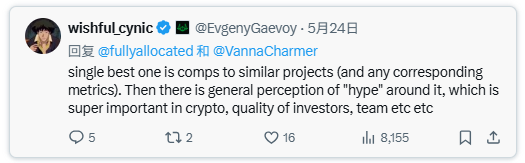
The playbook for selling a narrative is simple. You just fabricate something relatable but very hard to price for people, for example:
'Peter Thiel backed stablecoin token that will act as a proxy to Tether equity. It's bullish because Circle has a market cap of 27b and Tether makes much more revenue and profit with way less overhead. There's no direct way to get exposure to Tether so this token will serve that purpose! They're also building a network that might be akin to the circle payments network and are also building some privacy features around it. The future of finance, can go to 100b!'
This is something you can easily sell to most of your friends if you want them to buy a token. Narrative needs to be digestible but at the same time it should leave room for hallucinating a high valuation.
What's next? Fixing market structure for tokens
I'm still a firm believer that crypto is still one of the industries with the most asymmetric upside for the common man, but this edge is slowly decaying. Speculation is crypto's main PMF, it's the initial hook that makes market participants interested in whatever we might be building. This is why we need to fix market structure. Part II of this article will be on how platforms like Hyperliquid can significantly change this game.


All Comments