


On April 1, 2026, the AI-driven decentralized trading platform PINDex officially launched.
The emergence of PINDex has, without a doubt, injected a powerful stimulus into the currently dull and burdened Web3 industry and global finance. This is not merely the rise of a new force—it is the infinite potential unleashed by PINDex’s unique economic model system built around $PIN, as well as the deep integration of the project itself with AI. This marks yet another iteration of the traditional financial paradigm.
In the current fervor around OpenClaw, humans can already achieve “Let AI do something,” but that is far from enough. PINDex aims to go further: “Let AI think something, and manage something.” On this foundation, it has realized an organic integration of scenario-based AI Agents and behavior-incentivized $PIN tokenomics.
Let us further explore PINDex’s intrinsic potential, but before that, we need to understand the shift in the financial paradigm.
Chapter One: Human-Brain Trading is Being Replaced by AI Exchanges
By 2026, the essence of financial markets has shifted. If you are still talking about “market intuition,” or trying to find so-called wealth codes by staring at a few candlestick charts, you have already become the lowest-tier “liquidity provider” in this brutal ecological niche.
We must face a harsh truth: human biological functions can no longer keep up with the physics of modern finance.
Traditional decentralized trading may solve asset ownership at the code level, but at the execution layer, it remains a lawless wasteland. The seemingly tiny millisecond-level delays of mainstream public chains are, in volatile contract markets, an open invitation for “arbitrage”—high-frequency traders’ slippage and MEV attacks legally drain retail investors’ capital.
Research from the University of Hong Kong’s Faculty of Business and Economics has already exposed the final barrier: when humans process complex, high-frequency information flows, the brain automatically defaults to “heuristic intuition”—essentially, greed and fear. 90% of losses are not due to insufficient intelligence, but because you are an emotional, fatigable, slow-reacting carbon-based being. In the face of trillion-level computational pulses, such biological limitations are fatal—and can be precisely harvested by algorithms.
Chapter Two: Why AI Strategies Are the Evolutionary Endpoint of Trading
Why is AI quantitative trading the only survival path in this collapsing era? This is not a marketing phrase—it is pure mathematical suppression and dimensional reduction through physical execution.
In today’s trillion-level computing battles, if you are still obsessed with MACD, RSI, Bollinger Bands, and other so-called technical indicators, you are essentially trying to drive a 300 km/h racing car through a rearview mirror. These linear tools, born in the last century, are merely mechanical constructs of historical relics—they are inherently lagging and dull.
Against AI-native logic, these tools are as barren as wooden crossbows in the Stone Age; they cannot reach the liquidity pulses in the financial deep sea. PINDex completely clears away these “latency illusions” and instead enters the absolute realm of high-dimensional feature extraction.
This liquidation of old tools is fundamentally based on a complete reconstruction of microstructure cognition in finance. Financial time series are never mild normal distributions—they are deep oceans filled with strong non-stationarity and unpredictable jumps. Traditional models only capture surface waves, whereas AI products like PINDex, based on Self-Attention architectures, have the representational power to penetrate deep data layers, capturing patterns and opportunities in the position adjustments of major institutions and whales, thereby enabling precise intervention.
This dimensional reduction strike on microstructure transforms trading from blind experiential gambling into preemptive certainty. Every trade is treated as a simulated survival game in a brutal ecosystem. Across hundreds of millions of strategy collisions, AI evolves not only instinctive profit capture but extreme sensitivity to risk, allowing it to brake more coldly than any human body just milliseconds before a market collapse, ensuring full asset protection.
This cognitive reconstruction ultimately leads to a three-stage rocket of trading evolution—no longer a hypothesis of profit, but an inevitability at the physical and computational level:
- Speed Inevitability: Human physiological reaction limits are 200ms, which is equivalent to standing still on a battlefield of trillion-level computing. Current AI products can improve this by tenfold to 20ms, or even faster—for example, PINDex, backed by the ENI public chain, achieves 10-microsecond execution latency. The moment a profit window opens, AI completes scanning, hedging, and exit in one seamless process.
- Absolute Rationality: AI is accountable only to numbers. It has no “let’s hold and see” luck, nor “revenge positions” frenzy.
- Saturation of Alternative Data: While you painstakingly read an outdated research report, AI can complete semantic alignment of 50,000 unstructured texts in one second. It can instantly calculate the impact of minor JPY fluctuations on NASDAQ and crypto contract markets, and preemptively position itself.
Chapter Three: An Intuitive View of AI Strategy Superiority
We can further illustrate AI strategy superiority and inevitability through a comparison table:
| Dimension | Traditional Investment (Human/Basic Strategy) | PINDex Quantitative (Deep Learning / Large Model) | Advantage |
| Execution Precision | 200ms – 500ms delay | 1μs – 10μs (microsecond level) | 20,000× speed advantage |
| Risk Control | Max drawdown avg 20.8% | Max drawdown 6.1% – 8.5% | Risk exposure reduced 60% |
| Profit Sharpness | Sharpe Ratio 1.2 | Sharpe Ratio 3.5+ | 2.5× profit efficiency |
| Information Breadth | 5 texts/day | 50,000 semantic analyses/sec | 5,000× throughput |
| Evolution Efficiency | Monthly / quarterly strategy adjustment | 24H real-time adaptive | 100× faster response |
Data confirms: using AI to identify “micro fingerprints” in Level 2 tick data achieves 42.1% higher accuracy than traditional technical indicators. This means, before you see institutional entry, AI has already completed position building and taken the top seat.
For conventional AI strategy products, this is often the ceiling. PINDex goes further.
- PINAgent AI: A product entirely based on AI strategy trading. Not a simple trading plugin—it is the “AlphaGo” of Web3. Users can obtain long/short information and operation advice for BTC, ETH, ADA, SOL, and other global mainstream cryptocurrencies, along with personalized P&L reports. More importantly, it provides multidimensional insights including social media indices, heat maps, price changes, and research reports, enabling users to become their own “Smart Money.”
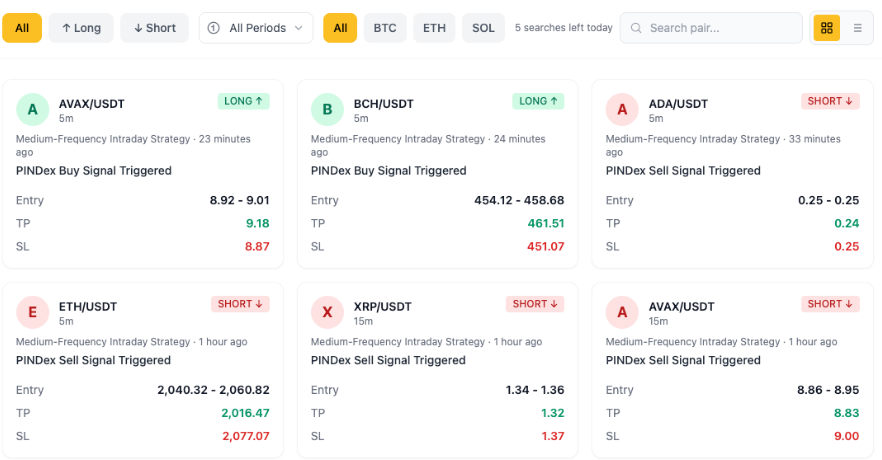
Its advantages include:
- Institutional Market-Making Logic (PINAgent-MM): Embeds top Wall Street market-making models, extracting “volatility premiums” rather than guessing directions. Millisecond-level hedging extracts compound gains.
- Level 2 Visualization Perception: Converts order book data into image signals; Vision Transformer (ViT) identifies liquidity provider intentions. VIP users can hedge or increase positions 450ms before market reversals.
- Auto-Trading: Eliminates hesitation at the execution layer; during extreme drawdowns, it is colder than you; at bottom singularities, it is greedier than you.
PINDex also organically integrates scenario-based AI Agents with behavior-incentivized $PIN tokenomics.
Chapter Four: PINDex Official Launch—Trillion-Level Computational Wealth Backbone Based on $PIN
On April 1, 2026, PINDex officially launched. To celebrate, it offered an “Early Bird Privilege” campaign: the first 1,000 users to stake $PIN received a PINAgent AI VIP account (worth 1,000 USDT), granting real-time AI trading signals, intelligent risk P&L dashboards, deep market alerts, and future AI auto-trading features.
This is PINDex’s vision: providing AI strategy convenience while placing real wealth, $PIN, in your hands.
Why does $PIN possess ruling-level wealth potential? The answer lies not in speculative hype but in its seamless “tax-capture” value model:
- 80% Net Profit Buyback and Burn: Physical capital reinforcement. All PINDex protocol profits—including AI market-making, strategy revenue, and trading fees—have 80% net revenue repurchased and permanently burned on the secondary market. The more PINAgent earns, the faster $PIN burns. This is underpinned by real, continuous on-chain cash flow.
- Hard Link Between Computing Power and Fuel: As the only settlement asset of the ENI public chain ecosystem, $PIN is the sole “fuel” powering trillion-level intelligent machines. Post 3.31 launch, AI strategy calls by tens of thousands of users create rigid $PIN absorption.
- High-Intensity Burn: Initial circulation is kept extremely low. Post-private sale, unallocated shares are destroyed. With staking events after 3.31, most $PIN will be locked long-term. Algorithm-driven continuous buy pressure creates a “liquidity black hole,” unleashing enormous wealth gravity.
This is PINDex’s ambition: while enjoying AI strategy convenience, it places the true key to wealth, $PIN, directly into users’ hands. Top-tier technology without extreme economic models cannot generate a real gravitational field.
Chapter Five: Hardcore Synergy—Embedding the “AI Brain” into a Trillion-Level Public Chain Body
Previously, at PINDex’s launch event, its strategic partnership with the ENI public chain was not a formal commercial union but the ultimate physical fusion of “brain” and “body.” If PINAgent AI is the supreme command for decision-making, the underlying high-performance public chain is its neural execution center.
This native-level deep coupling ends the history of AI strategies as external, weakly effective “plugins,” ushering decentralized finance into the true era of intelligent computation.
Traditional AI trading tools are limited by centralized servers or inefficient chain responses, causing strategy execution to fail instantly. PINDex embeds AI verification nodes at the blockchain layer, achieving “atomic-level synchronization” from strategy generation to instruction execution. Every AI decision regarding arbitrage or market-making instantly becomes immutable and unstoppable on-chain commands. This scenario-based deep integration eliminates hidden execution deviations and ensures absolute transparency in algorithmic supremacy.
Within PINDex’s architecture, AI undergoes a fundamental identity leap—it is no longer just a static advisor but an active predator of protocol liquidity. Driven by $PIN-based incentives, PINAgent AI performs millisecond-level scans and cross-arbitrage across global liquidity pools, with profits accurately flowing back to the ecosystem. This transformation from “passive liquidity provision” to “active market premium capture” is a fundamental inversion of financial logic.
This “brain-body unity” architecture gives $PIN far deeper underlying value than ordinary tokens. In PINDex’s vision, trillion-level computing power is no longer a lab experiment but transforms into measurable, real profit orders. $PIN is the sole value capture tool of this global “intelligent printing machine.”
As global participation surges, computing demand rises, and token supply is absorbed into a “liquidity black hole” via AI profit buybacks, $PIN’s explosive potential grows non-linearly, achieving leapfrog value reshaping. This is not just investment—it is a preemptive buyout of intelligent computation dividends in the algorithmic supremacy era.
Conclusion: Join This Intelligent Symbiosis Revolution
In the AI era, wealth distribution logic is being reconstructed. PINDex’s course is set—the launch is not the end but the beginning of an AI-native financial order.
The future is here; intelligence wins.


All Comments