

Cointime

Download App
iOS & Android

Someone counter-hacked a North Korean IT worker: Here’s what they found

A small team of North Korean IT workers — linked to a $680,000 crypto hack in June — have been using Google products and even renting computers to infiltrate crypto projects, according to newly leaked screenshots coming from one of the workers’ devices. 

In an X post from ZachXBT on Wednesday, the crypto sleuth shared a rare inside look into the workings of a North Korean (DPRK) hacker. The information came from “an unnamed source” who was able to compromise one of their devices. 

North Korean-linked workers were responsible for $1.4 billion exploit of crypto exchange Bitbit in February and have siphoned millions from crypto protocols over the years.

The data shows that the small team of six North Korean IT workers shares at least 31 fake identities, obtaining everything from government IDs and phone numbers to purchasing LinkedIn and UpWork accounts to mask their true identities and land crypto jobs. 

One of the workers supposedly interviewed for a full-stack engineer position at Polygon Labs, while other evidence showed scripted interview responses in which they claimed to have experience at NFT marketplace OpenSea and blockchain oracle provider Chainlink.
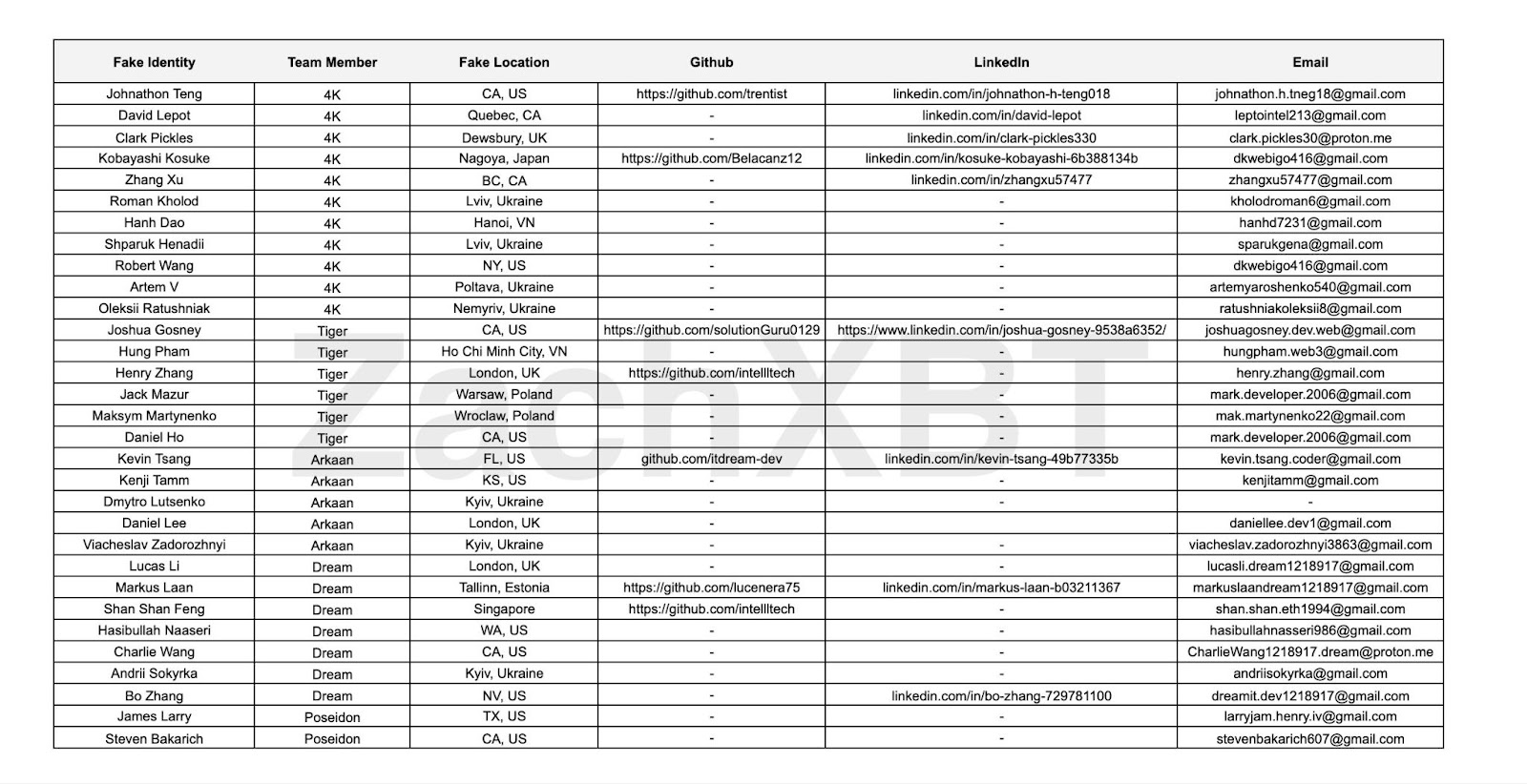
  Fake list of identities involved in the North Korean IT scam operation. Source: ZachXBT


Google, remote working software

The leaked documents show the North Korean IT workers secured “blockchain developer” and “smart contract engineer” roles on freelance platforms like Upwork, then use remote access software like AnyDesk to carry out the work for unsuspecting employers. They also use VPNs to hide their true location.

Google Drive exports and Chrome profiles show they used Google tools to manage schedules, tasks and budgets, communicating mainly in English while using Google’s Korean-to-English translation tool.One spreadsheet shows IT workers spent a combined $1,489.8 on expenses in May to carry out their operations.

  Interview notes/preparation, likely intended to be referenced during an interview. Source: ZachXBT

North Korean IT workers tied to recent $680,000 crypto hack 

The North Koreans often use Payoneer to convert fiat into crypto for their work, and one of those wallet addresses —“0x78e1a” — is “closely tied” to the $680,000 exploit on fan-token marketplace Favrr in June 2025, ZachXBT said.

At the time, ZachXBT alleged the project’s chief technology officer, known as “Alex Hong,” along with other developers, were actually DPRK workers in disguise. 
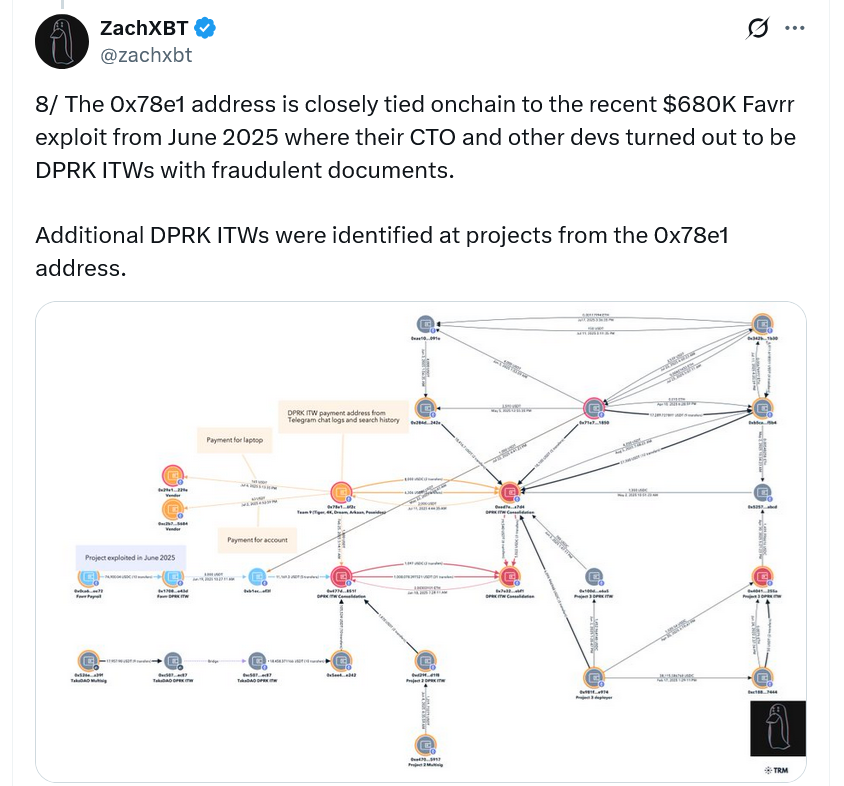
  Source: ZachXBT

The evidence also provides insight into their areas of curiosity. One search asked whether ERC-20 tokens can be deployed on Solana, while another sought information on the top AI development companies in Europe.

Crypto firms need to do more due diligence

ZachXBT called on crypto and tech firms to do more homework on potential hirees — noting that many of these operations aren’t highly sophisticated, but the volume of applications often leads to hiring teams becoming negligent.

He added that a lack of collaboration between tech firms and freelance platforms further contributes to the problem.

Last month, the US Treasury took matters into its own hands, sanctioning two people and four entities involved in a North Korea-run IT worker ring infiltrating crypto firms.

Comments

All Comments

Recommended for you

  • Trump Shares Op-Ed Claiming He is Winning the War Against Iran

    On August 29, U.S. President Trump shared a commentary article from the New York Post on Truth Social on Saturday, which stated that he is winning the war against Iran and should maintain the current strategy. The title of the article Trump shared read: 'Trump is Winning the War Against Iran - Stay the Course.'

  • Morgan Stanley: 2028 as a Key Observation Point for Global Memory Competition Landscape

    On August 29, Morgan Stanley pointed out that the rise of Chinese memory manufacturers should not be viewed merely as a technological catch-up or low-cost substitution; what is truly noteworthy is that their production capacity may gradually become large enough to alter the supply structure of the global memory market. Changxin Technology and Yangtze Memory Technologies are currently entering the mainstream product market and gradually extending into high-profit markets such as HBM, high-end server DRAM, and enterprise SSDs. Morgan Stanley considers 2028 as an important observation point for the global memory competition landscape. From 2026 to 2027, demand for AI servers, capacity crowding of advanced wafers by HBM, import substitution, and the time required for customer certification may absorb most of the new supply from Chinese memory manufacturers. By 2028, as Chinese manufacturers expand production, the additional capacity from Samsung, SK Hynix, and Micron, which had previously initiated expansions, will also be released. At that time, the supply variables in the global memory market will significantly increase. Morgan Stanley estimates that Changxin's DRAM monthly production capacity will rise from 180,000 wafers in 2025 to 300,000 in 2026, accounting for approximately 13% of global DRAM wafer capacity and about 11% of bit shipments; by 2028, it is expected to further increase to 500,000 wafers, and by 2031, it could reach 800,000 wafers. If the expansion proceeds smoothly, Changxin's global DRAM bit shipment market share could approach 15% by 2030, and it may even have the opportunity to surpass Micron in production capacity around 2028, becoming the third-largest DRAM supplier in the world.

  • US Spot Ethereum ETF Sees Net Inflow of $102.17 Million Yesterday

    On August 29, according to monitoring by Trader T, the US spot Ethereum ETF recorded a net inflow of $102.17 million yesterday.

  • US Spot Ethereum ETF Sees Net Inflow of $102.17 Million

    On August 29, according to monitoring by Trader T, the US spot Ethereum ETF experienced a net inflow of $102.17 million yesterday.

  • US Spot Bitcoin ETF Sees Net Outflow of $201.81 Million

    On August 29, according to monitoring by Trader T, the US spot Bitcoin ETF experienced a net outflow of $201.81 million yesterday.

  • US Spot Bitcoin ETF Sees Net Outflow of $201.81 Million Yesterday

    On August 29, according to monitoring by Trader T, the US spot Bitcoin ETF experienced a net outflow of $201.81 million yesterday.

  • BTC Surpasses $78,000

    Market data shows that BTC has surpassed $78,000, currently priced at $78,009.49. The 24-hour decline has narrowed to 3.23%. Due to significant market fluctuations, please ensure proper risk management.

  • BTC Surpasses $78,000

    Market data shows that BTC has surpassed $78,000, currently priced at $78,009.49, with a 24-hour decline narrowing to 3.23%. The market is experiencing significant volatility, so please ensure proper risk management.

  • BTC Briefly Drops Below $77,000

    Market data shows that BTC briefly fell below $77,000, currently reported at $77,694, with a 24-hour decline of 3.3%. The market is experiencing significant volatility, so please ensure proper risk management.
