

Cointime

Download App
iOS & Android

SEC’s Peirce defends transaction privacy as Tornado Cash verdict looms

US Securities and Exchange Commission (SEC) Commissioner Hester Peirce told an audience of blockchain researchers and practitioners on Monday that lawmakers and regulators need to protect people’s right to transact privately.

Her comments come as Roman Storm’s Tornado Cash trial heads toward a verdict.

Peirce said in a speech at the Science of Blockchain Conference that privacy-protecting technologies and the right to self-custody crypto should be safeguarded, along with the rights of developers of open-source privacy software, who shouldn’t be held responsible for how others use their code.

“We should take concrete steps to protect people’s ability not only to communicate privately, but to transfer value privately, as they could have done with physical coins in the days in which the Fourth Amendment was crafted,” she said.

“Although a centralized intermediary or even a DAO deploying a DeFi application could build in restrictions on its use, an immutable, open-source protocol is available for anyone’s use in perpetuity, so requiring that it comply with financial surveillance measures is fruitless.”

Peirce’s comments come amid jury deliberations in the trial of Roman Storm, co-founder of the crypto mixing service Tornado Cash, which allows users to mask the origin and destination of cryptocurrency from prying eyes.
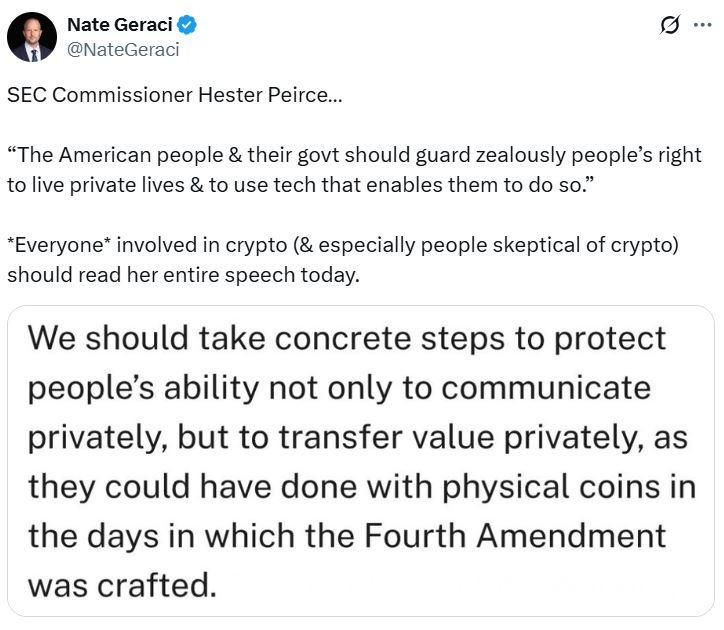
  Source: Nate Geraci 


Stifling privacy technologies slows innovation

In the 1990s, governments, for national security reasons, wanted to keep strong cryptography out of private hands, according to Peirce.

She noted it took court cases and pushback from cryptographers such as Phil Zimmermann — the developer of Pretty Good Privacy (PGP) encryption software — to turn the tide, leading to many technological advancements.

“The internet could not have succeeded without strong cryptography, so a determined set of cryptographers pushed back and convinced the government that cryptography in private hands was a net positive,” she said.

“Because of their hard-fought victory in the courts and the court of public opinion, we daily rely on encryption to send email, engage in online banking, buy from online merchants, communicate with one another through voice and video, and conduct many other daily tasks.”

DeFi broker rule should stay dead

In the same speech, Peirce also said that regulators shouldn’t be asking businesses to keep a record of who they or their customers transact with, as was nearly enforced by the so-called decentralized finance (DeFi) broker rule.

“Doing so would deputize us to surveil our neighbors—a practice antithetical to a free society. Nor should we require an intermediary to step in the middle of peer-to-peer transactions,” she said.

“As with the internet, technologies that have legitimate uses are better left in the permissionless, available-for-all-to-use category, even though doing so enables people to use them for bad purposes, because taking any other course would impinge fundamental liberties.”

Before US President Donald Trump killed it on April 10, the Biden administration-era DeFi broker rule would have required DeFi protocols to disclose gross proceeds from crypto sales, including information regarding taxpayers involved in the transactions, to the Internal Revenue Service. 

Crypto mixers on trial

Storm is standing trial in the Southern District of New York over allegations that criminal elements used the mixing service for money laundering and that Storm is responsible for facilitating their actions. If convicted, he could face up to 40 years in prison.

Storm’s defence team and the industry argued that Tornado Cash, like any tool, can be used by both normal citizens and bad actors and the software developers shouldn’t be held responsible for the actions of others.

In a similar case, the co-founders of Samourai Wallet are facing charges stemming from their involvement in the crypto mixing protocol. They opted to plead guilty on July 29 after initially trying to get the case dismissed. 

Comments

All Comments

Recommended for you

  • BTC Surpasses $76,000

    Market data shows that BTC has surpassed $76,000, currently priced at $76,008.59, with a 24-hour decline of 0.38%. The market is experiencing significant volatility, so please ensure proper risk management.

  • First Refunds from 'Trump Tariffs' to Be Issued Around May 11

    On April 30, a document from the U.S. International Trade Court indicated that the first refunds for tariffs imposed by the Trump administration under the International Emergency Economic Powers Act will be issued around May 11. The U.S. Supreme Court announced a ruling on February 20, stating that the International Emergency Economic Powers Act does not authorize the president to impose large-scale tariffs. A ruling by a U.S. International Trade Court judge on March 4 ordered Customs and Border Protection not to impose tariffs based on the International Emergency Economic Powers Act during tariff liquidation. This means that tariffs previously imposed under this law must be refunded. (Dongxin News Agency)

  • BTC Surpasses $76,000

    Market data shows that BTC has surpassed $76,000, currently priced at $76,001.81, with a 24-hour decline narrowing to 0.41%. The market is experiencing significant fluctuations, so please ensure proper risk management.

  • BTC Falls Below $75,000

    Market data shows that BTC has fallen below $75,000, currently priced at $74,966.94, with a 24-hour decline of 1.58%. The market is experiencing significant volatility, so please ensure proper risk management.

  • Federal Reserve Keeps Benchmark Interest Rate Steady at 3.5%-3.75%, Meeting Market Expectations

    On April 30, the Federal Reserve maintained the benchmark interest rate range at 3.5%-3.75%, in line with market expectations. This level has been sustained since the last rate cut in December 2025.

  • BTC Falls Below $76,000

    Market data shows that BTC has fallen below $76,000, currently priced at $75,994.44, with a 24-hour decline of 0.01%. The market is experiencing significant fluctuations, so please ensure proper risk management.

  • Walsh's Fed Nomination Receives Sufficient Votes to Advance Review Process

    The U.S. Senate voted on the nomination of Walsh for Federal Reserve Chair. The Senate Banking Committee voted to advance Walsh's nomination to the full Senate.

  • Squads Secures $18 Million Strategic Financing Led by Solana Ventures

    Squads, a multi-signature protocol in the Solana ecosystem, has announced the completion of $18 million in strategic financing, led by Solana Ventures, with participation from Coinbase Ventures, Haun Ventures, L1D, and others, bringing the total funding to $42.9 million. This round of financing was completed in December of last year and was only recently made public. Squads' stablecoin payment platform, Altitude, allows businesses to conduct 24/7 global payment settlements in stablecoins through self-custody wallets, integrating into the global payment network with compliance and risk control systems.

  • MoonPay Acquires Crypto Security Startup Sodot for $100 Million in All-Stock Deal

    MoonPay has announced the acquisition of Israeli crypto security startup Sodot for $100 million in an all-stock transaction. Following the completion of this acquisition, Sodot will be integrated into MoonPay's newly established Institutional division. MoonPay Institutional is expected to provide a range of cryptocurrency and blockchain services to large traditional financial institutions, including trading, tokenized securities, payments, wallet management, and stablecoin issuance.

  • Belo Completes $14 Million Series A Financing Led by Tether

    On April 29, Latin American digital wallet Belo completed a $14 million Series A financing round, led by stablecoin issuer Tether, with participation from Titan Fund, The Venture City, Mindset Ventures, and G2. The company plans to use this funding to expand into Mexico, Chile, Colombia, Peru, Bolivia, and Paraguay, while deepening its business presence in Brazil, focusing on serving freelancers and remote workers engaged in cross-border payments. The goal is to reduce the costs and friction associated with cross-border payments and foreign exchange through stablecoin infrastructure.
