

Cointime

Download App
iOS & Android

Poland overtakes El Salvador in global Bitcoin ATM count

Cointime Official

From cointelegraph by Arijit Sarkar

Poland added 10 new Bitcoin ATMs on Jan. 27, bringing its total to 219 active machines and surpassing El Salvador as the fifth-largest cryptocurrency ATM network globally after the US, Canada, Australia and Spain.

Poland added 24 crypto ATMs in its ongoing four-month-long installation spree that began in October 2024. Numerous other countries, including current leaders Canada, Spain and Australia, continue to see an uptick in local active crypto ATMs month over month, according to Bitcoin ATM Radar data.
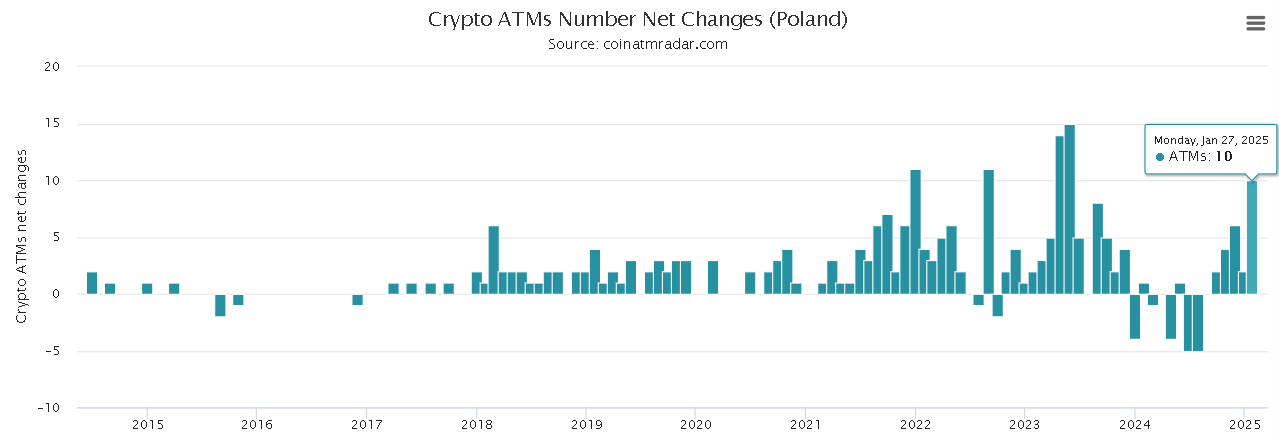
Net change of cryptocurrency machines number installed and removed monthly in Poland. Source: Bitcoin ATM Radar

El Salvador lags despite an impressive headstart

While the US and Canada dominate the global Bitcoin 

BTC$98,985ATM network with thousands of active machines, El Salvador was once the third-largest crypto ATM hub in October 2022 after installing 215 machines to support Bitcoin adoption.

However, the country has not increased its existing capacity — a move contrasting other major economies. Cointelegraph reached out to a Salvadoran authority to learn more about the nation’s plan for driving further Bitcoin adoption.

In contrast, Poland has installed 12 new ATMs in January alone, with more expected before the end of the month.

The current top 10 countries for Bitcoin ATM networks are as follows:

  1. United States – 30,780 ATMs (80.8%)
  2. Canada – 3,062 ATMs (8%)
  3. Australia – 1,389 ATMs (3.6%)
  4. Spain – 276 ATMs (0.7%)
  5. Poland – 219 ATMs (0.6%)
  6. El Salvador – 215 ATMs (0.6%)
  7. Hong Kong – 196 ATMs (0.5%)
  8. New Zealand – 191 ATMs (0.5%)
  9. Germany – 173 ATMs (0.5%)
  10. Puerto Rico – 162 ATMs (0.4%)

Check out Cointelegraph’s beginners’ guide to learn more about Bitcoin ATMs, how they work and how to use them.

While crypto ATMs have no direct impact on local Bitcoin adoption, they provide grassroots exposure to citizens and help serve the unbanked. Regulators have expressed concerns about the potential misuse of crypto ATMs for money laundering and terrorism financing, but the machines remain a key infrastructure for cryptocurrency accessibility.

Roughly 38,100 crypto ATMs are currently active globally, spread across 65 countries and powered by 356 operators. 

Australia has recorded the most consistent growth of crypto ATMs for nearly three years. The country joined the 1,000+ Bitcoin ATM club alongside the US and Canada in April 2024.

Comments

All Comments

Recommended for you

  • Nexus Chain & Cointime to Host Industry AMA — Unpacking DeFi’s “Missing Layer”

    Nexus Chain will host a global AMA on December 27, 2025, at 20:00 (UTC+8) — “DeFi AMA|Unpacking the Missing Layer in Layer1.” The session will explore a key question facing the industry: as PoS evolves and liquidity remains fragmented, does DeFi still lack a foundational execution layer?

  • Japanese listed company ANAP Holdings increased its holdings of Bitcoin by 127.73.

    according to market sources, Japanese listed company ANAP Holdings has disclosed an increase in its Bitcoin holdings by 127.73 coins. As of now, the company's total Bitcoin holdings have reached 1,346.58 coins, valued at approximately 118 million USD.

  • Changpeng Zhao: Binance Wallet now supports identifying malicious addresses; you will receive a warning if you transfer funds to them.

    Zhao Changpeng posted on Binance Plaza stating, "The cryptocurrency industry should be able to completely eradicate address poisoning attacks and protect users. All wallets should simply check whether the receiving address is a poisoned address and block the user.This is a blockchain query. Wallets should not even display these junk transactions anywhere. If the value of the transaction is very small, filter it out. Security alliances in the industry should maintain a real-time blacklist of these addresses so that wallets can check before sending transactions. Binance Wallet is already doing this. If a user tries to send to a malicious address, they will receive a warning.

  • Bitcoin spot ETFs saw a total net outflow of $189 million yesterday, marking the fourth consecutive day of net outflows.

     according to SoSoValue data, the total net outflow of Bitcoin spot ETFs is 189 million USD.The Bitcoin spot ETF with the largest single-day net outflow yesterday was Blackrock's ETF IBIT, with a single-day net outflow of 157 million USD. Currently, IBIT's total historical net inflow has reached 62.34 billion USD. The second is Fidelity's ETF FBTC, with a single-day net outflow of 15.2979 million USD. Currently, FBTC's total historical net inflow has reached 12.189 billion USD. As of the time of writing, the total net asset value of Bitcoin spot ETFs is 114.289 billion USD, with the ETF net asset ratio (market value as a proportion of Bitcoin's total market value) reaching 6.53%, and the cumulative historical net inflow has reached 57.076 billion USD.

  • BTC falls below $88,000

     market shows BTC fell below $88,000, currently at $87,997.85, 24-hour decline reaches 0.88%, market volatility is significant, please manage your risk accordingly.

  • The U.S. spot Ethereum ETF saw net inflows of $84.59 million yesterday.

     according to Trader T monitoring, the US spot Ethereum ETF had a net inflow of 84.59 million USD yesterday.

  • ETH breaks $3,000

     the market shows ETH breaking through $3000, currently at $3000.08, with a 24-hour decline of 0.38%. The market is highly volatile, please manage your risk accordingly.

  • Binance Wallet launches "secure auto-signature" service

     according to the official announcement, Binance Wallet has launched the "Secure Auto Sign" (SAS) service: it now supports mnemonic/private key wallets to trade on Binance Wallet (web version).

  • Circle minted 500 million USDC on the Solana network.

    according to Onchain Lens monitoring, Circle has minted 500 million USDC on the Solana network. Since October 11, Circle has issued a total of 18 billion USDC on the Solana network.
