


In 2025, the crypto industry is entering an unprecedented turning point—whether from the perspective of regulatory clarity, institutional involvement, or infrastructure maturity. Over the past decade, crypto assets have swung between three long-standing contradictions: regulatory ambiguity, technological limitations, and waves of speculative sentiment.
But this year, everything has fundamentally changed. Regulation is becoming clearer, infrastructure is being deployed at scale, institutions are entering at full speed, and—for the first time—crypto is stepping into a truly institutionalized era. Within this macro transformation, Nivex is emerging as a critical connective hub in the next-generation financial system, powered by intelligence, on-chain architecture, and regulatory alignment.
1. The Industry Enters an Institutionalized Phase: Project Crypto Redefines the Rules
Recent remarks from SEC Chairman Paul S. Atkins reveal a major regulatory inflection point for the crypto sector. Introducing “Project Crypto,” he emphasized that most crypto assets are not securities in economic substance, investment contracts can terminate, and tokens are not bound to securities classification permanently.
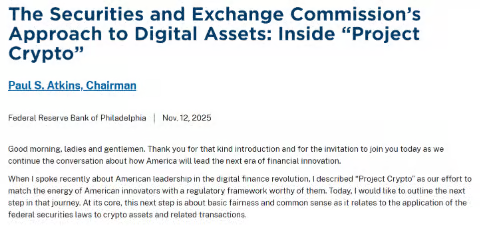
Future regulation will no longer hinge on a token’s name or issuance method, but rather its underlying economic function. More importantly, the SEC, for the first time, publicly signaled support for financial super-apps built under a unified regulatory framework—allowing securities and non-securities assets to coexist and trade on the same platform. This marks a shift from restricting innovation to defining boundaries that enable and safeguard innovation.
This transformation not only clears a decade of regulatory fog for developers and exchanges, but also lays the legal and structural foundation for the expansion of on-chain finance. With regulatory clarity, innovation is no longer walking a tightrope—it can grow securely within a well-defined rulebook.
2. Clear Industry Trends: On-Chain Finance Accelerates Toward Mainstream Adoption
The evolution of crypto finance is no longer confined to crypto-native environments. It is rapidly being embraced by global institutional giants. Over the past year, JPMorgan, BlackRock, Visa, PayPal, and Fidelity have all launched stablecoin payments, tokenized U.S. Treasury funds, and on-chain settlement systems. Meanwhile, Stripe and Circle have directly stepped into the competition to build their own blockchains.
On-chain finance is becoming fundamental infrastructure for major global institutions.
Simultaneously, the scale of on-chain assets is expanding at an explosive pace:
- Annual stablecoin settlement volume has reached $46 trillion
- Tokenized RWA markets have surpassed $30 billion
- Decentralized perpetual futures platforms have grown 8× in annual trading volume
- On-chain TVL and DEX markets show全面回暖 (full revival)
Infrastructure has also progressed dramatically: blockchain throughput has increased over 100× compared to five years ago, and gas fees have fallen to historic lows. For the first time, the industry is technically ready to support hundreds of millions of users.
Against this backdrop, competition among exchanges has shifted fully—from simple listing and fee battles to competition based on infrastructure strength and ecosystem synergy.
3. Nivex’s Strategic Transformation: From a CEX to an Intelligent Financial Bridge
In response to these mega-trends, Nivex is undergoing an important strategic upgrade. It is no longer just a traditional centralized exchange; it is expanding into a fully integrated intelligent financial bridge. This transformation is driven by three pillars: intelligent systems, on-chain capabilities, and regulatory readiness.
AI-driven strategy systems are becoming one of Nivex’s most important advantages. By analyzing on-chain capital flows, market structure, volatility models, and sentiment data, the AI strategy engine enables users to gain institution-level strategic capabilities. During the October 11 global market crash, the system successfully guided large numbers of users to avoid systemic risk—outperforming human judgment with exceptional stability. This is real proof of how intelligence creates genuine financial value.
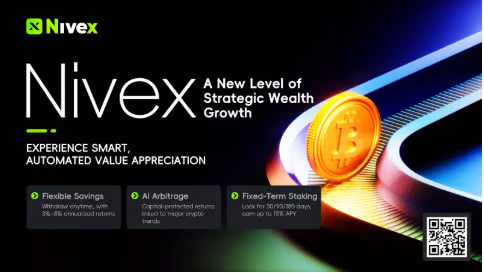
Meanwhile, the launch of the Nivex Web3 Wallet marks its full entry into the on-chain asset sector. Beyond non-custodial accounts, multi-chain support, DApp connectivity, cross-chain capabilities, and DID identity, the wallet serves as Nivex’s unified portal into the blockchain world. Users can move seamlessly across assets, applications, and trading scenarios.
The wallet acts as the user entry point; the exchange acts as the liquidity engine. Once connected, they form a self-reinforcing growth flywheel, enabling users to transition effortlessly between on-chain and off-chain environments—while gradually depositing assets and strategies into the Nivex ecosystem.
On the compliance front, Nivex is adopting proactive regulatory alignment, establishing a unified asset classification system, institutional-grade custody, and cross-jurisdictional KYC/AML standards—laying a robust foundation for global expansion. Now that Project Crypto has clarified pathways for the U.S. market, such forward-aligned regulatory structures will define the future winners of the industry.

4. Nivex’s Future: A Unified Ecosystem of Entry, Liquidity, and Strategy
Nivex is building a multi-layer ecosystem composed of its wallet, exchange, and on-chain infrastructure.
- The wallet handles user entry and on-chain interactions
- The exchange provides high-liquidity asset matching and strategy execution
- The on-chain ecosystem provides decentralized assets, applications, and identity primitives
Together, these form the essential components of the future crypto super-app.
Going forward, Nivex will:
- Strengthen personalized AI strategies by integrating on-chain data, user behavior, investment preferences, and risk models
- Deepen the linkage between the wallet and exchange to enable seamless one-click experiences across asset management, strategy execution, and liquidity access
As institutions and users migrate into the on-chain world, Nivex is well-positioned to become their primary bridge into Web3.
5. After the Industry’s Coming-of-Age Moment, Nivex Stands at the Center of a New Cycle
The year 2025 represents crypto’s coming-of-age ceremony. Regulation has clarified, technology has matured, institutions have committed, and on-chain finance has moved from the periphery to the mainstream. Nivex stands at the center of this macro transformation.
With its intelligent strategy systems, on-chain wallet infrastructure, and future-ready compliance framework, Nivex is becoming one of the most promising bridges between traditional finance and the Web3 world.
The future belongs to intelligent, transparent, and on-chain financial systems.And Nivex is becoming one of the most essential bridges in that future.


All Comments