

Cointime

Download App
iOS & Android

New York lawmaker wants to tax crypto sales and transfers

The US state of New York may tax the sales and transfers of crypto and non-fungible tokens (NFTs), under a bill submitted in the state’s Assembly.

Assembly Bill 8966, introduced on Wednesday by Democratic Assemblymember Phil Steck, would add a 0.2% excise tax on “digital asset transactions, including the sale or transfer of digital assets.”

The bill, if passed, would take effect immediately and apply to all sales and transactions, starting Sept. 1.

If enacted, the bill could bring in significant tax revenue for the state, as New York City is the world’s largest financial and fintech hub, home to industries that have embraced crypto by buying up billions worth of tokens or offering crypto-based financial products.

Crypto tax to fund school substance abuse programs

Steck’s bill denotes that the funding from the crypto tax sales would be earmarked to expand a “substance abuse prevention and intervention program to schools in upstate New York.”

The bill clarifies that it would change the state’s tax laws, and the new levy would apply to “digital currencies, digital coins, digital non-fungible tokens or other similar assets.”

There are multiple steps before the bill becomes law. It will need to pass through a committee before being put to a vote before the full Assembly; it would then be sent to the Senate and, if approved, on to the governor, who could pass or veto the bill.

State taxes on crypto widely vary

In the US, the federal and state governments can both levy taxes, which leads to states lowering — or in the case of Texas, completely scrapping — corporate and income taxes in the bid to attract companies looking to minimize their tax bills.

Most states do not have guidance on how their tax authorities should treat crypto. Others, such as California and New York, treat crypto as cash, while states like Washington exempt crypto from taxes, according to Bloomberg Tax.
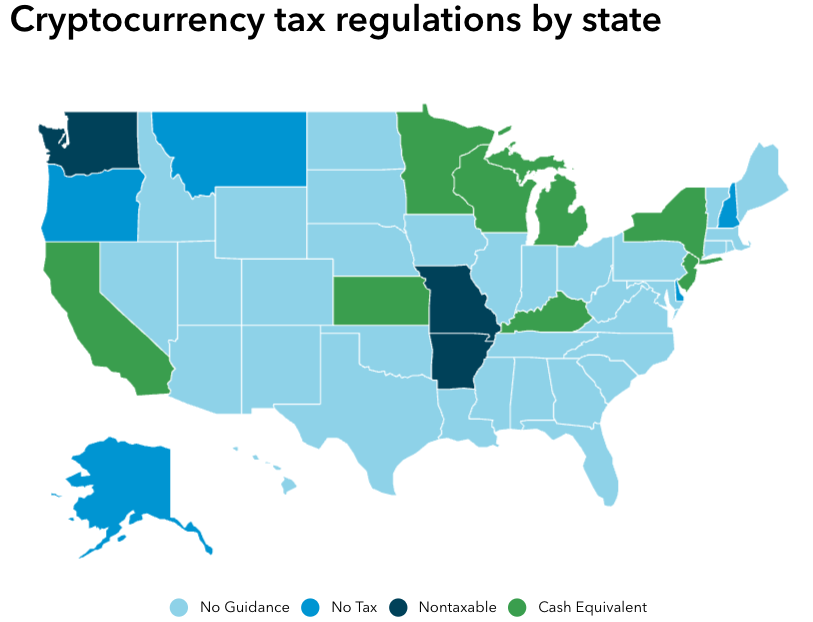
  Crypto tax laws by state as of July 2022. Source: Bloomberg Tax

New York home to crypto bigtimers

New York, more specifically New York City, has long been home to crypto industry heavyweights due to its status as a global finance center.

Stablecoin issuers Circle Internet Group and Paxos, along with crypto exchange Gemini and analytics firm Chainalysis, are headquartered in the city, while many other crypto firms operate offices there.

New York was the first US state to launch a comprehensive regulatory regime for crypto, in 2015 introducing the BitLicense, a divisive permit that caused many crypto companies to leave the state as it was too burdensome. Others, such as Circle, Paxos and Gemini, embraced the opportunity to be regulated.


Comments

All Comments

Recommended for you

  • Strategy CEO: Company to Continue Adding More Bitcoin This Year

    On August 11, Strategy CEO Phong Le said in an interview with Fox News that the company will continue to accumulate more Bitcoin within this year.

  • BTC Falls Below $64,000

    Market data shows BTC has fallen below $64,000, currently trading at $63,998, with a 24-hour decline of 1.25%. Market volatility is significant; please exercise risk control.

  • Nvidia reportedly developing trillion-parameter open-source AI model Nemotron 4

    On August 11, Nvidia is developing a new generation of open-source artificial intelligence model, Nemotron 4, with an expected parameter scale of at least 1 trillion, aiming to compete with the world's leading open-source large models. Nvidia hopes to expand the application scope of AI through an open model ecosystem and further drive market demand for its GPU computing power. Nvidia has previously launched the Nemotron series of open-source models, including the Nemotron-4 340B series with 340 billion parameters, primarily used for large language model training data generation, model development, and enterprise AI applications.

  • Crypto-Friendly Bank Erebor Seeks $1.5B Funding with a16z Participation

    On August 11, Erebor Bank, a crypto-friendly bank co-founded by Oculus and Anduril founder Palmer Luckey and Palantir co-founder Joe Lonsdale, is seeking $1.5 billion in funding, with a pre-money valuation target of $8 billion. This valuation is nearly double the $435 million valuation the company had when it completed a $350 million funding round in December 2025. Erebor has already received support from investment institutions such as 8VC and Haun Ventures, and the new funding round is expected to attract participation from Lux Capital, Andreessen Horowitz (a16z), Human Capital, Valor Equity Partners, and SV Angel, among others. As AI infrastructure investment enters a phase of rapid expansion, Erebor is targeting the financing needs of AI companies. AI companies require substantial capital to purchase GPUs, build data centers, and secure energy supplies, while traditional financial institutions are gradually exploring financing models for AI infrastructure assets. However, whether Erebor can maintain rapid growth after the AI and crypto industry cycles cool down remains a key focus for the market. The funding round has not yet been finalized and is expected to be completed within the coming weeks.

  • Russia's Central Bank Adds Bitcoin, Ethereum, and USDT to Publicly Tradable Cryptocurrency List

    On August 11, the Central Bank of Russia included Bitcoin, Ethereum, and Tether (USDT) in the list of cryptocurrencies that can be publicly traded on domestic exchanges.

  • BTC Breaks Above $64,000

    Market data shows BTC has broken through $64,000 and is currently reported at $64,000.33, with a 24-hour decline of 1.53%. Market volatility is high, so please exercise caution and manage risks accordingly.

  • BTC Falls Below $64,000

    Market data shows BTC has fallen below $64,000, currently at $63,999.77, with a 24-hour decline of 1.89%. Market volatility is significant; please exercise risk control.

  • Vitalik Updates Ethereum Roadmap: Privacy, Post-Quantum Scaling, and Native Rollups Become New Priorities

    On August 10, Vitalik Buterin stated that he had compared the 2023 Ethereum roadmap with the current Strawmap. The overall direction still overlaps considerably, but some priorities and technical paths have been clearly adjusted, including raising the priority of quantum safety, downweighting VDF and some EVM improvements, and replacing old designs with solutions such as a unified binary tree, PBT, and new state types. He noted that the most notable change in the current Strawmap is the emergence of several new topics not included in the 2023 roadmap, reflecting a shift in Ethereum's R&D focus. These new priorities include: stronger native privacy support, aggressive scaling in a post-quantum context, specification streamlining for formal verification, Blob and Gas futures, native Rollups, and a more open design space for the future shape of the EVM. Vitalik also emphasized that Ethereum's scaling approach is shifting from 'expanding all activities comprehensively' to 'designing more scalable dedicated mechanisms for specific high-load scenarios,' and he regards STARK proofs and AI-accelerated formal verification as important foundations for the protocol's future. Overall, this update shows that the Ethereum roadmap is evolving toward quantum safety, privacy-first, censorship resistance, high performance, and simpler protocol design.

  • ETH Falls Below $1900

    Market数据显示,ETH has fallen below $1900, currently reported at $1899.19, with a 24-hour decline of 1.28%. The market is highly volatile. Please exercise risk control.

  • Microsoft Plans to Release Next-Gen MAIA 300 AI Chip in September

    On August 10, according to reports, Microsoft plans to release its next-generation MAIA 300 AI chip in September.